
(Listen to the radio version here.)
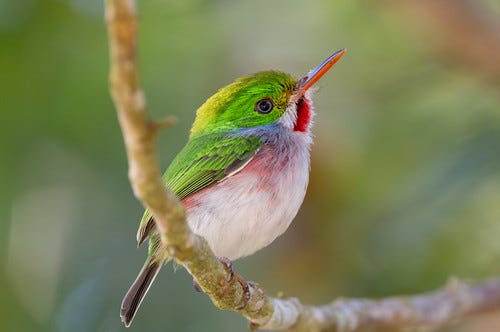
In the past two years, I’ve been to Hawaiʻi, Florida’s Dry Tortugas, and Cuba, and I’m headed to the Galápagos next summer, so I’ve been thinking a lot about islands—how because of their isolation, most islands in the ocean evolve entirely different species than those on the nearest mainland.
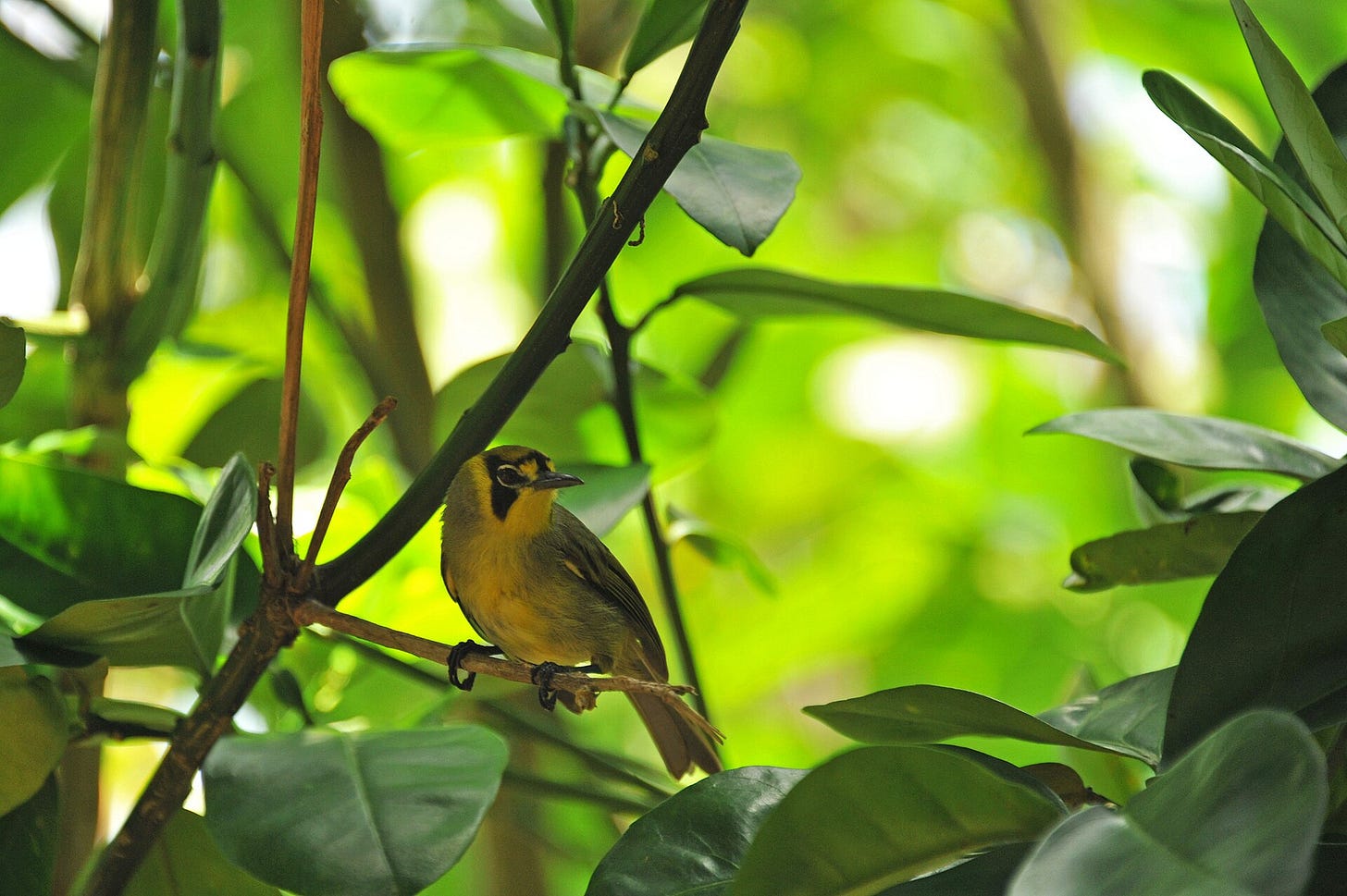
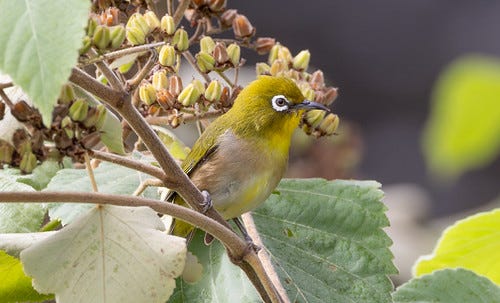
Australia, New Zealand, and Madagascar were originally attached to the ginormous Gondwana, so both plants and animals were always present on them, but those big islands were separated from their original mainland for so many millions of years that a great many of their plants and animals evolved into unique forms found nowhere else on earth. Japan and the British Isles separated from their continents much more recently, so their flora and fauna have hardly changed. Japan has one extinct endemic bird species (that is, a bird found naturally nowhere else on earth), the Bonin Grosbeak, and one living endemic species, the Bonin White-eye.
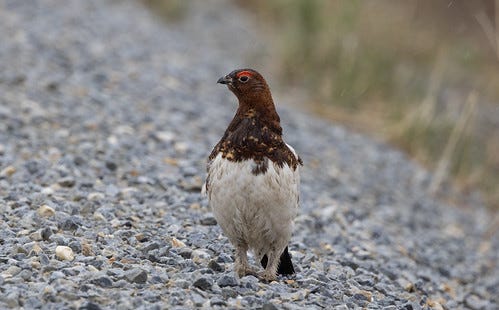
The British Isles have two endemic birds, the Red Grouse and Scottish Crossbill. I’ve never been to the U.K. so have seen neither, but the Red Grouse used to be considered a subspecies of the Willow Ptarmigan, which I have seen in Alaska. 1
The Galápagos and Hawaiian Islands are volcanic—they erupted out of the ocean with no life forms whatsoever on the hot lava. The Galápagos Islands are about 605 miles from mainland South America; Hawaiʻi is much more remote—2,300 miles from the nearest continental land to the east (southern California) and about 3,850 miles from the nearest continental land to the west (Japan).
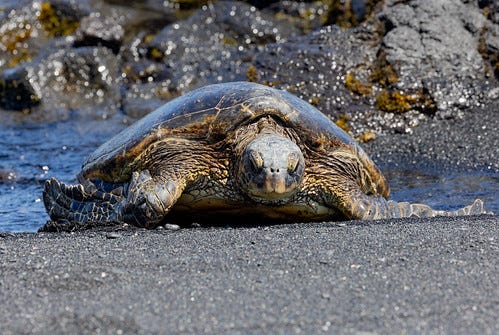
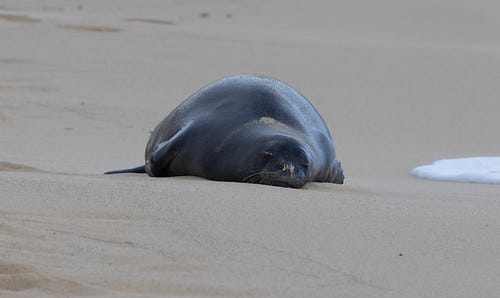
As the lava cooled, little by little, seeds, insects, and ballooning spiders carried by air currents over the vast ocean found their way to the islands; sea turtles, sea snakes, and sea mammals swam there; and bats and birds flew there. And evolutionary biologists believe that some land reptiles, perhaps stranded on floating mats of vegetation, floated as far as the Galápagos. (Every land reptile found in Hawaii was introduced by humans.)
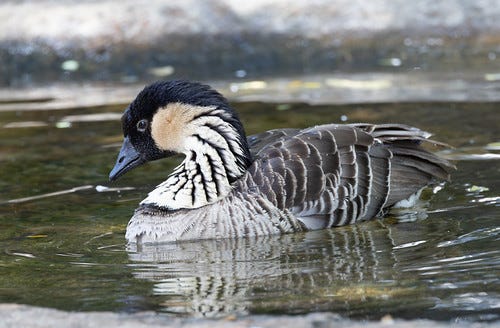
Of course, all these plants and animals came from somewhere else, but being isolated from everything, and on a volcanic island with nothing familiar, every organism that found its way to one of these emerging volcanic islands quickly died or had to adjust and adapt to survive in the strange new world. If they not just survived but lucked into finding someone of the opposite sex so they could reproduce, little by little their descendants evolved into species found nowhere else on earth. Mates weren’t too hard to find when a bird arrived in a group. The Nēnē (Hawaiian Goose) evolved from the Canada Goose.
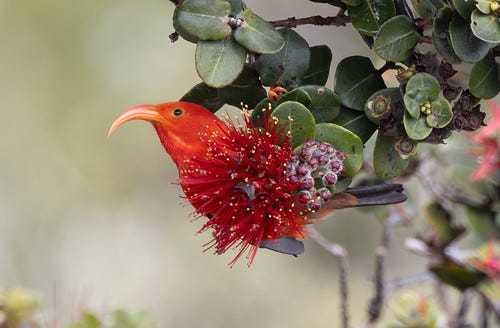
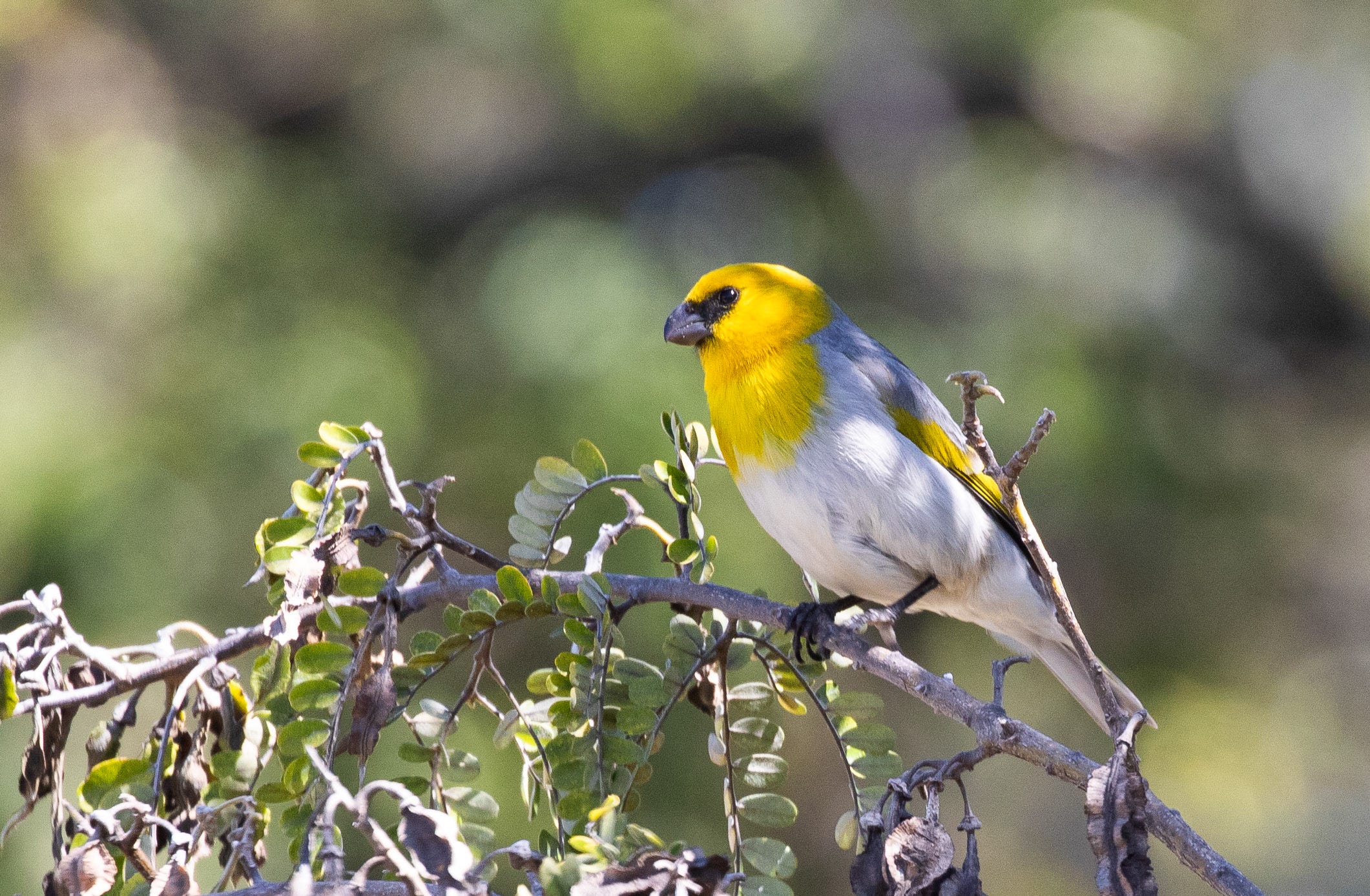
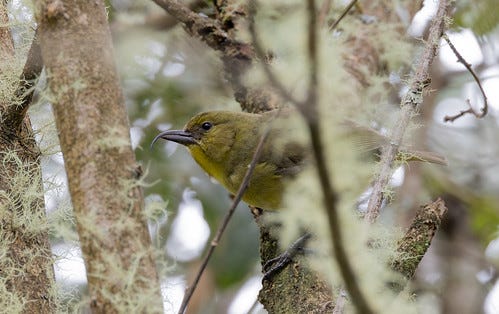
DNA studies found that all fifty-or-so species of Hawaiian honeycreepers evolved from a single flock of what were probably Common Rosefinches, a widespread species of Europe and Asia.
The closest known relative of all 17 Darwin’s finches is the Dull-colored Grassquit of South America, which I’ve never seen.
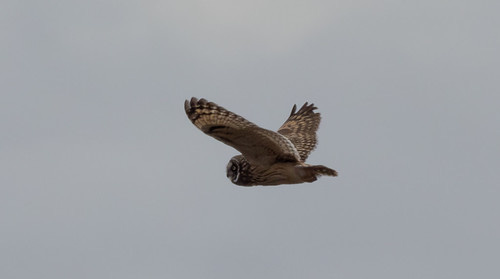
I’m more mystified about how owls made their way across so much ocean and managed to find mates. The Short-eared Owl is found as a native species on every continent except Australia and Antarctica, but somehow made its way to both the Galápagos and the Hawaiian Islands long, long ago and reproduced. Both island groups are still too similar genetically to our Short-eared Owls to be considered new species.
The Barn Owl, native to six continents including Australia, is also native to the Galápagos. Barn Owls live in Hawaiʻi, but in this case were introduced by people.
The Caribbean Islands are a mixed bag. As far as I can work it out, the Bahamas formed over 150 million years ago atop moving tectonic plates below the ocean surface. Limestone formed above these plates in shallow ocean waters as calcium carbonate from corals, shellfish, and other oceanic organisms accumulated over time. This was also how the upper and middle Florida Keys formed, but even though the Bahamas are barely 50 miles from Florida, there are big geological differences. The Bahamas sit on the “Great Bahama Bank” and “Little Bahama Bank” that have been accumulating miles-thick layers of sediment for over 100 million years, while most of the Florida Keys are along the edge of the shallower “Florida Platform,” tied closely to Florida and North America’s geologic history. The Dry Tortugas are considered part of the Florida Keys but have a different geological origin—they’re far younger, and developed as a coral atoll shaped by modern sand and coral rubble accumulation. Unlike the more stable, rock-based upper keys and the Bahamas, the tiny islands making up the Dry Tortugas are continually reshaped, eroded, or relocated by tropical storms, ocean currents, and wave action. The 700 islands making up the Bahamas include just 6 endemic birds, and the Keys have no endemic birds at all.
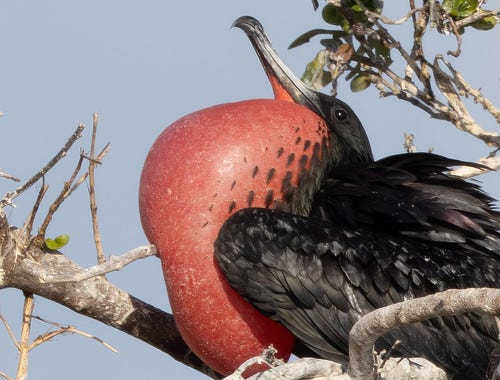
Cuba has an entirely different geologic origin from the Bahamas or the Keys. All the Greater Antilles islands exist because of the relative motion of the Caribbean plate and surrounding plates along with volcanism and a process called obduction. If you understand geology better than I, you can read a great article from the Geological Society of America, “The Geology of Cuba: a Brief Overview and Synthesis.”
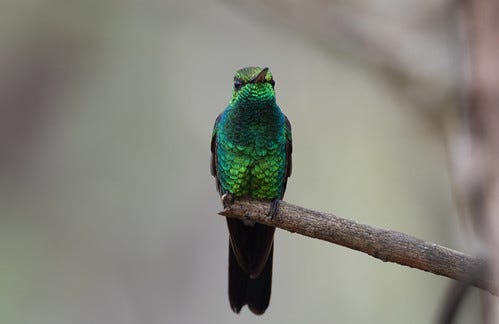
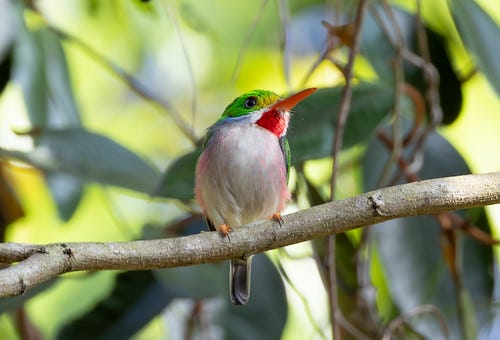
Anyway, Cuba is the largest of the Greater Antilles islands. As a whole, the Greater Antilles has 109–143 endemic species (depending on current taxonomy). About 27 bird species are endemic to Cuba alone, and 22 other Greater Antillean endemics are found in Cuba as well as other islands. For example, the Cuban Emerald is endemic to the Caribbean Islands but not to Cuba, because it’s also found in the Bahamas.
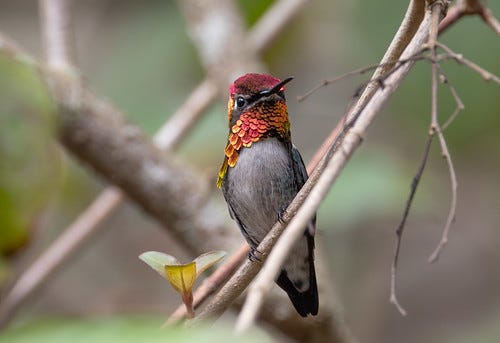
But the Bee Hummingbird, the smallest bird in the known universe, is found nowhere on the planet except Cuba.
The proximity of the Greater Antilles to North, Central, and South America, within a major migration route, explains how so many birds found their way there in the first place. The year-round subtropical climate and the nature of islands kept many of those wanderers from heading out over water again, so that over time, they evolved special adaptations for life in their new world.
All in all, whether it’s tectonic plates or two scientific disciplines colliding, we get some pretty interesting results!
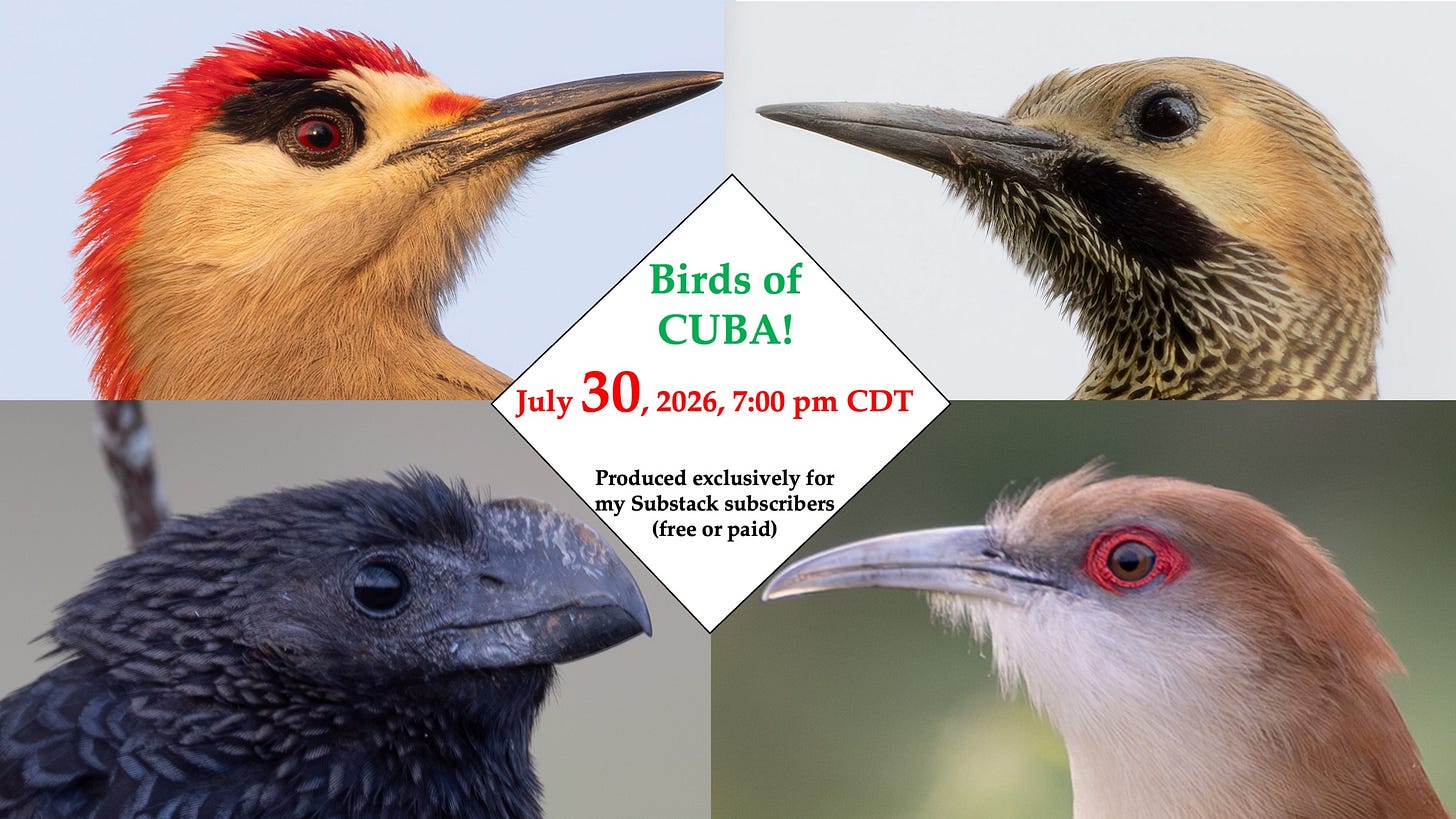
Tomorrow night, Thursday, July 30, at 7:00 pm CDT, I’ll be doing a Zoom presentation about the birds of Cuba. If you are a subscriber, free or paid, you’re invited. Thanks to my generous Substack paid subscribers and people who’ve made donations via “Buy Me a Coffee,” I’ve been able to upgrade my Zoom plan so I don’t have to panic if I get close to 100 participants. If you are a free subscriber, you’re still very welcome to all my work, too!

I just started a “Buy me a coffee” thing for people who want to support my work but don’t want a paid Substack subscription. I am committed to providing all my content for free to anyone who wants to read it, but every bit of support does help me keep working. I have to pay for my website host, my Flickr Pro account, the Adobe software subscriptions that allow me to edit my photos and podcast, the Microsoft Office software that I use for writing and presentations, my recording and photography equipment… It adds up. Please don’t feel obligated, but you can give a one-time tip for as little as $1 if you click on the button. Thank you so much!
Fun factoid where etymology and ornithology collide regarding the word ptarmigan: the word tàrmachan, of Scottish Gaelic origin, was in written use since at least 1599. Ironically, it was a Scottish naturalist, Robert Sibbald, who added the “p” at the beginning in 1684, mistakenly believing that the word must have originated from the ancient Greek pterón, for wing or feather, even though no ptarmigans have ever been found anywhere near Greece!
No posts
Comments
Nothing yet. Say the first thing.
Sign in to join the conversation.