
One of the biggest misconceptions about child development is the idea that every childhood experience carries the same developmental weight.
Modern parenting culture often treats development like an endless optimization project by telling us that babies and kids need the right toys, the right activities, the right enrichment, and the right schedule. But, developmental neuroscience actually makes an important distinction between two very different kinds of experience.
Some experiences are so fundamental that the developing brain essentially expects them to happen. Other experiences are not biologically required, but help shape us into unique individuals. This doesn’t mean children need a perfect environment. It means the developing brain is prepared to learn from experiences that are common across human societies, such as language, caregiving, movement, and social interaction.
Developmental scientists often describe this as the difference between experience-expectant and experience-dependent development, a framework associated with the work of Greenough et al. (1987).
Experience-expectant development refers to experiences the human brain evolved expecting across development:
language exposure
visual input
movement
caregiving
social interaction
The brain is biologically prepared for these experiences and relies on them to organize neural systems normally. Experience-dependent development is different.
These are experiences unique to the individual:
learning piano
reading
gymnastics
chess
speaking a particular language
playing soccer
coding
These experiences are not universally expected by the brain, but they help shape the brain over time through learning and repeated practice.
And honestly, understanding this distinction changes how we think about parenting pressure, enrichment culture, and what children actually need to develop well.
One of the classic examples of experience-expectant development comes from vision research (e.g., Knudsen, 2004)
Human infants are born with visual systems that still require patterned visual input to fully organize themselves. If normal visual input is severely disrupted very early in life, for example, through untreated congenital cataracts, parts of the visual system may not develop typically.
The brain expected visual input. The input never fully arrived. Development changed as a result.
Language works similarly. Children do not need exposure to one specific language, but the developing brain expects language exposure broadly. The A child raised around English will learn English. A child raised around ASL will learn ASL. A child raised in a bilingual environment can learn both (Kuhl, 2004).
The expected experience is human communication. But experience-dependent development is different.
Reading is another good example!
Humans did not evolve with brains genetically pre-programmed specifically for reading. Written language is far too recent historically. Instead, reading recruits and reorganizes existing neural systems in response to learning and repeated experience (Dehaene & Cohen, 2011; Dehaene, 2010) .
Playing a musical instrument is another classic example. Studies have found structural and functional brain differences associated with extensive musical training (e.g., Hyde et al., 2009).
That is experience-dependent plasticity: the brain adapting to individual experience.
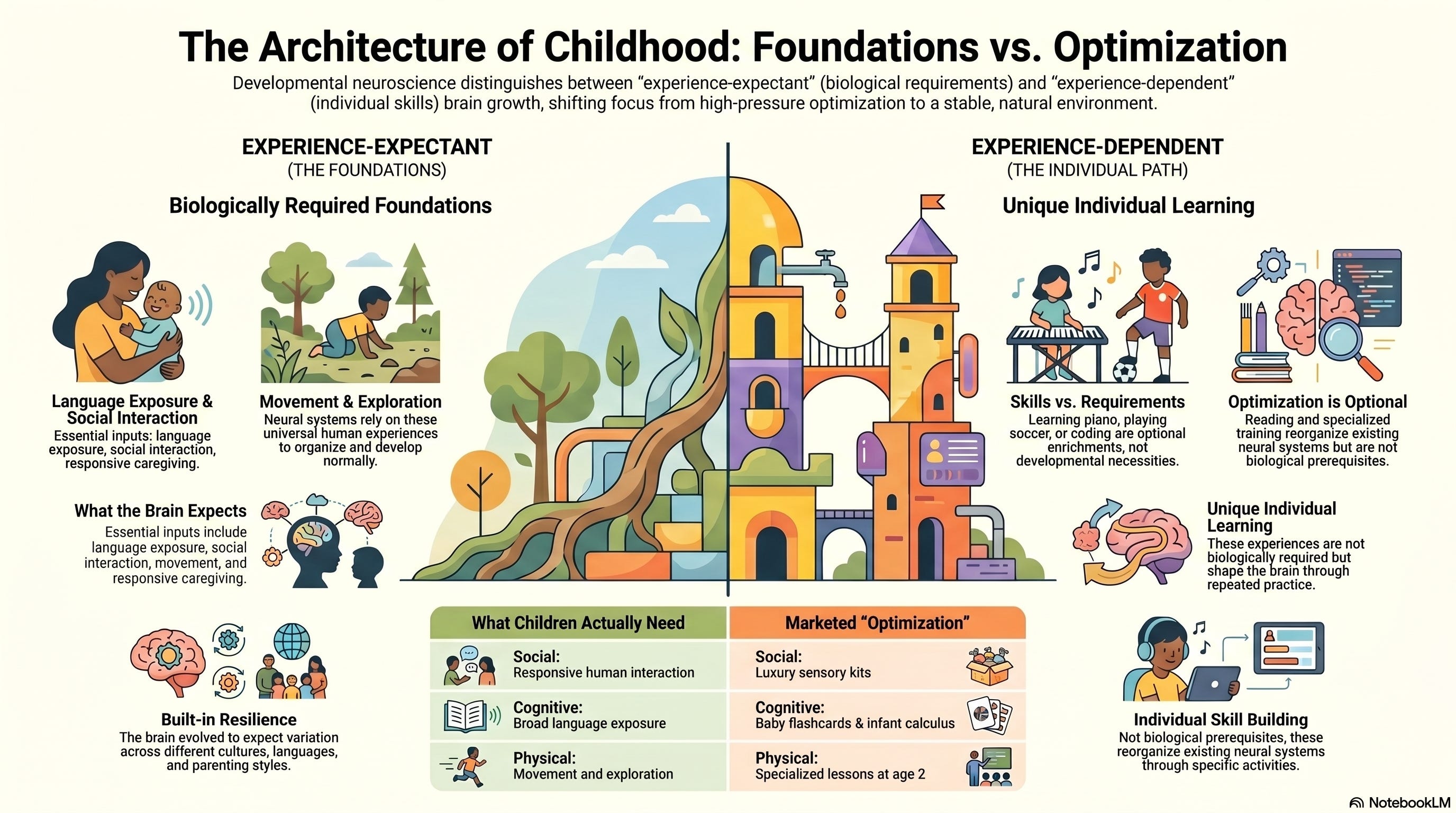
This distinction is incredibly important because modern parenting culture often treats all experiences as if they carry the same developmental weight, but they do not. There is a huge difference between experiences a child’s brain broadly requires for healthy development and experiences marketed as “brain boosting.”
Children do not need:
baby flashcards
infant calculus
luxury sensory kits
violin lessons at age 2
a perfectly optimized enrichment schedule
But children do need:
responsive human interaction
language exposure
opportunities for movement and exploration
relationships
safety
caregiving
social connection
The internet has created an entire industry around convincing parents that every moment is a critical opportunity to optimize neural development.
That is not what developmental neuroscience actually says. In fact, the experience-expectant framework partly explains why children are often remarkably resilient across a wide range of normal environments. The developing brain evolved expecting variation in families, homes, cultures, languages, routines, and lifestyles.
This also helps explain why debates about “the one right parenting method” are usually oversimplified (and why being a ‘good enough parent’ is perfectly okay). Human development is not built around a single perfect childhood formula.
Children’s brains are not empty buckets waiting to be filled with enrichment. They are biologically prepared systems that expect certain foundational human experiences and then adapt further based on the unique lives children actually live.
Development is not about maximizing every opportunity. It is about providing the foundations that allow children to grow and then letting them become themselves.
Experience-expectant development involves experiences the brain broadly expects during development.
Examples include language exposure, visual input, caregiving, and social interaction.
Experience-dependent development involves learning tied to individual experiences.
Examples include reading, music training, sports, and specialized skills.
Not every enriching activity is biologically necessary for healthy development.
Responsive relationships matter far more than constant optimization.
Developmental science supports flexibility and variation far more than many parenting influencers suggest.
Development Decoded is built on a simple belief: science should be clear, practical, and accessible to anyone who cares about kids. I write, research, and create resources outside of my day job and family life to make that happen. If you’d like to help fuel the work, you can now do so with one coffee at a time.
Dehaene, S. (2010). Reading in the Brain: The New Science of How We Read. Penguin.
Dehaene, S., & Cohen, L. (2011). The unique role of the visual word form area in reading. Trends in Cognitive Sciences, 15(6), 254–262. https://doi.org/10.1016/j.tics.2011.04.003
Greenough, W. T., Black, J. E., & Wallace, C. S. (1987). Experience and brain development. Child Development, 58(3), 539–559. https://doi.org/10.2307/1130197
Hyde, K. L., Lerch, J., Norton, A., Forgeard, M., Winner, E., Evans, A. C., & Schlaug, G. (2009). Musical training shapes structural brain development. Journal of Neuroscience, 29(10), 3019–3025. https://doi.org/10.1523/JNEUROSCI.5118-08.2009
Knudsen, E. I. (2004). Sensitive periods in the development of the brain and behavior. Journal of Cognitive Neuroscience, 16(8), 1412–1425. https://doi.org/10.1162/0898929042304796
Kuhl, P. K. (2004). Early language acquisition: Cracking the speech code. Nature Reviews Neuroscience, 5, 831–843. https://doi.org/10.1038/nrn1533
Comments
Nothing yet. Say the first thing.
Sign in to join the conversation.