
I had every intention of finishing this recap on Tuesday. But during the afternoon I became engrossed in writing about the race in Iowa’s first Congressional district, and after dinner I got sucked into watching the Democratic primary results from Michigan.
With no further delays: the audio file for the August 3 edition of “KHOI’s Capitol Week” is at the top of this post. Here’s the detailed written summary, for those who would rather read than listen. If your email provider truncates this message, you can read it without interruption here.
Here’s what Spencer Dirks and I covered this week:
We started with news from the Polk County District Court. Last week, Judge Joseph Seidlin upheld the State Objection Panel’s decision to exclude the Libertarian ticket for governor and lieutenant governor from the ballot, on the grounds that lieutenant governor candidate Jules Cutler did not submit the required affidavit of candidacy.
You can read the whole decision here. A running theme: the Libertarians are responsible for their own mistakes.
There was a factual dispute over whether Cutler tried to submit her affidavit on June 2. Judge Seidlin found that even if the Libertarian version of events was accurate, and an employee in the Secretary of State’s office wrongly told her she didn’t need the document, they didn’t reasonably rely on an election official’s mistake. Therefore, the situation is not comparable to a 1977 case decided by the Iowa Supreme Court.
Finally, walking away from the Secretary of State’s office without filing the affidavit because she thought “the Republicans must have changed the law again,” is simply not reasonable. She could have told Phillips to humor her and accept her affidavit anyway. Cutler is a licensed, practicing attorney who has previous experience representing Libertarian candidates in an election case. See Gluba, 11 N.W.3d at 461. She could have immediately gone back to her office or even used her phone to quickly research and confirm whether the law had changed. To shrug one’s shoulders on such an important matter is not reasonable.
Libertarians had also argued they did not have time to cure the error, because the Secretary of State’s office initially accepted their paperwork (when they should have rejected it for lack of an affidavit from Cutler). But the judge found: “It was the Petitioners who decided to wait until half-way through the last day to file their papers. The risk of not having time to resubmit papers was theirs.”
I’ve said it before, and I’ll say it again: candidates, don’t file your paperwork at the last minute.
My own recording of the State Objection Panel’s June 15 meeting turned out to be important for this case.
For reasons I cannot understand, the panel charged with settling disputes over who qualifies for the Iowa ballot doesn’t record its meetings. The Libertarians had argued that they didn’t receive due process for several reasons, pointing to the lack of an official record.
During a long evidentiary hearing on July 21, Michael Boal (the attorney representing the Republican voter who objected to the Gluba/Cutler ticket) submitted my recording of the meeting, which I had posted on YouTube, as an exhibit. The attorney representing the state agreed, and Libertarians did not object. Judge Seidlin rightly declined to consider my video the official record, but found it to be “of high quality” and spanning “the entirety of the proceedings.” So he considered the recording when deciding how to handle certain legal arguments and evidence.
At several points, the judge observed, Libertarians didn’t raise certain arguments during the June 15 meeting. For example, they didn’t object to the three panel members taking a vote after hearing from only one witness. So the judge wasn’t going to consider those points later. “The court cannot find the record inadequate when the Petitioners did not object to its inadequacy.”
The judge was clearly troubled by some aspects of how the panel considered the Gluba/Cutler objection. But ultimately, he found “there is substantial evidence in the record supporting the Panel’s findings,” which means it didn’t rise to the level of unreasonable, arbitrary, or capricious action.
For years, I have urged the Secretary of State’s office to record State Objection Panel meetings. They are always newsworthy, and almost every election cycle, at least one of the panel’s decisions gets appealed. Usually the court has to decide the case with no accurate record of what happened or who said what at the panel meeting.
I emailed staff for Secretary of State Paul Pate and Attorney General Brenna Bird again last week to ask why they don’t maintain an official record of State Objection Panel proceedings. No response.
The Libertarian Party of Iowa has not yet announced whether they will appeal this decision. They may pursue another path to get Nicholas Gluba and a running mate on the ballot for the governor’s race. Iowa law allows minor parties (“non-party political organizations”) to nominate candidates through conventions, rather than collecting signatures on petitions.
The state convention route might be challenging, due to certain legal requirements. But if they appeal to the Iowa Supreme Court and lose, it would likely be too late to hold a convention and submit the required paperwork by the deadline in August.
I think they would have an uphill battle on appeal, seeking to show the lower court ruling was wrong and the state panel’s decision was arbitrary and capricious. In a 2024 case involving Libertarian candidates for Congress, the Iowa Supreme Court held that strict compliance is the standard for election laws. It seems likely justices would agree that failing to submit a candidate affidavit is grounds for excluding the ticket from the ballot.
Last Wednesday, Polk County District Court Judge Patrick Smith upheld the state panel’s decision striking Libertarian candidate Marco Battaglia from the ballot in Iowa’s third Congressional district. You can read that ruling here. The issue was that Battaglia’s legal name is Mark Andersen.
Libertarians had argued that state law does not specify that the “candidate’s name” in the form the candidate wants it to appear on the ballot must be a legal name. But the judge found that “it defies common sense that the law would allow the candidate to use a name on the ballot altogether different and unrelated to his legal name.” Furthermore:
Requiring the candidate to use his legal name on the petition and ballot is consistent with strict compliance because it avoids imposing on these officials the burden of making that determination, for which the law provides no criteria. Requiring the candidate to use his legal name is evenhanded because it allows ballot access based upon an objective standard and does not permit a candidate to be excluded based upon arbitrary or subjective criteria.
Judge Smith rejected Libertarian arguments that it would be unconstitutional to exclude Battaglia, or unfair since he’s run for office several times under that name. His candidacy was never challenged on that basis, and the state panel never decided the issue before. So these are not “exceptional circumstances” preventing the state from enforcing the law now.
The Libertarian Party announced on Monday that Battaglia “has experienced a medical emergency that prevents him from continuing his campaign.” So he will not appeal the ruling. Libertarians plan to hold a convention to nominate another candidate for the third Congressional district.
In the same ruling that covered the Andersen/Battaglia case, Judge Smith found the panel correctly decided to keep Libertarian Rick Stewart on the ballot in the second Congressional district. A Republican voter had argued the candidate’s nominating petitions identified him as “Richard Stewart,” while he signed his affidavit and wanted to appear on the ballot as Rick Stewart.
The judge found, “Nothing in Chapter 45 requires the form of the candidate’s name on the nominating petitions to be identical to the form of the name on the affidavit of candidacy or the ballot.”
It’s not clear yet whether Republicans plan to appeal. I doubt the Iowa Supreme Court would reverse this decision.
Last Thursday, the Republican Party of Iowa filed suit to allow the state to require signature verification on absentee ballots. That provision was part of a law Republicans enacted in 2017 but has been blocked since 2019.
With so many new election laws and related lawsuits since 2017, I had completely forgotten this case. Marissa Payne summarized the issues well in this story for the Des Moines Register. Excerpts:
The suit seeks to lift a 2019 injunction, which resulted from lawsuit between the League of United Latin American Citizens of Iowa and Iowa Secretary of State Paul Pate. […]
The court injunction blocked a 2017 Iowa law that lets election officials dispute ballots with signatures that don’t match the voter’s signature on record.
The law, House File 519, directed county auditors to implement procedures to verify voter identity by requiring voters to provide identification documents. County auditors had to compare signatures on voter affidavits at polling places and on absentee ballot envelope affidavits. […]
The judge ruled there was a risk of inconsistent enforcement and found the signature matching provisions violated the Iowa Constitution’s due process and equal protection clauses. The ruling blocked the state from requiring voters to include an identification number when requesting a ballot.
Republicans say changes in Iowa law and recent Iowa Supreme Court decisions since the injunction have undercut the legal argument for keeping the pause in place.
I don’t know whether there is enough time for a court to hear arguments and rule on this case before early voting starts in October (20 days before the general election).
The Republican National Committee is backing the lawsuit, so they clearly believe GOP candidates would benefit if county auditors have to match signatures for every absentee ballot. That may be true—Iowa Democrats do vote early in far greater numbers than Republicans. On the other hand, hundreds of thousands of Republicans also use absentee ballots. A lot of older people living in rural areas vote by mail. Older voters may be more likely to have ballots rejected because their signature has changed over time.
We covered a couple of stories from Iowa’s U.S. Senate race. Last Wednesday, Ashley Hinson’s campaign announced that the GOP nominee “ accepted debate requests from Iowa PBS and Nexstar Media, the parent company of WHO-TV.” Josh Turek’s campaign has been talking with TV stations but hasn’t announced any specific debate plans. They said the Democratic nominee “is eager to face off” against Hinson.
Libertarian candidate Thomas Laehn told the Cedar Rapids Gazette “he had not received invitations to participate in the debates and said he would hope to debate.” Often news organizations have requirements for candidates to be invited to televised debates, such as hitting a certain fundraising benchmark or a certain level of support in polls.
Usually the candidate who is trailing benefits from more debates. Polls generally show a tight Senate race in Iowa, with either Hinson or Turek slightly ahead.
The format favors Hinson, who worked in broadcast news for a decade before entering politics and frequently appears on national cable networks. She has far more experience on television. She will be polished and knows how much she can say in 60 seconds or 90 seconds or whatever.
On the other hand, sometimes a candidate who beats expectations can come out of a televised debate with momentum. Turek will certainly be the underdog.
We still don’t know how many debates will take place between the candidates for governor, Rob Sand and Zach Lahn.
Turek’s campaign released a new digital ad last week showing the Paralympic gold medalist playing basketball (“I-O-W-A” instead of “H-O-R-S-E”) with former President Barack Obama.
“I know a little something about winning Iowa,” the president said. They compared lists of all-time basketball greats, and Obama asked how things are going. Turek said, “Everywhere we go, urban areas, rural areas, people are ready for change.”
Obama’s calm and casual demeanor draws an unspoken contrast with President Donald Trump, whom Hinson has loyally served and lavishly praised for years.
Near the end of the video, Obama said, “Of all the things I’ve done in politics, Iowa was my favorite thing. There was just a magic about regular folks showing up in gyms like this and just, talk it out.” He closed by saying, “Not only did I get whooped, but you’ve got here a man of character. Somebody who knows how to win. Now the ball’s in your court, Iowa. Let’s make sure that we send Josh Turek to the United States Senate.”
Obama doesn’t film ads for every Democratic candidate. I see this video as a sign that national Democrats view the IA-Sen race as winnable. Most forecasters rate this race as “lean Republican,” which is where I would put it. The recently released Fox News Senate forecast called it a toss-up.
We covered several stories related to the governor’s race. GOP nominee Zach Lahn has scheduled meet and greets and one town hall for this week. Since the June primary, he’s done relatively few public events announced in advance.
These are scattered across northeast and northwest Iowa. Meet and greets are happening in Clay, Osceola, O’Brien, Emmet, Chickasaw, Franklin, and Butler counties. The only town hall was booked in Fayette County, with a focus on agriculture issues. You can find future event details on Lahn’s campaign website.
I attended Rob Sand’s Warren County town hall in Carlisle last Tuesday. Warren is one of those counties containing a mid-sized city (Indianola) as well as the growing communities of Norwalk and Carlisle. Democrats like Tom Harkin and Tom Vilsack used to win in this area, and Democrats need to improve their performance here and in similar counties.
This time I registered as a member of the public as well as a member of the media, to see what it’s like for regular voters who sign up through Sand’s campaign website. Not only did I immediately receive a confirmation email, and a reminder email the day of the event, a staffer or volunteer called in the morning to see if I was coming, and to make sure I knew the correct time and location. That’s an effective organization. It’s no wonder Sand is drawing big crowds almost everywhere.
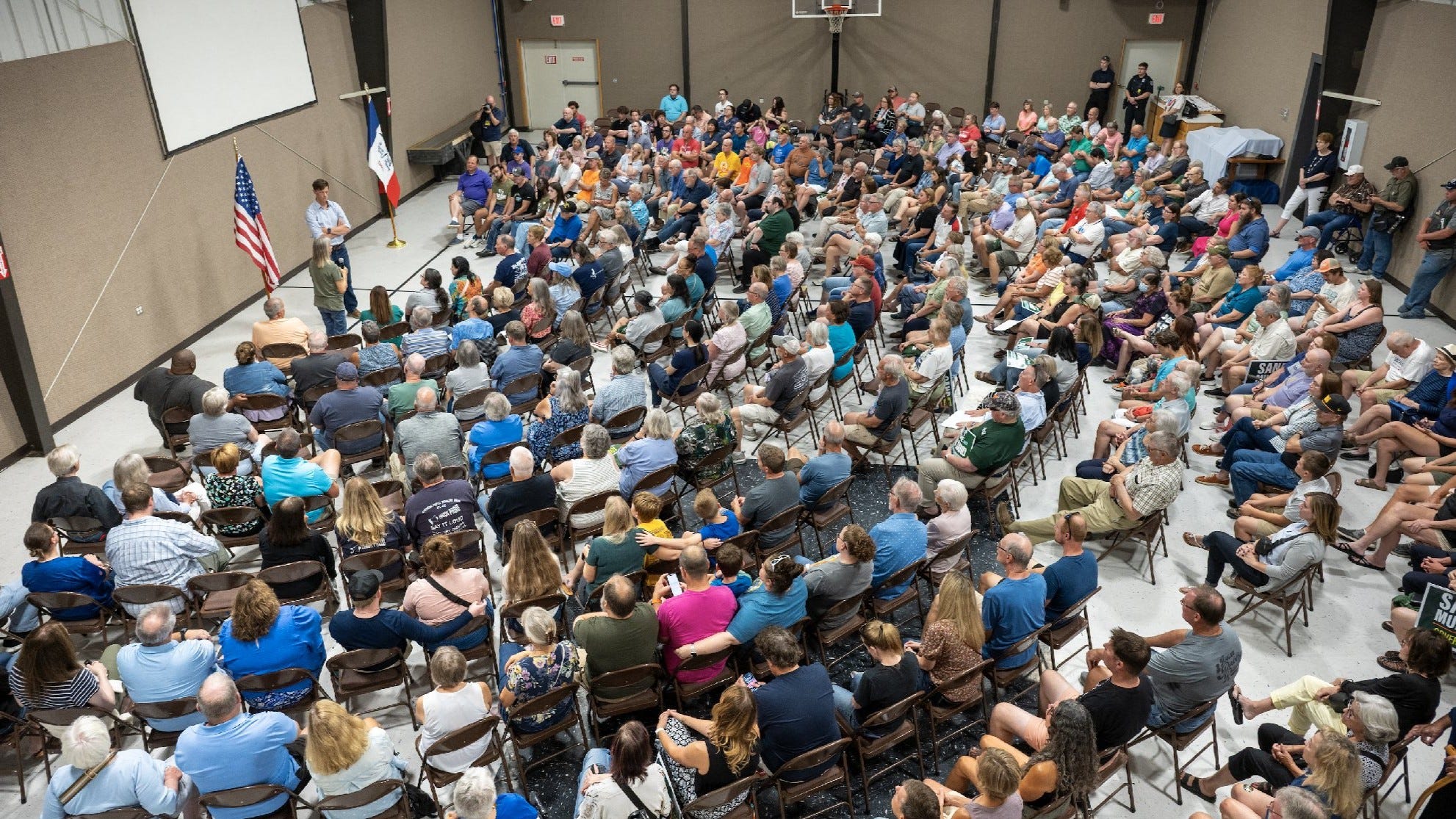
The campaign estimated that 300 people attended the Carlisle town hall. I forgot to do my own head count, but here’s a photo of the room, posted by the campaign. You can see me near the upper right corner, standing in the back recording. My full video is on my YouTube channel.
Sand makes a point of recognizing Republicans in the room at his town halls. During the Warren County town hall, he handed the microphone to Gary Leffler, a well-known GOP activist better known as the “Trump tractor guy.” I clipped Leffler’s questions and Sand’s answers.
They were tricky questions: one was trying to get Rob to either agree with or disavow comments from Sarah Trone Garriott, the Democratic nominee in Iowa’s third Congressional district. (Leffler mischaracterized her meaning.) Leffler also said his Christian faith teaches him that life begins at conception and wanted Sand to square his faith with his support for abortion rights.
The Lahn campaign pulled a short clip from my video to portray Sand as a “Wolf in Sheep’s Clothing” and “an abortion extremist who supports absolutely no limits on when an unborn baby can be terminated.” Several Christian conservatives reposted the video. Bob Vander Plaats did so with the comment, “This is what’s at stake...While @RobSandIA may initially sound good, he’s desperately wrong. Nothing more dangerous than to take God’s Word out of context.”
Lahn needs to consolidate support from the Christian conservative wing. Many of those Republicans preferred Adam Steen or Brad Sherman in the GOP primary. Distorting Sand’s stance on abortion is one strategy, and I expect they will go back to that well repeatedly.
Sand responded to the attacks with his own social media video, saying he knowingly handed the microphone to a Republican activist, and “My opponent’s campaign then edited our personal pain down to a sentence to exploit and misrepresent. That’s not leadership, that’s politics.”
In responding to Leffler, Sand had revealed that he and his wife have “suffered the pain of miscarriage.” While he still thinks about that “third little set of feet” who might have been, he also would never tell someone who lost a seven-year-old child that he knows how they feel. He doesn’t believe that’s the same thing. He acknowledged that many people agree with Leffler, while others point to Bible verses suggesting life begins at breath. (That’s true—most Jewish authorities do not consider a fetus to be a person until birth.)
I wasn’t able to attend Sand’s town hall in Newton last week, because it conflicted with my live radio show. But Erin Murphy covered the event for the Cedar Rapids Gazette, and the abortion issue came up.
Sand, during the Newton town hall Monday, was asked by an attendee at what week of pregnancy would he make abortion illegal.
“I think that Roe vs. Wade (the landmark 1973 U.S. Supreme Court ruling that effectively set legal abortion up to roughly 20 weeks of pregnancy, but was overturned in 2022) was a reasonable decision, and that if different states wanted to set it at a different level,” Sand said, before being cut off by applause. “But there might not be only one reasonable answer to that. There might be a range of reasonable answers. …
“At the end of the day, I know this, my answer on this: I’m not running to be king or queen or dictator, and I’m going to be working with a Republican (-majority) Legislature. I just told you, I think that Roe vs. Wade was reasonable. It set up a floor that was higher than six weeks. I don’t like the idea of it being at the very end, but there’s a middle ground there that is reasonable.”
Sand takes questions from the media before every town hall. In Carlisle last week, I asked whether he plans to release his tax returns. (For many years that was standard practice for Iowa’s nominees for governor.)
Sand said he hadn’t thought about it. “I imagine we probably will.” I followed up: does it depend on whether Lahn releases his tax returns? Sand said he hasn’t put time into thinking about it.
I’ve emailed this question to the Lahn campaign and haven’t heard back. It appears the Republican isn’t eager to put his tax returns out there. As part of a reply to me on X Monday morning, Lahn wrote, “Don’t care about Rob’s tax returns.”
Among other things, tax returns would show whether Lahn filed state taxes as an Iowa resident in 2024 and 2025.
To my surprise, on Sunday morning Lahn mixed it up with me on the platform X. His campaign staff haven’t been answering my questions for more than a month, but he is still a “reply guy” on social media. It was a pretty contentious exchange. I had questioned his claim that Sand “actually has private jets.”
He replied by directing me to investigate a long list of things about Sand’s family, adding, “I will tell my team that anytime we have an inquiry from you about any subject we will send this tweet and ask for a status update first.” (That’s not how it works.)
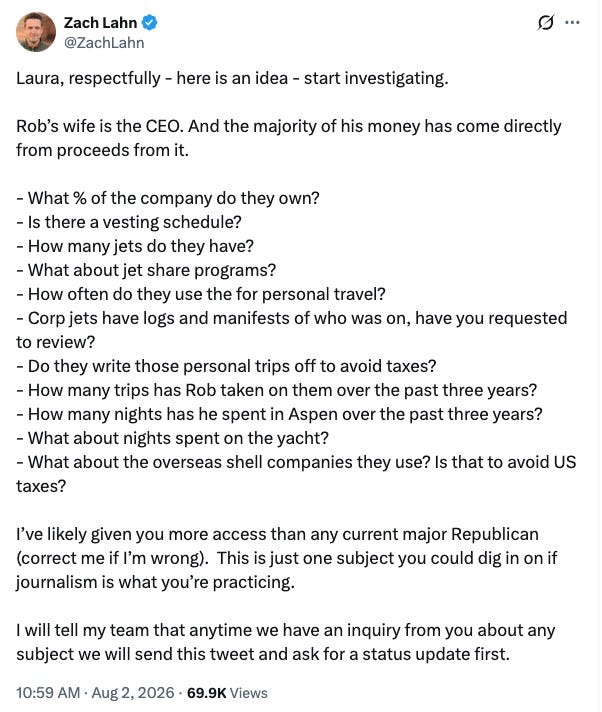
During our back-and-forth, Lahn revealed more details about the finances of his running mate, State Representative Derek Wulf.
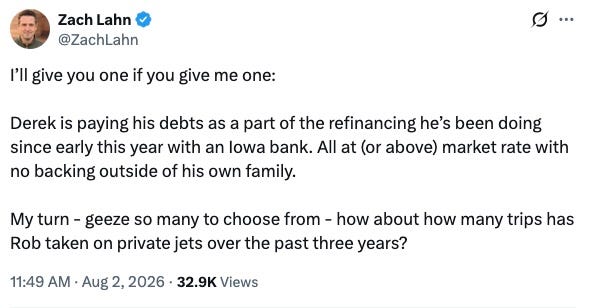
After I suggested that his to-do list for me was a pretext for avoiding questions such as “Who's repaying Derek Wulf's debts?”, Lahn offered a barter of sorts.
(My Iowa Writers’ Collaborative friend Douglas Burns quipped, “Journalism, truth itself aren’t commodities to be traded like crypto.”)
Anyway, it was news to me that Wulf “is paying his debts as a part of the refinancing he’s been doing since early this year with an Iowa bank. All at (or above) market rate with no backing outside of his own family.” It’s not clear whether he meant only members of the Wulf family or also Wulf’s in-laws. Someone must be putting up a lot of collateral to secure new loans.
I don’t know which Iowa bank is working with Wulf on a refinancing. In April, his current bank (WCF Financial) asked for a commitment letter from the Hardin County Savings Bank, but I haven’t independently confirmed that they are involved.
A court hearing in the foreclosure case was scheduled for August 4 in Black Hawk County District Court. However, attorneys for Wulf and WCF Financial jointly asked to delay that hearing until the week of August 20 as they continue to negotiate.
A recent poll of the first Congressional district, covering most of southeast Iowa, showed Democrat Christina Bohannan in the lead with 40 percent support. Republican incumbent Mariannette Miller-Meeks had 35 percent, and independent Michael Bridgford 11 percent, with 11 percent of respondents unsure.
We mentioned this poll a couple of weeks ago, because Bridgford’s campaign was touting it, but we didn’t have full results. I would like to see more confirmation of these numbers from a survey not commissioned by an organization supporting independent candidates for Congress. But it certainly adds to the evidence that IA-01 will be a highly competitive race.
Bridgford’s campaign cited this poll in a statement saying he meets the criteria to be included in the planned debate on the Iowa PBS program “Iowa Press.”
With all official eligibility metrics satisfied, including FEC contribution benchmarks and broad press coverage, the campaign has formally requested inclusion in the upcoming broadcast. Including Bridgford alongside Republican incumbent Rep. Mariannette Miller-Meeks and Democratic nominee Christina Bohannan will ensure Eastern Iowa voters receive a complete, well-rounded view of all options on their ballot this November.
Iowa PBS traditionally hasn’t invited third-party candidates to these debates, but we also haven’t seen any independents running for Congress poll at more than 10 percent or raise more than $100,000 for their campaigns.
Bridgford is running on a centrist platform, hoping to pull power in Congress away from extremists in both parties. The idea is that even a handful of independent House members could force change (e.g. their votes might be needed to elect a speaker). The Independent Leadership Council led by former Senator Joe Manchin of West Virginia is supporting Bridgford’s candidacy.
The Democratic Congressional Campaign Committee, which is the main campaign arm for U.S. House Democrats, added Iowa’s second district to its “Red to Blue” program last week. In this open seat, currently represented by Ashley Hinson, Democrat Lindsay James will face Republican Joe Mitchell, Libertarian Rick Stewart, and independent candidate Dave Bushaw.
I would have added IA-02 to the top target list at least six months ago. I understand why the DCCC waited until after the June primary, so as not to show favoritism toward any of the three Democrats seeking the nomination.
Candidates must meet certain benchmarks to be in the Red to Blue program. Being on the list makes it easier to raise money from Democratic donors around the country who are looking for the most competitive races.
The National Republican Congressional Committee put IA-02 on its target list in March, recognizing that Mitchell is not a sure thing.
Why are three of Iowa’s four U.S. House districts competitive? Because we don’t have gerrymandering. Our redistricting process—a model for the country—doesn’t allow mapmakers to use partisan data or split counties. That means no “cracking” or “packing” of voters to make it impossible for one party to win.
Last Tuesday, Democratic candidate for secretary of agriculture Chris Jones rolled out what his campaign called “a comprehensive roadmap to expand Iowa’s local food economy by helping schools serve more food from Iowa farmers.”
The F.A.I.R. (Food, Agriculture, Infrastructure, and Resilience) Farm Plan “would be the largest investment of state funds in local food infrastructure in history. The goals of the program would be for more than half of all foods served in Iowa schools to be locally sourced within 10 years, and to make Iowa the leading state in the country for local food production.”
Jones has long talked about the need for Iowa to move away from a two-crop model and have more diversity on the landscape, with farmers growing more food people can eat (as opposed to corn and soybeans used primarily for ethanol and livestock feed).
We didn’t have time to get into the details of the plan, but you can find more information here. Mallory DeVries wrote about it on her Substack:
There’s bipartisan support for more local food in schools—Lahn mentions this in some of his campaign appearances. But Jones’ plan is more specific and ambitious than anything I’ve seen from other candidates.
Iowans will vote on a state constitutional amendment this November, which would require a two-thirds vote in the legislature to raise income taxes or corporate taxes. The conservative advocacy group Iowans for Tax Relief announced in July that they will spend heavily to educate Iowans about the proposal.
Former Iowa House Majority Leader Chris Hagenow, the president of Iowans for Tax Relief, told reporters they plan to use TV and radio advertising and direct mail. They will not expressly advocate for a yes vote (possibly because non-profits are limited in how much they can spend on political advocacy). Hagenow said they simply want to raise awareness that the amendment is on the ballot. “We believe strongly that Iowans support the premise of this amendment, that they support the idea of it being harder to raise their taxes. […] They simply need to know what this amendment does and that it will benefit them to vote ‘yes.’”
A website is promoting a yes vote at maketaxhikesharder.com.
Democrats and progressives largely oppose the amendment, because it would make it almost impossible to raise income taxes on wealthy individuals or corporations. Instead, the legislature would likely raise regressive sales taxes to deal with the budget shortfalls that are coming to Iowa soon.
I’ve heard rumblings that labor unions will work to defeat the proposed constitutional amendment, as they did when Iowans voted down a similar measure (requiring a three-fifths vote to raise taxes) in 1999. I would guess the “yes” forces will be able to vastly outspend the “no” forces.
Ed Tibbetts wrote a good column about this amendment last week.
By the way, before the town hall in Carlisle, I asked Rob Sand whether he plans to vote for this constitutional amendment. He said he hadn’t read the language yet, but if you’re going to amend the constitution you have to make sure you get it right.
The Democratic Legislative Campaign Committee, which works to elect Democrats to state legislatures, announced last Tuesday that it is targeting 18 districts in Iowa. Five of those are in the Iowa Senate. In a statement, DLCC President Heather Williams cited “a historic opportunity to remake the power dynamics in Iowa,” to “ensure an incoming Democratic governor can veto the worst of the MAGA agenda.”
Currently Republicans hold 67 of the 100 Iowa House seats (enough to override a veto) and 33 of the 50 Iowa Senate seats (one short of a supermajority).
Earlier in the year, the DLCC spotlighted these three Senate races:
Catelin Drey (Senate district 1, most of Sioux City and part of Woodbury County)
Heather Matson (Senate district 21, open seat covering most of Ankeny in Polk County)
Mike Zimmer (Senate district 35, Clinton County and parts of Scott and Jackson counties)
They’ve added two more races where Democrats are challenging first-term GOP incumbents. Both seats are in or near the Quad Cities area.
Tom Wieck (Senate district 41, covering a little bit of Davenport, parts of Scott County, all of Cedar County, and little bit of Muscatine County)
Nikhil Wagle (Senate district 47, covering Bettendorf, Eldridge, and parts of northern Scott County)
The DLCC is targeting thirteen Iowa House seats. Four are currently represented by Democrats (I mistakenly said three on the show):
Shawn Olorundami (House district 1, open seat covering part of Sioux City where Representative J.D. Scholten is retiring)
Amy Tagliareni (House district 42, covering part of Ankeny now represented by Heather Matson)
Dan Gosa (House district 81, covering part of Davenport; he’s an incumbent who was unopposed in 2024)
Andrew Fitzgerald (House district 98, covering part of Davenport and nearby Buffalo; current Representative Monica Kurth is retiring)
Again you can see a focus on the Quad Cities area. Strong Democratic turnout in Scott County will be important for statewide races as well as the first Congressional district.
Republicans hold the other nine House seats targeted by the DLCC:
Tom Walton (House district 28, western suburbs of Dallas County)
Heather Sievers (House district 40, eastern suburbs of Des Moines in Polk County)
Molly Buck (House district 41, north side of Ankeny)
Jill Alesch (House district 43, northwest suburbs of Des Moines, open seat because Eddie Andrews ran for governor)
Mandy Newton Rosenow (House district 46, Grimes and part of Dallas County)
Mike Tupper (House district 52, Marshalltown area in Marshall County)
Jacob Welper (House district 59, Mason City area of Cerro Gordo County)
Matt Robinson (House district 72, part of Dubuque)
Jennifer Kirkman (House district 99, Burlington area in Des Moines County)
We had just a couple of minutes to talk about the latest legal challenge to part of Senate File 496, the school book ban Republicans enacted in 2023.
Last week a group of large book publishers and two best-selling authors filed a new version of their lawsuit. This third amended complaint, which you can read here, takes a new approach. Instead of suing to block the law’s enforcement statewide, they are targeting three school districts and nine books that have been removed from libraries in one or more of the districts. The plaintiff publishers are Penguin Random House, Hachette Book Group, HarperCollins, Macmillan Publishing Group, and Simon & Schuster. The Authors Guild (an organization uniting writers) and banned book authors Laurie Halse Anderson and Jodi Picoult are also plaintiffs. So is Grace Van Gundy, a former Urbandale High School student.
The defendants here are the leaders of the Iowa Department of Education, Iowa State Board of Education, and Iowa Board of Educational Examiners, as well as school board members from Urbandale, East Union (that’s in southwest Iowa), and Nevada (Story County).
U.S. District Court Judge Stephen Locher has found the school book ban unconstitutional twice. Both times an Eighth Circuit Appeals Court panel has rejected his interpretation and sent the case back. Most recently, in April of this year, the Eighth Circuit judges said libraries are part of the school curriculum, and therefore library restrictions can be a form of “government speech,” not subject to the First Amendment.
This new lawsuit is not a constitutional challenge seeking to strike down the whole school book ban. The plaintiffs argue it’s unconstitutional for some school districts (with consent from the state) to apply the law against specific books: To Kill a Mockingbird by Harper Lee, Animal Farm by George Orwell, 1984 by George Orwell, Brave New World by Aldous Huxley, Speak by Laurie Halse Anderson, Nineteen Minutes by Jodi Picoult, I Know Why the Caged Bird Sings by Maya Angelou, The Rape of Nanking: The Forgotten Holocaust of World War II by Iris Chang, and Native Son by Richard Wright. All have been removed from library shelves in Urbandale, East Union, and/or Nevada schools, because they contain descriptions of a sex act.
I didn’t have time during the show to read this statement from Dan Novack, an attorney for Penguin Random House:
The Eighth Circuit made clear that Iowa’s law applies far more narrowly than the State had previously argued. Our amended complaint asks the court to enforce those limits for books that should never have been removed from school shelves and establish precedent that protects works of extraordinary literary and historical value. These nine books demonstrate how SF 496—and its overzealous enforcement—has resulted in the erasure of history, depriving Iowan students of essential information, stories, and ideas. Our goal is simple: to ensure all students have access to the books they need to learn, grow, and understand the world around them.
If the plaintiffs win, the ruling would not immediately apply to the whole state. They are only asking the court to rule that Iowa’s law has been unconstitutionally applied to these books. If the court requires these school districts to put the challenged books back on the shelves, other school districts might follow suit. A win in this case would open the door to other as-applied challenges, citing other books with strong literary, educational merit.
That’s all for now. Thank you for reading or listening.
Comments
Nothing yet. Say the first thing.
Sign in to join the conversation.