
Last week I shared the tools and resources we actually use with our kids. This is the deeper layer: the environments those tools belong inside.
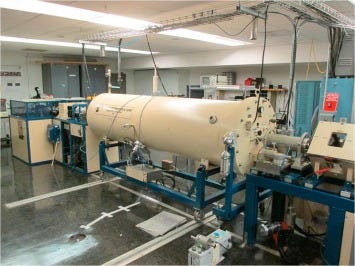
When I was a physics major at the Naval Academy, we had a particle accelerator and a small nuclear reactor in the basement of the building. I remember taking Advanced Quantum Mechanics. One day we’d solve for the wave function of a reaction, draw Feynman diagrams on the chalkboard as a class. We’d walk out with white chalk all over our black uniforms. The next day, the ten of us in the class would meet in the basement, roll up the sleeves of our shirts, tuck our ties out of the way, and get to work. As a group, we’d program the particle accelerator for whatever reaction we had investigated the day before, setting magnetic fields and computer readouts for what we hoped to see. Then we’d all huddle around the computer screen, staring excitedly for any kind of readout. As the semester wore on, we were encouraged to use the accelerator regularly, often times without faculty supervision. We would load our own reactions, set the fields we wanted, and see what happened. I was a young kid who thought I wanted to spend my life studying the mysteries that physics offered. Instead, I ended up flying carrier airplanes.
At 21 I was handed a particle accelerator and a nuclear reactor. At 28 I was expected to run relief operations over Japan after the 2011 tsunami. Five nations’ airplanes flying off the USS Ronald Reagan, all to bring aid to people in the middle of a nuclear disaster. It had never been done before. At 31 the Navy expected me to test a first-of-its-kind radar on a $256 million airplane.
The point of the accelerator was never the physics. The point was the room.
A room isn’t just four walls. It’s expectation made visible. It’s a dedicated place with real tools for doing real work, with real responsibility, before they’re ready. It isn’t enrichment. It does not organize itself around a child’s comfort. It isn’t a classroom with nicer supplies, and it doesn’t shrink to the child. It expects our children to grow into the room.
Maria Montessori understood that children are shaped by the environments prepared for them. I’m trying to extend that insight: rooms designed not just to educate children, but to form them.
It is an old pattern. We used to bring young people near the real thing, not after they were formed, but as part of their formation. Laura Deming was working in Cynthia Kenyon’s lab at UCSF at 12. Michael Faraday became a bookbinder’s apprentice at 13, spent years reading the books he was binding, then talked his way into Humphry Davy’s lectures, bound a transcription of them, and landed an assistantship. Michelangelo was working in Ghirlandaio’s bottega at 13 and painting frescoes at the Tornabuoni Chapel within a year. Young people were not kept from serious work until they were ready. Serious work was what made them ready.
My children never got rooms like that. None of their friends do. Not even the ones who are homeschooled. I’m building what I can in our house, but my wife has already put up with an airplane, and I don’t dare to ask her for a particle accelerator in the basement.
We used to expect that young people would do real work. We used to push them into that work before they were ready. We used to know that work was what formed them, rather than something they earned after they were formed. If we still believe that, and I do, then we owe our children rooms where it’s still true.
I’ve been dreaming of those rooms for years. Unfortunately, the full room is still years off, and our kids don’t have years to wait. The good news is that we can start at whatever scale we have, and we can start now. We can start with a shelf, a table, a bench, a whiteboard, a set of tools left out. The size isn’t the issue. The issue is whether the room exists.
The first step is to choose one place, put real tools there, and let unfinished work stay in view.
I started with our dining room. We’re not a “formal dining room” family, so I gave that room over to work. Two bookshelves, both at hand and eye level for the kids. One is filled with art supplies: colored pencils, markers, hot glue gun, felt, wire, clay. The other is reserved for what they make. There’s a work table in the middle of the room and two easels tossed wherever there is room. My daughter loves to grab the painting supplies. She sets up her easel near the table and gets to work. One day it’s the earth seen from space. Next it’s a duck swimming. Paint drips on the carpet and the easel and splatters on her furrowed brow. My son sets up his lego men on the carpet and films a stop motion movie. The latest one is something about a runner training for the big race. Legos are everywhere. I can’t tell you how many legos have been lost to the dogs. Good. The room is being used.
I expanded the design studio next. We have a Mac Studio and each kid has a Nikon Zfc digital camera. Many homeschool programs offer discounted licenses for Adobe Photoshop. My wife has used it for years in her photography businesses. Autodesk Fusion is free for personal use. It’s the same program I used designing parts for quantum computers. My son designed Hades’ helmet, Poseidon’s trident, and Zeus’ lightning bolt in Fusion, and proudly displays them on his dresser.
The temptation is to let these become toys. That would be a mistake. They are tools, and tools deserve a craftsman’s respect. Children learn that respect when their work is held up to better work and when they are expected to grow into the tool instead of having the tool shrink to them.
That room isn’t enough to contain my kids’ ambitions, so we moved into the garage. Half of the garage has a 14 foot workbench that’s covered with clecos, pliers, drills, a rivet gun, and different airplane parts strewn about in an order that only lives in my head. The shelving which used to hold gardening tools now holds a rotary polisher and too many wool buffers. They hold boxes of rivets. Tool batteries. Some completed parts sit around. There’s even a whiteboard with our work plan for the day. In the driveway is a shipping container filled with raw sheet metal. I’m planning the build of a DIY CNC router with my kids. My kids have plans for what they’re going to build and how they’ll sell it. I see them building their (very) rough P&L on my daughter’s whiteboard.
I’m trying to build a math circle room in our community. Montana State University has a summer math circle program for middle and high school kids. I’m hoping to do one year round, starting young. I’ve spoken to their math department about getting started. There’s no budget and even less interest right now. But imagine a room dedicated to real math. Seats in a circle. Chalkboards everywhere — maybe even floor to ceiling. Books in a little math library. Computers to run simulations on. A space where kids can work on math problems for weeks and nothing gets erased. It doesn’t have to be elaborate, but I can’t seem to make the system interested.
I’ve thought about building it myself. Even as a starting point for what I really want. I’ve looked at the business model every way I can, and I can’t make the numbers work for a business. It’s a great way to turn $1M into $100k. The rooms are worth building. It’s just not something one parent can build.
They are something a community can build. Each community can build the room that matters to them. Let’s say Bozeman (where I live) builds a learning space around a machine shop. My ten year old spends weeks figuring out the tolerances on a lathe, coming out with his own airplane themed chess set. A high schooler rebuilds a cylinder head on a ‘67 Corvette while his friends install the electrical system that they rebuilt from parts. Kids learn optics by machining their own lenses, then use them to scout for the hunting season. A retired mechanic volunteers two days a week to help with the work.
Imagine Park City builds around aerospace. Their room has a small wind tunnel, computers that can run CFD, and support from Northrop Grumman engineers. Boise builds an atelier to give the kind of art education that created the masters. Every town builds what matters to them.1 Communities of rooms forming generations of children.
Kids raised in a room like that go on to become the leaders that build the next room: the one we can’t yet imagine.
Every Resource I Use to Educate My Kids
·
Apr 14

When I started homeschooling, I was looking for an educational philosophy. Something I could adopt and follow. It was only when I gave up on that and started making the actual decisions — what to teach, what to drop, what to try again differently — that formation began. Not a curriculum. A daily practice of building the world my kids learn inside.
If this essay hit something true for you — especially if you're a parent trying to build one of these rooms — reply and tell me. That's how Formation works.
I want to build this, but I haven’t figured out how. If you’re trying, if you have community support and land and funding and political will, I’ll help you think through the build. I can introduce you to other parents trying the same thing. I can introduce you to professors or find the ones we don’t know. I’ll write about it and send more people your way. I want thriving community rooms that bad.
No posts
Comments
Nothing yet. Say the first thing.
Sign in to join the conversation.