
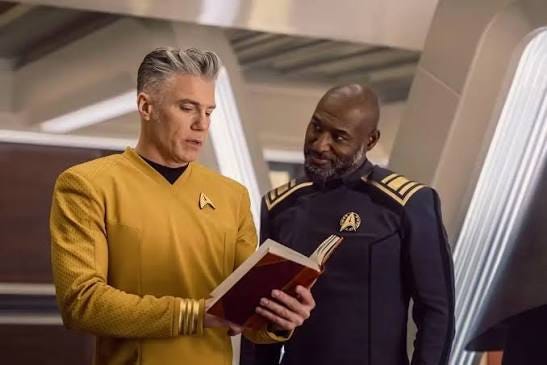
Adam Kotsko has noted how Star Trek series after TOS have often used formal devices like retroactive continuity and narrative devices like time travel to establish their own centrality to the franchise. In the linked article, his key examples are First Contact (which sees Picard, out of his own time, securing the utopian break in history that was first contact with the Vulcans) and Enterprise (which establishes the existence of another ship called Enterprise we never heard about, before Kirk’s, that was responsible for the founding of the Federation) — but we can quite easily see the same thing at work repeatedly at work in the Kelvinverse films (which begin quite literally with the moment of Kirk’s birth, albeit in a new, simplified timeline that was intended at the time to be permanent) and in the Discovery/Strange New Worlds era (whose characters, in various ways, contrive to make TOS, TWOK, and ENT itself all possible). With this week’s season four premiere, Strange New Worlds may have done the most ambitious version of this move yet: the crew of Pike’s Enterprise turn out to have been instrumental in causing the extinction of the dinosaurs, establishing the conditions not just for Star Trek’s utopian future but for the evolution of the human race as such.
This happens because, in an uncharacteristic moment of cold decisiveness, Pike refuses to prevent a genocide that prehistoric Martians have decided to enact on the insectoid race inhabiting a now-lost fifth planet in our solar system, using an antimatter fuel pod stolen from the Enterprise to craft a planet-destroying weapon. Pike has a chance to try to stop the disaster, but he intuits that he must instead allow the massacre to play out, and the crew surfs the massive energy field caused by the explosion to return to their own time. Because the events have the sheen of a predestination paradox, including the late realization that the Enterprise only went into the time distortion in the first place in response to a distress beacon that they would launch after they become stuck in the past, the crew concludes that this is not something they need to feel especially bad about. They had to do it—because they always had.
In the movie of the moment, Chris Nolan’s adaptation of The Odyssey, the great mythic trickster is reimagined as a PTSDized version of Nolan’s Oppenheimer reeling from the consequences of his decision to defy the laws of hospitality that structure Bronze Age society. Having broken xenia to insert a covert strike team behind Troy’s walls, which leads to the breaking of its impregnable defenses and, ultimately, the total destruction of the city, Odysseus concludes that he has damned himself and his people to collapse. The rapacious barbarians the Greeks have come to fear since the end of the war — the Sea People — are thus revealed to be a distorted vision of their own monstrous behavior, and the catastrophe the Sea People promise is in fact the natural consequence of the Greeks’ willingness to win at any price.
The Strange New Worlds episode actually gestures, briefly, in a similar direction: the Martian commander who orders the attack indicates that she is motivated to do so because she has seen, in the Enterprise’s data banks, the future of Mars as a barren wasteland and cannot take the chance that the insectoids are not responsible. In fact, of course, her actions cause the destruction of her planet.
Pike, though, for his part, does not even see his inaction as a crime. In the moment, he could have stopped the genocide of the Dol’drm, or at least tried to, but he orders a hold in the name of preserving what he sees as the proper order of history (including, of course, his own existence). In another era of Trek, the debate over what to do could have been the whole episode, with passionate arguments back and forth — but here the question doesn’t even fill an act break. After the explosion, the crew simply returns to the present, quickly washing their hands of the situation: his superiors at Starfleet give their stamp of approval (though they classify the mission for political reasons), and his crew is immediately ready to move on.
The result is a deeply discordant episode that, as a kind of happy-ending emergency exit, wants to revel in the away team’s transcendent encounter at the beginning of the episode with the dinosaurs they saw exterminated at the end of the episode — an almost psychopathic refusal of the true stakes of these events and the enormity of what has been depicted.
The Odyssey flirts with the notion that one can be the beneficiary of megaviolence without being accountable for it morally; Odysseus carefully keeps his son, Telemachus, away from the slaughter of the suitors so he can ascend to the throne with his hands clean. But meta-textually the movie signals that this is false hope; we know Bronze Age civilization will crash, all they have built will disappear, and in the end all these events, exactly as Odysseus suggests in his final oration, will only be misremembered as myths.
Strange New Worlds can’t bring itself to ask such questions; instead, it continues the trend of post-9/11 Trek, as identified so persuasively in Late Star Trek, working primarily as a long meditation on war, empire, and the national security state. This is all just another war crime to be classified and forgotten about — just another Tuesday in Starfleet. In the end even the episode can’t even sustain the fiction that Pike had no choice but to do what he did, or even that the Martian commander was wrong to do commit genocide on partial, incomplete intel; it has to have been the right choice. “She just wanted to save her own people,” Pike ultimately says of the Martian commander who, in an unhinged fit of paranoia and rushed conclusions, launched an antimatter superweapon to kill an entire species in a devastating first strike. “I would have done exactly the same thing.”
No posts
Comments
Nothing yet. Say the first thing.
Sign in to join the conversation.