
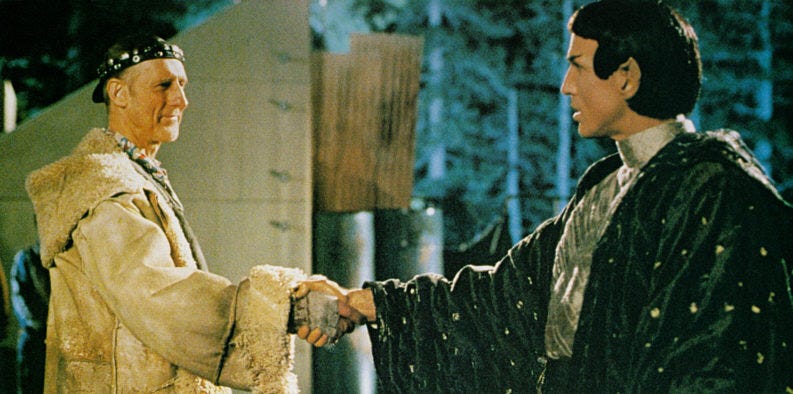
This week I hit a major milestone in my elaborate chronological Star Trek rewatch: the film First Contact. In terms of in-universe lore, there was virtually no pay-off to watching it in sync, because the Borg attack in the film comes out of nowhere. But thematically, it was interesting. The first thing to note was that First Contact came out in 1996—the 30th anniversary of Star Trek, which means, for those who want to feel old, that we are currently as far away from First Contact as the film was from “The Man Trap.” It was thus the third in a series of tributes, along with Voyager’s “Flashback” (in which Janeway joins Tuvok in a mind meld to explore his memories from behind the scenes on Undiscovered Country) and Deep Space Nine’s “Trials and Tribble-ations” (which I assume everyone remembers well).
Both series also did multiple time travel or flashback episodes, and in fact the last episodes to air prior to First Contact’s premier were time-travel themed: Voyager’s “Future’s End” (in which they travel back to the 1990’s and hang out with Sarah Silverman) and Deep Space Nine’s “Things Past” (in which a telepathy accident forces Odo to relive a miscarriage of justice from his days working for the Cardassians). It is illuminating to bring together all these variations on a theme:
Voyager does a flashback to Undiscovered Country to provide unanticipated background on a main character, and it time-travels back to the audience’s present day in a way vaguely reminiscent of The Voyage Home—but it is not a sheer tribute, because the episode has permanent consequences (introducing the Time Cops and The Doctor’s mobile emitter).
Deep Space Nine travels back in time to “The Trouble With Tribbles,” and it flashes back to its own past, providing unanticipated background on a main character.
First Contact uses flashbacks to return to Picard’s trauma with the Borg and introduce unexpected lore to that incident (namely the presence of the Borg Queen), and it uses time travel to visit a previously unattested, yet foundational era of Star Trek history.
Focusing on the tribute aspect, we could say that Voyager pays tribute to the original cast films, Deep Space Nine pays tribute to The Original Series, and Next Generation pays tribute to… itself. Put differently, both spin-off series are trying to lay down more solid roots and connections to the broader franchise, while in First Contact, Next Generation is asserting its own priority as the true foundation of the franchise.
Thirty years later, Star Trek is still the franchise that First Contact refounded. First Contact brought us face-to-face with impossibly high, universe-altering stakes, and the spin-off series both followed up immediately. Deep Space Nine finally pulled the trigger on the long-teased Dominion War in the wake of First Contact, and Voyager finally made contact with the Borg at around the same time. As I document extensively in Late Star Trek, every subsequent installment has followed in those footsteps (even Lower Decks, with its season 5 “damage to the multiverse” plot!)—and the final season of Picard brought back the Dominion War and Borg Queen plots from the spin-off to let the Great Man put his signature on them, accompanied by the literal theme music from First Contact.
First Contact also introduced the idea of exploring Star Trek’s own past, ideally through time travel. Voyager followed up on this with a series of plots about the role of Janeway’s ancestor (who looks uncannily similar!) in early space exploration and episodes like “Friendship One” that gesture toward humanity’s first missteps with warp technology. Obviously we then got Enterprise, the JJ-verse, Discovery, and Strange New Worlds, prequel series that all had major plots hinging on time travel. And as Gerry recently pointed out, all repeat, in their own way, First Contact’s gesture of asserting its own priority and foundational status for the franchise.
We are all presumably sick to death of these themes at this point, but what’s interesting watching it all in context is that it feels like a breath of fresh air. After the conclusion of Next Generation, the franchise seemed rudderless and completely unambitious. Generations was self-indulgent and frankly stupid, and the early seasons of Deep Space Nine and Voyager took a long time to figure out who the characters were and what the shows were going to be about. This is the moment when the expanded franchise of the mid- to late-’90s seems to hit its stride—First Contact finally showed that the Next Generation film franchise could make a real contribution in shaping the franchise, and both spin-off series began the plot arcs for which they are most remembered.
What is striking, and somewhat ironic, to me is that this newfound confidence went hand-in-hand with becoming more and more self-referential. First Contact unapologetically presupposes that you know particular Next Generation episodes—albeit by far the most famous ones—and that you are invested in the existence of the Star Trek future as such, and both Voyager and Deep Space Nine seem to grow more comfortable making canon connections (as when we encounter the Ferengi that Riker abandoned out in the Delta Quadrant) and building their own lore. I wonder if the 30th anniversary was a catalyst here, putting the writers in the mindset of referring back to previous stories even beyond the obligatory tributes. And they were right to be confident, because this stuff was actually good in a way that Star Trek had not consistently been for several years at this point.
In terms of the film itself, I have seen it, um, several times, and I didn’t expect any major insights. It did come through more clearly this time than on previous viewings that Picard’s obsession with revenge was making him “just as bad” as the Borg themselves, treating his crew like objects—most dramatically when he coldly defiles an ensign’s corpse to get a Borg transmitter, but also when he expects his crew to act as canon fodder and goes so far as to call Worf a coward for questioning his orders. He also repeatedly declares that anyone who is assimilated should be treated as permanently lost, even though the very trauma on which he is so insistently harping shows that is not the case. In the end, of course, he risks his life to rescue Data from the Borg’s clutches, though there is sadly no evidence they attempt to deassimilate any of the human drones. (Alas, Lt. Hawk! We barely knew you!)
There are also nice echoes of past episodes—such as their initial assignment to patrol the Romulan Neutral Zone, a reference to the first episode in which they encountered evidence of the Borg’s existence. That reference is later cashed out in Picard’s rather half-hearted rehearsal of his speech about transcending money in favor of self-actualization to a skeptical Lily. I also thought that Data’s strangulation of a Borg drone served as a visual echo of “Descent,” where Lore uses anger to control Data—but this time he has full control of his emotion chip, which he wisely turns off.
First Contact is far from a cinematic masterpiece. There is too much reliance on action, and the attempted catch-phrases mostly fall flat. You can almost feel Michael Dorn’s humiliation as he tries to sell “Assimilate this!” But the moment of First Contact still gets me every time. And on this viewing, I felt strangely moved simply to see the Next Generation crew on screen again. A year of alternating between Voyager and Deep Space Nine was long enough for me to sincerely miss them. Maybe I should be more forgiving of my fellow fans who could tolerate any plot contrivance—including the mass murder of older Starfleet officers and mass traumatization of the younger officers who were forced by the Borg to do so—for the sake of seeing the old band back together the -D’s beautiful hotel lobby of a bridge. The carpet! Wonderful!
No posts
Comments
Nothing yet. Say the first thing.
Sign in to join the conversation.