
The most recent Strange New World episode ‘A Case of Chiaoscuro’ is entirely in black-and-white (except for the titles/credit sequence).
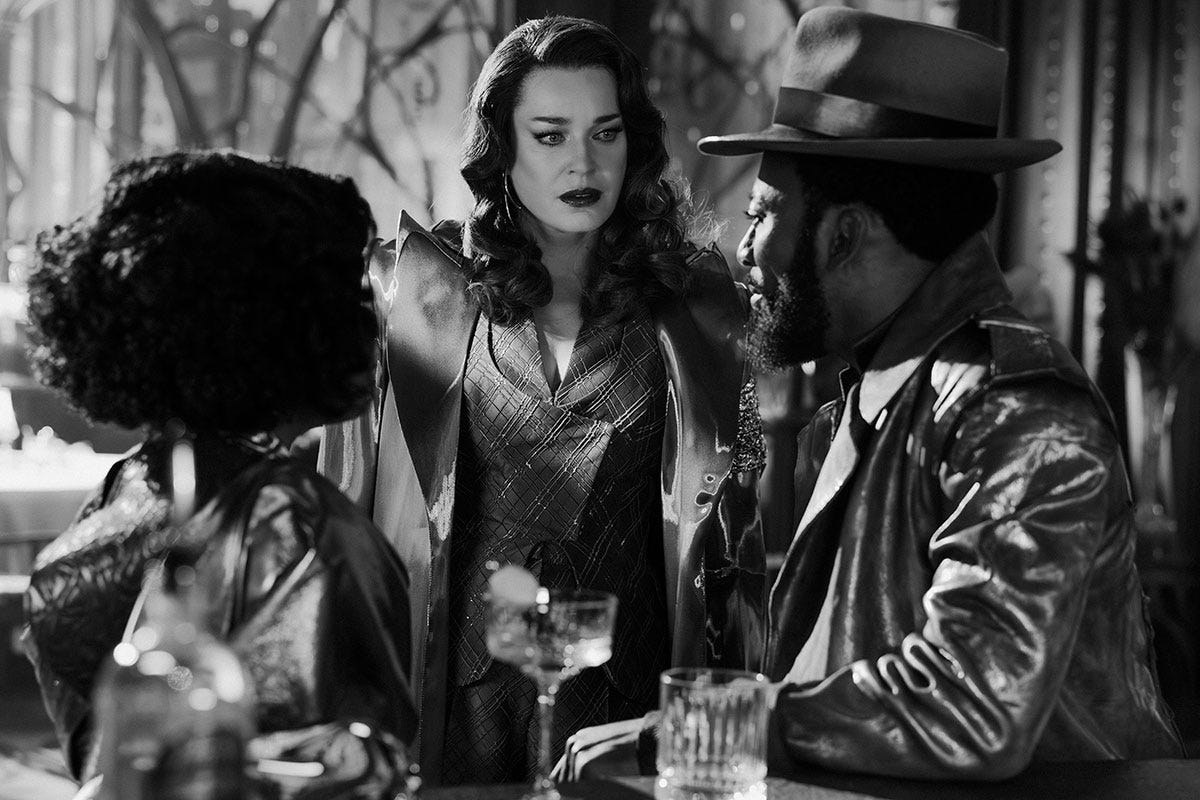
In his post on the episode Gerry Canavan suggests that in this the scriptwriters were ‘borrowing from Dune: Part Two the notion of a planet whose physical properties create a black-and-white visual spectrum’, which is very likely. It follows a broader conceit in Trek that what we see on the screen is actually happening in the world portrayed, as if the screen is a magic window into reality. Of course this is a misunderstanding of the nature of textual representation. There are various representational frames and conventions at work in any text. In 2009 John Lanchester, playing video games for the first time, wrestled with what struck him as the arbitrariness of the parameters of play:
As a video game, BioShock fully subscribes to the conventions of the medium, and if you as a non-gamer were to pick it up and give it a try, it is these you would probably notice most. Not just the conventions of which buttons and levers you press to move about the world of the game (annoying and hard to recollect as these often are) and not just the in-game mechanics, such as the ‘plasmids’ which you have to inject to give your character the powers he needs, or the tapes which are conveniently left around for you to discover and play back to hear the story of Rapture; but also the whole package of conventions and codes and how-tos which become second nature to video-game players, but which strike non-gamers as arbitrary and confining and a little bit stupid. Northrop Frye once observed that all conventions, as conventions, are more or less insane; Stanley Cavell once pointed out that the conventions of cinema are just as arbitrary as those of opera. Both those observations are brought to mind by video games, which are full, overfull, of exactly that kind of arbitrary convention.
Frye and Cavell are entirely correct. With different modes of text we understand representational conventions as conventions, as the premises upon which the story or experience can develop. You don’t go to see Don Giovanni and, ten minutes in, stand-up complaining noisily ‘but what kind of crazy world is this supposed to be, where people keep singing at one another? Why don’t they just talk?’ You accept the conventions of this idiom and enjoy the opera.
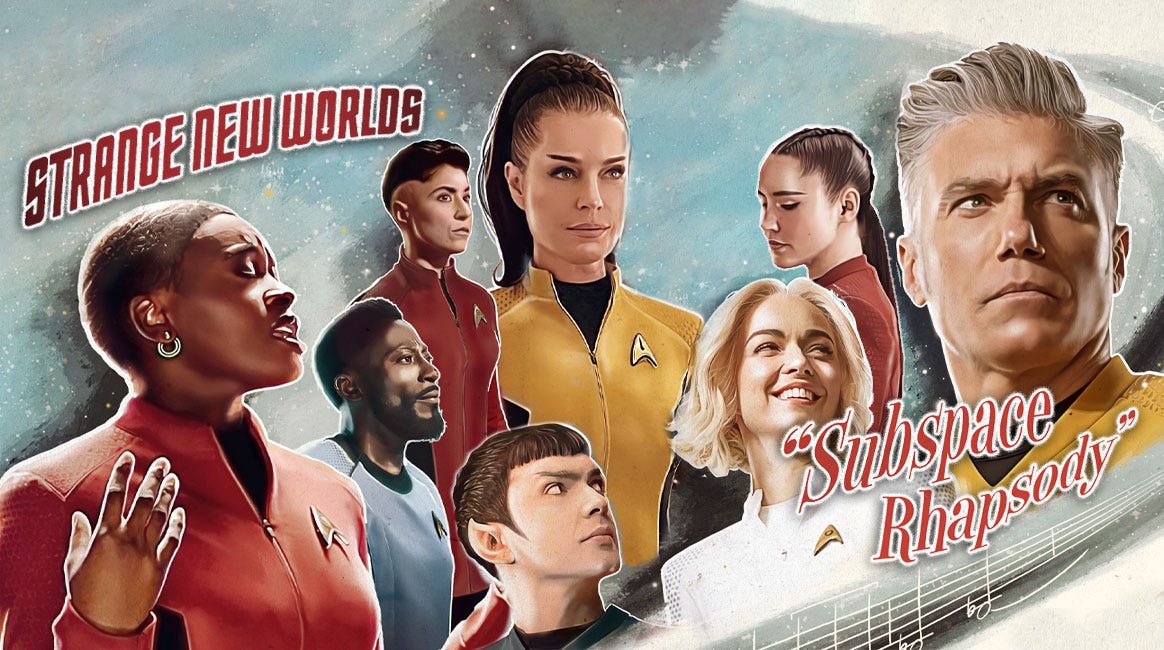
Except in SF, often, you don’t. This is because (as critics argue) science fiction is very often in the business of literalising metaphor.1 Not ideological false consciousness, but a world in which humans are literally enslaved by machine-intelligences and disposed into a falsifying virtual reality. Not memory, but literally travelling back in time. Not musical-theatre but a ‘subspace fold’ that produces a ‘quantum improbability field’ in which singing rather than talking literally determines communication.
And, as with this episode: not the representational conventions of 1940s Noir b&w cinema but a world in which strange radiation literally etc etc. Other conventions of the form are, with varying degrees of clumsiness, explained-away in ‘A Case of Chiaoscuro’. Noir often trades in lookalikes, doubles and disguises: this episode explains away the improbable contrivance by which Number One happens to be an exact doppleganger of the gang leader by M’Benga airily referencing the enormousness of the universe such that ‘it’s surprising these things don’t happen more often’. Sure, Jan. As to why the Klingon-occupied world of Mat’aar so closely resembles Gotham City 1940: this is not explained in the episode, but with enough ingenuity I daresay an in-universe explanation could be contrived.
Not that Trek is consistent in this. The Lower Decks crossover episode ‘Those Old Scientists’ (SNW s2 ep 7) starts in the animated universe of Lower Decks but transforms into live-action when its characters pass into the universe of Strange New Worlds. Here we accept that ‘animated cartoon’ is a medium of representation, and not a whole universe in which people are 2D drawings—although, of course, this latter was precisely the premise of Zemeckis’s Who Framed Roger Rabbit (1988). To be consistent, ‘Those Old Scientists’ should have had Roger-Rabbit-style cartoon characters wandering around the live-action SNW sets, and an in-universe explanation by which an evil mirror-universe animator interefered with human history at some point in the past setting-up a branching reality in which we are all trapped Flatlandlike in 24-fps moving-drawings.
You could dismiss this as a hobgoblin-of-little-minds version of consistency. The test is whether the episode ‘works’. On this front we can agree that the quality of these ‘treating the conventions of representation literally’ episodes has varied wildly. Come Muppettrek, we shall have another chance to gauge.2
It seems to me, per Frye and Cavell, that a corner of the universe where strange radiation means that everything appears black-and-white is intrinsically no more insane than a universe in which we can travel in time back to the Jurassic era, mirror-universes, or indeed that literal impossibility, faster-than-light-travel. We could say that it is only the familiarly of the panoply of sciencefictional metaphors, the robots and death-rays, the time-machines and lightsabers, the generation starships, space elevators and Dyson spheres (and all the rest), that prevents us dismissing them as ridiculous, in the way we might with the black-and-white world. Or we could argue that the need to literalise what is—clearly—a set of representational conventions from 1940s Noir cinema bespeaks a failure of imaginative engagement.
++
Gerry’s reference to Dune 2 did get me thinking. In Villeneuve’s movie, the Harkonnen world is strikingly and effectively rendered in an oppressively spare black-and-white.
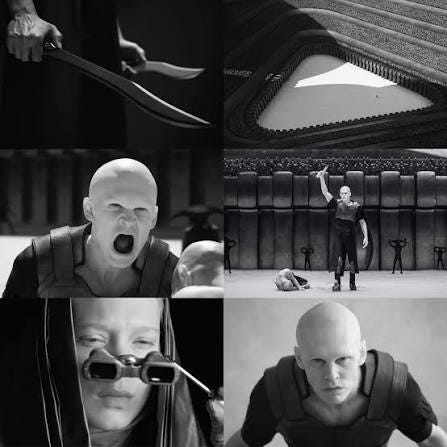
The movie does not offer an in-universe explanation for this, and in interviews Villeneuve himself has talked of it as a metaphorical apprehension of the society of the Harkonnens rather than, as it might be, a special kind of radiation.3 But then Dune itself, whilst not monochrome, is a visual world rendered with a very limited colour-palette: yellows and browns, whites and pale orange, black-and-greys, desert colours deliberately bleached of variety—nothing green, scarlet or blue.


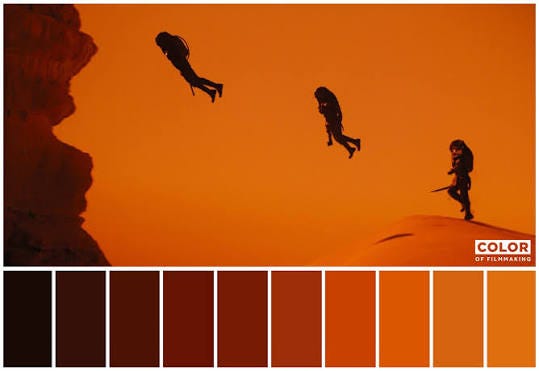
In this sense, Giedi Prime becomes a kind of parallel world to Dune: similarly focused, visually jejune, figuring a harsh, constraining world.
It’s well known that 21st-century cinema has seen a propensity for much more limited, or specific, colour-palettes than 20th-century moviemaking typically employed. In The Matrix, in-the-matrix scenes are all tinted greeny-black and ‘real-world’ scenes drably porridge and brown; Blade Runner 2049 balances neon-mauve and dark against the massively over-saturated orangeness of the Las Vegas sequence;
This is called ‘colour-grading’: Hitchcock might achieve his effects by carefully arranging sets and costumes, and choosing particular film-stock. In the 21st century it is more often a matter of digitally altering the colourwash in post production—O Brother, Where Art Thou (2000) was the first film to be entirely colour-graded digitally, to make it yellower. The colours connote and generate certain moods, or that’s the thinking. The filmmakers of the Harry Potter movies deliberately darkened the colour-palettes of the individual episodes as the series went on (‘With the first few films generally warmer tones and bright hues were used to convey the marvel and wonder of magic and Hogwarts, where the overall grade gets a significantly darker, bluer, and murkier as the saga progresses, reflecting the ominous and bleak prospect of Voldemort’s reign. [This] met with some unhappiness from fans who say they struggle to see detail in such dark shots’).
We could trace a broad shift in colour-grading across Trek. TOS was full of bright, prinary colours, often verging on the 1960s-psychedelic.
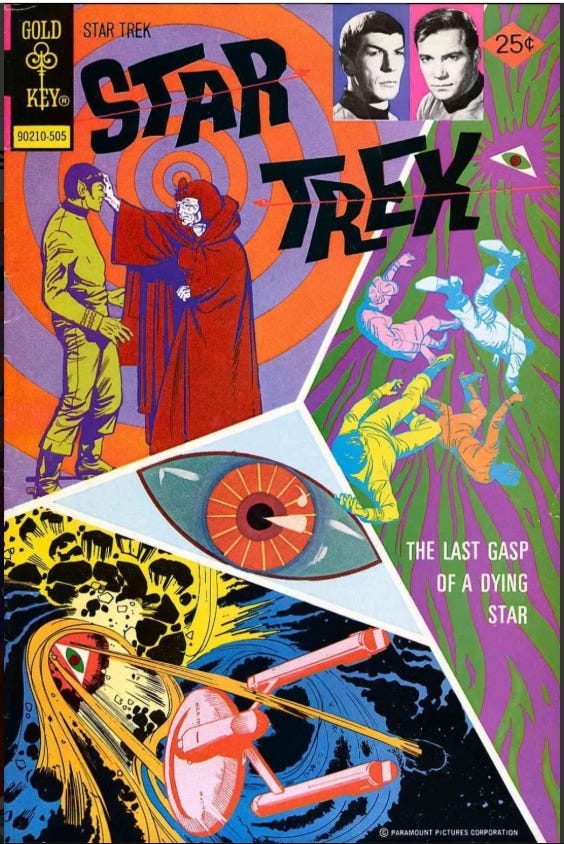
The TV show’s modest production budget realised this colour-palette with stagey, often minimalist sets, which strike me a beautifully defamiliarising, like a technicolour theatre-of-the-absurd. Waiting for Boldy-Godot.
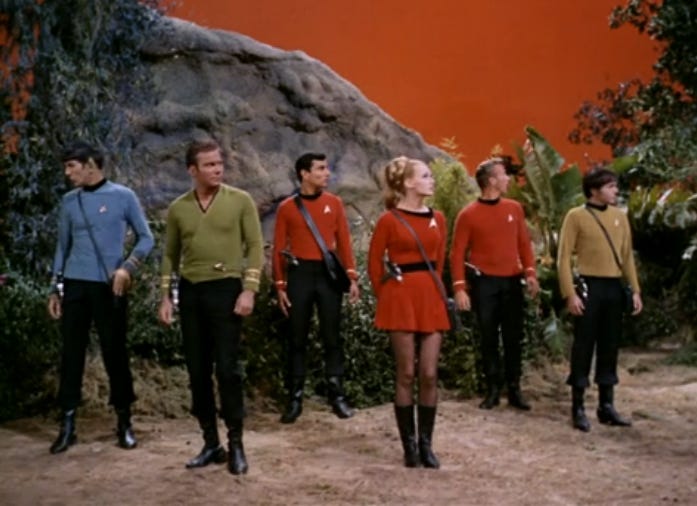
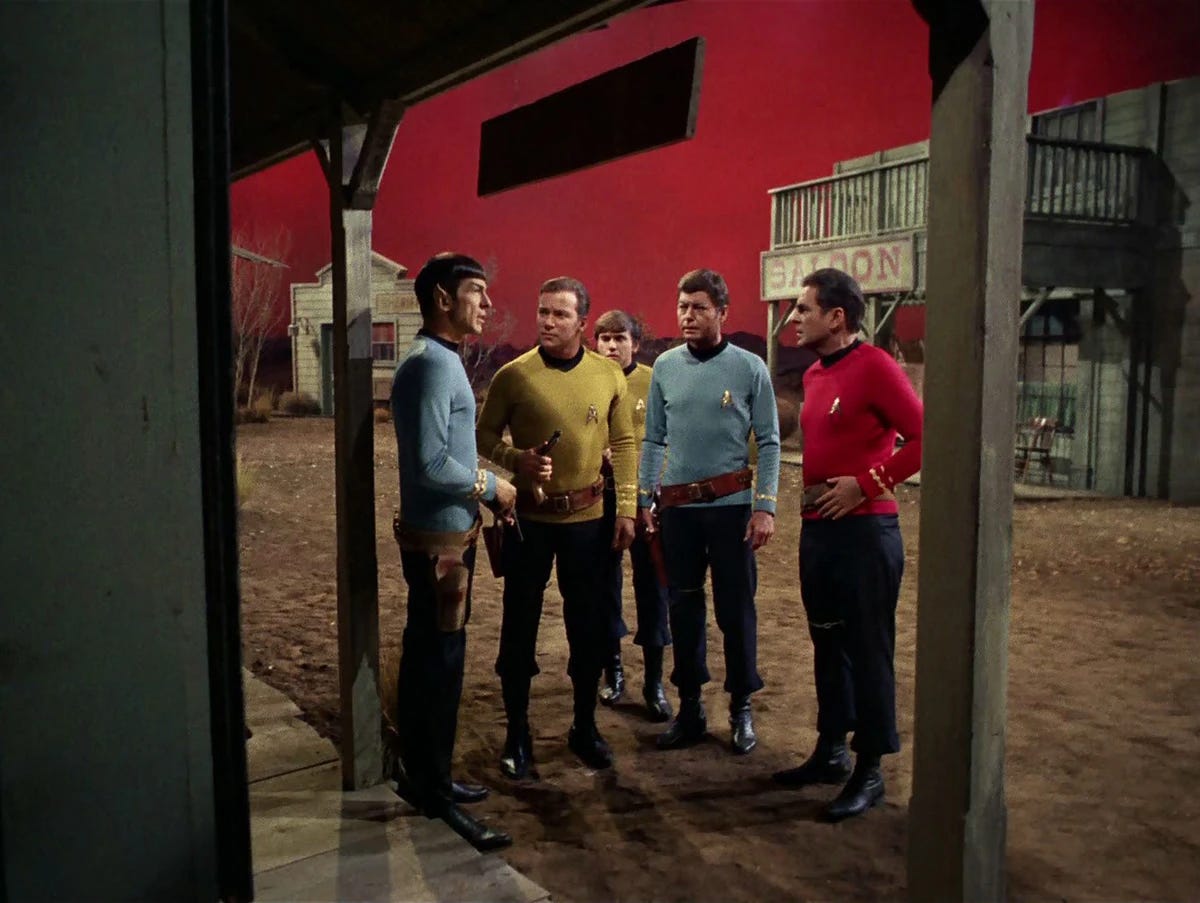
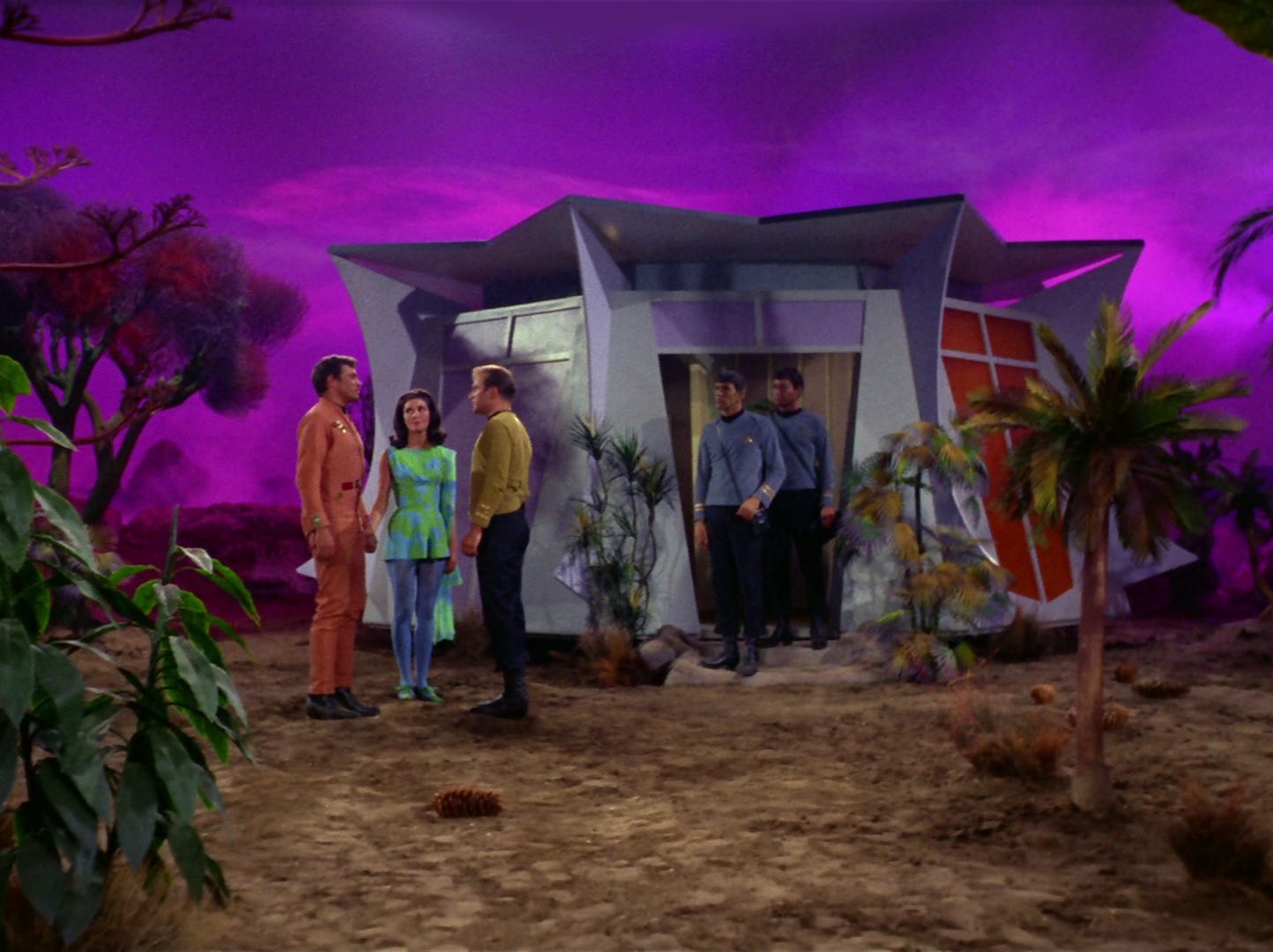
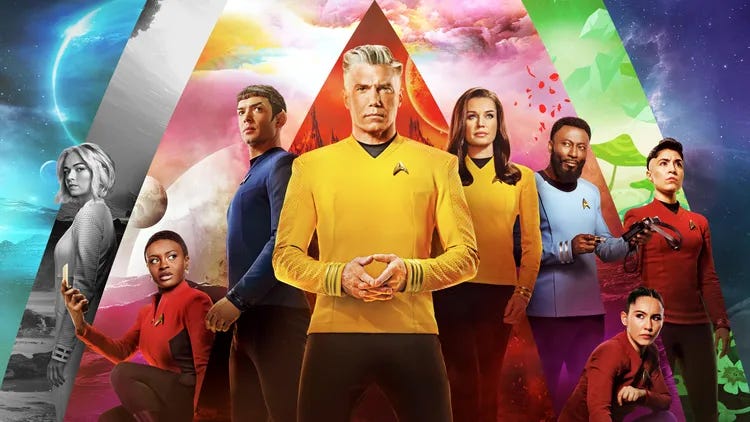
TNG was similarly colourful, perhaps to a milder, more pastel set of colour-grades. Deep Space Nine deliberately darkened its colour-grading, to suit its ‘darker’ storylines. I don’t mean to labour this point, which is obvious enough: the dreary steel and grey colour-palette of Picard was of its era, and one of the things Strange New Worlds has done has brought back the bright primary colours of TOS—fittingly. The SNW sets are a lot more intricate, more expensively made, the visual field a lot busier than is the case for TOS which means we rarely get that splendid Brechtian or Ionescoesque bareness and ostranenie that the best TOS visual representations provide. It’s also why the black-and-white ‘Case of Chiaroscura’ seems so out-of-place.
‘Science fiction is a radically metaphorical literature that aims to represent the world without reproducing it’ as this critic argues.
In the comments to Gerry’s post, Timothy Burke makes the good point: ‘If SNW was going to at least do the referentiality schtick, you'd hope they could do something more metafictional, maybe even "Voyage to a Weird Planet" level metafictional, where the SNW crew starts to wonder why they're reliving so many 20th and 21st Century genres.’ Gerry replies from the coalface of the Trek rumour-mine: ‘To that point I've seen speculation in a couple of different fan spaces lately that SNW may be already (and perhaps has always been) narrating from a position *after* Pike's incapacitation, not before. That is, maybe the final twist is that what we are watching are the television-like fantasies that keep him occupied on Talus IV, not "the real events," which is why they are so formulaic and clichéd, with inconsistent characterization and a bizarre relationship to the canon that actually follows the Pike era. They're his dreams.’ Which, hideous though it is to contemplate, has the smack of likelihood, not least because it would be a way of once again literalising what has been a matter of representational conventions.
‘Giedi Prime, the home world of Harkonnen, there’s less information in the book and it’s a world that is disconnected from nature. It’s a plastic world. So, I thought that it could be interesting if the light, the sunlight could give us some insight on their psyche. What if instead of revealing colors, the sunlight was killing them and creating a very eerie black and white world, that will give us information about how these people perceive reality, about their political system, about how that primitive brutalist culture and it was in the screenplay.’
No posts
Comments
Nothing yet. Say the first thing.
Sign in to join the conversation.