
A post at Late Star Trek’s sister site, r/ShittyDaystrom, provokes us: “How often are you guys updating your funeral recording message? Like if a new regular senior staff member is changed out, do you add them right away, or make sure they are cool first.”
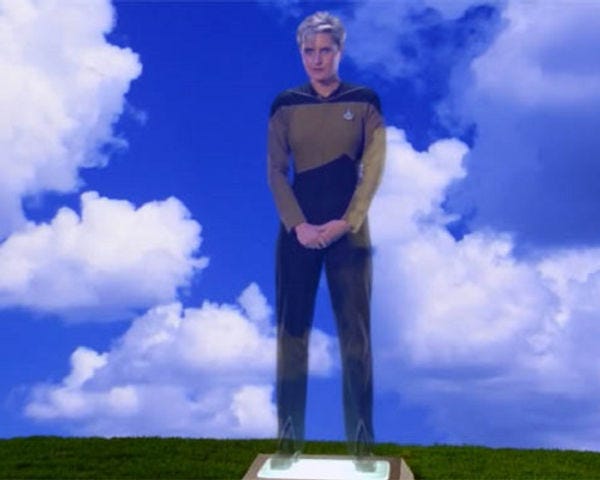
The reference, of course, is to Tasha Yar’s holographic funeral at the end of season one’s “Skin of Evil,” at which she addresses her crewmates for the last time.
“Skin of Evil,” famously, is a pretty odd episode — the first episode to kill off a series regular in franchise history, something that remains relatively rare even to this day (especially in an otherwise by-the-numbers “alien of the week” episode, as opposed to a major two-parter or a series finale). As with most season one episodes, “Skin of Evil” spends quite a bit of time on material that ultimately goes nowhere, briefly teasing a possible future romance between Worf and Yar in the cold open and spending a shocking amount of real estate on extremely minor character Leland T. Lynch, part of the rotating band of alternate chief engineers appearing before the show settled on Geordi for this role. (It’s a bit beyond the scope of this post, but the contempt the show has for Lynch is weirdly fascinating; Picard visibly hates him, and beta canon goes out of its way to make it clear that neither Geordi nor Scotty respect him either!)
Contrary to my memories of the episode, and perhaps yours, once they arrive on the planet where Deanna’s shuttle has crashed Yar is dispatched almost instantly; the timestamp at Paramount+ has her pronounced dead at minute twelve. (The episode gives her a few special musical stings and vaseline-on-the-lens closeups before this, but it’s noticeable only in retrospect, and the meat of the episode isn’t really about her.) Armus himself as an antagonist is wrapped up relatively tidily, too, leaving time for an unusually long epilogue that depicts Yar’s funeral within the holodeck, which is attended by our main characters and exclusively our main characters — raising the troubling possibility that Wesley was among her eight closest friends on the ship.1
Picard says that Yar has asked those gathered to celebrate her life with the above-mentioned holographic recording; we thus see a hologramatic image of Yar providing her own eulogy:
TASHA: Hello, my friends. You are here now watching this image of me because I have died. It probably happened while I was on duty, and quickly, which is what I expected. Never forget I died doing exactly what I chose to do.
Rubbing it in that Denise Crosby quit the show a bit there, I think.
What I want you to know is how much I loved my life, and those of you who shared it with me. You are my family. You all know where I came from and what my life was like before. But Starfleet took that frightened, angry young girl and tempered her. I have been blessed with your friendship and your love.
So far so good: no specifics makes this nicely evergreen content, a one-and-done record.
But then she starts to address the gathered attendees by name:
Will Riker, you are the best. You trusted me, you encouraged me, and most of all you made me laugh. Deanna, you are capable of so much love. You taught me without ever having to say a word. I realized I could be feminine without losing anything.
Okay, season one writing room, settle down.
Ah, Worf. We are so much alike, you and I. Both warriors, orphans who found ourselves this family. I hope I met death with my eyes wide open. Beverly. Your fierce devotion comes from within. It can’t be diminished. From you, I have learned to strive for excellence, no matter what the personal cost. Wesley, I’m sorry I won’t be able to see you grow into the exceptional man you’ll be. But your kindness and innocence are ageless. Geordi, in those moments I felt the most despair, you took my hand and helped me to see things differently. You taught me to look beyond the moment. My friend Data. You see things with the wonder of a child, and that makes you more human than any of us. Captain Jean-Luc Picard. I wish I could say you’ve been like a father to me, but I’ve never had one, so I don’t know what it feels like. But if there was someone in this universe I could choose to be like, someone who I would want to make proud of me, it’s you. You who have the heart of an explorer and the soul of a poet. So, you’ll understand when I say, death is that state in which one exists only in the memory of others. Which is why it is not an end. No goodbyes. Just good memories. Hailing frequencies closed, sir.
To the practical challenge of constantly recording and re-recording such a self-eulogy raised by our comrades at r/ShittyDaystrom we might add a second odd feature of this moment: the hologram speaks to each of the people gathered — who are all still alive, still on the ship, and still on good terms with her — and to only those people. Lucky thing! If she’d guessed wrong who would be in attendance, that could have been embarrassing…
Rick and Morty has parodied this mode of storytelling frequently, with multiple episodes that show Rick recording an seemingly endless chain of “if you’re hearing this, that means…” holograms in anticipation of every possible contingency. The simpler answer here, I think, is staring us in the face, and may very well have already occurred to you: obviously, Yar never recorded this message at all. Given what we see of the strong lack of norms around the digital impersonation of living people in the holodeck — something that would be trivially easy to prevent with safeguards, were it important to anyone to do so — we already know that the people of the 24th century by and large have a very lax attitude towards hologramatic replication, with even sex-based edge cases like Barclay’s pornographic programs and Geordi’s Leah Brahms chatbot treated more like cases of bad manners than like the serious ethical and in some cases legal breaches they would be in our time. The simplest solution to this otherwise insolvable conundrum of how often you record your funeral message is therefore that the holodeck algorithmically produced an image of Yar that said the sorts of things she might be imagined to say in such a situation, and that the crew found this replication acceptable and sufficiently healing. In other words, it’s a deepfake, and they’re all cool with it.
From this perspective some of the oddness of her oration becomes immediately recognizable. It has all the hallmarks of LLM-generated text (including strong positivity bias and even a classic “it’s not x, it’s y” formulation!), with generalities that seem initially profound but actually have little relationship to the people they are actually addressed to. Is Beverly’s defining quality really “fierce devotion”? (For that matter, have we ever actually seen Beverly and Yar speak? Is Crusher only there because otherwise inviting her underage son would seem even weirder?) Does Geordi ever show the sort of emotional intelligence she attributes to him — and how would he really feel about his section of the oratory being two separate puns on his blindness?
What Yar’s oratory reveals is not only the spareness of her actual connections on the ship but the emotional stuntedness of the entire crew, who are seem completely satisfied by this display, and who, even as they silently file out of the funeral five minutes after they arrived, do not seem to realize that they have not mourned and perhaps cannot mourn her.
Data, of all people, hangs a lampshade on this in his closing dialogue: “Sir, the purpose of this gathering confuses me.” And it’s only Data who continues to stand silently at the hologramatic gravesite as the episode concludes, trying to process the true complexity of death and grief while everyone else on the ship has already moved on. More human than any of us, indeed.
Having written this post, I wonder now if perhaps this moment was in the creative background for the creation of the season 3 episode “The Bonding,” which has become somewhat notorious in fandom for Roddenberry’s behind-the-scenes claim during production that children in the twenty-fourth century would have a greater acceptance of death, and would have no particular need to grieve or mourn dead parents.2 The detached and oddly cold behavior of the crew at Tasha’s funeral, that is, is of a piece with a broader ideological commitment to a different, ostensibly more evolved mode of human being that populates the Roddenberry-led years of TNG.
Roddenberry said this during production of “The Bonding,” it turns out, because the original plot of the episode seems to be a sort of unexpected answer to my speculation here that this Yar is a digital recreation, not a real recording. In the original script of the episode, Jeremy chooses to use the holodeck to recreate his dead mother, whereas in the final script this is turned into an alien invasion to make this event nonconsensual and nondeliberate (and thus to sidestep the question of how people in such a digital-first society would handle the temptation of holodeck resurrection3). Whether or not we conclude the funeral’s Yar is really a deepfake, there’s no doubt that the holodeck has the capacity to make precisely this kind of image, and to do it for far longer than a five-minute farewell — and so the question becomes less about whether this technology would be used to short-circuit the typical grieving process and more about why, in a series where hologramatically replicating both the living and the dead is already incredibly commonplace, we don’t see it happen all the time.
It occurred to me while writing this post that the selection of the “series regulars” in season one of TNG seems somewhat unmotivated in light of the other series, where there is typically a more obvious relationship between who is a regular and who is a senior officer on the ship. In this case, neither Worf nor Geordi are especially obvious candidates for “regular” when the show begins, as neither has an especially important job: Geordi’s role at the Conn is quickly doubled by untrained teenager Wesley, and Worf is more or less standing around waiting for a vacancy as head of security to open up. It wasn’t intended — because they didn’t know Crosby would decide to leave so soon — but there’s a retroactive, oddly meta-narrative sense that what ultimately makes these eight specific people the main cast of the show (and not, say, Argyle or Leland T. Lynch) is that these are the eight people who attend Yar’s funeral.
“The Bonding” has also always stood out (at least to me) as one of the most memorable examples of the crew adopting a child who is subsequently never heard from again — and that it’s Worf, the king of the bad dads, doing it is only a bonus.
It’s probably worth noting here that, almost forty years later, a digital resurrection was the rumored plan to back fan favorite Captain Liam Shaw (Todd Stanwick) for Star Trek: Legacy, after the character was killed near the end of Picard — as well as, of course, one of the major plot gimmicks in that foundational Star Trek intertext, Red Dwarf.
No posts
Comments
Nothing yet. Say the first thing.
Sign in to join the conversation.