
Judee Sill may be one of the most unusual singer-songwriters of the California music scene in the early 1970s.
She had talent, skill, and connections. She was the first artist signed to David Geffen’s Asylum Records, the label that became home to artists like Jackson Browne, Joni Mitchell, Tom Waits, and the Eagles. She wrote with the seriousness of a composer, sang with plainspoken clarity, and filled her songs with images of grace, longing, redemption, failure, and spiritual hunger.
And yet, by the time she died in 1979, at only 35, she had largely disappeared from public view. There was no obituary to mark her passing, and even many of her friends had no idea she was gone.
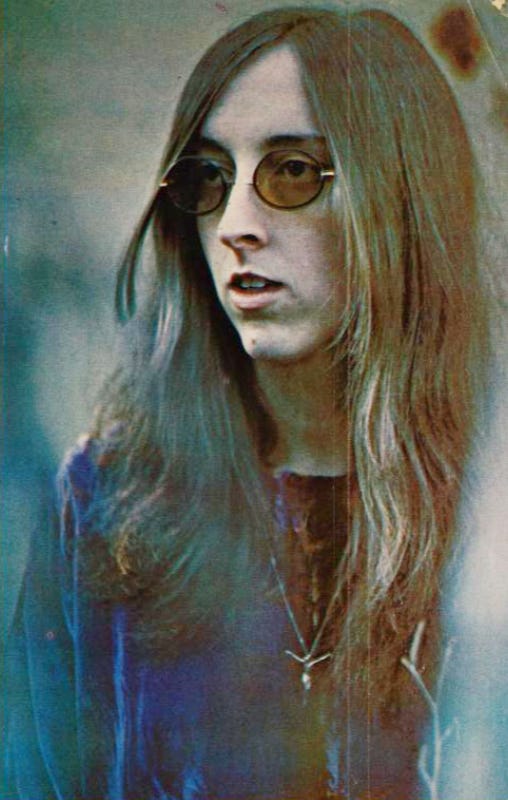
Judith Lynne Sill was born in Los Angeles in 1944, learned piano in her father’s bar, and grew up in a home that became increasingly unstable after his death. During her teens, her life had veered into crime, arrest, and reform school. Still, she never lost touch with music. She served as a church organist and absorbed the gospel sounds that would later find a home in her songs.
Sill once described her style as “country-cult-baroque”, which sounds like something a record company would reject for being too accurate. It really does fit. Her music could include country touches, gospel cadences, folk guitar, classical counterpoint, mystical imagery, and vocal arrangements that seem to float above the earth while somehow staying grounded.
One Pitchfork review suggested her musical spirit had less in common with the standard 1970s singer-songwriter lane than it did with artists like Brian Wilson, Nick Drake, and composers like J.S. Bach. She loved Bach; it showed in her writing. Not in a stiff or academic way but in the way she used the inner logic of hymns, rounds, and carefully interwoven lines.
That’s probably why she was hard to market at the time. She was too folk for classical listeners, too classical for folk listeners, too religious for some pop audiences, and too unruly for anyone hoping to package her neatly. In other words: perfect for being rediscovered decades later.
Judee Sill’s music career briefly seemed headed somewhere big. She sold the song “Lady-O” to the Turtles, crossed paths with David Crosby and Graham Nash, and, as mentioned above, became the first artist signed to David Geffen’s new Asylum label.
Her self-titled debut album, Judee Sill, was released in 1971. Graham Nash produced its best-known single, “Jesus Was a Cross Maker”, a song later covered by such artists as Cass Elliot, the Hollies, Warren Zevon, and Linda Ronstadt (whose version was retitled Bandit & a Heart Breaker).
That should have helped make Judee Sill famous. It didn’t.
Her second album, Heart Food, came out in 1973. This time Sill had more control: she wrote, arranged, and produced the album with Henry Lewy.
The album is often considered her masterpiece. It contains “The Kiss”, one of her most breathtaking songs, and closes with “The Donor”, an eight-minute piece that feels part folk song, part prayer, part requiem, and part private vision.
Commercially, though, Heart Food also failed to break through. After that, her relationship with Asylum deteriorated. A planned third album was started in 1974 but not finished during her lifetime. Twenty-six years after her death, Jim O’Rourke mixed the unfinished songs, which were released as the double CD Dreams Come True.
For a feature song, I chose “The Kiss”. “Jesus Was a Cross Maker” may be the best-known Judee Sill song, but “The Kiss” may be the one that most clearly shows what made her extraordinary.
It is quiet, luminous, and almost unbearably tender. The melody feels suspended between earthly love and spiritual longing. The piano writing has a formal beauty, but the song never becomes cold or showy. It feels intimate, as if someone is trying to describe a sacred experience without breaking it by speaking too loudly.
It is impossible to write about Judee Sill without acknowledging the painful parts of her life: addiction, trauma, legal trouble, injury, disappointment, and an early death from a drug overdose in 1979. But I don’t want to reduce her to those things.
Suffering may have shaped Judee Sill’s music, but it did not write the songs for her. Her craft did. Her intelligence did. Her ear did. Her spiritual imagination did.
The tragedy is not that she suffered and therefore made beautiful music. The tragedy is that she made beautiful music and so few people heard it while she was alive.
Over time, Judee Sill’s reputation has grown. Her two studio albums were reissued, unfinished recordings and demos were released, and a documentary, Lost Angel: The Genius of Judee Sill, helped bring renewed attention to her life and work. The documentary includes interviews with people who knew or admired her, including Linda Ronstadt, Jackson Browne, David Crosby, Graham Nash, David Geffen, and others.
She is also one of those artists whose influence is easier to recognize in retrospect. Her music does not sound dated. It sounds oddly current: searching, wounded, intricate, spiritually restless, and uninterested in easy categories.
She reminds us that obscurity is not the same as failure. Sometimes the world simply takes too long to catch up.
Wikipedia
YouTube
Article in American Songwriter
Spotify
🎶 Spotlight No. 64
If you know a singer-songwriter who’d be a great fit for a future spotlight, ask them if they’re interested. If yes, click the button below and let me know.
This newsletter is completely free—no paywall, no catch. If you’d like the next issue delivered to your inbox, just hit “Subscribe now” below. When you see an invitation to make a pledge of money, click “No pledge”. This is a free newsletter.
Thanks for reading—and for helping shine a light on under-the-radar brilliance.
Disclaimer
All biographical details and quotes in this post come directly from online sources. The thoughts and opinions shared are those of the original authors. I use AI tools to help organize information and smooth out the writing, but every spotlight is personally curated, shaped, and approved by me. Songwriter Safari isn’t responsible for the accuracy of submitted details or the availability of external links.
Comments
Nothing yet. Say the first thing.
Sign in to join the conversation.