
Imagine for a moment something that you cannot truly imagine: Instead of the three-dimensional being that you are right now, you blink your eyes and suddenly you are two-dimensional. Or maybe you were born and your whole existence has been two-dimensional. However it happened, you’re not three-dimensional. We call those three dimensions length, width, and depth, or if we get really mathematical about it, we describe three dimensions with three axes. If you’re two-dimensional though, you just… don’t have one of those. It doesn’t even matter which one is gone, because it just means you are a completely different entity that cannot perceive or understand that third dimension. You can’t even fathom that there is a third dimension, because you’re just not built to notice or understand a third dimension.
This is kind of what prediction generation machines are compared to us: metaphorical two-dimensional entities that are simply not at all like three-dimensional entities. In AI and humanoid robots, prediction generation is the combination of complex algorithms that have access to compatible tools and are trained on tremendous amounts of data to provide responses and behavioral output meant to please three-dimensional entities. It’s not a perfect comparison here, because obviously AI and humanoid robots are not two-dimensional nor truly entities with intelligence or understanding, but it does fit with the shape of what still goes wrong with AI and humanoid robots, which is that humans are expecting prediction generation outputs to please them in spite of the giant limitation that prediction generation is not inherently going to be the most desirable result.
I’ve talked before about the “toy on the stairs” example and I’ve described the awkward, lackluster and kind of “off” demonstrated behavior of Figure when it put dirty dishes into a dish drying rack directly, even though there was no washing and no drying to be had and the dishes and the drying rack were nowhere near a kitchen where they would truly belong. In these examples, I focused more on how executive function is required to really get things right. Of course, it would be fantastic if prediction generation machines were completely something else and were able to develop executive function as we know and utilize as humans, but it’s important to recognize the difference and how that creates results that may be acceptable or even seem impressive at first, but as tasks become more complicated, it can become more clear that the prediction generation machine’s output is subpar.
One tiny little “disclaimer” before I get into it more is that I don’t think that prediction generation machines are barred from being useful or capable in plenty of ways. It is still, however, very important that we recognize our own anthropomorphizing and emotional responses to the output of prediction generation machines. It is very easy for humans to be excited or impressed by a robot that does something cool looking, but that does not mean that everything that sparkles is gold. When we’re training and designing and adding tools to our prediction generation machines, we need to constantly and discerningly ask ourselves what it is we want those prediction generation machines to be. Then, we must assess the results by considering, “Do we want this?” and, especially importantly, “Should we want this?”
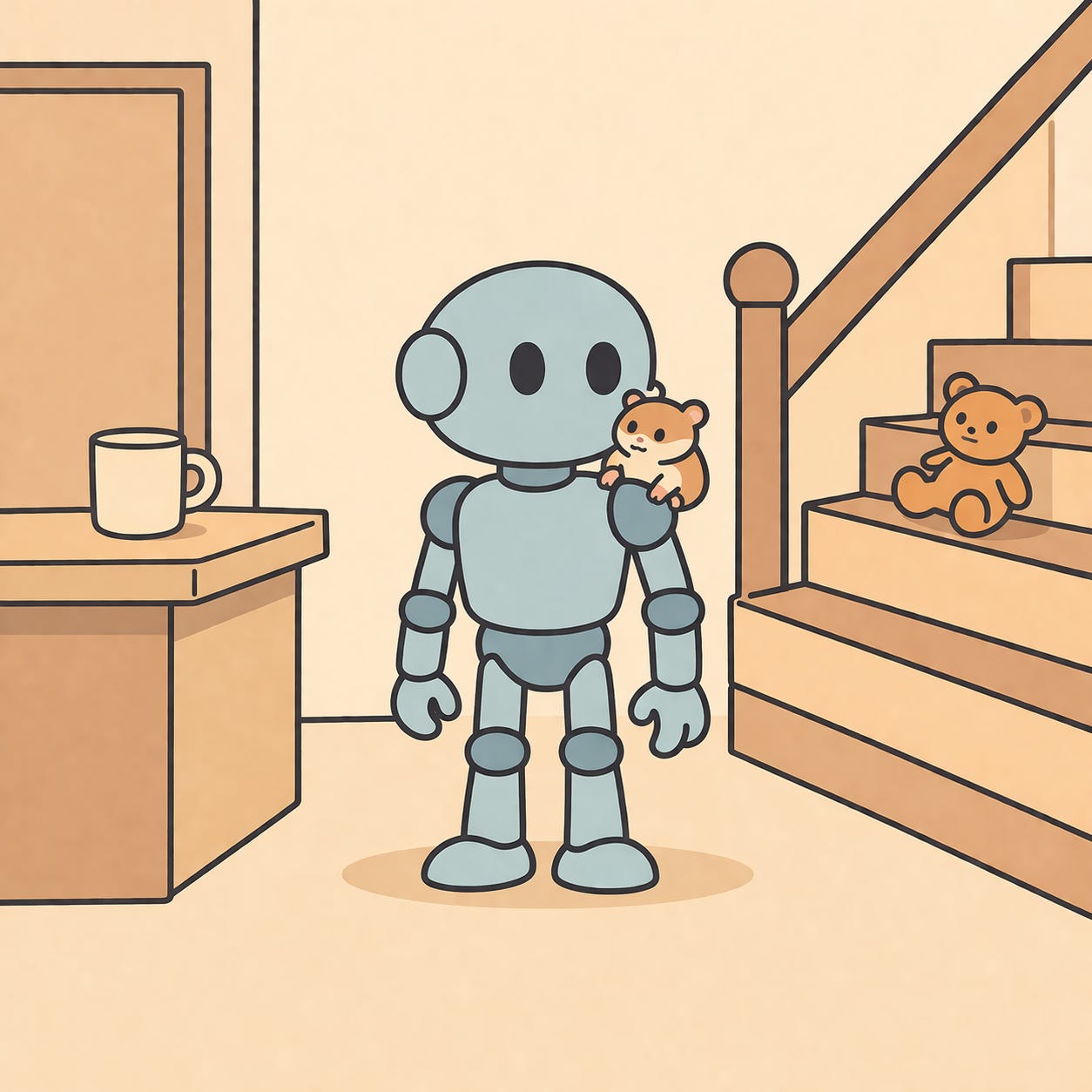
We’ve had the “toy on the stairs” scenario before, but today, let’s meet “the cup with liquid in it.” When a human enters a space or simply notices that there is a cup with liquid in it, a human (hopefully) has a number of thoughts about it. We might think to investigate and decide what the liquid in the cup is, check whether the cup is cold or hot, consider what we know about other actors in the surrounding space such as whether someone simply moved out of the room for a moment and is returning for this cup or is actively in the room or space and simply out of arm’s reach of the cup, or assess that the cup is in or next to the sink for cleaning. The base assessment from a prediction generation machine is to take in the environmental information that there is a cup first, then probably next seek to discover if the cup is empty or not, and without significant cup-related training, a household humanoid robot meant to clean the house will likely next decide whether to leave the cup alone or clean up the cup and any liquid contained in it.
The “cup with liquid in it” is very low stakes. If I’m in the house with the household robot and I leave a cup with cold water in it at my desk or kitchen table while I go answer the door or go to the bathroom for a minute, returning soon after, I would be a little annoyed if I returned and the robot had emptied the cold, fresh water into the kitchen sink and washed the cup. However, even in my annoyance, the robot didn’t clearly “fail” here, because it is cleaning up the space, which is a main purpose. If I left a cup with a few drops of water on the bottom sitting in the basin of the kitchen sink and the robot ignored it, I would also be annoyed, but the robot still might not cleanly “fail” in this scenario, either, because it might be waiting to swap the dishes from the full and currently active dishwasher or it’s dealing with the water I spilled all over the floor moments prior to putting the cup into the sink.
In the “cup with liquid in it” scenario, just like the “toy on the stairs,” there are many possibilities. The cup might have medication, a supplement, or even simply an expensive-to-make fresh drink in it, so dumping it out is not truly the “right” choice. Prediction generation machines can “learn” from training data how to distinguish liquids in a cup and to incorporate known things about the users in the household, such as already knowing that a morning coffee is still quite fresh if the unattended cup exists at 7:22 a.m., only minutes after the user has made it. Prediction generation with this type of training can usually handle this sort of scenario and start producing desirable behavior for the user.
If a robot finds the cup with liquid in it and does nothing, unless the liquid came from a deeply careless mad scientist and it is about to explode, the outcome is likely acceptable. The cup might not be cleaned and put away and it might not be the most desirable result to a user if it’s sitting out of place somewhere, but almost certainly nothing bad happens, which is generally an acceptable result. Much like Figure and the dirty dishes set right into the dish drying rack, though, acceptable might still appear strange. The robot cleaning up the cup when someone wanted it left alone is still arguably acceptable, because, again, nothing particularly bad happens and the robot is still doing its function of cleaning. The result is undesirable, but, grudgingly, acceptable. This means “acceptable” and “desirable” are not mutually exclusive. If the robot finds that cup, assesses that it’s the user’s favorite morning coffee drink with all the sugar and milk (or whatever, I don’t drink coffee, but insert some fancy favorite drink making method here), recognizes that it is still hot and fresh, assesses that the user is dealing with an important phone call in another room or answering the door or engaged in some other distraction, and then brings the coffee to the user’s usual coffee intake spot, like at a desk in a home office, then the robot has done something “desirable” and “acceptable.”
The “cup with liquid in it” is a very simple scenario. It’s practically guaranteed right now that a humanoid robot that discovers a cup with liquid in it will perform an acceptable behavior. It’s too simple with hardly any behavior that would be unacceptable. The robot is highly unlikely to take the cup with liquid in it and fling it across the room, or pour hot liquid on a human, or intentionally spill the liquid on itself and create an electrical hazard. These would be obvious unacceptable behaviors, and in the narrow world of “cup with liquid in it,” we’re pretty firmly past absolutely terrible outcomes for such simple tasks. The “cup with liquid in it” scenario is arguably much simpler than even the “toy on the stairs” problem I’ve discussed in previous parts of this series. However, even the “toy on the stairs” problem has many acceptable results that are likely, but don’t necessarily mean a good, desirable result. The toy being removed from the stairs, no matter what happens next, is almost certainly an acceptable result, because now a hazard has been removed from the stairwell. If the toy is a favorite toy but the robot throws it in an incinerator to remove the hazard, that’s certainly an undesirable result. The toy is still a lower stakes scenario, but a toy might be more expensive or have more value than a single consumable drink, so it is slightly higher stakes than the liquid in the cup.
To really think about the difference in what prediction generation machines are able to do and our expectations of their behavior, let’s find a higher stakes scenario. Your beloved, living, breathing, escape artist pet hamster has begun chewing its way through a metal bar in its very large and comfortable habitat seemingly just for fun. Little Houdini has stuffed herself just barely through that chewed bar and is outside the cage, bleeding and struggling to breathe because hamsters aren’t meant to eat metal bars and she scratched herself pretty badly as she slipped through. She isn’t running loose, but she is in obvious and immediate danger. Unlike with the cup and the toy, there are a lot of very unacceptable and undesirable responses that a robot might do. If the robot ignores little Houdini, she might die (actually, she probably dies, because hamsters are very resilient until they aren’t, so time is critical). If the robot recognizes that Houdini is out of her cage, but not that she is in great distress, it might return her to her cage only. If she weren’t in distress but simply loose and the robot returns Houdini to her broken cage without repairing the cage, even temporarily, or putting Houdini into a different and safe enclosure, this is also unacceptable and undesirable, because Houdini is just going to get loose again, and possibly hurt herself this time. If the robot recognizes that Houdini is out of her cage and in life-threatening distress and then alerts her human, this is finally acceptable but not necessarily desirable. Houdini has a chance at this point, though. The most desirable behavior from the robot discovering Houdini like this is that the robot carefully gets Houdini into a travel carrier, figures out which emergency veterinarian she can be taken to at this hour, and simultaneously or nearly simultaneously alerts her human so that the human can take action. If Houdini’s human isn’t home to take Houdini somewhere, another desirable behavior would be for the robot to contact a veterinarian and ask for help. Hamsters need experienced small animal veterinarians, not regular dog and cat vets and not livestock vets, so this would also be an important part of a desirable outcome. This is a much more complicated, high-stakes scenario and poor little fictional Houdini is very affected by the household humanoid robot.
Closing the gap of acceptable but undesirable behaviors takes patience and understanding from the users of these prediction generation machines. Our prediction generation machines can only ever be prediction generation: they can’t think like we do and never will. They can get better and better at prediction generation so that drinks are not wasted, homes are not left with scattered messes, and little hammie Houdinis have the best chances of surviving an escape gone wrong. Prediction generation can’t ever reach a perfect-world level of behavior, nor will it ever be truly, deeply like a human, but there is plenty of room still to get a lot closer in many ways. We need to patiently provide the training for more and more complicated and uncommon scenarios to reach towards more robust and likely responses from our AI and humanoid robots.
No posts
Comments
Nothing yet. Say the first thing.
Sign in to join the conversation.