
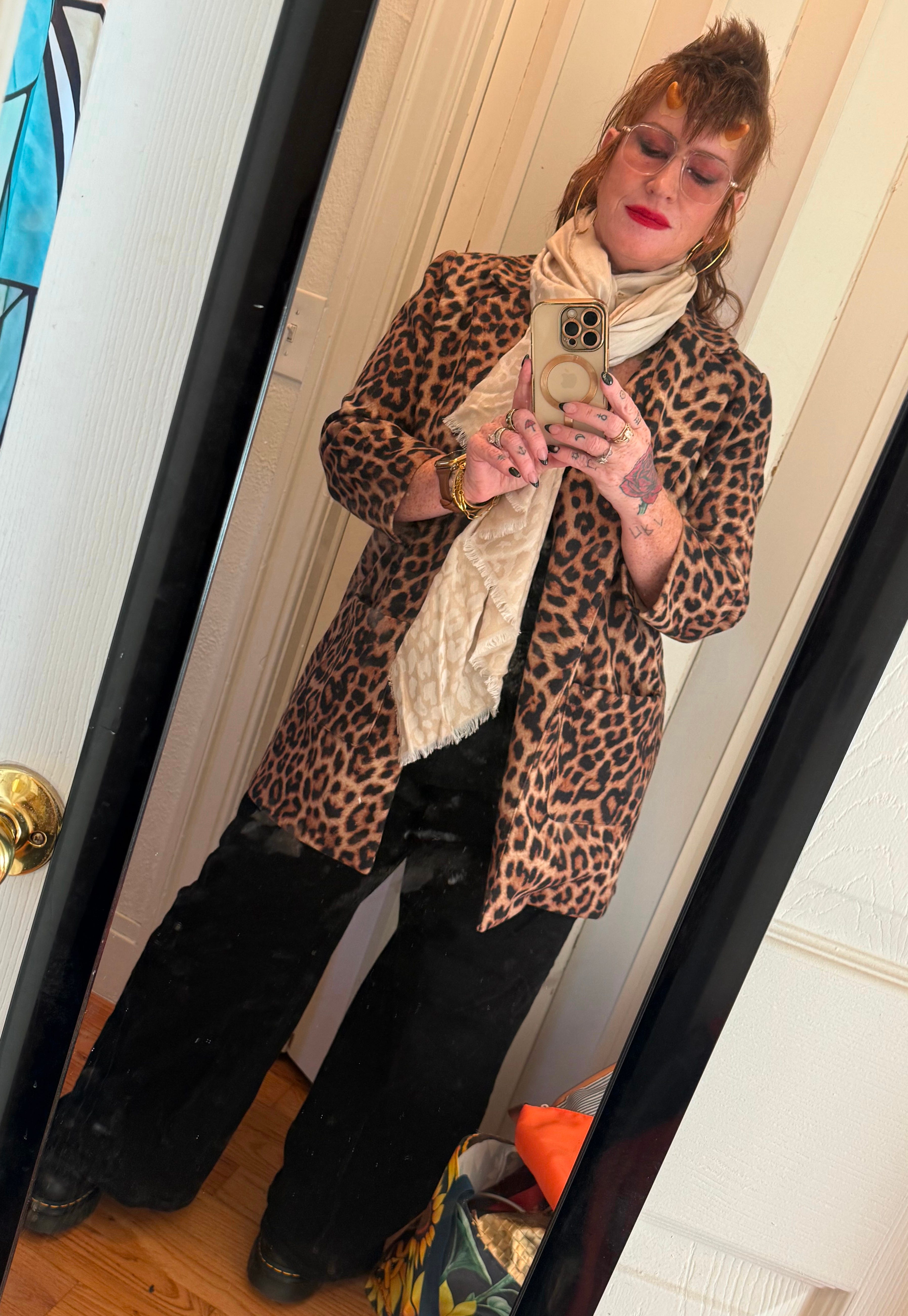
This year, for Halloween, I decided to attend a networking event with horns and a leopard print jacket on. I went as “the devil you don’t know.” I was new to the space, didn’t know a soul, so it made sense in its own funny way.
However, the deeper reasons were also present: I was entering into a space I didn’t know. I was working on a slow process of stepping away from a space I know intimately.
A truth I’m facing is, sometimes the devil you don’t know may be better than the devil you do.

As folx who have experienced trauma, we love to stick to the known–even when the known invites further trauma. As folx with certain types of neurodivergence, we love predictability, known patterns, foreseeable outcomes. We may find comfort in the areas where we know in advance what’s coming at us, even if what’s coming is a fist, or a rough word, or an undercutting of the ground we stand on.
We may stay in the space of the known even when we know we are courting more of the same.
Those areas of predictability can easily become hobbles.
What of the moment when we realize that perhaps anything is better than the predictability of continued trauma?
This statement is risk-aversion in a folksy wrapper; no matter the cost, stay with the predictable. You never know what challenges the unknown holds. At least you know you can survive the things you have already survived, in many cases, again and again.
This mentality is, in extreme cases, some part of what keeps folx in situations of intimate partner violence. In less extreme scenarios, it may keep us in settings–career, social, religious or spiritual–that are actively eroding our sense of self.
Many of us rationalize; it’s not that bad, I’ve been through worse, or that old chestnut, “I’m not a quitter!” We stick with it because we are taught that having grit is a more laudable personal designator than practicing self-preservation is.
However, the fact of the matter is that the physiological impacts of stress land in the body the same way whether the stimulus is a sustained threat of violence, a sustained threat of loss, or a sustained threat of interpersonal conflict.
And, this is doubly true for survivors of trauma. Those of us who have systems that easily go to eleven on a scale of 1-10, and have a harder time finding basic homeostasis in a more chill environment, will find ourselves gravitating to the upper registers.
The devil we know actually lives within our very nervous systems, a puppet-master, rigging the game toward the foreseeable need for system jolts to feel normal. To feel “in control.”
Share Lasara Firefox Allen, MSW
Yesterday, I found myself watching a TEDx talk by a career coach who coaches high-performing executives. She was discussing burnout and linking its occurrence to unaddressed or unresolved trauma. Her hypothesis was that even minor traumas (or as she coined them, “everyday traumas”), when unresolved, can result in symptoms of burnout.
This was a new thought for me. I had never really linked the two together before. But upon reflection, it made sense; my experience of burnout is heavily tied to my experience of system overload, which is directly influenced by my systemic response to trauma-triggers.
And the kicker is, until we resolve our traumas, we are more likely to seek out reiterative experiences of them. We seek, again and again, the devil we know; the angry father, the passive-aggressive mother, the violent or withholding spouse–or variations on the theme.
Homeostasis is homeostasis, after all. The known is the known. Better the devil you know.
I have been seeing an osteopathic chiropractor for a few months now. Her work is designed to reach into the nervous system and rewire it. At my most recent session, I realized that, after years of trying method after method of trauma recovery, of course, the body is the doorway I’ve been looking for.
I slowly feel myself unfurling, softening the holding patterns, releasing the clenching in my hips, my gut, my chest, my jaw. A novel relaxation is finding its way up my spine, via my nervous system.
I can see this healer because I have enough credit to put it on my not-so-slowly growing credit card.
I do see this healer because I know this genre of work is effective for me. I see this healer because I know that the outcomes of my ACEs, plus the impacts of things I have done in my life to live with them, spell an early demise. And if I’m not careful, I now know, that will likely come from too much wear-and-tear on this loving heart.
It’s an imperative; I need to soften.
There is no virtue in self-abnegation. No virtue in struggle for struggles sake. As we all know, all too well, there are areas of struggle that will come to meet us. But maybe we don’t have to build struggle in as the baseline?
This is one of my most hard-won insights (not that I’ve solidly won it, yet): in this body of alarm bells and sirens on standby–when they are not ringing incessantly–softness is novel. Fight or flight is all sinew and muscle tension, always at the ready to jump into action at the slightest provocation.
Softness is unguarded, open, present. Softness is also electric at the edges, for me. Vulnerable. Softness, when I sink into it, still feels like risk.
I am doing the hard work of reformatting my hardwiring.

So I walk this new path–not even a road yet, kind of a thicket if I’m being honest, but I’m pretty sure I see a clear road ahead–with a devil, hand in hand.
I’m wagering that as I get to know her, I just may find she’s a goddess in disguise.
It’s not that bad, she said
as her eyes fell out of her head
We continue walking
the known road
never branching off for the
road less traveled
until a slide takes out the road ahead
a tree falls
sometimes crisis
is opportunity
we just need a
crash!
bang!
disaster
to get us to the unknown road
Or we walk with the devil we know
all the way to a hell
of our own making;
never having seen the forest
for the trees
Maybe the devil you don’t know
isn’t really all that bad
No posts
Comments
Nothing yet. Say the first thing.
Sign in to join the conversation.