
Throughout the previous nine parts of this series, I’ve put forth many examples of the photochemicalphilia that has gripped the movie industry for almost 15 years. It’s incumbent upon anyone who is espousing a strong hypothesis to try to disprove your own theory.
I have “already done this” in the sense that my background in filmmaking and filmgoing, starting in the mid-Seventies, only concerned film. As late as 1999, in a column for Mix magazine titled “In the Year 2025,” I wrote about how film was still it, and how nothing electronic came close in terms of camera and projection image quality. (I had ceded the field of sound to digital, and in these here Substack pages stay tuned for another multi-part series on photochemicalphilia, this time for the last plateau, archiving.1)
That opinion would change rapidly in three stages spread over the next eight years. The first one was at the turn of the century with the evolution to digital finish via a DI, followed closely by the introduction of DCPs in 2006 and finally the superb file-based cameras by RED the next year.
By 2012, with the beginning (shooting) and end (projection) in the digital realm probably in the 80th percentile, and the middle (a DI finish) at 99.9%, photochemical film was on life support. You could say “almost literally” because Kodak had just filed for bankruptcy protection. (This transition was all covered in parts one and three.)
Thus the trail of tears of this Substack series of mine, tracing as it does how the 70mm releases of The Master and The Hateful Eight have evolved in recent years to the FILM! P.R., for movies like The Brutalist, Oppenheimer, Sinners, and One Battle After Another, rendering most moviegoers and filmmakers unable to resist. This has all led up to the release today of Christopher Nolan’s new movie, the recently retitled The Odyssey Filmed Entirely in IMAX.2
I hope that I’ve made the case for looking askance at photochemicalphilia and why there’s no meaningful technical reason to support the use of film either in shooting or projecting a theatrical motion picture. When you get past metrics in technical matters, discussion about how they affect the art almost always ends up in hoogity-boogity pretense.
Okay, then, why is film still hanging around like the guest who wouldn’t leave? When it comes to cinematography, I believe that it comes down to ego that manifests itself both as macho preening and sad masochism.3 Before we go there, let’s count the benefits of shooting digitally. This list is far from original, because the reasons are self-evident and universally known.
First, digital is cheaper to use, and this means that, in sidestepping film, the producer and director can4 push dollars into other parts of the movie that might need it. Another day of shooting? Pay the crew more? 5 (This is trimmed down from the worst-case iteration I wrote in part seven that was a mash-up of the cost of Christopher Nolan’s recent movies, which I’ll call The Odyssheimer6.) Herewith a list for a normal movie shooting 125,000 feet of 35mm 4-perf film:
Cost of testing (always greater with film than with digital): $5,000
Cost of stock (125 x $975/1,000-foot roll of 5219): $122,000
Cost of processing (125,000 x $0.20/foot): $25,000
Cost of scanning negative at 4k for dailies (125,000 x $0.24/foot): $30,0007
Cost to make proxies, archive data to LTO: Allow $8,000
Cost to dust-bust negative during DI8 (150 hours @ $100/hour): $15,0009
This $205,000 I consider a minimum surcharge as everything listed above is somewhat mandatory. Point Counterpoint: I showed these numbers to a producer friend of mine who said, “Yeah, but with digital you have the extra cost of a DIT (Digital Imaging Technician) salary and their sometimes-expensive equipment.” To which I said, “That might be true, and the data wrangling part of their job is certainly important, but data security is the digital version of a film loader.” Beyond that, I’m somewhat mystified about the true need for a DIT. For starters, you can use the camera as the source of the display LUT,10 and the idea of (here’s the “n” word again) needing to go further and have full color correction available on-set makes me hurl. As do video villages with 10 people sipping lattes weighing in on the performances, not to mention the contrast. (“What do you say, Amanda, a little less negative fill?”) Help me, Jesus. No one in their right mind would say that said villages are essential parts of the filmmaking process.11
Each of the following film surcharge items is optional, depending on desires and where you’re shooting:12
Cost to transport the stock to location
Cost to transport stock to the laboratory
Cost for fancy processing: push/pull/bleach bypass, etc.
Cost of scanning negative again at 4k (if not done at that resolution the first time)
Cost to make dailies prints
Cost of projection (if you print and want to project dailies)
Second, digital is much easier to use, in many ways:
The cameras are more compact and flexible.
Longer camera run times. (See below before you jump at me about the Alleged Downside of this.)
You know you’ve got it, or not, right there and then. On a sharp, calibrated monitor.
The effective ISO/ASA is orders of magnitude higher, with richer blacks. Shooting large night exteriors on film? Barbaric and sometimes very expensive, adding to the film-shooting surcharge in leaps and bounds.
You can selectively mimic the look of film, with many options. (See below for more, um, granularity on this.)
These assume you’re shooting in 35mm with a normal, small, fantastic camera like a Panavision Platinum or Millennium X2. But if you want to put on a pith helmet and go on a cinematic archaeological dig (VistaVision) or to be able to get Christopher Nolan on the phone so he can dispense 15-perf wisdom (IMAX), well, those ridiculous options I’ve written about ad nauseam in this series.
Second, let’s look at the look. One could say that film is worth the extra money and trouble because of the feel of it. Analog. Human.13 Not-digital. This is a fair goal and film would seem the only choice if there weren’t many options to add grain, texture, and you-name-it to a digitally captured and finished image. This transformation is done to taste in the calm of the DI suite in post-production.
My initial contact with commercial solutions to this problem was LiveGrain, which the founder, Suny Behar, demonstrated for me at length back in 2019. (I believe its first use dates to 2015, which is a year after its initial patent application.) I am in no way claiming that LiveGrain was the first company to do this, only when my eyes first saw the process.
And I was blown away by its ability to simulate not just a specific camera stock, but what would happen if it was push (or pull) processed. Or, comparing and contrasting the grain resulting from normal 16mm vs. 35mm pushed a stop. Quite impressive.
The past decade has seen many companies introduce either standalone applications or (more commonly) plug-ins for programs such as DaVinci Resolve and FilmLight Baselight. The various “rheostats” give the user unlimited abilities to tweak the image to a ridiculous degree beyond basic color—saturation, halation, gate weave, bleach bypass … I’m not going to attempt to laundry list all options, but the number of sliders that go from zero to 11 (or from -11 to 11 if they span a “0” null point) are endless.
Whenever I hear someone say that a certain sound in the mix is like a “sound effect,” I know what they really mean. Of course, it is a sound effect—it ain’t dialogue or music. They are trying to say that it sounds like a library effect, doesn’t feel organic or natural, or part of the scene.14 Film emulation programs are a loaded gun for the imaging in this respect, giving directors and cinematographers that ability to pull audiences, consciously or subconsciously, out of the movie, having twisted five-too-many “knobs.” Or at least that happens too often to my eyes.
Sidebar: Over 15 years ago I was chatting with a colorist buddy who had just worked on a movie by a director friend of mine. I gently asked why the movie looked so flat and uninteresting, something he would genetically be incapable of doing on his own. The answer was a sigh, followed by something I was unaware of: Many young DPs and gaffers are so enamored of the control during the DI process that they intentionally light flat, expecting to “dodge and burn” the image like they were Ansel Adams printing Moonrise, Hernandez, New Mexico. This is so wrong in so many ways, and let me just say that this approach is one of the most egregious examples of the misguided “fix it in post” attitude.15 In this example, no matter how many power windows they create, it won’t look better than if they had taken a little more time shooting. In fact, it certainly took more time to light it flat than it would to use only practical lighting. Help me, Jesus.
Aside from LiveGrain, among the best-known top-dollar options are Dehancer, FilmBox, and Genesis. The latter is notable because its braintrust includes Steve Yedlin, who is renowned for his resolution demos that soberly pick apart many myths about what is really important in imaging. The comparisons of the Alexa 65 to both 35mm and IMAX 65mm 15-perf film is nothing that you can un-see.
There are many less-expensive options, sometimes included with color timing software, so there’s no need for me to list what you’re a keystroke away from finding out about on the internet. The one you can afford and which gives you the look you want is the best one for you.
Not only am I not going to attempt to rank or compare the above-noted film emulation options, I know that you might ask: Why emulate film when you can do it for real—Film out from the graded file and scan that back in to use in the finishing of the DI. You can, and many facilities have done this. The best-known formal “process” is Shift AI (for “Analog Intermediate”—clever) at FotoKem.16 You have probably already seen it on movies such as Project Hail Mary, Dune, and The Batman, among many others.
With Kodak’s catalog available like an all-you-can-print Pancho’s Mexican Buffet, the exact path and number of generations is wide open to help filmmakers put film back in their film. Just go out to a negative (fine-grained pre-print emulsion? camera stock?) and scan that back in? Or make a print from the negative and scan that? The options and cost therefrom are extensive and limited only by your imagination and pocketbook. (And the awareness that each film generation is softening the image.) They can even incorporate variations into the film-out process on the way to prints.17
The cost to do this is admittedly18 expensive, and is halfway to the old J.P. Morgan quote: “If you have to ask how much it costs, you can’t afford it.”19 It appears that Shift AI can do one trick that can’t be done with any piece of software—(mis-) adjust the shutter timing during the film capture. I read about this in an American Cinematographer article about Project Hail Mary and how they created the look of the Earth flashback sequences. (Anyone please correct me if this can be achieved “in the box” without jumping the rails to Rochester, New York.)
There is one specific downside (outside of cost) to Shift AI and the film out/scan back in approaches: You’re stuck with what you get and although you can twist knobs further as if doing a DI from scratch, there’s only so much you can do before having to re-do it.
Regardless of how you do it—software-only or with an analog intermediate—there is no doubt that you will achieve a result that even the most experienced and sharp-eyed imaging expert would do better tossing a coin than to guess what is live (film photography) and what is Memorex (digital photography presenting as film). The fact of the matter is that, even with little attempt at emulation, a digitally shot image is often fairly indistinguishable from scanned film. The great cinematographer Roger Deakins has said, when asked how to make digital look like film: defocus and add grain.
Again, I ask, why are people shooting film, much less large formats?20 And, taking it further, large formats for television—the Ryan Coogler-helmed X-Files reboot pilot and some shooting on Euphoria season three were done on 65mm film. The mind reels how the director and the studio charted the cost/benefit histogram of this approach. Shooting in 65mm is being connected to the idea that they might show the pilot in theaters; this doesn’t make a lick of sense.
The only use of film I can see is to teach film students the classic process, if only the pit-in-the-stomach pressure of “did we get it?” (See the end of this part for a word on Super 8.)
These days there is a certain cachet associated with all-things-analog21, with the Beatles and the Stones of this genre being film (motion picture or still) and vinyl. Just as the vinyl-, tube-, and otherwise placebo-worshipping audiophile industry could not exist if humans were incapable of snobbery or pretension, so does the land of photochemicalphilia rely on not just these forms of elitism, but also another duo: macho and masochism. Macho is an easy one to explain; it’s much tougher to shoot or project film than its digital equivalents. It intertwines with ego because it separates one from the digital hoi polloi.
In shooting, to start you have to load film on the magazines in changing bags,22 and at the end of the day seal everything up to go to the lab, where fastidious camera reports that match clearly legible slates are necessary.23 (They’re needed for digital, too, but not to the same degree.) But the important parts concern not only getting the correct exposure, but also dealing with the much-lower ISO ratings of film, requiring more attention to simply getting an exposure.
Macho transitions to masochism when dealing with the above-noted ideas that you don’t really know what you have until the film is processed and scanned (or printed). That you walk away from the set not knowing only that you might have screwed up, but also if the film was X-rayed in transit or something happened in processing … all of this qualifies for masochism because it doesn’t have to be. Mr. Deakins has spoken frequently of his desire to get a good night’s sleep when shooting a movie.
Film projection also checks the macho box big-time because it is much more involved than digital projection, which can be as simple as hitting “play” on a server. It’s insanely complicated24 and of course I understand and respect why old-school projectionists (and theater technicians who keep everything running) are threatened by DCPs. They (and cinematographers) can talk all about how tough it is to deal with film, but like Tommy Lee Jones tells Harrison Ford in that great moment in The Fugitive: I Don’t Care. This is all separate from how it looks and all things being equal, in 2026, digital is going to be superior.
The first time I really saw digital projection (I’m excluding the 1999 Star Wars Episode I screenings, or any ad-hoc attempts that followed in the next few years) was in summer 2004 at the old Hollywood Pacific theater (née Warner Hollywood Theatre) that had been turned into a test lab by the Entertainment Technology Center to arrive at standards for the Digital Cinema Initiatives program.
I saw the StEM (Standard Evaluation Material) movie that had been made to assist in testing. Looking at it projected in a butterfly mode (film on one side, with the other side being the same material projected digitally, but flopped), most of the test I gave a slight edge to digital, but a time or two I thought the film was a bit sharper. The caveats are important to note here: First, film at that point in the 21st century was as mature and as good as would ever be. Not just the know-how at the lab, but also the fact that Paul Rayton was at the projector, a tweaked Kinoton. Digital scanning, finishing, and projection were still in their relative infancy—remember that the DI process was effectively less than four years old. Oh, and the projector was an early generation DLP 2k. Today, digital cinema has been around for 22 more years, and the problems with film projection are still here, as they always have been and will be, and are only getting worse as equipment gets old, while projectionists and skilled maintenance techs slowly disappear.
Of course, when talking about the macho of film projection, I’m referring specifically to the act of projecting as opposed to having one’s movie projected on film. Any knucklehead can requisition that a print be made. It blows me away that people will spend money to go the cheap and dirty film route—direct-to-print from a digital file on a Cinevator—all to be able to screen at a theater owned by Quentin Tarantino.25 Yeah, it gets you on a film projector, but sadly some people think that it’s also a form of archival protection of their movie.
Anyone wanting to see further proof of the projection subset of photochemicalphilia need look no further than YouTube, where there are dozens of examples of projection porn. A few just include seeing film in shipping containers, while you can feast for days on ones that rock you out on the threading of projectors. I could go on and give my dear readers a Whitman’s Sampler of these links, but I give up. Do it for yourself and let me know the silliest.
But if it’s a print you want, quién es más macho than the one that clocked in at 600 pounds and 11 miles long, the metrics bandied about for the Oppenheimer 70mm IMAX prints.

You might ask me: Why do you care about this so much?
And my answer would be that I have great love and affection for motion picture cinematography, having studied the art, techniques, and history of it for 50 years now. I was very fortunate, when working with Steven Soderbergh starting with sex, lies, and videotape and continuing for almost 35 years, managing the budgeting, scheduling, and technical matters of post-production, be they for sound, imaging, or archiving. A wonderful school for an autodidact.
I feel that both this empirical experience and thought-study have given me a good appreciation of not just what looks good, but also how the imaging sausage is made. As obsessed as I might seem with the arcane technical matters—I’ll challenge anyone in the Jeopardy! Widescreen Projectable Image Area Trivia Edition—I’m confident that I never let those matters influence my taste in the art. Church and state, advertising and editorial, without fear or favor.26
In this regard, it’s interesting to note that my favorite examples of cinematography (for dramatic features)27 all happen to have been shot with the Runt of the Widescreen Litter: 35mm 1.85:1. No other professional format has such bad metrics in terms of image enlargement to the screen.
Yet that didn’t stop Francis Coppola and Gordon Willis on The Godfather Part II (as they had on the original) and Warren Beatty and Vittorio Storaro on Reds. I remember seeing Reds on opening night, December 4, 1981, at the National Theatre in Westwood in a show print that years later I realized was the first use of the ENR silver retention process developed at Technicolor Rome. The images were so rich and beautiful that I couldn’t believe it. I didn’t want the movie to end.
The work that Messrs. Willis and Storaro did on those movies didn’t need no stinking 65mm or digital. Or, help me, Jesus, VistaVision.28 They knew not only how to frame, but also how to light, which was much needed when using stocks rated at 125 ASA.
Right behind these movies in my cinematography all-time-fave list is The Curious Case of Benjamin Button. Although this was in the 2.39:1 ’scope ratio, it was in the runt of the digital litter, and was shot primarily with the now-obsolete Thomson Viper FilmStream, whose specs pale in comparison to the RED cameras director David Fincher started using a few years later.
It doesn’t matter; the images are absolutely gorgeous from start to finish. I think I might need to re-set my Day Zero for photochemicalphilia from the release of The Master in 2012 to Todd McCarthy’s Variety review of Benjamin Button in November 2008. He wrote that “it is possible that the picture might have been warmer and more emotionally accessible had it been shot on film.”29 Again, I can only say: Help me, Jesus.
So, I care because I see audiences and perhaps more importantly, young filmmakers misled by making the fact that something was shot on FILM as important, that it used an OBSOLETE FILM FORMAT as notable, and with BLIMPED cameras the size of washing machines as laudable.
Thus my own personal description of what these folks, and others who tout their formats as worthy of beating into the brains of the public:
When anyone wants to curry favor by the use, or even the mention, of gear or technical approach, they wear the scarlet letters “IC” in my brain. As noted above, vinyl and film are surefire words that almost designed to impress.
It’s important to distinguish that anything which functions as a transducer …
lenses collect light onto a sensor or film
a digital imaging sensor or specific film emulsion
a microphone that changes sound waves into a tiny electrical signal
microphone pre-amp that converts mike-level signals into line-level to the console
speakers that bring electrical signals back to sound waves
… is an essential part of its respective sound and image recording process.
Then again, outside of these important stages, people in the audiophile industry with a straight face sell or laud speaker cables that cost over $130,000 a pair and power cables for $7,000. Or wooden racks for $4,000. These manufacturers, and those who publish Stereophile and The Absolute Sound, et al, need to be thrown in jail. Or, at the very least forced to participate in a reality show—let’s call it Sodomy by Blind Test!—in which they have to prove they can tell the difference between a $150,000 turntable and one that costs $500. Endless knee-slapping variations that would see people who don’t know an RCA connector from an XLR tuning in, but who will take delight in watching pretentious idiots pretending to hear the “liquid low mids” of certain USB cables.
InstaCred kicks in (with our current discussion) when young filmmakers think that the mere act of shooting on film gives them a merit badge, with “old glass” two more, and if in VistaVision30, well, they’ll have to build a new wing to their home. Oh, for fuck’s sake.
Do they really know the look of said old glass, or does it roll of the tongue like a music engineer might say, “I like Neve 1073 modules” maybe having only heard them once if at all, or, maybe closer to this discussion, might not be able to tell the difference between a genuine hardware unit and a much less expensive software plug-in emulation. (There’s that word again.)
Sometimes InstaCred manifests itself, as it has been doing the past few weeks, by sticking one’s nose so deep up Christopher Nolan’s butt that the CDC should be keeping on eye on things. Was the press junket for The Odyssey in Wuhan?31 It’s terrifying to me to see all of these journalists, influencers, what-have-yous, swearing fealty to him, having previously done so for Messrs. Anderson and Tarantino. I’ve recently seen some nodding dutifully with Tom Cruise32 about his upcoming Digger movie that was shot on VistaVision.
I need to give a shout-out of sorts to Hoyte van Hoytema, who has shot Christopher Nolan’s recent movies, for what he said in an interview: “When someone who doesn’t know about cinematography watches our film and loves it, and really buys into it, that’s my job well-done. I strive with my images that people can forget about technology, forget about the fact I’m lugging a big camera and that it was difficult. I’m lugging a big camera because I really believe that that window is what will give people the best connection to the essence of the story. I would prefer that people know as little as possible about how difficult it is or how hard it is, how cool it is, or how good it is. The proof is in the pudding. If people respond to it, then by all means.”
Right on. It’s a shame that his boss, and the P.R. for his boss’s movies, doesn’t accommodate such a catholic point of view. The P.R. makes sure that people walk into the theater having been bombarded with … I’ll stop here.
When discussing this broad subject matter—the fetishization of analog artifacts—many people remind me that with youngsters, it’s a form of rebellion against the cheap and easy .mp3 files that were foisted upon them. And I get why old-timers like me long for certain things of yesteryear: vinyl (what artwork!), cassettes (video and audio: for the freedom to make your own). But to get all gooey eyed over big, impractical, shitty-looking VHS tapes33 or crappy-sounding music cassettes. Words fail me.
But that doesn’t fully explain it, and I think the idea goes a little further—they attribute a cool factor to low quality, even to the point of liking old digital cameras.34 One of the GOAT photochemicalphiliacs (Quentin Tarantino) not only shows film exclusively at his Vista Theater, but he35 has next to it his Video Archives Cinema Club that shows either 16mm or VHS. (But not UHD discs.) Cool!
I helped restore a low-budget movie a few years ago, and ran into a crazy problem: The sound I had to work with was an extremely lame almost-stereo mix, with dialogue, music, and sound effects mixed together. On one scene, the music was mixed way loud, almost over the dialogue. Bad enough, but worse when you consider that one 30-second stretch was about six frames out of sync. Because the picture department was scanning from the uncut original negative, they could have slid those shots to knock them in sync. Easy, right?
Maybe, but the company refused to make the correction, even though I told them that it was a mistake that the director didn’t approve, the movie having been finished out of his control. When I pushed them to make the correction, I was informed that this restoration was “for the fans,” which I could only interpret to further mean “who would think such mistakes as cool.”
I read an article in my local newspaper about how a local cinephile-of-sorts feels that some movies (like the 1997 Flubber) being “god-awful” to start with, and were best appreciated on lo-fi technology.
Again, for the fans who seek to be cool, not for the filmmakers.
A blame that is frequently foisted upon the world of digital moviemaking is that the run times of each card (their film “magazines”) gives knuckleheaded directors the ability to keep rolling, and keep rolling, and …
These things all remind me of the backronym of MIDI36: Mindless Idiots Demanding the Impossible. Okay, I can see how sometimes shooting somewhat extended takes can be a benefit with comedies, and even occasionally with dramas, but please don’t say that rolling the camera for 20 minutes frequently is necessary for the story. Does anyone want to say with a straight face that their comedy needed to roll constantly, when Airplane!37 was done with normal 1,000-foot magazines?38 Or that their movie’s drama and acting surpassed that of The Godfather because of the uninterrupted takes? You know the old proverb, the bad director blames his camera’s running time.
Do you think that the Coen brothers, Clint Eastwood, Steven Soderbergh—directors who have a reputation for being prepared and making up their minds up and moving real fast—shoot more material now (digitally) than they did on film? In the case of the latter person, I can assure you that Steven doesn’t, and I’d bet the farm likewise on the others.
A similar concept is put forth that because film is more expensive to shoot, that everyone—the cast and the crew—snaps to attention more when shooting film, and takes the process more seriously. I’m going to refer you to anyone who has worked with Clint Eastwood or Sidney Lumet, and ask them if they weren’t locked and loaded every time they heard the sound team say “speed!”
If you don’t take shooting seriously because of what the lens is (or is not) imaging onto, I say you have other problems and truly do not respect the art and craft of motion pictures.
When IMAX started rolling out its digital iteration in late 2008, this was the beginning of the end of large-scale distribution of IMAX 15-perf 70mm prints. My research has 132 such prints being made earlier that year (remember, DCPs were only two years old) for The Dark Knight, but soon IMAX decided to join everyone and go digital, initially using two, 2k Xenon digital projectors to fill large screens in multiplexes around the world.
Although I keep up to date with technical matters in the movie industry pretty closely, somehow news of this had evaded me when I saw that theater 1 at the AMC Elmwood in Harahan was now showing IMAX. Stamp “idiot” or “dunce” or whatever you wish on my forehead, but I approached the person on duty at the theater and, when informed that there was no print in the booth, I cried “foul.”39
Soon after this I found out the sarcastic name for this change, LieMAX, that was spreading through the blogosphere. The irony of this complaint (to me, at least) is that I would much prefer digital projection than film, and the current top of the line at IMAX theaters—GT Laser—looks pretty darn good. (This is how I saw the truly remastered 2001: A Space Odyssey in 2018, as noted in part six.) In fact, I think the definition of LieMAX has somewhat shifted, with GT Laser and dual 4k projectors with 1.43:1 screens (at some locations), are considered to be “not lying.”
The success of the original LieMAX gave birth to the land of Premium Large Format theaters, in which theater chains found out that they, too, could add a surcharge to by giving people a (too-) large screen, a 4k projector, and allegedly a better sound system.
Wait, you might be saying: This is not photochemicalphilia; all of these are digital. True, but they’re all still pulling the wool over the eyes of the public, selling something as special which decidedly it isn’t. Maybe the sound systems are a little better (I’ve never heard it as such), but the screens are, like IMAX, too-big, which is a “fail” for me.
There are other, “4D,” features that some PLFs have, but I have no interest in having a hand in the seat reaching up my butt whenever a colonoscopy is enacted on-screen.
I do not include Dolby Cinema theaters in this category, although they technically are PLF, because they look great with high dynamic range images, have a superb, proprietary sound system40 that has an equivalent on mix stages, and their screens are properly proportioned to the seating area. And they have the great reclining seats!
This December will prove yet again that money is the mother of PLF formats, with the birth of a new flavor: Infinity Vision, which is nothing more than certifying specs in existing theaters. “Necessity” because Dune: Part Three is going to be commanding IMAX screens the holiday season, so Disney decided to “invent” a new format to pimp up the screenings of Avengers: Doomsday. It will have a “soft opening” (my phrase) in September with screenings of Avengers Endgame: Encore.
The modern concept of “certifying” technical specifications began in 1983 with the THX program, and was very popular for the next 15 or so years. The difference between THX and PLF systems is that there was serious science and research behind the former, where the latter is only a cash grab. However, THX was never, contrary to popular misconception, a sound format in and of itself.
IMAX has been further diluting its brand, to people who care about such matters, by having not only a “Filmed in IMAX” (on 15-perf 65mm film) but also “Filmed for IMAX” (which means it was shot on a really good digital camera that IMAX deigns to certify)41, and finally “Experience It In IMAX” which roughly translates to: “Fuck it, we have open dates in our theaters, and we’re going to show anything.”
I’m writing this not having seen a frame of the movie proper outside of trailers, but within the next two weeks I’m going to see it five times: tonight, opening night, in 35mm at the Alamo Drafthouse downtown L.A., IMAX 70mm at 7:00 a.m. on Saturday morning at the Universal CityWalk, then back in my homeland in 70mm 5-perf at the Prytania in New Orleans, and finally at the AMC Elmwood in nearby Harahan I’ll see it in Dolby Cinema and in standard IMAX digital.
I did a survey of AMC theaters in New Orleans, Los Angeles, and New York of the cost of Odyssey tickets and found out some interesting information:
There is exactly a $7.30 surcharge for IMAX 70mm tickets over those for standard laser digital, regardless of the theater (Lincoln Square in New York or CityWalk in Universal City), day or night.
Dolby Cinema tickets cost the same as IMAX 70mm at Lincoln Square.
Standard 5-perf 70mm costs 30 cents more than standard digital!
As I have done the past few years with multiple-format viewings of Oppenheimer, Sinners, and One Battle After Another, I take a special blend of motion picture imaging ginger to completely refresh my eye palate, making it as objective of an experience as possible.
Because the 41 15-perf IMAX prints of The Odyssey are all being made from the cut original camera negative, I fully expect it to look spectacular, even from row E, seat 11. I’m curious how the “normal” 5-perf 70mm prints will look, given that they will go through an IP/IN stage. The reduction factor from 1.43:1 15-perf to 2.20:1 5-perf is not that great, given the amount of cropping necessary. Although reduction is always a good thing, we’ll see if it makes up for the two pre-print generations.
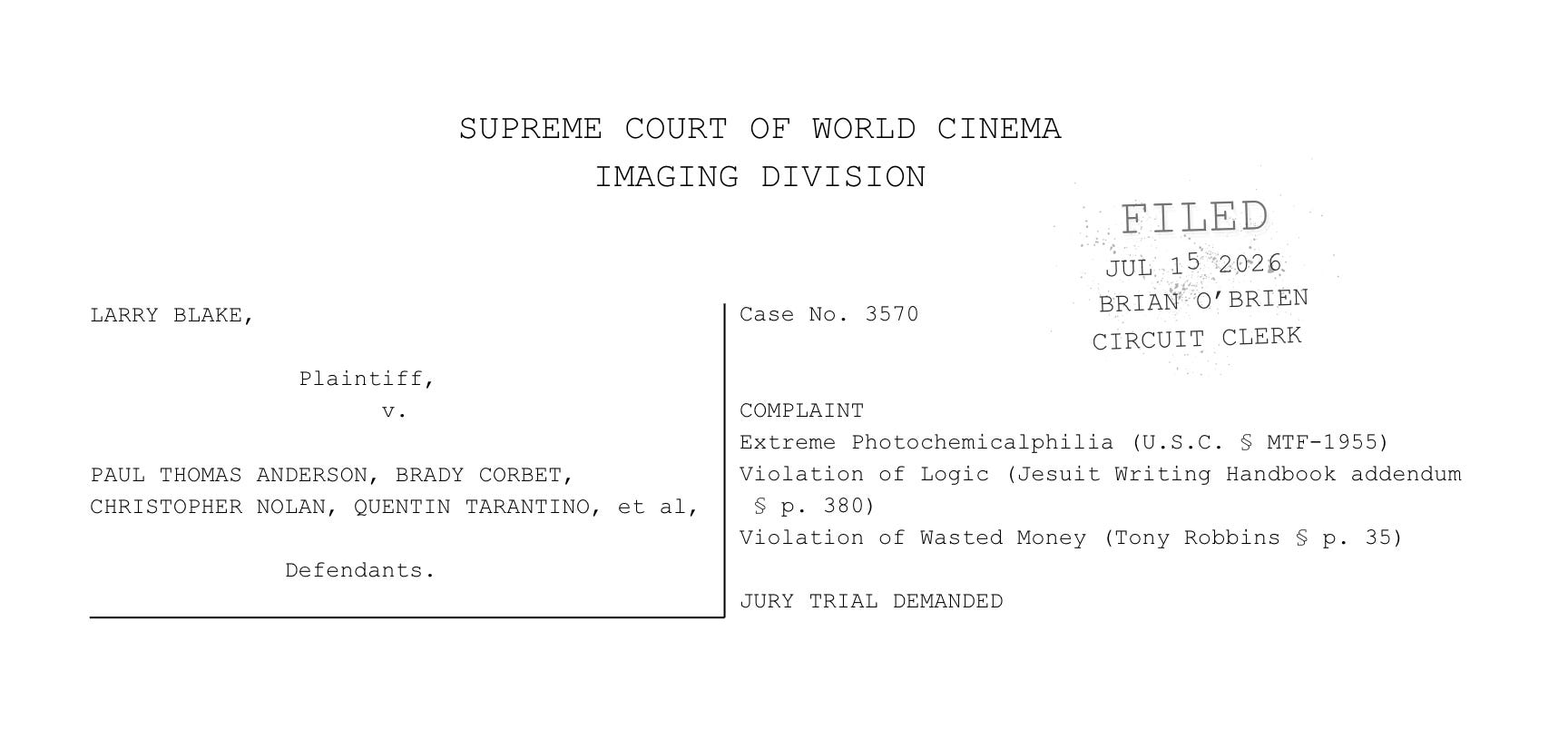
The big question will be answered when I see the 35mm version. As I wrote in part seven, because of the large number—at least four!—of pre-print generations between the 15-perf OCN and the ’scope Oppenheimer print that I saw, it looked abysmal and disgustingly soft. Mr. Nolan should have been taken up on charges in the International Court of Justice (Imaging Division) in The Hague for having claimed that those prints had 6k resolution.
In an interview regarding the various formats that The Odyssey will be playing in, Mr. Nolan says that the 35mm prints have “a little bit more texture than some of the cleaner formats like the IMAX format. But its a really beautiful texture, really filmy. Very cinematic.” In mere hours after I post this, I’ll see if Mr. Nolan again gives me, on 35mm, another one-way trip to Grain City, Iowa, and if so, it’s fucking shame that people will be touting the euphemistic “texture”42 of those prints.
Again, not only will I view each format objectively, I will separate the technical experience from the story and the filmmaking, just as I did with Oppenheimer, which I thought was a brilliant movie. He’s a very talented director, with so much to offer moviegoers, and it saddens me to see him (and the others who I’ve focused on in this series) pimp himself out. I view these photochemicalphilia writings in some way as a corollary of Newton’s Third Law of Motion: For every action, there is an equal and opposite reaction. Here, for every bit of ridiculous technical P.R. foisted on the public and the lapdog press by directors such as Messrs. Nolan and Tarantino, there is an equal need to call them on it.
The technology and the story are separate items and they will always remain separate, and this conflation of the reason to see a movie in some part because it was shot in IMAX is not only wrong because digital would’ve looked better, but it also drags people away from the real reason to see movies.
I get that he is trying to do his part to sell his movies,43 helping his studios justify the money that they ponied up. But, as I wrote earlier, people Love His Movies and the worlds that he creates. The idealist in me thinks that should be enough.
Here’s the link to the epilogue where I relay reporting from my early precincts. It grew to a full, new part. (Eleven of ten!)
Please note: This series draws on much research I’ve done for my in-progress book Solving the Digital Dilemma. Eventually, many words from these Substack writings will find their way back there. Like all the words in What’s a binky?, these are © 2026 by Larry Blake. All rights reserved.
The points I made in Part One, that this -philia didn’t exist in the 20th century, equally applies to archiving. Not only did you always end up with film, there was no practical digital option available to you.
But, as I hope I’ve shown in this series, the first decade in the 21st century quickly brought digital imaging to all areas of motion picture production and exhibition. Nonetheless, there was still the thought that film remained the answer, and the Academy’s publication in 2007 of a paper titled The Digital Dilemma was manna from heaven for archiving photochemicalphiliacs worldwide.
For me, it was a source of grief, and is almost single-handedly responsible for the received wisdom distrust of motion picture digital archiving. Since 2008 I’ve given rebuttals to it in many places and in many forms, and indeed in 2017 I started working on a magnum opus, titled Solving the Digital Dilemma. I hope to finally get it out in the world at some point next year.
Ahead of that, I will be doing another multi-part series here that will focus the archiving strain of photochemicalphilia. Much fun to be had!
But do they ever? You tell me. But this is a first cousin of the old “why did they make a stupid $200-million superhero movie when they could have made 10 smaller good ones at $20 million each.” Sounds good, but not going to happen.
These number assume standard four-perf 35mm shooting, and numbers can get more granular if you shoot two- or three-perf.
Oppenheimer would be more expensive because of the need to create two OCNs (65mm 5- and 15-perf) and The Odyssey because it was shot exclusively in the larger format.
It used to be common to scan at 2k for dailies, and then re-scan (and re-clean!) at 4k (select takes with handles) for the final. Going for the 4k gold at the start is more common these days.
I don’t remember if I’ve ever seen this referred to when DPs talk about the cost of shooting film. Maybe they’re just not aware of it.
I’m told that this number varies greatly filmmaker-to-filmmaker: Some don’t mind a certain amount of dirt, as if to emblazon (hmm, I should use that word more often) their images with photochemical provenance. See part eight, where I go into the dirt that emblazoned The Brutalist.
LUTs here would be used to properly display, with overall desired color correction, etc., to on-set monitors.
I’ve often felt that video villages are the on-set equivalent of having a boatload of people at a final mix of a movie, which is also certainly a fun place to be. I don’t give a shit: When I’m mixing a movie, every person not-credited as “director” gets in the way of my doing the job at hand.
Note that I’m not factoring in camera rental. I think sometimes digital might be cheaper, sometimes film. Regardless, it’s not a huge difference either way. I think. Let me know your thoughts and experience.
They can talk about the purity and human-ness of film all they want, but someone needs to explain to me how grainy film images are natural. I look out in the world and don’t see grain; to me, it doesn’t exist in nature.
You film school grads would say: “Not diegetic.”
The film sound corollary of this is when production sound mixers record 16 tracks on a simple scene, isolating everything just to give us post-sound folks options, not realizing we don’t have the time to weed through everything.
We worked with FotoKem in 2001 to do the film-out of PAL Mini-DV material for Full Frontal, although this was not an intermediate, but an “end” to be cut in with the rest of the movie which had been shot in 35mm. This negative, and not the original digital file, was the source of those sequences when Steven and I remastered Full Frontal, which appear in a boxed set with seven* other movies of his. Stay tuned to these pages for words on this, and the explanation of the asterisk.
An Experienced Professional friend told me that he had seen Project Hail Mary both digitally and on film and said that the digital version had more grain than it did from a 15-perf 70mm IMAX film print. I wish I had seen this.
FotoKem acknowledges as much in their literature. As I’ve said before, I’m friends with the folks there on Alameda Avenue in Burbank (or at least I was before this series), and hope that they continue to live long and prosper as the longest-standing full-service film lab in the U.S., if not the world. The labs at Technicolor, Deluxe, and DuArt all stopped short of centennial celebrations, and I keep my fingers crossed that the Broderson family can make it another 36 years. Indeed, here’s to the Aschenbach family at Colorlab in Maryland going another 47. And, trust me, I get the ironic spin that someone who trashes film as a capture and projection medium would wish that the last companies doing it live long and prosper.
Although he was speaking of a yacht.
A side note on archiving: It’s standard operating procedure to deliver a textless version of movies, where all that is added to the image—be it date, location, burned-in subtitles, or standard documentary “lower thirds” that ID the speaker—are removed. The most common need is of course in international versioning.
I think that, considering how relatively new the process of film emulation is, it would be very wise to salt away the DI in a “minus-texture” version. This would be especially important in a situation where the process was used to an extreme, say something as visually bizarre as the use of AutoTune on Cher’s song “Believe.”
Playing devil’s advocate here, that effect was just what they wanted, and that’s that, then you only create and archive it one way, to ensure that no one can change anything.
It’s just something to think about.
A bizarre experience I had over 15 years ago: I got a call from someone asking me if I could mix from 35mm mag. No, I said, not only don’t I have even one mag dubber, I know of no facility in the country that still has a row of dubbers to play back edited sound elements, as in the olde mag days. Sure, there are transfer bays galore out there, but they are one-unit-at-a-time endeavors. Why, pray tell, are you asking?
He said that he wanted to do a movie completely analog—write on a typewriter, shoot on film and record on a Nagra, cut and mix the sound analog, and make only 35mm prints with an optical soundtrack.
I’m not sure if I asked him what he was trying to prove, or who he was trying to impress. The answer is pretty evident: He was reaching beyond InstaCred to “MegaCred.”
This reminds me of an opposite, but equally meaningless pursuit that was undertaken back in 1983, when a guy made a movie called Digital Dream exclusively to show off how great digital movie sound was. It is, or eventually became, but his movie’s sound wasn’t top drawer.
I have this image of a Gen Z budding photochemicalphiliac thrilled that they’re about to shoot 16mm film for the first time, and realizing that they need to use a changing bag, and looking on YouTube for advice. Then realizing that they have to get a light meter.
The amount of work that happens in the dark, when processing motion picture film, is crazy. I can’t imagine what it would be like to have to handle 15,000 feet of badly organized and mis-slated camera negative.
I have never run anything more complicated than a 16mm projector.
As noted in part five, he owns two theaters in Los Angeles, the New Beverly and the Vista, which don’t have digital projectors and only show film.
To those of you who don’t get the references implied here: Yeah, I get that it’s not written in so many words in the Constitution, but the “Establishment Clause” in the First Amendment does indeed separate the U.S. government from churches, full stop; it’s the hallmark of good periodical publications to not have their editorial departments take any clues from their colleagues who sell ads; “without fear or favor” was first written in The New York Times in 1896, and is as succinct of a way one can express the concept of “impartiality.”
I wrote in part three that I considered Samsara the most beautiful, period, but it is of a unique genre.
I really have to stop trashing VistaVision, but given the crap that the filmmakers spewed on One Battle After Another and The Brutalist, and that the public gobbled up … they deserve every bit of crap they get in return, if only to offset … I’ll stop now.
He goes on to dig deeper: “It has been argued that digital is a cold medium and celluloid a hot one and a case, however speculative, could be made that a story such as “Benjamin Button,” with its desired cumulative emotional impact, should be shot and screened on film to be fully realized. These are intangibles, but nor are they imaginary factors; what technology gives, it can also take away.”
Here’s the DP of The Brutalist talking about speaking with a 14-year-old kid who wants to grow up to shoot VistaVision. It pains me that this kid is thinking of this, just like other kids, those interested in sound, care too much about Atmos.
Note that I’m a big fan of Mr. Cruise, and will show up on opening day of his movies to see his stunts. His desire to thrill audiences and his GOAT work ethic are quite impressive; I just don’t think that shooting in VistaVision merits any plaudits.
I thought only The Onion could make this shit up: Someone has made a movie that (warning: please put power tools down) is going straight to VHS! Please read the article in the hyperlink and let me know how this is a “deliberate middle finger” to AI. I’m from below the Mason-Dixon line and sometimes I’m a bit slow.
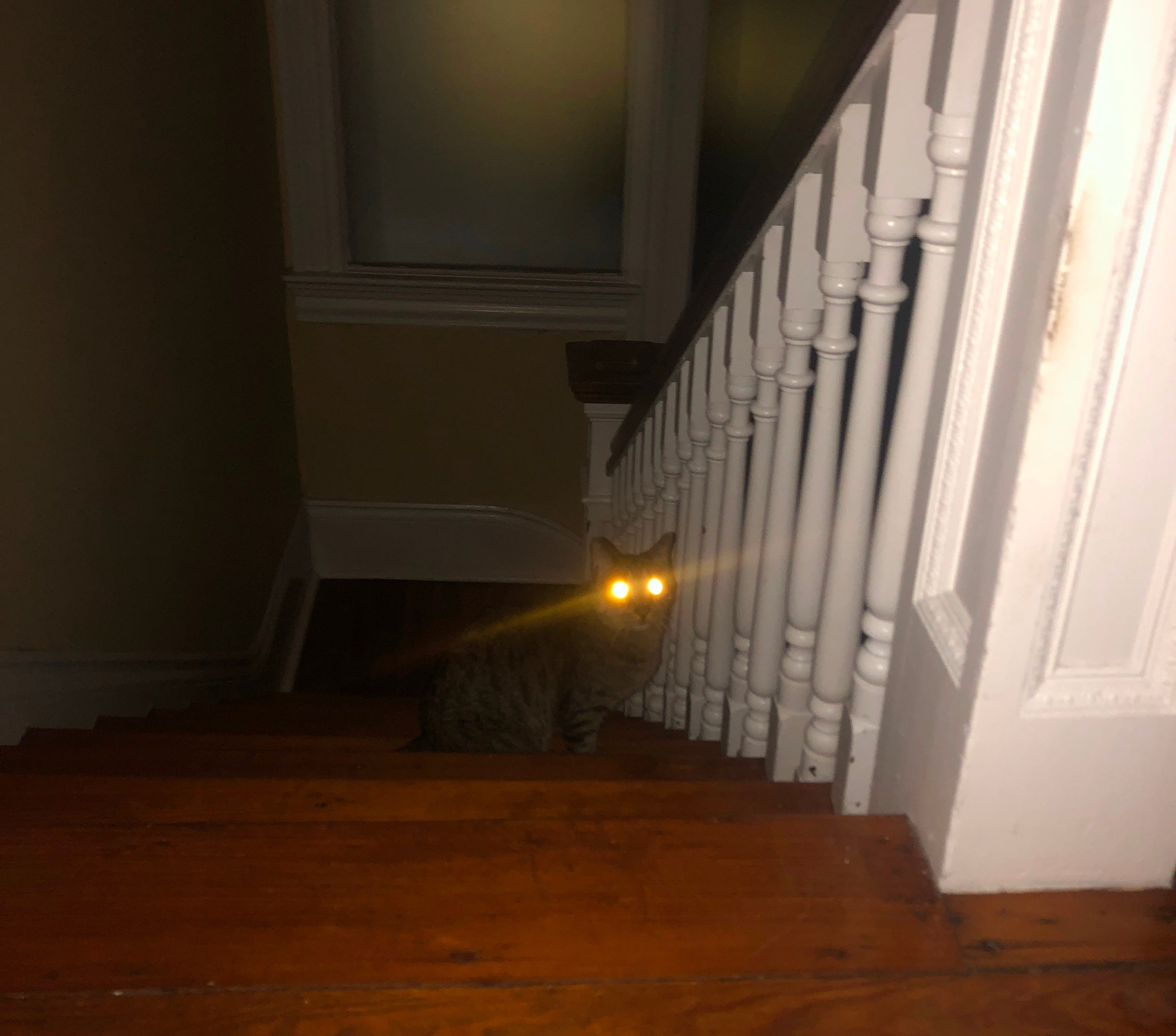
My only use for “old digital cameras” is that my current iPhone, when I use the flash in the dark, doesn’t make Sasha look like Devil Cat with glowing eyes. Here’s a classic from my previous phone:
I have to give Tarantino credit for playing devil’s advocate with himself and speaking approvingly how digital cameras—or even cell phones—have made filmmaking accessible to many people who otherwise wouldn’t have the means. He’s then quick to say that he can’t understand why an established filmmaker would not shoot on film.
MIDI of course being the very powerful tool of musicians to “sequence” musical samples when creating and composing.
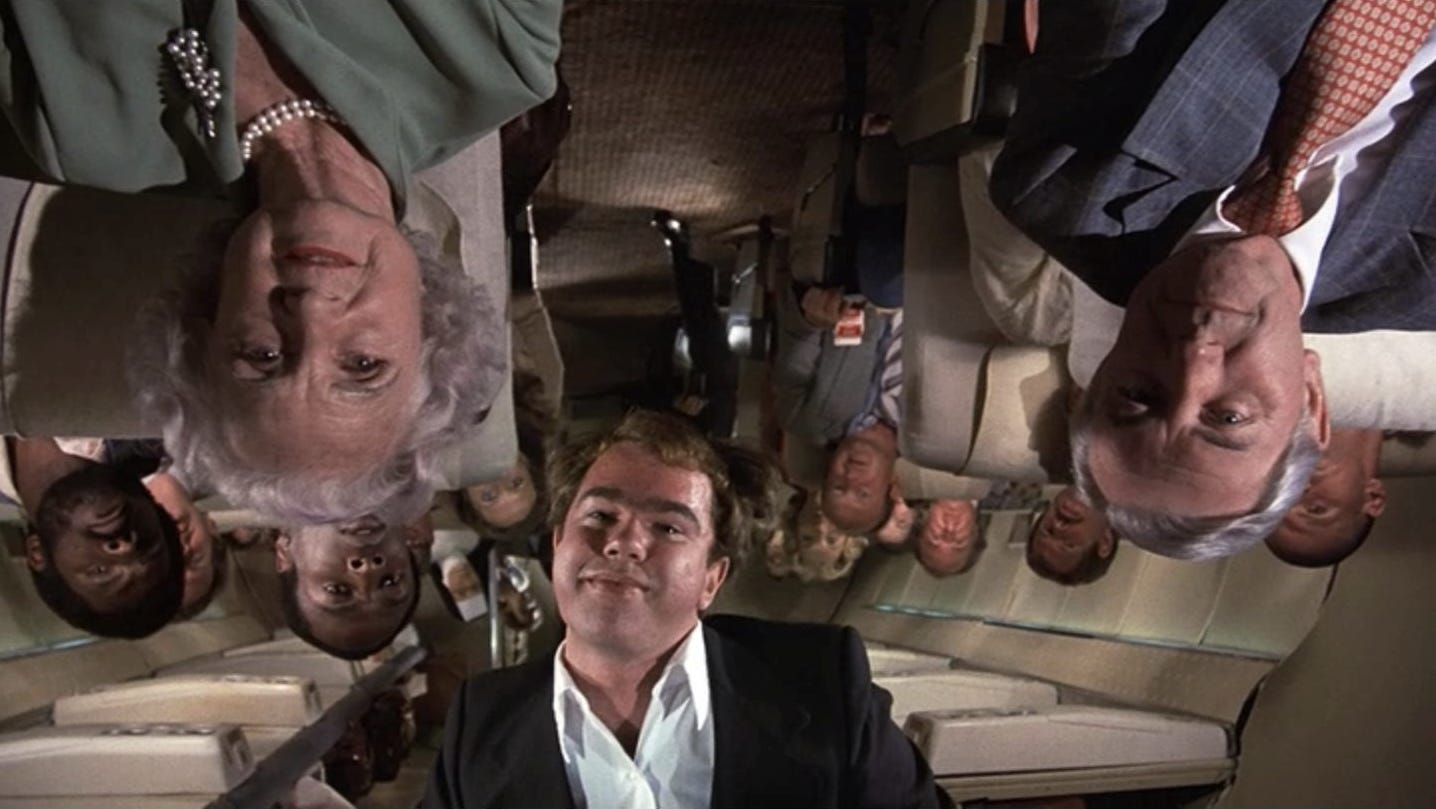
I cannot believe that NONE of my paid subscribers have taken me up on the offer of a signed copy by the Upside-Down Man in that classic comedy! (Here’s another, upside-down, view.)
Or what was achieved with the totally improvised This Is Spinal Tap, using 400-foot 16mm mags. It pains me to think how much funnier it would have been had they had been able to roll continuously for an hour. Not.
I have a long, sordid record of fruitlessly complaining to associate assistant trainee managers in theaters. One of the most humorous was at the first movie that my wife-to-be and I ever saw together, Gone Girl, on October 3, 2014. They showed the Atmos trailer before the movie, to let us know about their sound system, in spite of the fact that the movie didn’t have an Atmos mix. After the movie, I tried to impress upon said person that this was misleading, but he nonetheless tried to convince me that Gone Girl was, in fact, in Atmos. After two back-and-forths, with a sigh he realized the reason I didn’t understand why he was right: “Oh, we downloaded it from a satellite.”
Outside of the fact that I have some issues with Atmos, though more so with the home iteration than the theatrical.
It has a separate meaning, that the movie uses the “full container” 1.90:1 aspect ratio. IMAX makes something of a big deal about this as if a) it’s something that they came up with and is unique to them, and b) there’s some amazing quality gain. The screen, and the resolution, are the same as normal 1.85:1, just 2.5% larger. (Yawn.)
Another word, in all of its forms, that Mr. Nolan needs to retire is “immersive.” In this interview he says it three times. The word, in general, needs to buried after being boiled and burned.
Comments
Nothing yet. Say the first thing.
Sign in to join the conversation.