
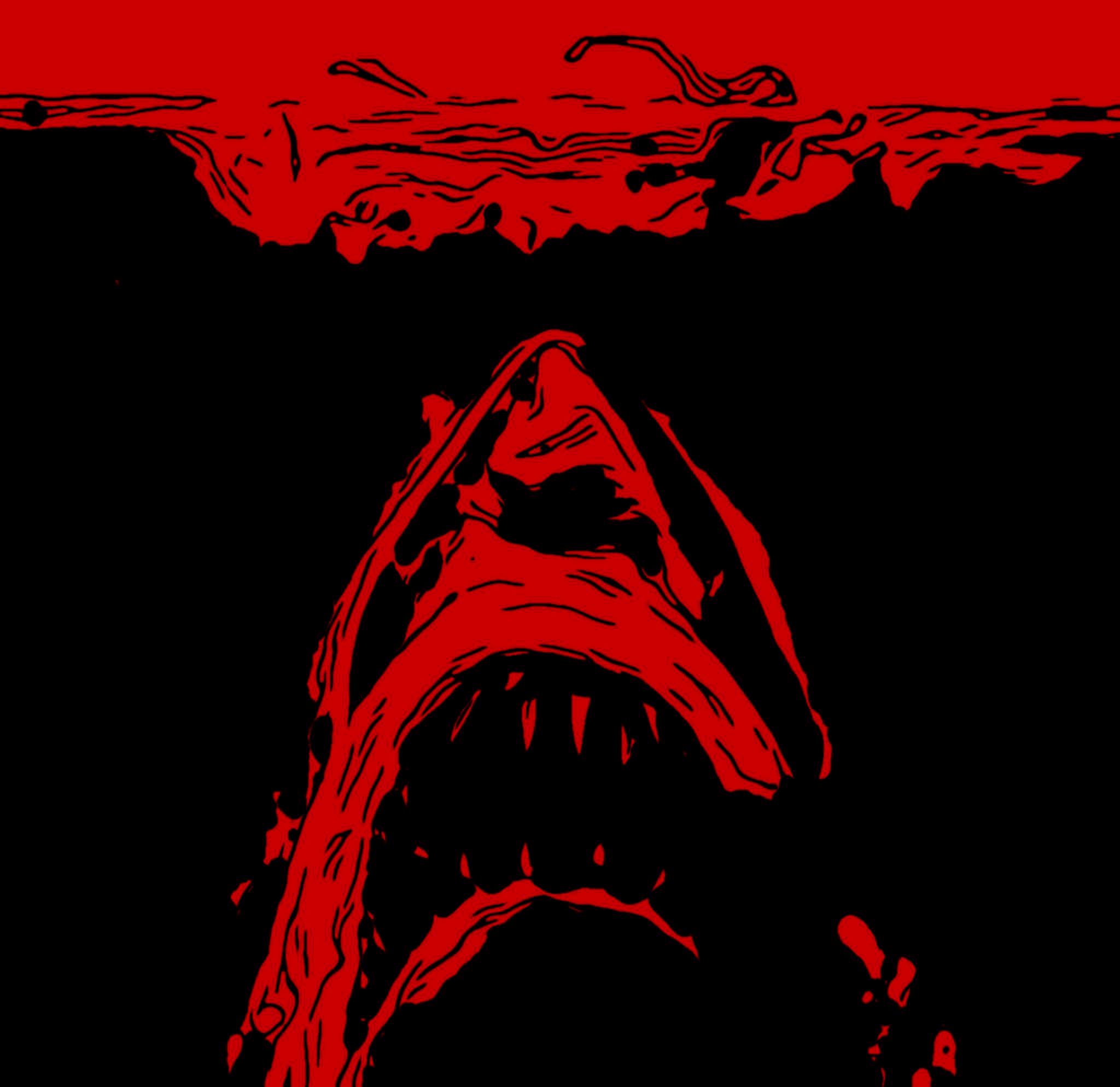
Although we had first met in February 1979, Steven Soderbergh and I had known of each other for a few years via a mutual friend. That meeting, at a screening (I hesitate to call it a “film festival”) in Baton Rouge of Super 8 movies we all had made, was short and sweet.
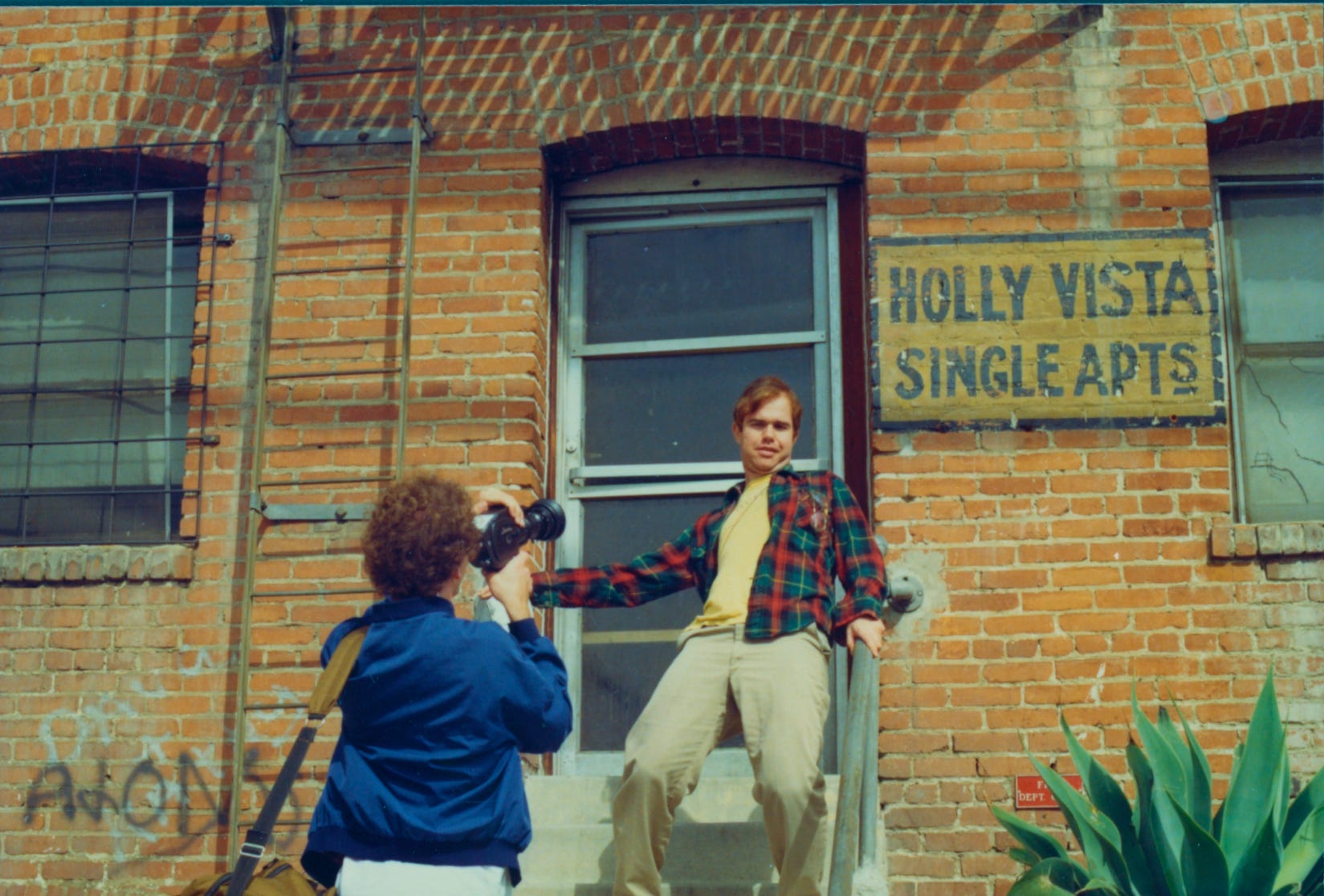
Almost two years later, we connected for real in Los Angeles, where I had been living for a year and a half, and where Steven had just moved, having just turned 18 and graduated from high school. He slept on the filthy floor of my crappy studio apartment, room 301 of 1975 N. Beachwood Drive, for many months.
We immediately found that we were of like minds on all-matters-movies, be they films themselves, or filmmaking techniques and technology. (My building was then called the Holly Vista Single Apartments, and we of course renamed it the Holly VistaVision.1)
It was a matter of time until we latched onto our shared love of all-things-Jaws. How much? I gave him my one and only ORIGINAL Jaws t-shirt.
The story of our eventually making movies together is touched on in the About me section of this Substack, and among the many constants has been our appreciation of Steven Spielberg’s achievement 51-plus years ago. My interest in Jaws sourced from seeing The Sugarland Express in 16mm ’scope in spring 1975,2 having previously read about it in American Cinematographer. Sugarland’s direction blew me away, leading me to line up at the first showing of Jaws on June 20 at the Joy Theater on Canal Street in New Orleans.3
Steven’s fixation on the Jaws movie lapped mine a decade or so ago when he started really looking into the making of it, as in tracking down the daily log reports and the lined script. The initial thought was to use the research as a springboard for a book on directing based on various lectures that he had given, but that idea eventually gave way to what we all can now enjoy as an app, Production 02074 Anatomy of an Activation.4
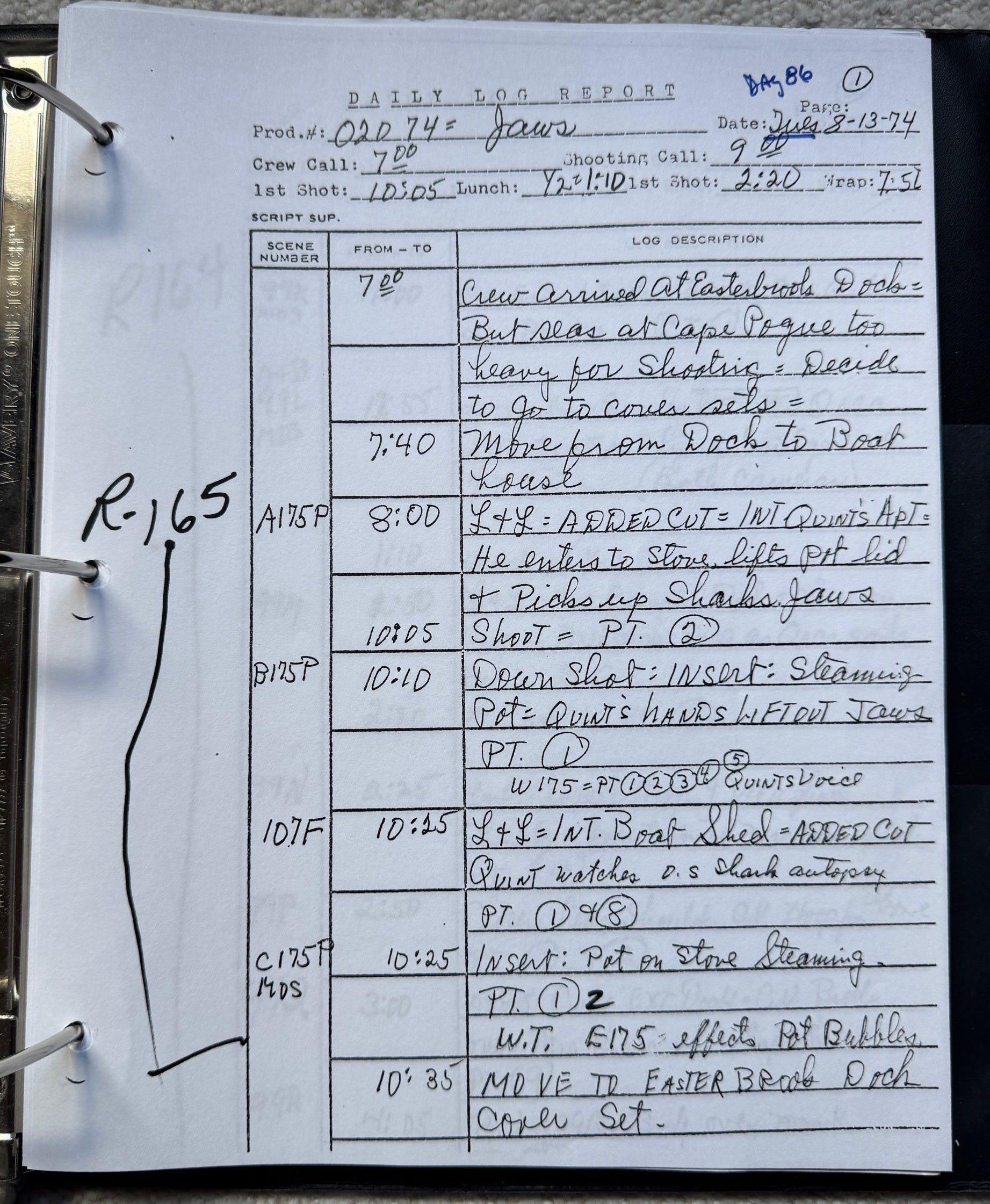
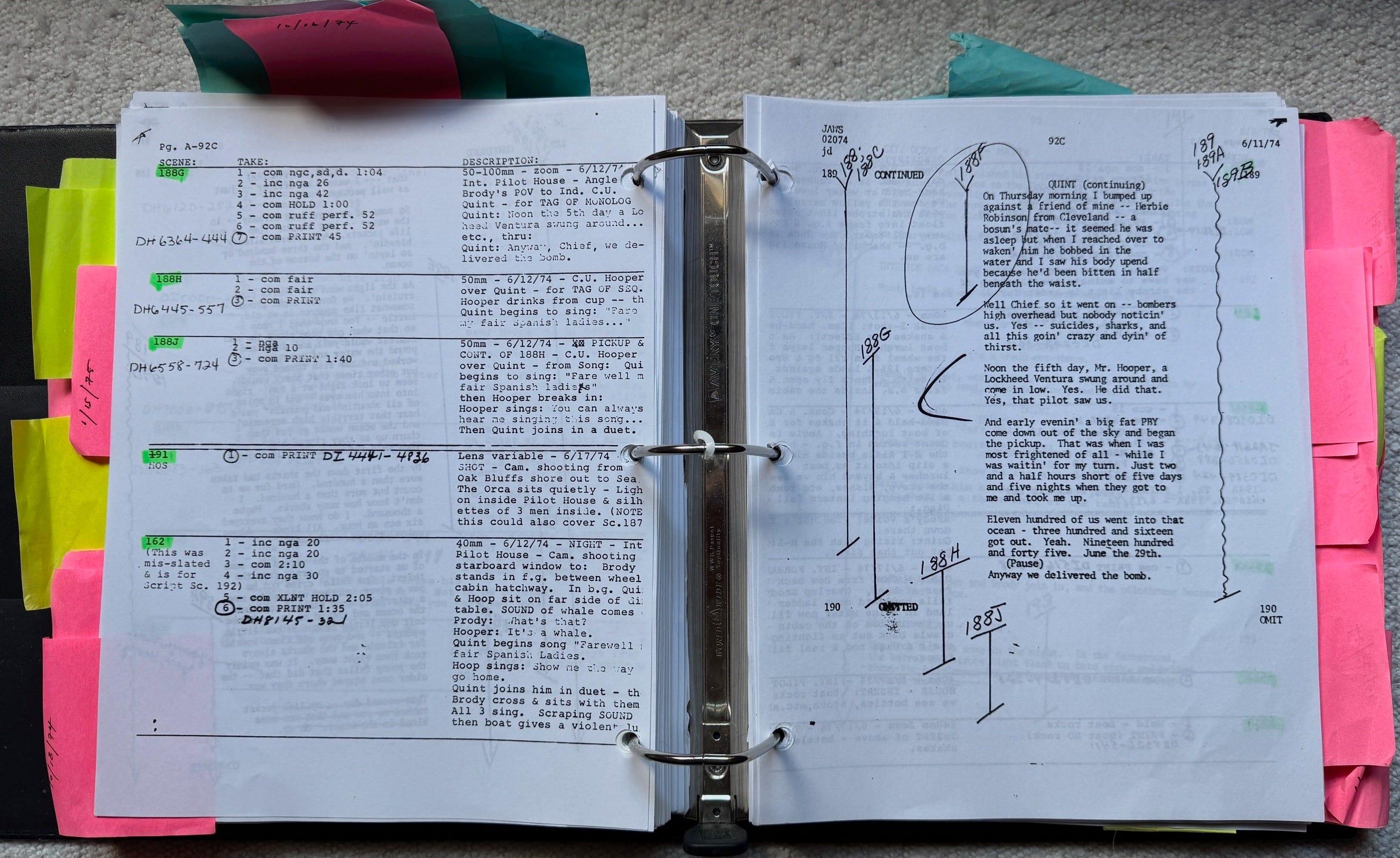
Steven goes through each of the 143 days of shooting in chronological order, noting each setup, what takes were printed, focal length(s)5 of the lens(es), and whether or not a shot was in the final film. (If not, “NIFF.”) Asterisks bring your eye to a change in setups. When something is in the movie, there are frame grabs showing you key frames. (The day-by-day detail in the app is not unlike that in the book The Beatles Recording Sessions, by the great Mark Lewisohn. Very different but equally comprehensive.)
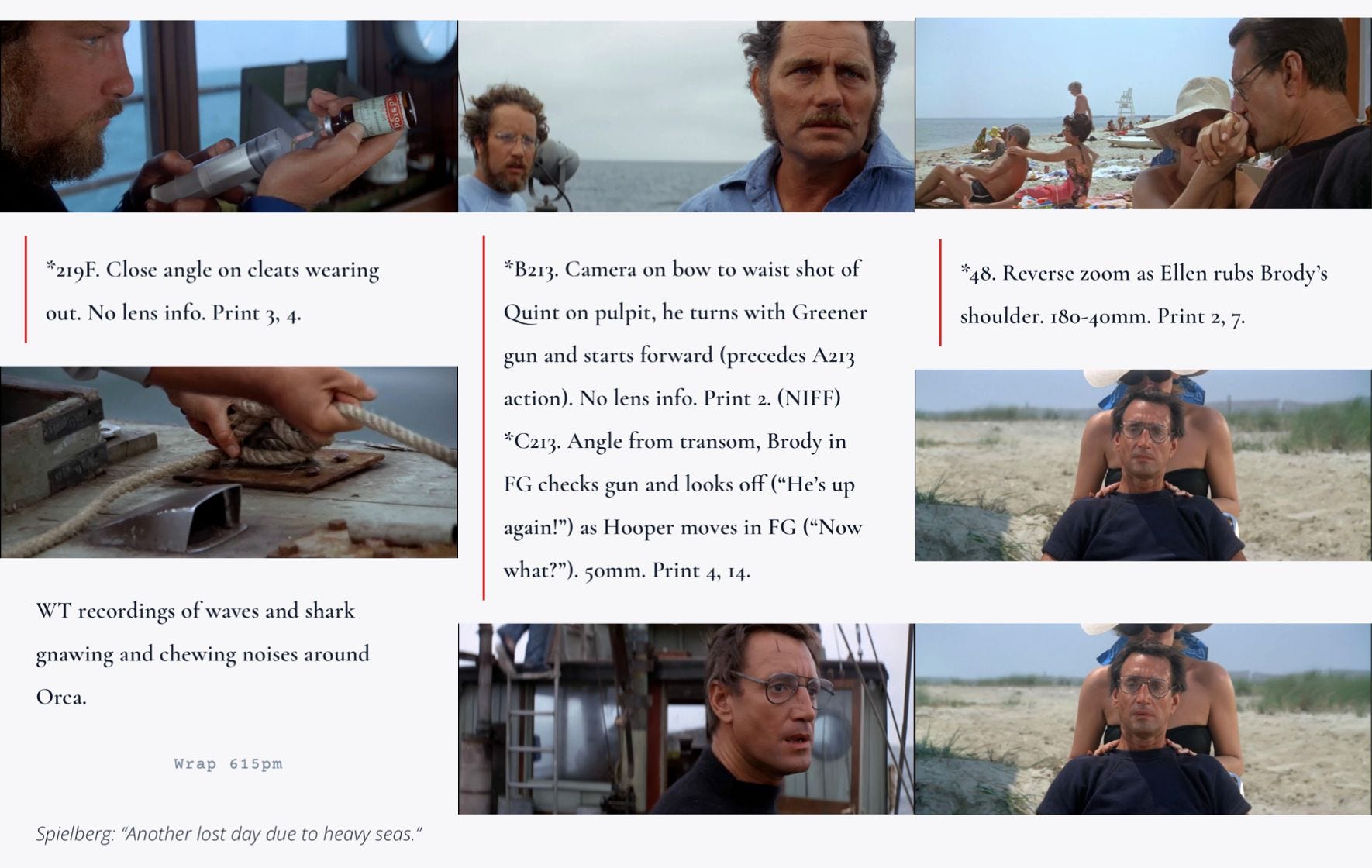
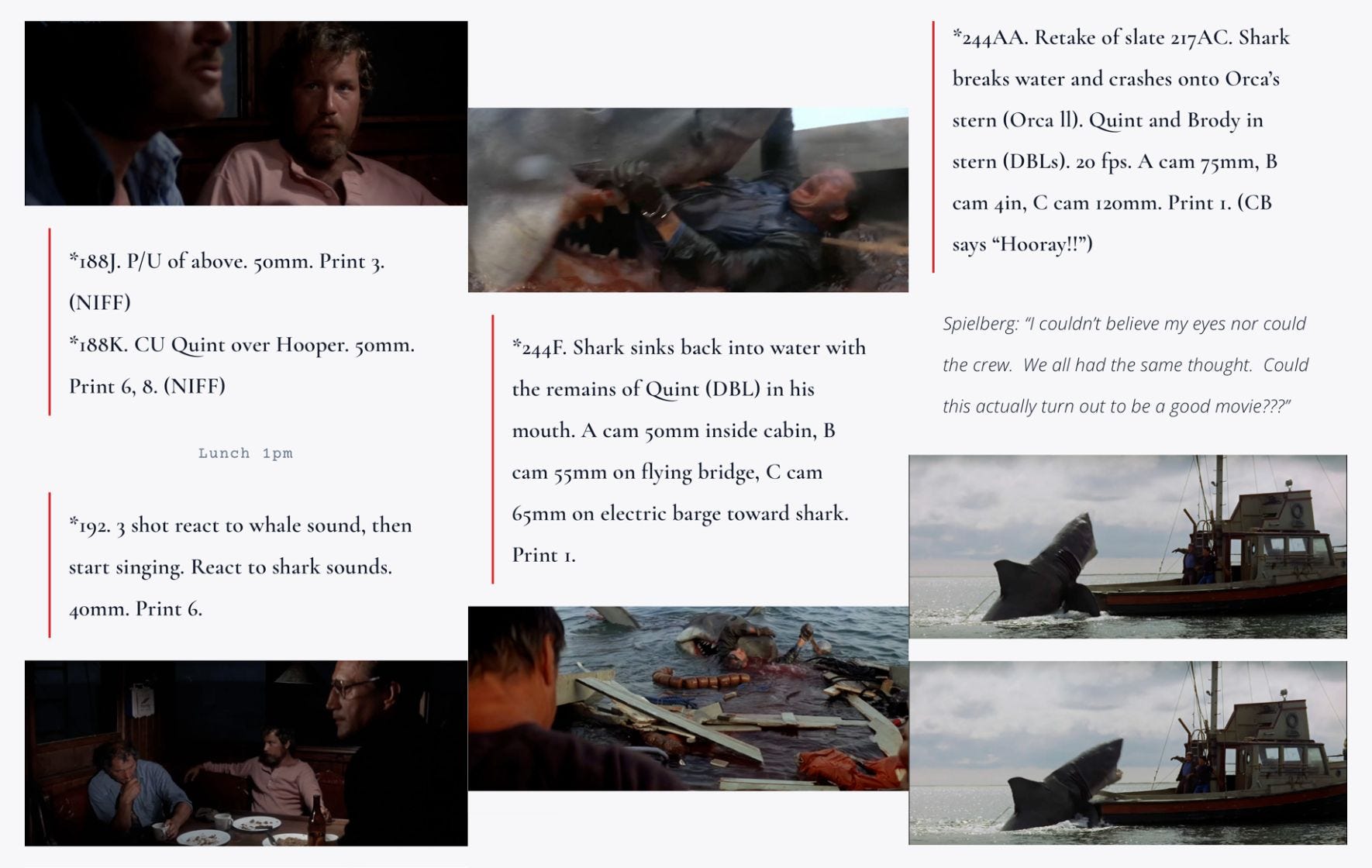
Among the revelations I had when I went through the app:
We all knew about the inserts and additional shooting in various pools, the Universal backlot, and the MGM water tank, but I had no clue about the three days of crucial ocean footage (“Don’t wait for me!”) that was shot off the coast of Long Beach.
The number of days when they came away with nothing, literally or virtually, what Mr. Spielberg calls “washouts.”
How many shots were not in the final movie. I had assumed since it was such a rough shoot, that he would have used pretty much everything.
Much good stuff on the shooting of the USS Indianapolis scene.
I can only count two moments when they were screwed because a boat appeared on the horizon, ruining a carefully blocked shot with the shark in the water. I was always under the impression that this was a constant problem. (Today, that would be easily painted out, maybe even right there in the DI.)
There are wonderful comments here and there by Mr. Spielberg himself, commenting on where his mind was on a given day, and his crazy ups and downs. He also wrote a lovely epilogue.
Note that this isn’t Steven’s first imaginative look at the filmmaking chops of the original Steven S-berg: On his company’s website he has posted an, um, revised Raiders of the Lost Ark: black and white, no dialogue, no sound effects, just some music by Trent Reznor and Atticus Ross (from their The Social Network and The Girl with the Dragon Tattoo scores) to help keep things moving. The idea, which works brilliantly, is to force the viewer to grok Spielberg’s blocking, staging, and editing all the better. See for yourself.
Production 02074 achieves its goal of giving a sense of how Spielberg didn’t just finish the movie (something they often wondered might not happen if the mechanical shark continued to shit the mechanical bed off of Martha’s Vineyard), he made an immortal one. In an article featuring friends commenting on his career, Martin Scorsese says that “[i]f the shark had worked, Jaws wouldn’t have been what it was. It wouldn’t have done the business it did. The situation drew creative solutions from Steven that he wouldn’t have gotten to if things had gone more smoothly.”
I think the unsung heroes of Jaws are his producers, Richard Zanuck and David Brown, who stood by their young director through this most trying of shoots, eventually going 88 days over the original 55-day schedule.
In his commentary for The Godfather, Francis Coppola talks about how people will ask him what he did, considering the great cast, the story by Mario Puzo, plus the work of Walter Murch, William Reynolds, Nino Rota, Dean Tavoularis, Gordon Willis, and Peter Zinner. The answer: He hired them!
Along these lines: Credit has always justifiably been given to editor Verna Fields, but the app makes even more clear to me what I already knew, how Mr. Spielberg had to insist on getting this difficult shot, and then doing so again, and again, dozens of times. He doesn’t do that, there’s nothing to cut, or what is there is not interesting. What did he do? He shot it!
So, don’t walk, run your fingers on your smart phones and iPads to download the Production 02074 Anatomy of an Activation app, and give $24.99 to an animal charity at the same time. All the while opening yourself up to loads of fun.
Like all the words in What’s a binky?, these are © 2026 by Larry Blake. All rights reserved.
I’m clearly trying to keep my VistaVision streak going.
In the now-deceased Colonnade at the LSU Student Union, where I first met Steven.
And I saw it again the next night. At both screenings, when Hooper says that the shark must have come up from the south, and throws a Louisiana license plate (“Sportsmen’s Paradise”) to Brody, the audience went crazy! I just saw the movie again this past week, and while there were laughs, it was nothing like back in 1975. I guess most everyone had seen the movie before.
Sometimes noted like old-school cinematographers and projectionists, in inches, wherein a 100mm lens is a “4 in.”
Comments
Nothing yet. Say the first thing.
Sign in to join the conversation.