
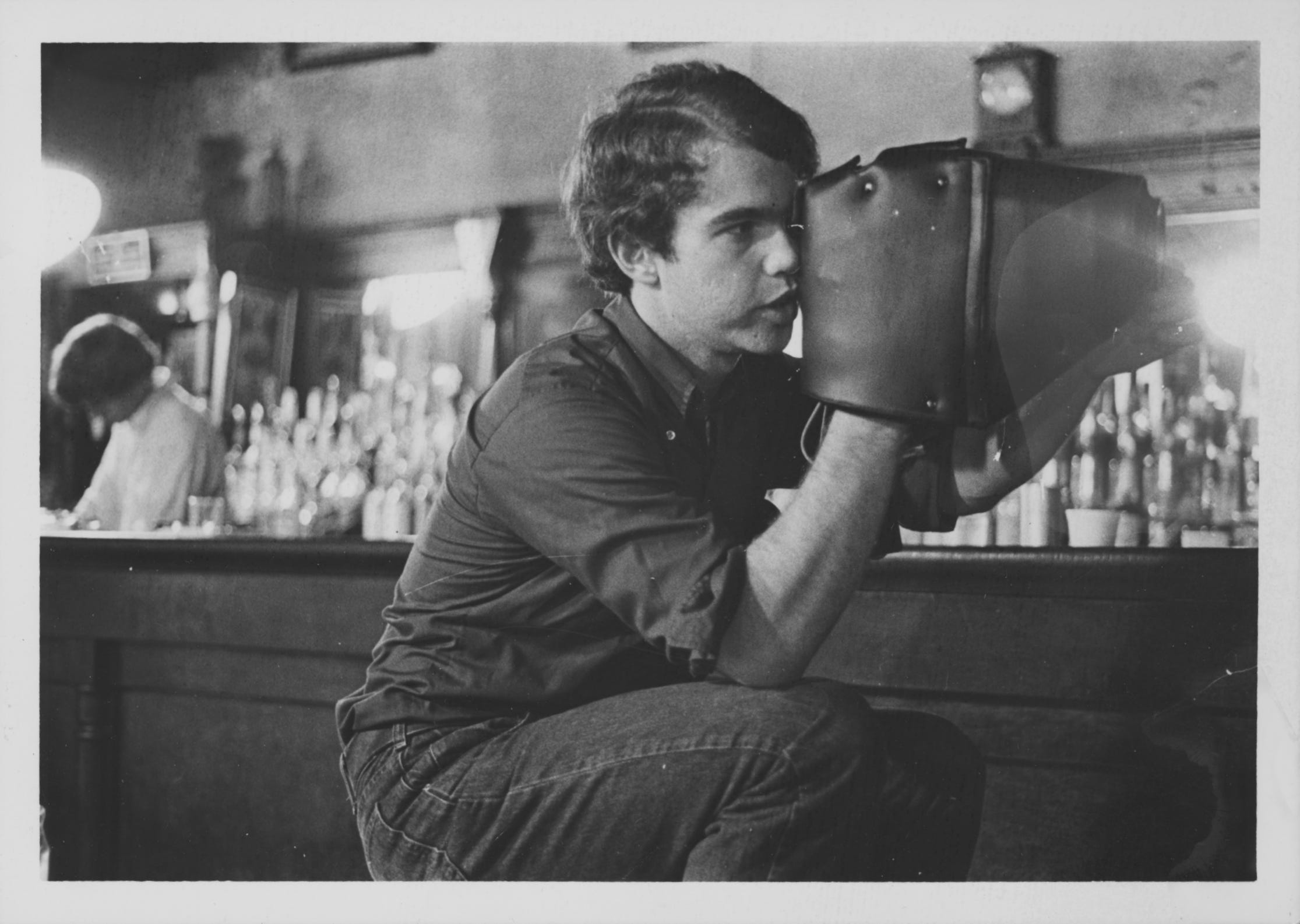
I wrote earlier about how an article on Citizen Kane in the October 1972 Esquire put the set screws down on my desire to make movies. It just recently occurred to me that another article two years earlier, also in Esquire—”Is Truffaut the Happiest Man on Earth?”1—flicked the first lights on for me. It was written by the French director François Truffaut himself and his answer was “Yes.” I had not yet seen any of his films, but eventually The 400 Blows and Jules and Jim elevated him into my nascent film director pantheon.
There was a sentence in Truffaut’s piece that made an impression on me, that it didn’t matter what a director did, or what the movie was about, or how it was made. “[T]ragic or light, modern or old-fashioned, in color or in black and white, in 35mm or in Super 8 […] Only the result matters, which is the good the director does himself and the good he does others.”
After Citizen Kane, the next filmmaker/movie combo to hook me was Stanley Kubrick’s 2001: A Space Odyssey. I was late to the game on this one, not having seen the 70mm engagement at the Trans-Lux Cinerama theatre in New Orleans during its first run in 1968, but after I finally did catch up, I consumed everything I could find. Top of the list was the Jerome Agel-edited The Making of Kubrick’s 2001. It is a gloriously wide-ranging grab-bag of material of every step of its pre-production and production, then following through to the release and reception, including reviews and a multitude of letters to Kubrick about the meaning of the movie. It’s too bad Agel only had a mass-market paperback canvas to work with.
Following from Truffaut’s thoughts above, there was a similar and more succinct quote by Stanley Kubrick in Agel’s book: “Perhaps it sounds ridiculous, but the best thing that young filmmakers should do is get hold of a camera and some film and make a movie of any kind at all.” The yen to make motion pictures having fully hooked me, I followed his lead and started purchasing Super 8 equipment in winter 1976, during the last semester of my ill-fated studies at LSU in Baton Rouge.
At that time, I just wanted to learn how to shoot, and the idea of sound wasn’t yet on my radar. Yes, I could record sound with a single-system camera, using mag stripe on the film, but that wasn’t of interest to me. I knew that cutting sound welded to the picture was not the way it was done in Hollywood. I purchased a Braun Nizo S800 camera that had a wide zoom range (7-80), a multitude of speeds (18, 24, and 54 fps), an adjustable intervalometer, and in-camera fades and dissolves. You could even press a button and have the speed ramp up to or down from 54 fps, the aperture adjusting accordingly! Plus, it just had a good look and feel about it, thanks to the design by Braun’s Dieter Rams. (See this video about the history of the company and its cameras.)
My first use of it was a short (Treachery) spoofing the Spring 1976 Daily Reveille newspaper staff, with highly improbable scenes like Mike Farley and Scooter Hobbs making eyes at each other across Underwood typewriters and Susie Phillips flashing passersby with a raincoat. It qualifies as “a movie of any kind,” and while not exactly The 400 Blows or Citizen Kane, it was a start.
Rounding out my gear was an Elmo ST-1200D projector. But, no sound recording nor any editing equipment beyond the fantastic, sharp viewer made by Minette. To show the silent Treachery with its “score,” I transferred (to consumer ¼-inch tape) music such as the adagio from Swan Lake (Mike and Scooter’s love theme), finally ending furiously with Grieg’s In the Hall of the Mountain King.2 I started and stopped the tape as needed while the movie played. All well and good for the 2 (two) times that it was ever shown in 1976, except that 50 years later I’m not sure exactly what music I used and at what location, or even where the tape or its source LPs are today. My first—and, I hope, last— EPIC FAIL in the land of movie archiving. For sound, no less!3 But I still have the edited Kodachrome movie.
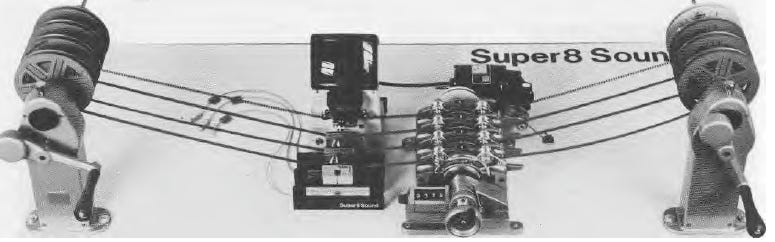
In the summer, having flunked out for a second and final time, I regrouped at home in New Orleans, working as a waiter at the Napoleon House. Undoubtedly my first serious connection to Super 8 had been the November 1975 issue of American Cinematographer that was completely devoted to the format, with a focus on offerings at the Cambridge, Massachusetts-based Super8 Sound, Inc. (They spelled the name tight like that, I’m assuming to distinguish between the company and the format. I’ll follow that lead.)4 Just as B&H online is an inexhaustible, constantly changing, wish-list today, so was the Super8 Sound catalog5 the motherlode of my initial filmmaking gear lust in the Seventies. I know that 16mm was supposed to be the training wheels in those days, but that was far beyond my financial reach.
I would say “… the reach of me and my friends” except that as of when I left LSU, it was just me, with no fellow travelers in the world of Independent Filmmaking, New Orleans Division.6 This would change rapidly when I found out that New Orleans had a local outpost of Super8 Sound! I sped over to Light House Media Center at 1022 Lowerline St. in the University area of uptown New Orleans, and what happened there was a sea change for my career.
I was greeted by the owner, a short, funny, charismatic, smart guy with a Spanish accent: Georges Cardona. He spelled his first name French style, and as his life and background would unfold, maybe he had some familial connections to France. Maybe not. As best as we would suss out, he was from Colombia. Or was it Germany? He soon played Dolly Levi with me and another Light House client, Steve Tyler, and we both became his first protégés. More in part two (on September 1) on Georges, his personal provenance, and his mentoring that 40 years later would become world-infamous in the 2018 movie Shirkers.
Steve and I became immediate fast friends, and are still going strong 50 years later. We bonded not only over our career aspirations, but also with our love of The Band and everything Stanley Kubrick. Light House became a second home to us, and looking back now, the idea is nuts that in 1976 there was a company in NOLA so devoted to Super 8 filmmaking that it had a screening room.
As I was lucky enough to be living at home, I soon transferred my money from Nap House tables almost directly to Georges and Light House. The complete system as designed by Bob Doyle (an astrophysicist from Harvard!) and the team at Super8 Sound had many ingenious parts that brought the small gauge close to the land of professional filmmaking.7 Not fully, as the format had certain unavoidable limitations, but enough for me to Make Movies.
They modified gear (like crystal control of cameras by companies such as Beaulieu of France and my Nizo), made Super 8 equivalents of professional equipment (modified portable ¼-inch decks to be Super 8 fullcoat recorders, and cassette decks to accept sync signals), and most importantly, wrote clear instructions as how to make the various pieces and parts work together.
Other companies independently developed products to flesh out the system, such as the flatbed editors by MKM and SERA (Super 8 Research Associates) and projectors by Elmo. I only used Bonum reels because you didn’t need to tuck the film into a slot when threading! The small pleasures of filmmaking.
To tie together everything synchronously, they invented a new sync pulse: 1/F—one pulse per frame. Although it maybe in theory it was not as precise as normal sync pulses—which would have 2.5 cycles per 60 Hz frame), it did work, and was adopted on a wide variety of cameras, recorders, and projectors. They made clever use of multipin DIN connectors to remote start and then keep in sync all this gear.
Their editing bench was ingenious, starting with a standard synchronizer and rewinds, but attaching to it not only a motor/foot pedal to run at 24 fps, but also sound heads whose sync could be slid relative to the picture on the (of course) Minette viewer.
Add to this the multitude of labs which offered not just Super 8 processing but also printing. However, given that all stocks at the time were reversal, with projection contrast, any print (also reversal) was, to say the least, not spectacular.
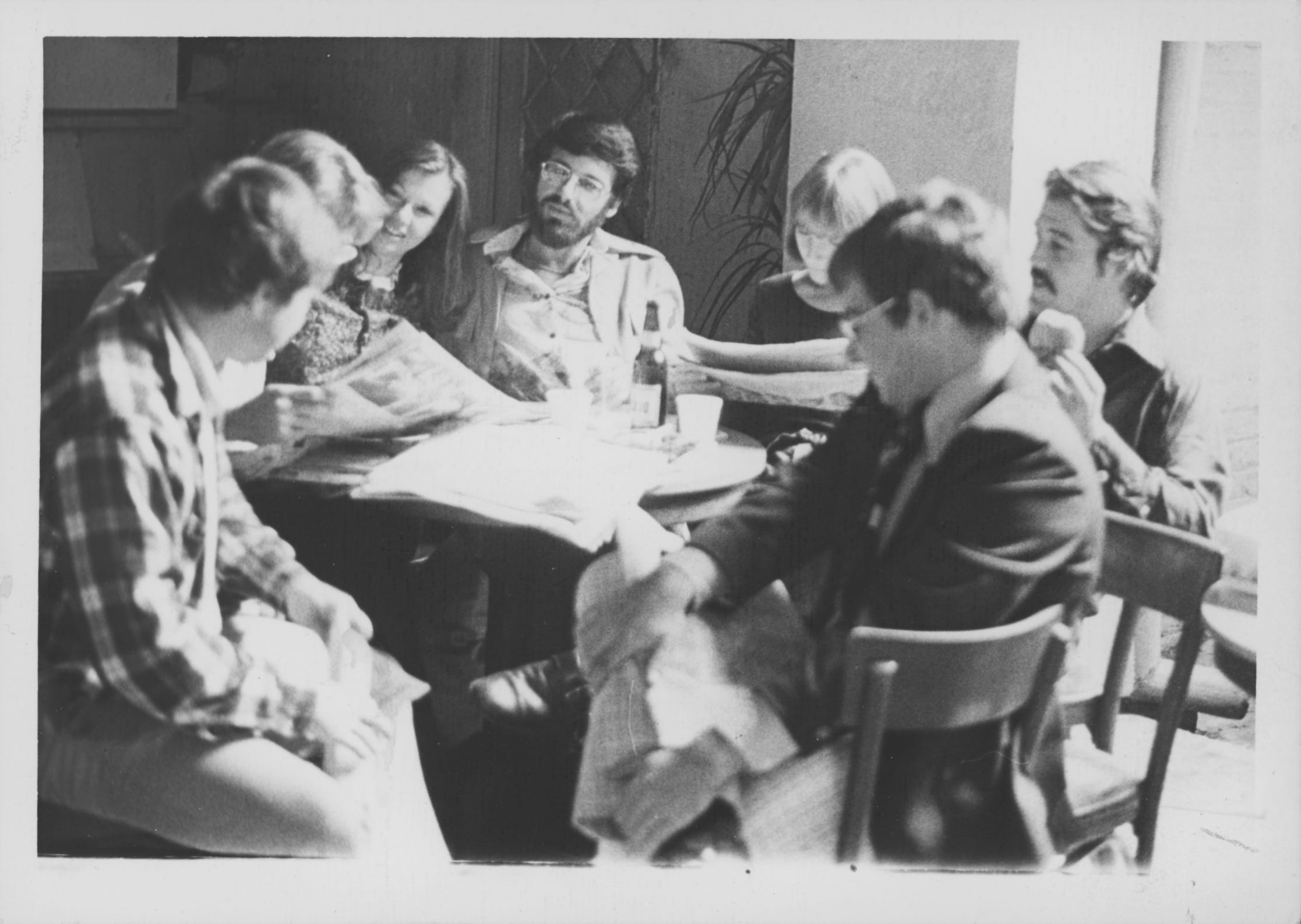
The young filmmaker variation of the old writing adage—Write what you know—is clearly “Shoot where you have access.” In my case it was the Nap House, where I ended up taking orders for muffulettas8 and Pimm’s Cups from June 1976 until April 1979. We only shot in the signature front room, with no thought or ability to cover the full place including the patio and the E Room.9
I hasten to add that although many movies and commercials have been there since 1977, I was the first! Among the people I beat to the punch is Oliver Stone, who in 1991 shot at the Nap House the scene in JFK the afternoon of the assassination where Jim Garrison (Kevin Costner) looks at news on TV.10 Right before that, leaving his office, Costner tells a colleague, “Let’s go to Napoleon’s” [sic] in his bizarre Garrison accent that a buddy of mine termed “Southern surfer.”
This was going to be my first real movie, and the initial title was 30 Minutes, aiming as it did to show that many real-time minutes in the day of a waiter. The location was easy, as was the casting: If I knew you in fall 1977, and you lived in Louisiana, you (and everyone you knew) were Taft-Hartleyed in! Among my victims were my sister, two girlfriends (not mine), three buddies from high school, and three from LSU. One of the latter was Lee Caire, who had got me the job at the Nap House in the first place,11 and who stars as “Lee,” the waiter. He was a natural and is by far the best thing in the movie. (I give myself an Honorable Mention for some of my camera blocking.) One Asshole Customer (there are three!), the one at table 4a,12 was played by the New Orleans writer Jason Berry, who later would go on to international fame for his reporting on clergy abuse in Louisiana and around the world.
The screenplay riffed on a strange-but-true story: I was waiting on a couple at table 4b. By body language I could tell they were just friends, and I was smitten with the lady. I told Lee, “That’s the girl for me.” I infused her with as much of my Future Southern Filmmaker Charm as I could, and when I bussed the table after they left, of course there was a note under her plate. Her name, city, and phone number: Vicki […], Tulsa, Oklahoma, (405) […] Unbelievable, right? Lee and I were shocked and stunned. The end of the fourth movement of Beethoven’s Ninth Symphony must have been playing on the Nap House turntable.
What’s even more unbelievable is what I did next: Did I drive to Tulsa, call her from a phone booth, go to her apartment, and hold over my head a tape deck playing “Eight Days a Week”?13 14 No.
I. Never. Called. Her.
Upon hearing this story, my wife, Eva, said that I was a complete idiot. I’d like to think she is partly happy that my idiocy gave an opening for us to meet 34 years later.
“Principal photography” (!!!) was going to take place before we opened on Saturday and Sunday mornings the month of October, 1977. I was going to shoot the movie in sequence, but this required that everyone be there for all eight days. After a slow first two days of shooting, I found out that certain people who were there the first weekend couldn’t make it back for the second. Which is a big problem when someone is supposed to be at table 6 the whole movie doesn’t show up on day three.
Oops. Back to one15, literally.
Another problem revolved that I was being, um, too normal in my blocking and shooting. Everything on sticks, carefully composed. Nice and neat, but slow and not very dynamic. Low energy.
As that other old adage goes—problems are opportunities in disguise—presented itself to me when we showed up on the eighth day of shooting, Sunday, October 27. Sal Impastato, the manager of the Nap House, said that this was indeed to be our last day. (In the main room with customers; kitchen stuff was going to be shot later anyway.)
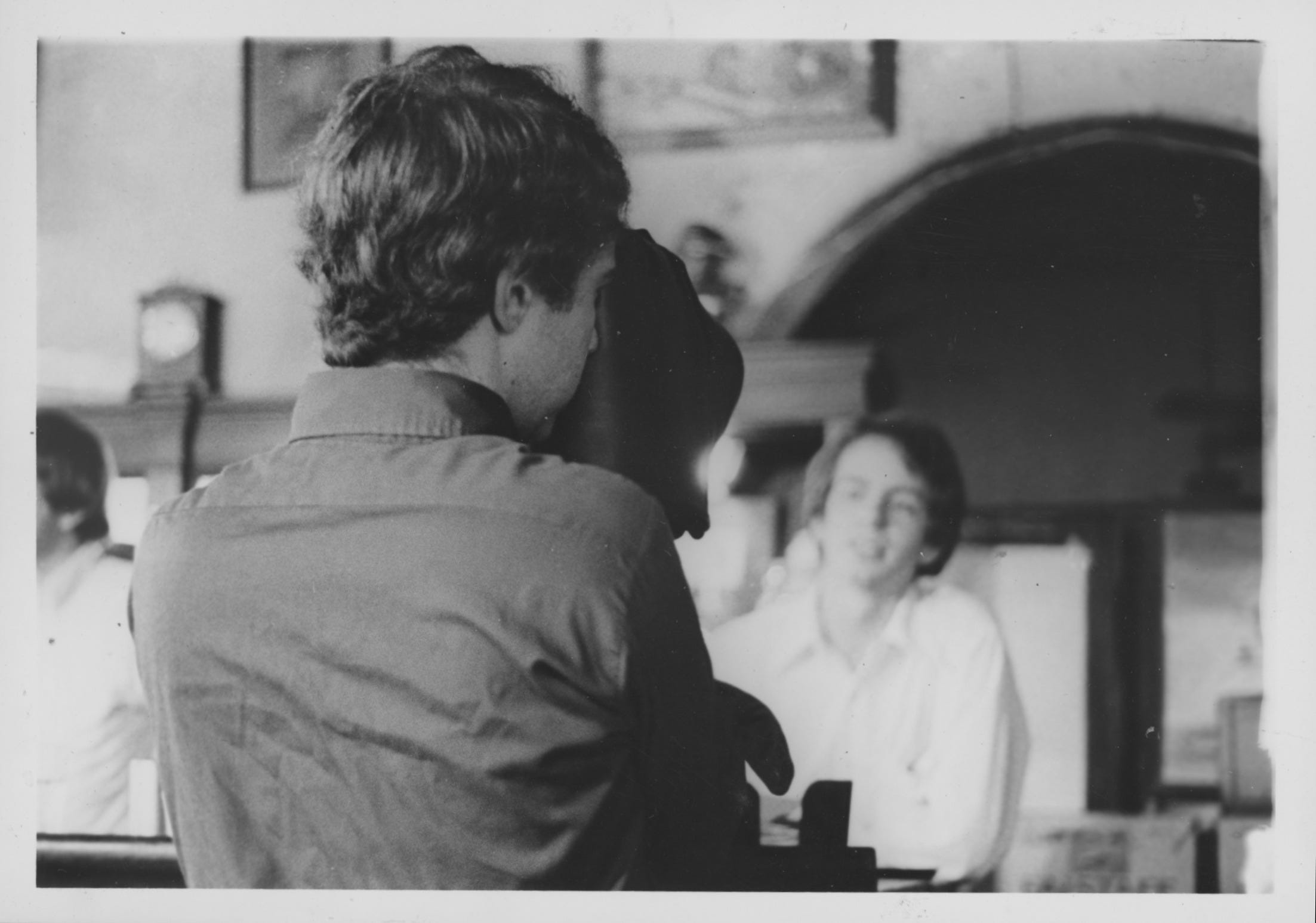
I had to immediately cut down the script and adapt it on the spot to fit my assembled cast of 17. We blasted through the movie, rarely shooting more than one take, including a bold “one-er” lasting a minute that I’m happy to say Lee and I nailed. Some of the scenes were impromptu one-take wonders: David Dybek was at table 5, and even though I had something more extended scripted for him, he told me that he was late for work, so moments later we shot him telling Lee that he couldn’t wait for his sandwich and had to go. He walked out of frame, out the door, and never stopped. In retrospect, I’m shocked that no camera or processing errors resulted in anyone disappearing from their table in a 24th of a second.
The “opportunity in disguise” revealed itself in that shooting this fast actually came up with that missing energy of the movie. By two p.m., I had covered the 11 minutes of screen time that took place in the front room. In the kitchen, the “Cook” was initially played by my high school buddy Kevin McDermott, who some of you might know from an earlier posting. Although he is one of the funniest people you will ever meet, this did not translate to Acting. His body language was more like he was being shot with a 9mm Browning Hi-Power16 than a Super 8mm Beaulieu. Sprinkle in a dose of Ralph Kramden on live TV.
In the best tradition of Roman Polanski in Chinatown and (later) Sydney Pollack in Tootsie, your faithful director took over behind the counter and in front of the camera. 17 Forgetting for the moment that Kevin would have been worse had he indeed appeared in the movie, I rank my performance as the worst by a white male in film history. Eva, who never cuts me slack, says that I’m being too harsh, but I think for once she’s wrong. I’ll let you decide. Here’s one of my best/worst lines:
0:00
-0:02
We were shooting with two Beaulieu cameras, and if my memory is correct, the 5008 “A” camera, operated by Steve Tyler, was umbilical cord tied to the Super8 Sound Recorder II (fullcoat recorder), and my 4008 was under crystal control. Both cameras had padded “blimp-silencers" (Super8 Sound’s term) which did a good job of reducing their noise. (And you thought Christopher Nolan was the first person to make a camera safe for sync sound recording. Ha!)
When I got back the processed film, one problem revealed itself: The T-stop of the Steve’s 5008 wide-open was much “faster” than my 4008 at its maximum aperture. I groaned when I realized that everything that I had shot on my camera had a grainy green cast due to the underexposure.18
I knew from the beginning that I was going to make a workprint from the reversal original footage. Because Super 8 has never had printed-in sequential edge numbers, I had to develop my own system—now that I think about it, the one thing that Super8 Sound didn’t detail in its documentation—to mark the workprint and original in the synchronizer with a Sharpie-written Morse code to aid in “negative” conforming. (Here19 is the summary of that technique that I sent Steven Soderbergh in 1982 so he could adapt it for his work in making what might be his best movie, Rapid Eye Movement.20)
Because the frameline in Super 8 is so small, I didn’t just conform the original footage, I checkerboarded it into A/B rolls using a Bolex cement splicer. I had Leo Diner Films of San Francisco make a “release print” that was mag striped.
I then set about mixing the movie with the Super 8 fullcoat edited master playing back in sync with my Elmo ST 1200D projector. The sync process was a hoot: Having made a punch hole in black leader that corresponded to a start mark on the mag master, I put a Super8 Sound “Photostart” in front of the lens and when it flashed the punch, the Super8 Sound Recorder II started, the speed governed by a separate 1/F cable from projector to the deck. It sounds crazy, but it worked and held sync for all 15 minutes. I simultaneously flew in a background walla track from a cassette deck, recording the mix on the print’s mag track in the projector.
Cut to, as we say, the first screening, which was in the E room at the Nap House. People told me that they loved it, but wish they had been able to understand more of the dialogue. I think they were too kind to say “some of the dialogue.” I can’t blame Georges, who recorded it, and can only say that the combination of lack of real dialogue editing, lack of any fucking clue as to what I was doing, sharp sounds (bottles and plates down), no compression, non-professional actors who didn’t project, deliriously wrong EQ21 … that screening has traumatized me to this day. When I’m mixing dialogue, I’m insanely fussy that every non-throwaway line is up-front and intelligible.
Let’s not forget the easiest way to make a bad sound job worse: We had a steaming, screaming turd of an “ADR” line. (In quotes because we just made a wild recording and called it a day.)
But, I learned many lessons, which was the goal.
What I first wrote to be the eponymous 30 Minutes was whittled down to 15 Minutes after editing, and that’s what I called the movie in the subsequent decades. I was astonished to find out, when I did a “restoration” of it back in 2010, that the length is in fact 14 Minutes. If you round up.22
In part two I’ll continue with my adventures in Super 8—the mysterious Georges and the movie Shirkers and the crazy story of the home lab where my movies were processed.
Like all the words in What’s a binky?, these are © 2026 by Larry Blake. All rights reserved.
“Is Truffaut the Happiest Man on Earth?” Esquire, August, 1970.
I can’t imagine how many other “student” movies have used Grieg to a frantic end.
Today it amazes me how often filmmakers don’t keep track of their master sound elements, and the rude awakening they get when they have to restore a movie. This happens all the time, on Professional Movies shot in 35mm and costing millions of dollars. I should benefit from something of a Get-Out-of-Jail-Free card because Treachery was truly Amateur.
This was not the first attempt at bringing Super 8 into the world of serious filmmaking. Best known is the work Richard Leacock had done on a crystal-sync Super 8 system when he was teaching at MIT in the early Seventies. Before that, there was the Bell & Howell Filmosound Super 8 system, adapted from its earlier 16mm incarnation, but this was by no means designed for professional-adjacent uses.
Right after I left LSU, a group started up there at Coates Hall, led by a filmmaker named Michael McCallum, which is where Steven Soderbergh first learned the ropes. More on this in the next part.
See this 1973 video explaining what was going on then and there.
The muff at the Nap House is still my favorite in NOLA. The antipasto salad has remained consistently great, and more importantly, theirs are heated, as opposed to the “original” cold ones at Central Grocery.
This is the room behind the bar, and the name came from “Elba,” the island where Napoleon was exiled. Some waiters there today say it stands for “Emperor,” but they’re wrong.
Also wrong: The carriage tour drivers in the Quarter, when passing by the Nap House, would often say, “And this is where Napoleon stayed when he visited New Orleans.” In the summer, when the side doors were open and I could hear this, I would rush outside and yell to the poor tourists in the carriage: “He’s lying! Napoleon died on Saint Helena!”
The Napoleon House, then and today, only plays classical music. I have no music in the film, which Nap House aficionados said was an omission.
In the top back corner of the room, near the left arch, is the tray where the TV was in that scene. The Nap House has not only never played rock music, it has never had a TV. Everything else in JFK is true … NOT!
If you walk in the main room at the Napoleon House, above the arch on the back right is an etching of the room done in 1978. It shows me approaching the bar, Lee in the back scraping tips off of table 6, and seated at table 8 waving is Rangoon Johnny. A true New Orleans French Quarter character: He cleaned the place before we opened, but was fired when Sal caught him pissing in the mop bucket. He earned his “Rangoon” sobriquet because he would accost fresh-faced Lee and Larry, exhorting: “You’ve never been in the jungles of Rangoon, son! You’ve never been in the Greek Navy: Two boys, one blanket. You get what I’m sayin’, son?”
My sister sat at his table. Well, at least her nose did as that is the only part visible in the final movie.
Neither Peter Gabriel’s So album nor Cameron Crowe’s directing career existed in 1977, and boom boxes were just getting started, so I’d have to make do with a cassette tape recorder.
Text within this block will maintain its original spacing when published
Ooh, I need your love, babe
Guess you know it's true
Hope you need my love, babe
Just like I need you
This is what assistant directors say after a take, busted or not, for everyone to go back to that set-up’s starting positions. Not starting the whole movie again.
Then I only knew of this 9mm model because it was what Frank Serpico carried to protect himself from other cops.
Tune in next week for yet another strange-but-true story, this one about the home in Philadelphia where the footage was processed.
Looking back now, given that I only did the workprint, A/B roll cement splice procedure twice, the last being four years before this letter, I’m amazed I had such recall of the specific steps. Are these things only a young brain can do?
I boosted the low-mids I think because I read somewhere that that was where the energy on the voice was, not realizing that it was definitely not the location of the clarity of the voice. Help me, Jesus.
Today I never deliver the sound for a movie without creating an LFOP (Last Frame of Picture) sheet that documents key scene and edit locations throughout the movie. I know to the frame the length of movies I work on.
Comments
Nothing yet. Say the first thing.
Sign in to join the conversation.