
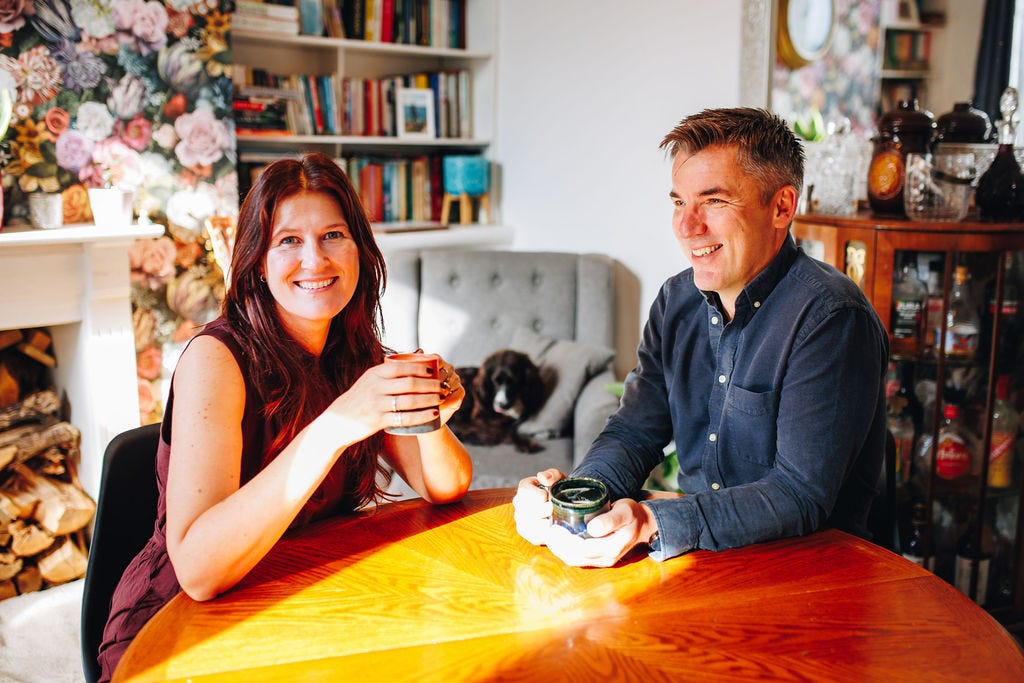
We want to say a huge hello and welcome to all our lovely new subscribers, many of whom joined after Caroline’s LinkedIn live collab with Fundraising Everywhere last week.
Also, extra big hugs to Sophie, Lucinda, Chloe, Lauren and Rebecca who have recently upgraded their subscriptions to paid. Thank you for keeping the iced coffees flowing over here during these warm summer days.
We appreciate you all very much.
…we’ve finally gotten around to booking our summer camping holiday!
This means that we can confidently forecast rain in approximately two weeks' time (because it wouldn’t be a Cornish camping holiday without at least one daily downpour).
Congratulations to any parents out there who like us, are clinging on for dear life as the school year finally draws to a close. There’s the inevitable additional admin - speech day, leavers discos, work experience round 2, residentials, lost property panic, unplanned mufty days (‘No, I don’t have a pound!’) and phone calls from frustrated teachers about children who have unequivocally given up / checked out where homework is concerned.
Once we’re clear of the morning school run and Caroline is no longer channeling Julia from Motherland, we’ll be celebrating with an Aperol Spritz and a Sainsbury’s Millionaire’s Cone (arguably the best own brand Cornetto dupe available - very cheap, very delicious).
Since March, Caroline has been undertaking monthly research into Donor Advised Funds, everything from reading articles, attending training, listening to podcasts, reaching out to DAF representatives (with varying levels of success) and many awesome conversations with Nest Egg readers who have shared resources and contributed their own experiences
Today’s article is Caroline’s reflections after four months of immersing herself in everything to do with DAFs.
She’s honed her learnings to five key things which she feels are most useful for fundraisers to know.
So in short, if you read only one article about DAFs, make it this one!
Wishing you a great week ahead, and remember to treat yourself to a box of Millionaire’s Cones (Sainsburys have not paid us to say this).
Caroline and Tony
by Caroline Richardson
Back in March, I set myself a challenge.
My plan was to spend a bit of time each month learning all I could about DAFs, and to share these discoveries with paying subscribers to the Nest Egg.
I set out my plan in this post. Paying subscribers can go back and read the detailed monthly posts in the archive.
If now is a good time for you to upgrade your subscription (perhaps you’re on a DAF-related learning mission too and fancy a handy shortcut?), go ahead and push the button…
For July, which is halfway through this nine month endeavour, I wanted pause, reflect and share the most important things I’ve learned with all Nest Egg subscribers.
Here’s the stuff which has stuck with me:
If you’re a fundraiser, DAFs are definitely something to know about.
But knowing about them won’t mean that you suddenly find yourself with a fresh list of untapped prospects. Expectations must be managed.
They’re not the same as charitable trusts and work in a very different way. Reaching out to DAFs directly is not what any of us should be doing.
Know that DAFs are more major donor adjacent than trusts and foundations adjacent.
If you work in a large fundraising team, ensure that ‘understanding DAFs and strategically positioning your organisation so that you can comfortably receive DAF gifts’ sits with your major gifts team.
There are actions you can (and should) take, but they’re probably not the actions you might think of (at least until you’ve learned more about what DAFs are and how they work).
Practical things fundraisers can do:
Use your website to speak directly to DAF holders / prospective donors. Explain that your charity welcomes gifts via DAFs and give your charity’s name and registration number to make it easy for them. Here’s an example I did for my client recently.
Speak to your major donors about DAFs. Ask them if they use DAFs as part of their philanthropy (donors will often make donations from multiple places) so that you can administer their gifts correctly.
Learn the basics of Gift Aid as it relates to higher rate taxpayers.
Learn also about accepting non-cash gifts e.g. property, shares, crypto, whisky, wine, gold etc…
Know who the main UK DAFs are, what makes them different to other DAFs and the names of their staff and trustees. Source connections via your own board of trustees and use LinkedIn to connect.
Engage with DAF published content. Many will host events or will share articles on their own websites, in newsletters and via LinkedIn. Add your own reflections in the comments or via DMs to build your own knowledge base, your network, your credibility and your influence.
Should you be lucky enough to receive a gift via a DAF, work to build a relationship with the representative.
Also relevant for invite-only trusts (actually all trusts for that matter), but governance where DAFs are concerned is everything.
Donors using DAFs will absolutely suss you out in advance of making a gift. This has been the consensus amongst every DAF representative I’ve heard from during the course of my research.
There’s a governance checklist in this article.
Make some time to go through it and check your house is in order.
Another consensus from the DAF professionals and probably my most important learning over the course of this project.
We can tinker with our websites and insist upon governance reviews all we like (and to be fair, as fundraisers we really should involve ourselves in these activities), but ultimately, if we want to raise more from DAFs, we need to build relationships with major donors aka, the people who actually use DAFs.
I guess the elephant in the room here is that given the rise of the use of DAFs and the fact that major donor fundraising is currently the preserve of mostly larger charities (Small Charity ROIs 2026 highlighted just how few small charities are doing major donor fundraising in comparison to large charities), are we likely to see an acceleration of the wealth gap that already exists in our sector?
Are DAFs to ‘blame’ for this and should we make an argument against their use?
Well, I don’t know, it’s hot, I’m working to a deadline and this is probably an argument for another day.
But I truly believe though that major donor fundraising is for charities of all sizes, so long as you are consistent in your practice and manage expectations in the early days.
If I could offer one piece of advice to charities looking to move with the times and capitalise on the rise of the use of DAFs, then I too suggest investing more time, effort and resource into your major gifts work.
Have you been following along with my DAF project?
What have you learned?
What surprised you?
Reply to this email to tell us your reflections.
Comments
Nothing yet. Say the first thing.
Sign in to join the conversation.