
Darling,
A writer friend likes to take me to task when my story turns are rendered too bluntly. “I want you to take me there,” she’ll say. “But Christ, woman, buy me dinner first.”
In other words, don’t be obvious. Don’t let it feel like math, a map, fan service. Earn it.
Among the hardest moments to earn? Third Act Breakup, darling.
In this luminous BookTok era, when romance is discussed via “tropes,” many a reader has declared they cannot stand the Act Three Tear-Apart. (To be pedantic, it’s less a trope than a nicely dramatic way of achieving the subsequent beat in which one’s protagonist suffers a dark night of the soul, but let’s flow with the vernacular.)
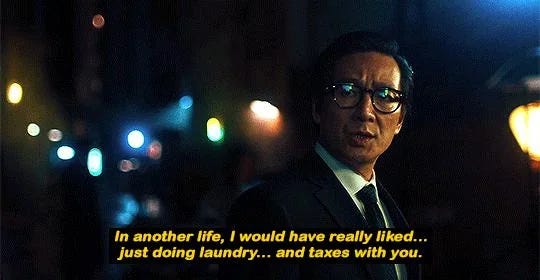
Best case, a reader means, “I loathe it deliciously.” Done well, the TABU makes us grieve, growl, and read faster, wondering how the couple could fix this catastrophe.
But. Often, readers mean: This is stupid. I see through it. I don’t believe in this break-up, so its resolution will feel unearned.
Let’s discuss.
The TABU is situated on the cusp of the book’s final burst of event. Right before the villain kidnaps your MC, say. Or just after the Big Bet is won. On the eve of the Climactic Heist. Et cetera.
The TABU creates world-shifting complication. It devastates our heroes, affecting their ability to pull off the ultimate task. Ideally, it also throws a wrench in the plot—apart, it success becomes procedurally harder.
Famously, the end of a book is the hardest bit. (Save the beginning and middle.) It’s when threads braid together. The torture of penning a rich tale is in balancing all elements to bring them to a satisfying close.
This is why the TABU often fails. The balancing didn’t balance.
In act three, the writer must land several story planes at once. Favoring the plot plane is an attractive trap.
Why? Plot works mathematically, gorgeous, so making it add up is clear and linear. So tempting to deliver that, even at the cost of character work.
I often note the Plot Trap whilst touristing other genres. I’ve read many a thriller, agape at how far astray from recognizable human behavior some go to serve a twist. Granted, thrillers must thrill. And in a world where TV fetishizes cops quipping over corpses, our culture has lost perspective on how people behave in the face of life, death, and odoriferousness.
In other words: when the focus is cleverness, the realities of being a person with a heart as well as a brain take a backseat.
But romance writers are not afforded grace when heart-driven turns are unearned.
Nor should we be. We write relationship. Relationships are history and expectation meeting reality and possibility. Characters spurred to fury, bravery, to cruelty and to self-sacrifice . . . for love.
Love is ever and only human. So these behaviors must be recognizably human. Trackable. Understandable. (They also must be as smart as the character’s previous actions—many a TABU rings false because someone is suddenly more idiotic, irrational, or amnesiac than they’ve been for the last 300 pages.)
Therefore, our most important third-act event isn’t the villain’s mask torn off, the marriage market victory, the ultimate battle. It’s that pesky breakup.
The seeds of the breakup need to have been present in the first scene.
The thing that prompts protagonists to TABU is tied to beliefs about worthiness, purpose, ability to love and be loved . . . the wrong view of themselves that is right there in Chapter One.
The inevitability of the breakup must be retrospectively obvious. Foreshadowed in their first conversation. This inner friction was always going to tear them apart.
The reader might yowl; might post that the TABU destroyed them. But that won’t be a complaint.
Break your heroes up for the plot—a fight must happen, throw gasoline posthaste!—and your reader will eyeroll and move on to other faerie smut.
And when they post Hated Tropes, TABU might rule the list.
But now you know, the list should be titled Things Writers Often Do Badly.
Simple: be bone-crushingly hard on your work, darling!
The story will work if the writer is strict with specificity and internal logic, especially when rendering characters. And if she harnesses all that character work in service of allowing her MCs to make terrible mistakes. To hurt one another in pursuit of what they think will keep them safe. To cut so deep, the wound seems lethal.
I think of it as writing myself into a corner. One thinks, Gods, I have no idea how to fix this.
It must be thus. The writer must stretch to find an answer, because the characters must stretch. The answer must be elusive, hard-won.
So: when they break up, we know we’re due an HEA, but also enjoy that it won’t be easy. Characters must face that thing they’ve been avoiding since they were hurt so badly they formed their world view around it.
The breakup is brutal because it is emblematic of this misguided view. The heart they’re actually slicing out is their own. Often, they think they’re saving the other person.
It’s a mess. It’s wrong. It can never be undone. It’s bloody awful.
It makes perfect sense. It had to happen.
They can’t possibly get to Happily till they face the thing inside themselves.
You don’t hate the TABU, darling! You hate safe writing. You hate romance so painted by the numbers that you see numbers through the paint.
But when a story is rich and deep, driven by the truth of the characters, the TABU is just one of many moments that keep you turning the pages.
Happy reading and writing! Do let me know your TABU thoughts.
LMxx
Comments
Nothing yet. Say the first thing.
Sign in to join the conversation.