
Overcome by the majestic beauty of St Paul’s Cathedral, few visitors pay much attention to the ancient statues of historical grandees that dot the church, in its nave and chapels and aisles.
That’s a pity, because one such statue is very relevant to our story. One of these worthy citizens, frozen in marble in 1799 by renowned sculptor John Bacon, was the man whose work led indirectly to this book being written, almost a quarter of a millennium into the future.
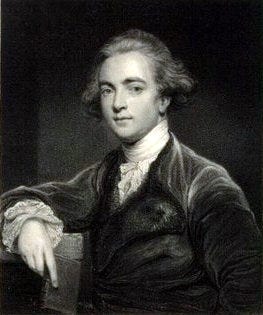
Sir William Jones born 1746 in London, was an early student of languages. A native speaker of English and Welsh, he learned Greek, Latin, Arabic, Hebrew and Persian at an early age while a student at Harrow.
Jones was a linguistic polymath. As a young man he had already learned several European languages and moved on to Latin and Greek. By the end of his life he claimed to know 28 languages, having studied to a high level English, Latin, French, Italian, Greek, Arabic, Persian, and later Sanskrit. Working with a dictionary he could read Spanish, Portuguese, German, Norse runes, Hebrew, Bengali, Hindi, and Turkish. He had studied to some degree a further twelve languages – Tibetan, Pali, Pahlavi, Deri, Russian, Syriac, Ethiopic, Coptic, Welsh, Swedish, Dutch, and Chinese.
He graduated from Oxford in 1768, after being made a Fellow of University College. He worked as a translator and tutor to George Spencer, the second Earl Spencer and ancestor of Princess Diana Spencer (whose brother Charles Spencer is the 9th Earl today). Lord Althorp took him on his grand tour of Germany, France and Italy as a companion.
Such was Jones’s renown that in 1768 King Christian VII of Denmark hired him to translate a book of Persian poetry into French, published in 1770. Further books on Persian literature followed.
However his academic work and love of oriental literature and culture was not financially rewarding, and with some reluctance he set out to study law from 1770. He continued his academic work alongside this, building on his Oxford studies. He learned Persian to such a degree that he published a groundbreaking study of the language, A Grammar of the Persian Language, in 1771.
He became a Fellow of the Royal Society in 1772 at age 26 and at age 28 published a commentary on Asiatic poetry. Samuel Johnson called him ‘one of the most enlightened of the sons of men’. [1]
Called to the bar at the Middle Temple in 1774, he was not content with being a linguist and a lawyer. He began to dabble in politics, worked with Benjamin Franklin in London and Paris on the cause of the American revolution (which he supported) but he failed to become an MP.
He mixed with the great and good of the day like Burke, Gibbon and Samuel Johnson, while working as a lawyer and publishing a famous law treatise Essay on Bailments, which was much reprinted in the 19th century and is still in law libraries today.
His pamphlet on the defects of the British constitutional system (in light of the successful US war of Independence, of which he was a fervent supporter) was even the subject of a trial for seditious libel in 1784, the outcome of which changed British law on libel (cf. R v Shipley, 1784).
In 1783 he married and moved to India to take up the role of judge on the Supreme Court in Calcutta in Bengal (modern Kolkata), and was knighted that same year.
He combined administering the law with studying Indian literature and culture, and produced a number of books on various aspects of Indian poetry, philosophy, music and botany.
He admired Indian culture and believed that Greek philosophy, as in the works of Pythagoras and Pato, had a common source to Hindu philosophy. This is less surprising when one considers the common source of both their languages, though from an earlier period.
He soon turned to the study of Sanskrit, the classical language of Indian religion and literature.
This was no longer a spoken language in the 18th century, except in religious rituals and the study of ancient texts - but it had been spoken in India from around 1500 BCE to 1300 CE. The language spoken in Jones’s time was Hindi or Bengali, both related to Sanskrit.
Sanskrit was the language of Hindu religious texts and so Jones felt he should understand it in order to better understand the culture of the people with whom he was working. He studied the Vedas, the ancient religious texts with a local Sanskrit scholar.
A further reason for learning Sanskrit was to learn about the ancient laws of Hindu society, so he could interpret them correctly in his legal judgments. He worked with local legal experts but realised he was getting only second-hand interpretations of Hindu law – and he wanted to be able to read the original texts. At the time he wrote to a colleague:
‘’ To commence without loss of time study of the Sanscrit. His reflection had before suggested the knowledge of this ancient tongue would be of the greatest utility enabling him to discharge with confidence and satisfaction to himself the duties of a judge….
As a lawyer he knew the value and importance of original documents and records… and as a stronger man of science he disdained the idea of amusing the learned world with secondary information when they had the means of access to the original sources’’[2]
He had a prodigious memory (he learned Shakespeare’s ‘Tempest’ by heart at 12, and wrote out a copy from memory as he didn’t have long-term access to the book), and was very disciplined – he rose at dawn to spend an hour on Sanskrit grammar before starting his day as a judge.
He continued to deepen his knowledge of Sanskrit and translated many works of poetry, literature, laws and philosophy into English – translations made for the first time.
He developed what became known as the Jonesian system for the transliteration of Indian languages, so that Indian texts could be read in Latin script without a knowledge of the Indian alphabet. This system became the international standard and is still in use today in a modified and updated form as the Hunterian transliteration system.
The Society
In 1784 he founded a new society in Calcutta, the Asiatic Society, to promote the study of Indian language, culture and literature – as yet a fairly unresearched topic in the West.
He became its first President, and held the position for the rest of his life, organising the meetings and writing a lot of the papers published by the society.
He and the society members studied Indian culture, published essays, gave speeches, and translated Indian works. Jones published many translations, which were praised by no less a poet than Goethe, who used them to learn about Indian literature.
The Speech - February 2, 1786
You are reading this because of the speech Sir William Jones gave on February 2, 1786 in Calcutta at the third annual meeting of his Asiatic Society.
In this speech on the history and culture of the Hindus he spoke about the Sanskrit language, and described his discovery, in these words that would be quoted across the world for the next 250 years:
‘’ The Sanscrit language, whatever be its antiquity, is of a wonderful structure; more perfect than the Greek, more copious than the Latin, and more exquisitely refined than either, yet bearing to both of them a stronger affinity, both in the roots of verbs and the forms of grammar, than could possibly have been produced by accident; so strong indeed, that no philologer could examine them all three, without believing them to have sprung from some common source, which, perhaps, no longer exists; there is a similar reason, though not quite so forcible, for supposing that both the Gothic and the Celtic, though blended with a very different idiom, had the same origin with the Sanscrit; and the old Persian might be added to the same family.’’ [3]
In this, the ‘philologer speech’, he outlined his theory that Sanskrit, Latin and Greek had a common root, a common parent language, and they might also be related to other language groups such as Celtic languages, Germanic languages and Persian.
This speech, and the further development of his theory through subsequent essays, had a huge impact on the academic world. Linguists were immediately captured by the theory and across Europe scholars turned their attention to the study of the links between Indo-European languages and later the theoretical reconstruction of the original Indo-European language.
The Impact
Modern scholars consider his insights to have been ground-breaking, creating a new field of science:
‘’Jones’s brilliant suggestion put linguistic scholars on the right track of conceiving human speech to be groupable in families members of which were derived from a common archetype…….’’ [4].
Jones’s theory led to the development of modern comparative philology or comparative linguistics and the study of the Indo-European languages, including the parent language itself which had died out. As a result ‘’in this sense Sir William Jones was the first modern linguist.’’[5]
But the impact of such a discovery went further than just illuminating linguistic history. His theory of ancient languages challenged the accepted (even by him) religious teachings of the time:
‘’his theory is one of the most important in the history of ideas, and ultimately marked the end of the conception that God gave Hebrew to Adam as a direct gift of the first language, initiating the separation of religion from linguistics, which could then move toward science’‘[6]
That view, that ‘’his theory is one of the most important in the history of ideas’’, also meant that he had an impact beyond language and linguistic study. The settled view in Western society was that India was primitive and under-developed, and lacked culture. Jones’s work making Indian literature, poetry and philosophy available to Western scholars started to change that view. And his theory that Sanskrit, the Indian language, came from the same common parent as Latin and Greek, possibly through migrations of people who settled northern India, revolutionised the understanding of Indian history and its place in world history. The theory of migrations will be the subject of later chapter.
Cognate examples
How did his theory arise? Through his study of Sanskrit, he noticed many similarities of vocabulary with the Latin and Greek languages he had already learned. He made a note of what we now call cognates, words that are ‘cousins’ to words in other language, derived from a common parent (however distant that parentage may be).
He noticed that the most common and frequently used words in one language – numbers, family relationships, parts of the body – seemed to be very similar across a number of languages.
Here are some of the most obvious examples that would have jumped out at him, and other scholars of the time. The cognate link to Proto-Indo-European (PIE) shows the shared history, but it’s not necessary to know this to see the relationships with English.
These initial items are easy to understand; in the second part of the table, one needs to know a little about other languages to see the connection which has been muddied by historical language change.
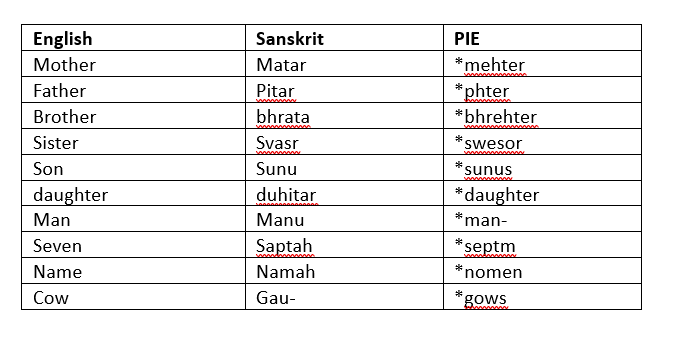
For example, the Sanskrit for tooth was dant, from the Proto-Indo-European word *dent-. From these roots we get our words dental, dentist etc. But Old English toð had lost the /n/ sound when developing from Proto-Germanic *tanthu-. Old High German was zand, as in modern German Zahn.
Some are less obvious, like Sanskrit veda meaning knowledge, especially ritual knowledge. This is from the Sanskrit verb vid- to know, from PIE *weid to know, to see. This is cognate with German Wissen, to know and Latin videre, to see.
How do we see that in English? The Old English verb was witan, to know, from which we get the word wise, knowing things, and wit, with a changed meaning. Shakespeare used ‘God wot’, God knows.
NB The list in this table uses a ‘clean’ spelling of the Sanskrit words without diacritics (accents on the words) which would be used in some transliterations. As Sanskrit is written in its own non-Latin script, spellings in the Latin alphabet are always approximate, and diacritics are sometimes used to show features such as long vowels and emphasis – less necessary here in showing the cognates.
Language Families
Jones’s study of Sanskrit led him to see the similarities - the cognates - with Persian, Latin and Greek. He saw these as evidence of a language family - the first person to use the concept of kinship as a way of describing the relationship between languages.
In doing this he laid out the framework for the Indo-European language family that would spur on scores of 19th century linguists to analyse and re-construct scientifically the ancient forms of the language. (Bopp, Verner, Grimm etc)
Jones moved away from observing random cognate similarities to build a theory of genetic and familial relationships over time, which gave us the concepts of language families and language change over time. These concepts seem so commonsensical as to obscure how groundbreaking and original they were at the time.
He was the first to use family terms such as ‘sister’ to relate Sanskrit and Latin languages, as part of a family tree.
He insisted on avoiding the random similarities observed (eg via folk etymology - where words are coincidentally similar). He tried to be more scientific, looking at word derivations and the use of inflections (from grammatical cases) in different languages.
He identified the families of Indo-European as Germanic, Slavic, Hellenic, Romance, Iranian and further identified the subfamilies of Indo-European.
He noted for example the Indic family of Sanskrit, Prakrit, Bengali, Hindustani and even Romany, and also the Hellenic family of Doric, Aeolic, Attic languages, and the Germanic subfamilies of English Dutch Swedish and Gothic.
He understood that Lappish, Finnish and Hungarian belonged to their own family, Finno-Ugric, and suggested Turkish was related to Mongolian.
Proto language
We now call this earlier, unrecorded language a protolanguage, though this was not a term Jones used. This common source language might be unattested, not available in any written form, but it could be reconstructed on the basis of the word forms in the later languages.
This common source language has been re-named ‘Proto-Indo-European’. The ‘proto’ label referred to the fact that the parent language is a theoretically reconstructed form, based on analysis of the daughter languages which kept or didn’t keep its words and features.
Jones presented the concept of language families in a variety of essays while in India.
He didn’t use the term Indo-European (which was not coined until 1813 by Thomas Young), but looked at the range of languages in Europe and India and saw the connections.
He was not wholly right in his postulation, as he included Egyptian, Chinese, and Japanese in his language group, but excluded Hindustani (Hindi) and Slavic languages (which are both Indo-European in origin).
He did not try to reconstruct the original Indo-European language but understood that it ceased to exist after splitting into the different family groups.
He did not write much about the movement of people but suggested that the Indo-European speakers moved west, centred on modern Iran while the Indian speakers remained in India.
Jones was not the first
Jones has been rightly credited with founding the field of comparative linguistics, but scholars have also pointed out that he was not the first person to make the observations about languages being related. Lorenzen gives a very detailed account of earlier scholars commenting on language similarities, though they were hidebound by a focus on biblical history which they could not gainsay.
‘’ the various early European linguists who commented on the similarities among European languages shared a belief in the derivation of these languages from those spoken by the groups of people descended from the three sons of Noah — Japheth, Shem, and Ham — and associated the (yet to be so-named) family of Indo-European languages with one of these three families of people. Almost all these scholars, except Jones, associated the ancestral Indo-European with Noah’s son Japheth. Jones preferred to associate it with the descendants of Ham. [7]
Josef Eskhult, claims that a Dutch scholar Marcus Boxhorn (1612-1653) “was the first to propose the theory that German, Latin, Greek, and Persian derive from a common source, which he designates as Scythian”[8].
A modern biographer, Mukherjee, suggests Jones was “well aware of these developments” because of the same 1779 letter mentioned above. Jones wrote “Many learned investigators of antiquity are fully persuaded that a very old and almost primaeval language was in use among these northern nations [of Europe and Asia] from which not only the Celtic dialects but even the Greek and Latin are derived” [9]
Metcalf notes that in 1686 a Swedish scholar, Andreas Jäger, gave a public lecture in Latin in Wittenberg in Germany. In this lecture (republished in 1774 and thus perhaps known to Jones) he suggested that there had been ‘’an ancient language that once was found in the region of the Caucasus mountains and then spread to Persia and Europe, becoming the ancestor of Persian, Greek, Latin and Romance languages, Slavonic, Celtic, Gothic, and other Germanic tongues. ‘’[10]
Jäger’s theory (summarised by Metcalf [11]) also suggested that the ancient language (which he referred to as ‘Scythian’ had been a parental language and its follow-on languages were described as ‘daughter’ languages. Like James Parsons later he thought this ancient language had something to do with the story of Noah’s son Japhet.
In 1767, an English doctor James Parsons published Remains of Japhet: Being Historical Enquiries into the Affinity and Origin of the European Languages. This lengthy treatise used a list of words from different languages to suggest there was a common source to at least some languages. He studied 1000 words of Irish and Welsh in detail and suggested they had developed from a common language – but still biblical in nature, from ‘the house of Japhet’.
His theory was that many of the languages of Europe, Iran and India were related, developing from some early common parent. [12]
Legacy
It is clear therefore that Jones was not the first with this insight into language families. He was the first to make the connections so clearly, to separate language history from religious views of history, and to spread the concept more widely – especially through his wider work on Sanskrit and Indian culture.
Earlier scholars had found cognates between languages but were hamstrung by their Biblical ideas, and felt that these just showed the languages relationship back to the original Hebrew.
He was the first to break with these religious restrictions. Thus his contribution is essential, and is rightly credited with the foundation of modern comparative linguistics and our sense of the deeper commonality of western and eastern languages, history and culture.
Jones died not long after his groundbreaking work, in 1794, but left an enduring legacy in the study of the Indo-European language family – and in the 21st century, the archaeological and genetic study of the people who spoke that ancient language.
He had an influence beyond language, because in linking Sanskrit to European history, and writing about the glory of early Indian literature, astronomy, philosophy and civilisation, he changed the way that Europeans thought of India and its history and culture.
No posts
Comments
Nothing yet. Say the first thing.
Sign in to join the conversation.