
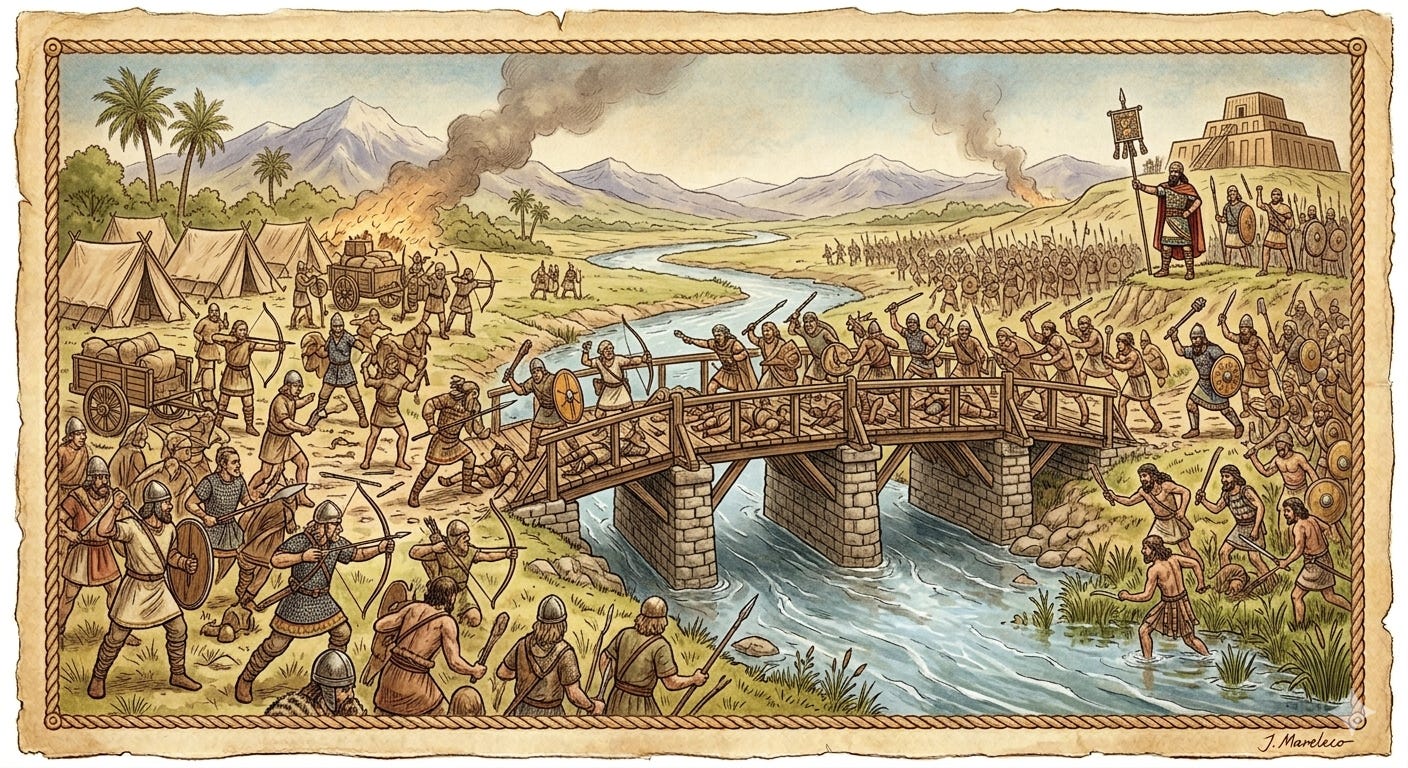
The history of English is a story of language battles, but occasionally a battle might have a linguistic significance, a chance to gain some linguistic insights into a very distant time without written records.
The Battle of Senlac in 1066 is one of those – the Battle of Tollense may be another. This was a large-scale violent battle fought over a bridge in central Europe, in the area of modern Germany just west of the Oder river, marking the modern border with Poland.
There is no record of the Battle of Tollense. We did not know about it until 1996. I had never heard of it until last month, when searching for new evidence of early Germanic DNA, I discovered Andrew Curry’s article for Science[1].
The story started with the discovery of an ancient arm bone sticking out of the soil near a river bank – with, quite unexpected and shocking, an arrowhead embedded in the arm bone.
According to carbon dating, the battle took place around 1250 BCE during the late Bronze Age, at a time when the Indo-European people and language were spreading across Europe from the Ukrainian steppe. Indo-European was dividing up into dialects which became the new language families such as Germanic, Celtic, Baltic, and Slavic.
The battle doesn’t give us direct linguistic evidence like inscriptions or texts, but provides informative context about the time, the place, the people, the DNA and possibly the language spoken then.
Experts think that this may have been a battle involving early Germanic-speaking people – whether as aggressors or defenders, we don’t know. At least one side of the fight is likely to be the people belonging to the people of the Nordic Bronze Age archaeological culture (1700-500 BCE), who were known to have lived in this and the wider region around this time – the descendants of the earlier Corded Ware culture which had spread from the Ukrainian steppe along with its languages.
We know the date of the battle because of the carbon dating of organic material found in the excavations, an archaeological analysis of the types of weapons and clothing found with human remains, points to this particular date in the late Bronze Age.
It was a large battle, involving an estimated 4000 warriors. So far, from a partial excavation of the riverside battle site, they have found 150 skeletons with extensive battle injuries, and archaeologists estimate a total death toll of around 750-1500 people, suggesting a fighting force of 4000-5000 warriors, suffering a 20% casualty rate (considered usual for hand-to-hand combat). It was violent – people had been clubbed, stabbed, slashed, cut and pierced with arrowheads.
Who was fighting whom? Originally it was thought this was a battle between two warring tribes, but later evidence suggests that this was an attack on a group of merchants bringing their trade across from the east of Europe towards the Germanic lands (or vice versa). So it was an economic raid rather than a fight over territory[2].
The DNA evidence suggests a fairly homogeneous population genetically, though teeth isotopes showed that some had come from further away. And some of the artefacts like arrowheads matched those from the Czech Republic, 300 miles away.
So it was probably a battle between elements of related cultural groups, with one group not from the local region, rather than an invasion by distant and unrelated tribes. This fits the Indo-European migration story – both north coast and central Europeans would share steppe ancestry even if they lived far apart. One theory is that Germanic warlords from southern Germany joined forces with those further north to attack this lucrative trade route[3].
It is claimed to be the oldest battle site in Europe, and one of the largest prehistoric battles known to history. The battle has even been dubbed the ‘Pomeranian Troy’, compared to the battles described in Homer’s Iliad of around the same period[4].
Significance
The significance of the battle is that it takes place in a location where we know about the archaeological culture of the local people living in the region at the time, and we know what language they were speaking in this location later in time – namely Germanic – and so we can risk some assumptions about the language they spoke at the time of the battle.
The genetic evidence found in the human remains in the excavation of the battle site suggest that the people there belong to the same genetic profile as the Germanic tribes of northern Germany and southern Scandinavia, showing also that they carried ancestry from the southeastern steppe. Some of them also showed ancestry from further south in the heart of central Europe – so perhaps invaders, mercenaries, traders passing through.
The detailed genetic evidence of the Y-chromosome DNA found in the skeletons points to Germanic people. Some of the samples had DNA haplotype such as R1b-Z2118 and I2-Y3672 which directly match the Longobard tribes who originated in southern Scandinavia before migrating south. These haplotypes also show they have a recent TMCRA - ‘time before most recent common ancestor’:
‘’Supporting the nature of these peoples as directly related to Pre-Proto-Germanic peoples is the fact that subclades R1b-Z2118 and I2-Y3672 (with a quite recent TMRCA just before this battle) are found among Longobards. In fact, strontium analyses show WEZ56 and WEZ57 (the R1b-Z2118* guy) probably spent their childhood in Scandinavia (Price et al. 2017), fully compatible with the hypothesized origin of Longobards in southern Scandinavia[5].
Thus it’s not too big a step to suggest the people whose remains we can study might be members of the early Germanic tribes, speaking an early form of Germanic. It seems we have evidence of Germanic-related people speaking early Proto-Germanic or perhaps the earlier form of Pre-Germanic around 1250 BCE (see next chapter).
The battle size and ferocity has also shocked archaeologists of the Bronze Age, an era that they had previously known as fairly peaceful, lacking major wars and large-scale battles, at least here in Europe. And these were not farmers defending their land, but professional fighters, says Detlef Jantzen, chief archaeologist for the state of Mecklenburg-West Pomerania.
‘’ twenty-seven percent of the skeletons show signs of healed traumas from earlier fights, including three skulls with healed fractures. “It’s hard to tell the reason for the injuries, but these don’t look like your typical young farmers,” Jantzen says[6].
The only comparable events known hitherto to have taken place during the Bronze Age were in the Fertile Crescent, such as the Battle of Tel Megiddo in 1457 BCE – immortalised in the biblical reference to Armageddon, and the Battle of Kadesh in 1274 BCE between the Hittites and Egyptians, the earliest battle for which we have evidence of strategy. And of course the legendary Battle of Troy, dated by Eratosthenes to the period 1194–1184 BCE – just after Tollense.
Why now?
Archaeologists like Kristiansen[7] point out that this was the era of the so-called ‘Late Bronze Age Collapse’ in the Mediterranean region. The highly sophisticated civilisation of Mycenae collapsed at around the same time (ca. 1200 BCE), the Egyptian pharaohs were under attack from the Sea Peoples - the world was in turmoil, and perhaps the ripples reached Tollense. Europe was becoming more warlike:
“Around 1200 BCE there’s a radical change in the direction societies and cultures are heading,” Vandkilde says. “Tollense fits into a period when we have increased warfare everywhere[8].”
And not long after Tollense, settlements in this north German region start to build heavily fortified villages rather than scattered farmsteads, a clear indication of new risks and conflicts.
Linguistic & Socio-historical insights
The battle also gives us some insights into how their society and community was organised.
The large size of the warrior bands involved in this battle point to some form of social organisation or organising authority. It takes a lot of coordination and communication to assemble a fighting force of 2000 men (assuming that one just one side), organise them, train them, feed them and direct them in battle. Who organised all of that?
This kind of organisation also takes linguistic sophistication, and assumes that everybody in the warrior force understood the same language (or dialect) even if they came from different tribes and speech communities originally. It might suggest the emergence of a common dialect from various developing in the region.
It also suggests a shared knowledge of specialised vocabulary for weapons, warfare and army structure (ranks, orders, regulations).
This was a large battle involving thousands of fighters trying to control a strategic bridge over a river, or perhaps trying to attach a caravan of merchants, also points to a system of established trade links in the region. Trade links, a key trade route through the region with large numbers of merchants is not only an economic issue but also a linguistic one.
This kind of trade contact brings linguistic contact – people from different speech communities travelling, searching for food and accommodation, buying and selling their goods all requires language contact and language skills.
As well as achieving practical communication for the trading, this language contact between groups of people speaking different languages always leads to language cross-fertilisation. One language influences another, words are borrowed, concepts modified, and language change spreads through the neighbouring speech communities.
Evidence from this ancient battle can illuminate the linguistic and socio-historical context of the time and place, which was most likely an example of a Proto Germanic-speaking society in local conflict with its neighbours or visiting traders.
[1] Curry, A. 2016. Slaughter at the bridge. https://www.science.org/content/article/slaughter-bridge-uncovering-colossal-bronze-age-battle
[2] Moody, O. 2020. Oldest known battle was massacre of merchants.
[3] Schlott, K. 2019, Auf Kriegszug gen Norden.
https://www.spektrum.de/news/auf-kriegszug-gen-norden/1680250
[4] Kosinski, T. 2023. Ancestors of Poles in the Battle of the Tollense Valley, Known as the “Pomeranian Troy” . Advances in Anthropology > Vol.13 No.1, February 2023
https://www.scirp.org/journal/paperinformation?paperid=123370
[5] Quiles, C. 2020. “Local” Tollense Valley warriors linked to Germanic peoples
[6] Curry, op cit
[7] Quoted in https://en.wikipedia.org/wiki/Tollense_valley_battlefield#
[8] Curry op cit
No posts
Comments
Nothing yet. Say the first thing.
Sign in to join the conversation.