
“I think you’d really like her novella,” my mentor told me over Zoom in 2022.
The “her” in question? The singular wordsmith Nicola Maye Goldberg.
Since that fateful Zoom call, I have read her work relentlessly, from her haunting novel Nothing Can Hurt You to her shorter works in anthologies for presses Car Crash Collective and Rose Books. I even attempted to acquire her first poetry collection The Doll Factory but it never arrived in the mail.
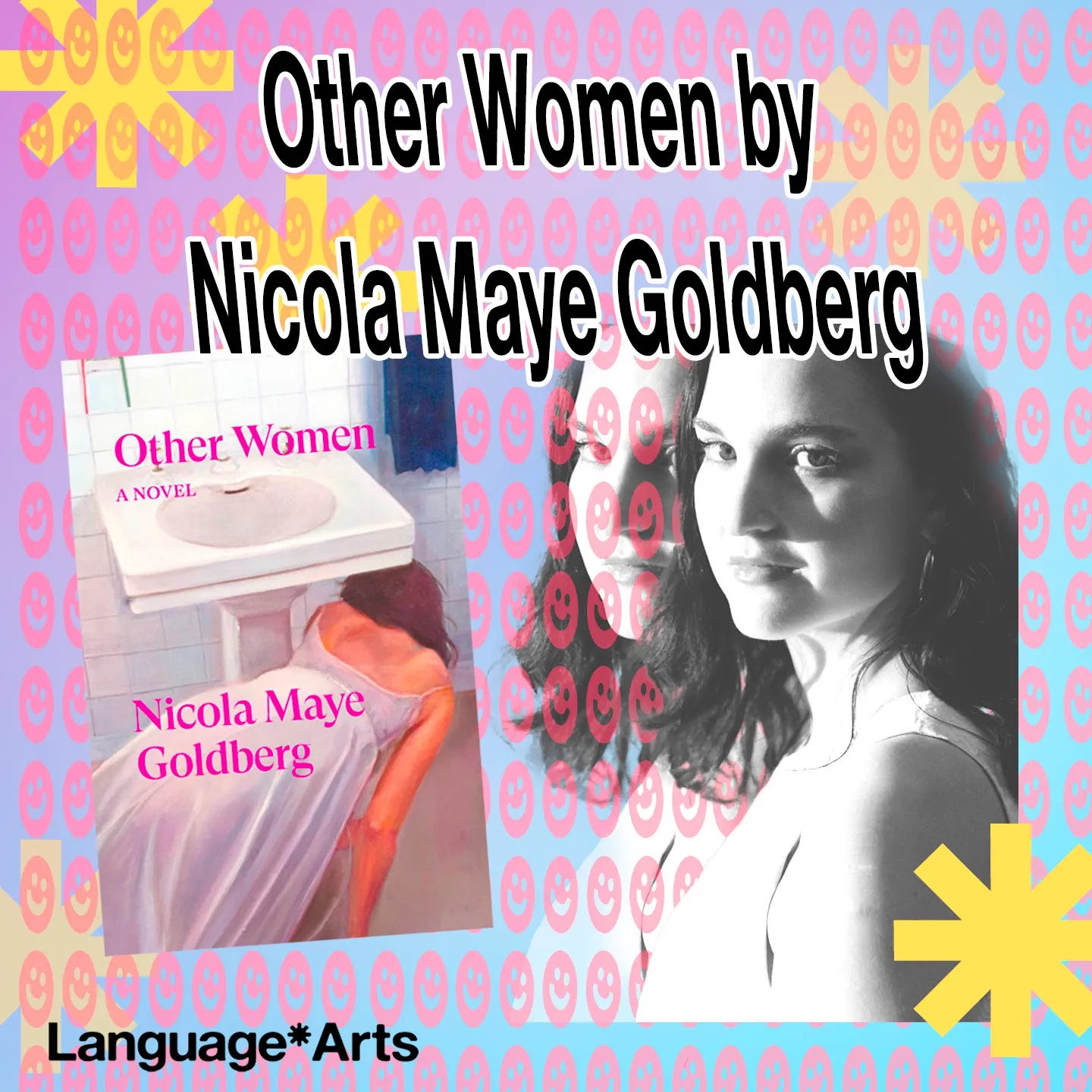
However, the novella in question is her cult classic Other Women, originally published in 2016 by Sad Spell Press and now reissued a decade later alongside some original short stories. This reissue is a tremendous feat in itself and shows how timeless and heartaching real Goldberg’s voice was, is and forever shall be.
Catherine Spino: Can you talk to me about how Other Women came to be? Was there any inciting incident that increased your curiosity or drive to tell this story?
Nicola Maye Goldberg: I was really in love with someone who did not love me back.
CS: A tale as old as time. I saw you did a Q&A at Book Club Bar the evening of the Verso edition launch and you mentioned how much you like stories where nothing happens. I love those quiet, seemingly simple moments of Other Women where plot-wise, minimal things happen, but there’s all this internal swelling of emotions. How did you approach that when you were writing and editing?
NMG: It’s just true to life, I think. I kept very detailed journals while I was writing Other Women and drew from them extensively.
CS: I am completely enamored by your prose. Everything feels so crisp and sharp, almost like nicking yourself on a cutting knife when you’re looking for a spoon in your utensils drawer. What is most essential to you when writing and editing your prose?
NMG: It’s funny you say that because I often think of writing in terms of sharp tools: Sometimes you need a scalpel, sometimes a chainsaw. An editing process I find very important now is reading my work out loud to myself. It’s tedious and humiliating, but it really works. The other was printing out the work and physically spreading it out across the floor, to get a sense of how the sequence should work.
CS: One of the most powerful things about this book, outside of the prose, is the length. It was biting and left me wanting more. What made you land with the length of the final draft?
NMG: The book originated as my senior thesis, so I only had a year to write it. Mona Simpson was my advisor — I requested her after reading her wonderful introduction to Anna Karenina — and I knew her guidance was going to be extremely valuable to me. I also knew that if I was going to complete anything resembling a final draft in that time frame, it would have to be short and very tightly focused. The length of the novel is really a function of that constraint.
CS: Was the publishing process for Other Women different from your second novel Nothing Can Hurt You? NMG: After I graduated, I went to the Columbia Publishing Course, where Shaye Areheart very generously agreed to read my manuscript. She sent it to some agents, who liked it, but told me it needed to be longer. I felt that making it longer would ruin it. Also, I was emotionally finished with the project.
I started seeking out smaller presses that would read unsolicited, un-agented submissions, until I found Elle Nash, who agreed to publish it as part of her Sad Spell Press project. I gave a copy to my teacher and friend, the late, brilliant Paul La Farge, and he gave it to his agent, Julia Masnik, who guided me along the way as I wrote Nothing Can Hurt You. It was my MFA thesis, so I got a lot of feedback as I was writing it — from classmates, professors, friends, as well as Julia, who believed in the book way, way before it was actually any good.
Almost ten years after I wrote Other Women, my beloved friend, the poet Katie Ebbitt, gave a copy to her fiancé, Cian McCourt, who is an editor at Verso, and he wanted to republish it. It was a long journey and I feel very fortunate that so many wonderful people along the way believed in this book. To summarize: I was very lucky and people were extremely kind to me.
CS: Did you have any anxieties or worries when you were working on this book? How did you push through?
NMG: Honestly, no. I was twenty-one and in love and I thought I was a genius. It was easy and fun, and I had a lot of help. Writing has become much more difficult as I’ve gotten older, which is not something I expected.
This interview has been edited and condensed for clarity.
Catherine Spino is a writer and performer from the East Coast. She has appeared in Rose Books, Sarka, Black Lipstick, House of Vlad, and more. Her work focuses on the primal, the domesticated, the anatomical, and the ethereal experience of being alive. She records her dreams daily and, most recently, wants to shoot a gun.
Comments
Nothing yet. Say the first thing.
Sign in to join the conversation.