
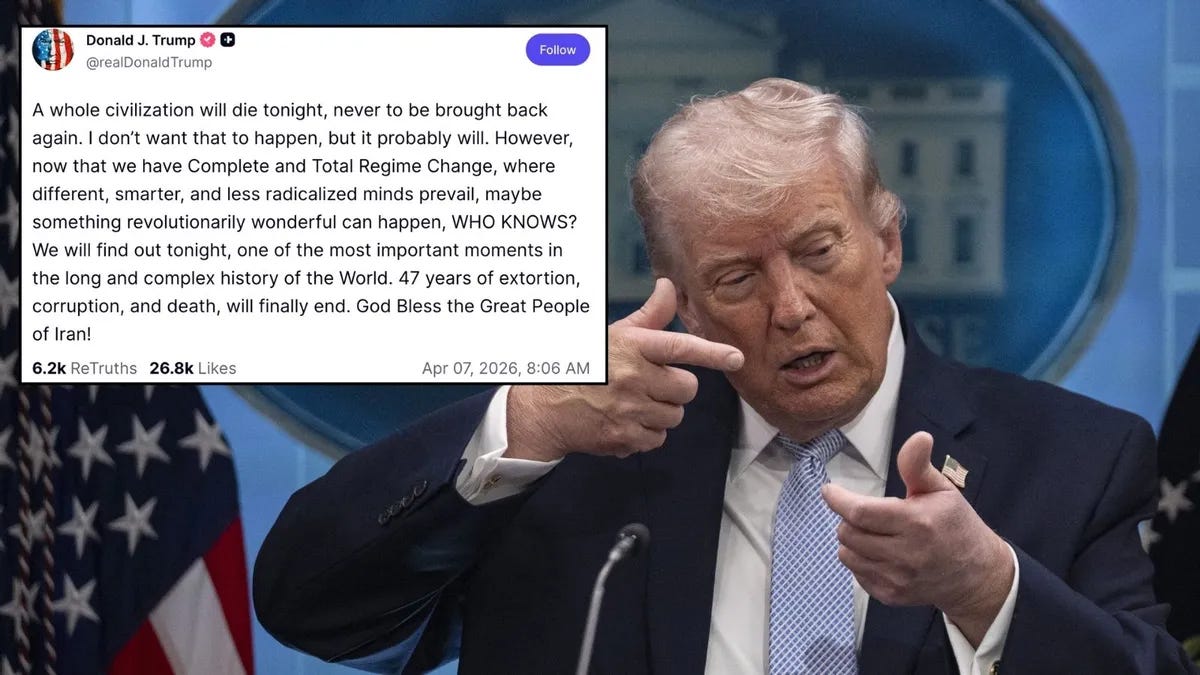
On the Tuesday after Easter, Donald J Trump, president of the United States, wrote to the world that “a whole civilization will die tonight, never to be brought back again. I don’t want that to happen, but it probably will.”
Read that first sentence again as an author, or a reader. A whole civilization will die tonight, never to be brought back again. The structure of that sentence has cadence, the message is menacing. It makes a great opening line for a thriller or the perfect ending to a noir.
But this is not a novel, and its construction is only the first disturbing thing about it. Much has been written about Trump’s meandering speeches. But Trump’s Truths, as he likes to call his posts, are the raw, unedited transcripts of a vindictive man constructing a story in real time while directing the destruction of an entire nation.
Joan Didion opened The White Album with a line: “We tell ourselves stories in order to live.” What she meant was that our subconscious tailors our lived experiences to the fiction we need to look good. As a defense mechanism, we erect a storyline against the chaos that would otherwise not let us sleep at night.
“We live entirely, especially if we are writers, by the imposition of a narrative line upon disparate images, by the ‘ideas’ with which we have learned to freeze the shifting phantasmagoria which is our actual experience,” she wrote.
The story Trump tells himself is dressed in the clothes of geopolitical necessity. The nuclear threat, the Strait of Hormuz, the people of Iran, proxy wars through the Houthis and Hezbollah are real. In his version, Iran is always the aggressor. America, a victim, only retaliates.
This will be in retribution for our many soldiers, and others, that Iran has butchered and killed over the old Regime’s 47 year ‘Reign of Terror.’ Thank you for your attention to this matter.
Yet US involvement in Iran goes back much farther. In 1953, the UK and US overthrew a legitimately elected government to protect British oil interests. The storming of the US embassy in 1979 was a reaction to that. Trump also papers over the 2015 Iran nuclear agreement painstakingly negotiated by European and US leaders that brought stability to the region until Trump unilaterally broke it during his first term.
Trump rearranges the events to fit his story. For him, the Iran Saga starts in 2020 when the president ordered the assassination of Iranian Major General Qasam Soleimani. Four years later, Iran tried to retaliate - twice:
Big threats on my life by Iran. The entire U.S. Military is watching and waiting. Moves were already made by Iran that didn’t work out, but they will try again. Not a good situation for anyone. I am surrounded by more men, guns, and weapons than I have ever seen before. Thank you to Congress for unanimously approving far more money to Secret Service - Zero No Votes, strictly bipartisan. Nice to see Republicans and Democrats get together on something. An attack on a former President is a Death Wish for the attacker!
Trump has never forgotten those near misses or his promise. He outed himself in March 2026 when he told ABC’s Jonathan Karl: “I got him before he got me… They tried twice. Well, I got him first.”
This is not the language of statecraft. It is schoolyard bravado, a mafioso settling a score. Secretary of Defense Pete Hegseth confirmed it, calling the 2024 assassination plot against Trump a “core motivation” for the military campaign.
The US policy on Iran’s nuclear capabilities is rationalization, but his personal grudge drives everything. When the world asked for his goal in the war, Trump told the truth: he wanted to kill the men who tried twice to take him out. For him, regime change has a different meaning.
Yet after he succeeded in his personal mission, the story doesn’t end. To his consternation, Iran’s revolutionary guard remains defiant and the world condemns his actions. The man who has staked his career on making America great is now overseeing what could be a global economic collapse and our country’s standing in the world.
***
It is hard to understand how we got to the point where the world would go along with a man settling a personal grudge. It starts with crude nicknames.
In 2016, Trump’s use of capitalization, name-calling and blunt talk was the mark of an insurgent trying to break into the system. As a candidate for president, Trump strutted his style as the outsider. His rude behavior was proof that he wasn’t going to do things the usual way. By belittling political rivals as Crooked Hillary or Crazy Marco, Trump stripped them of their dignity. Trump’s supporters smirked. They may not have liked some of his words, but they liked his swagger.
As a writer, this is great material. Readers love bigger-than-life personalities. Playing with their linguistic tics to convey maturity and develop character is to ply our craft.
By 2019, now-President Trump stopped ending his tweets (it was Twitter back then) with exclamations like “SAD!” “MAGA” or “FAIL!” He sobered up and uses “Thank you for your attention to this matter.” This phrase started to appear during his first impeachment trial. He attached it to a post announcing tariffs on China, signalling maturity to the world. This is his character transitioning from the insurgent to the administrator, mimicking the formal tone of a faceless department.
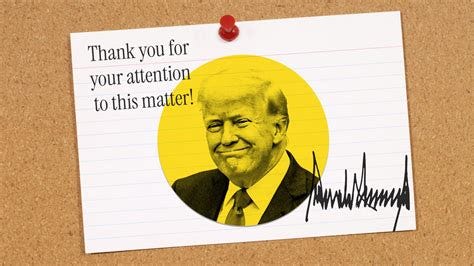
Thank you for your attention to this matter is how the apartment superintendent ends a notice reminding tenants about the trash. It’s the HR department’s email updating employees on corporate policy.
By ending his tweets with that sentence, Trump wasn’t ranting anymore. He was notifying the world about a policy change. The bureaucratic language gave his radical moves an air of legality: This is a routine matter. He’s handling it.
That is true character development.
By his second term, this staple of mid-century corporate boilerplate has become the unofficial seal of the American presidency. It is affixed to everything from sports commentary to the declarations of decapitation strikes against Iran.
What began as a sign of maturity has evolved into a rhetorical device. It serves as both a psychological silencer and a declaration of absolute, transactional power.
Thank you for your attention in this matter followed the announcement of Supreme Leader Ali Khamenei’s death. It followed threats to obliterate power plants. It followed “Death, Fire, and Fury will reign upon them.”
The effect is not ironic in a conventional literary sense. It is more obtuse: a bureaucratic nicety applied to apocalyptic content, training us to take it all in stride. Thank you for your attention to this matter demonstrates what Antonio Gramsci described as cultural hegemony. It codifies his actions by making them feel reasonable.
Trump uses possibly the most boring sentence in the English language to describe the most radical use of military force. He reduces his enemies to a resolved “matter” in a file folder. We learn to read pronouncements of mass destruction as though they are notices from our landlord.
At the same time, Trump signals that his power is so absolute that he does not need to justify it. He just needs to let us know. A statesman engages in negotiation. In this story, character Trump does not want discussion; he wants to dictate policy.
Using this catchphrase jars the people reporting on his notifications. Journalists are trained to look for new information and outrage in his posts. When he ends a post about war with a corporate cliché, it forces reporters to grapple with a tone that is simultaneously aggressive and mundane.
After threatening to blast Iran back to the Stone Age if the Strait of Hormuz remained closed, our flawed protagonist ended with Thank you for your attention in [sic] this matter, creating an unsettling dissonance.
In art, the frame tells us how to look at the painting. Trump’s “Thank you for your attention to this matter” is the frame. Journalists ignore the frame and update us on the threat. Because most people don’t read his posts online, many have missed his catchphrase. But that, too, is the point.
By treating Trump’s posts as standalone events and leaving out the sign-offs, reporters miss the character arc. This is a sitting president delivering the possibility of annihilation with the politeness of a building super. Our character has shown his inner self.
Moreover, signing off with his name is the ultimate power move. President DONALD J. TRUMP in all caps is the linguistic equivalent of a hostile takeover notice. It says that the ethics of the situation are irrelevant. The matter has already been decided. By him.
***
The story inside the frame of banality is Trump’s unedited raw passion, which builds as the story unfolds. Here we see the narrative arc. When the story begins in 2025, he is in emotional control.
We remain committed to a Diplomatic Resolution to the Iran Nuclear Issue! My entire Administration has been directed to negotiate with Iran. They could be a Great Country, but they first must completely give up hopes of obtaining a Nuclear Weapon. Thank you for your attention to this matter!
A year later, at the height of the drama, the leader of Iran was assassinated and Trump maintains his composure while staying his quirky self.
Khamenei, one of the most evil people in History, is dead. This is not only Justice for the people of Iran, but for all Great Americans, and those people from many Countries throughout the World, that have been killed or mutilated by Khamenei and his gang of bloodthirsty THUGS. … The heavy and pinpoint bombing, however, will continue, uninterrupted throughout the week or, as long as necessary to achieve our objective of PEACE THROUGHOUT THE MIDDLE EAST AND, INDEED, THE WORLD! Thank you for your attention to this matter. PRESIDENT DONALD J. TRUMP
As long as he believes he is winning, Trump’s vocabulary is clinical and hyperbolic:
He boasted that the United States Central Command “totally obliterated every MILITARY target in Iran’s crown jewel, Kharg Island.” He crowed that Iran’s nuclear capability “was blown to smithereens by our Great B-2 Bombers.” In another post he berated Western allies who “refused to get involved in the decapitation of Iran.” Each missive ended: Thank you for your attention to this matter.
These maximalist words turn human beings, even enemy leadership, into abstractions. He erases their humanity. By referring to 48 killed leaders as a “big event” or a “success we’re having,” the loss of life turns into a box-office metric.
Trump builds tension into his narrative act with his use of countdowns. By setting deadlines like 48 hours, 10 days, two weeks he creates cinematic tension. For writers, the ticking clock keeps audiences hooked. Citizens living in Trump’s world, though, are left in a state of constant anxiety.
In this production, Trump’s unravelling begins the day after his big event, when Iran does not roll over, as it had the year before when US military bombed its nuclear power plants..
Iran just stated that they are going to hit very hard today, harder than they have ever hit before. THEY BETTER NOT DO THAT, HOWEVER, BECAUSE IF THEY DO, WE WILL HIT THEM WITH A FORCE THAT HAS NEVER BEEN SEEN BEFORE! Thank you for your attention to this matter! President DONALD J. TRUMP
Capitalized words are visual representations of a raised voice. They are the mark of strongman syntax. In this story, it is also a sign that he is losing patience.
When Iran closes a major shipping lane for oil, Trump snarls. Feel his lip curling when he writes:
if the Hormuz Strait is not immediately ‘Open for Business,’ we will conclude our lovely ‘stay’ in Iran by blowing up and completely obliterating all of their Electric Generating Plants, Oil Wells and Kharg Island … Thank you for your attention to this matter. President DONALD J. TRUMP
Ten days later, the strait still closed, he is no longer taunting with ‘lovely stays’:
Death, Fire, and Fury will reign upon them. But I hope, and pray, that it does not happen!
Because he uses that modifier, we know that Trump is not a bloodthirsty man. That ‘but’ does extraordinary moral work in these posts. It abhors and announces violence at the same time. It positions Trump as someone who must, reluctantly, bomb a desalination plant. He’s sadder than Iranians are about the catastrophe he is about to unleash. There is no acknowledgment that all the power is at his command.
When Iran still does not comply, Trump loses all decorum. On April 6, he posts:
Open the Fuckin’ Strait, you crazy bastards, or you’ll be living in Hell — JUST WATCH! Praise be to Allah, Thank you for your attention to this matter!!!!!!!!!!!!
The swearing is new. So is his mockery of Allah.
In Regarding the Pain of Others, essayist Susan Sontag noted that the photographs of atrocities during the Vietnam war, endlessly repeated, did not produce empathy. Instead they numbed us from feeling the real plight of the people targeted by our napalm bombs. (This is also true for Gaza.) In the same way, Trump’s relentlessly rude and insensitive posts over the past decade have anesthetized us from their real meaning.
Read through his Iran texts again with fresh eyes: “Death, Fire, and Fury will reign upon them,” then “Open the Fuckin’ Strait, you crazy bastards,” then “A whole civilization will die tonight.” Each post crosses a new threshold. Yet we are so used to him, the escalation is flattened. Our Easter Sunday is not ruined because by dinnertime, we don’t discuss him with friends and family.
***
Media theorist Marshall McLuhan noted that electronic media collapses the distance between event and audience. Because we receive unfiltered information, we are totally immersed. Truth Social is not a newspaper. It is a direct neural feed from one man’s unmediated cognition to millions of screens around the world. When Trump types “A whole civilization will die tonight” on his phone and posts it at 10 pm, there is no editorial filter or institutional temperature check between the thought and its global distribution.
McLuhan called television a cool medium because it demanded the audience’s participation to complete the message. When Trump extends his executive presence into our iPads, his posts are something colder than cold.
In speeches, every time he has rambled into his trademark weave, Trump has watched audiences lean forward trying to figure out what he said. When conventional politicians complete their thoughts, people check their phones. Trump trails off and pundits argue for three days about what he meant.
His wild posts are equally ambiguous. What exactly did he mean with “A whole civilization will die tonight?” Instead of responding to a real threat, we discuss whether we should take him literally or seriously. As McLuhan would say: Posts are the de facto message.
But his audience is starting to notice the consequences of his actions. Each time we turn our eyes to a bombed girls school or the soaring price of gas, Trump loses control of his story.
There will be nothing like it!!! Open the Fuckin’ Strait, you crazy bastards, or you’ll be living in Hell - JUST WATCH! Praise be to Allah. Thank you for your attention to this matter!!!!!!!!!!!!
Those exclamation points confirm that Trump has lost his temper. For a character in a story, that makes good drama. But a world leader must be seen as keeping his head or he will start a war that he cannot stop.
Also, the exclamation points show a protagonist who feels a need to escalate in order to be heard. In 2019, one period was enough to signal serious policy. In April 2026, he needs twelve exclamation points to get the same reaction. Trump has to run faster (and SHOUT LOUDER) to stay in the same place in our collective attention.
Linguists call this semantic bleaching. Just as a currency loses value when a government prints too much money, a punctuation mark loses its power when it is used too often. Once he hits 19 exclamation points (a record set in a gilded White House ballroom ruling), the symbol stops representing emotion and becomes a joke.
By turning exclamation points and Thank you for your attention to this matter into memes, Trump’s audience has become a distributor for his brand. He’s turned the catchphrase into hat and t-shirt merchandise, too, so he can make money while our world slowly dissolves. Even this does not shock us.
His latest escalation is moving to visuals, from video game clips to cartoon characters and clips from movies. When words and punctuation fail, perhaps an image will do. Trump is now testing a world where meaning is conveyed through crude, undeniable visual dominance that requires no reading at all.
By keeping our eyes glued to our phones, he diverts us from examining the rubble he’s created in our own lives. That’s why none of us felt surprise when the president of the United States ends the announcement of a ceasefire on April 9th with: “[O]ur great Military is Loading Up and Resting, looking forward, actually, to its next Conquest.”
***
This is the story Trump tells himself about Iran. The most powerful military in human history, according to the posts of its commander-in-chief, responds only to unjustified violence. He wants us to believe this is the story of a country avenging the 1979 storming of our embassy and its hostage crisis.
Beneath that is his personal story: a man who was threatened but endured, who waited and finally triumphed. He settled the account even though he really didn’t want to. It is a classic story with a hero, a villain, a grievance and a reckoning.
That was not the story we saw in his posts. If we pay attention, we notice an expletive directed at a sovereign nation followed by a mocking fragment of a prayer. We see a madman order the assassination of 48 leaders in a single operation, causing the deaths of more than 1,000 citizens along with the loss of 13 US military personnel. All because of a personal vendetta. When he still couldn’t get his way, he announced the destruction of a civilization and told us his military were resting up for their next adventure. We are numb to it all because his rants have been so incessant for so long, and because we are thanked for our attention in these matters. And we, the anesthetized audience, just scroll on, exhausted.
The story was never about Iran. It was always about the teller.
Sources:
Meme credit: Fast Company
Didion, Joan. The White Album: Essays. Simon & Schuster, 1979.
Sontag, Susan. Regarding the Pain of Others. Farrar, Straus and Giroux, 2003.
McLuhan, Marshall. Understanding Media: The Extensions of Man. McGraw-Hill, 1964.
Gramsci, Antonio. Selections from the Prison Notebooks. Edited and translated by Quintin Hoare and Geoffrey Nowell-Smith, International Publishers, 1971.
https://ix.cnn.io/data/truth-social/truth_archive.json
https://www.trumpstruth.org/search
https://www.brookings.edu/articles/after-the-strike-the-danger-of-war-in-iran/
https://americanmilitarynews.com/2024/09/trump-reveals-big-threats-on-his-life-by-iran/
I used the Brooklyn Central Library for research verification and Google Gemini for Trump’s Truth timeline synthesis. The writing is my own.
No posts
Comments
Nothing yet. Say the first thing.
Sign in to join the conversation.