
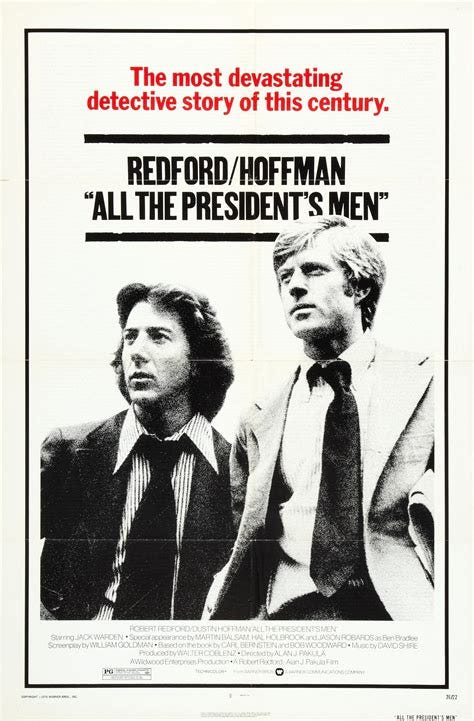
Edward R. Murrow had CBS. Woodward and Bernstein had The Washington Post.
But the reporting is only a part of it. McCarthyism needed The Crucible to become a cautionary tale. Watergate required All the President’s Men to create a national consensus.
It’s an important trifecta: Every history-making event needs a muckraking journalist who dares to expose corruption, a publisher with backbone and a cultural storyteller to turn that first draft of history into a shared agreement around what happened.
This year’s 50th anniversary of the movie All the President’s Men got me thinking: Who will help create that second draft when the people who run the newsrooms increasingly also own the movie studios?
Reporters Bob Woodward and Carl Bernstein were able to follow the money despite personal smears by the Nixon administration because their editor and publisher backed them. Nixon’s cronies threatened Post publisher Katharine Graham with financial ruin if her paper continued its investigation, including challenges against Post ownership of Florida television stations.
“During these months, the pressures on The Post to cease and desist were intense and uncomfortable, to say the least,” Graham wrote in her 1997 memoir, Personal History.
She ran the stories anyway.
Two years later, Robert Redford and Dustin Hoffman starred in All the President’s Men, the award-winning political thriller that helped America process the story of Nixon’s downfall into a shared history.
To be clear, the US did not immediately coalesce behind a consensus. Nixon retained defenders and distrust of the press was real. But over time, a broadly accepted narrative emerged that the press exposed abuse and held politicians accountable, helping to keep the country a democracy.
In 1954, Murrow aired a CBS show that exposed Sen. Joseph McCarthy’s pathological lies about the communist threat in the US, which included false tales of a spy ring of “card-carrying communists” in the State Department. McCarthy’s campaign harassed and blacklisted writers, musicians and bureaucrats.
Murrow could do that only with the full support of his producer, Fred Friendly, even though CBS feared it could lose its license. That show led to McCarthy’s downfall.
At the same time, Arthur Miller’s play The Crucible about witch hunts became the era’s enduring allegory. Two years later, Bette Davis starred in Storm Center, in which a small-town librarian is shunned by the locals after she refuses the City Council’s request to remove a book on communism from the shelves. The movie won an award at Cannes as “this year’s film which best helps freedom of expression and tolerance.“
These were the closest cultural narratives possible because Hollywood was under blacklist pressure, and could not safely or consistently process red-baiting events in real time. And CBS did eventually cancel Murrow’s show.
It took another five decades before Good Night, and Good Luck, George Clooney’s movie and Broadway play about Murrow, helped solidify a shared history of what happened.
Who’s going to write the movie script for this era, and what would it say?
The January 6th riot has no second draft. It has no movie or cultural story that we can coalesce around. It has a first draft that half the country actively refuses to read. The insurrectionists are pardoned. The Proud Boys are free. The Select Committee’s meticulous documentation of what actually happened is forgotten.
Now new stories are being drafted: Of the ways President Donald J Trump and his family have enriched themselves. Of the president’s sexual misconduct. Of the cavalier ways this administration discussed national security issues on Signal.
Last week, The Atlantic lobbed another bombshell at the Trump administration. Drawing from more than two dozen sources including current and former FBI officials, intelligence agency staff, hospitality workers, members of Congress, political operatives, lobbyists, and former advisers, investigative reporter Sarah Fitzpatrick painted a picture of a drunk and inept director of the Federal Bureau of Investigation.

We know these things only because of a plucky publisher.
The CBS that Murrow needed no longer exists. It is now owned by billionaire David Ellison. In a mere few weeks, that CBS settled a frivolous lawsuit brought by Trump, canceled Colbert and temporarily buried a segment about the El Salvador deportation prisons. Ellison soon is likely to add CNN to his possessions.
Woodward and Bernstein needed the Washington Post to publish. That WaPo is now owned by billionaire Jeff Bezos, whose other business interests like Amazon, Blue Origin and AI ventures depend on government contracts.
Bezos blocked The Post’s planned endorsement of Kamala Harris ahead of the 2024 election, donated $1 million to Trump’s inauguration and realigned the opinion section toward the prevailing political power.
It is hard to imagine today’s Post mounting the kind of sustained, existential confrontation with presidential power that Katharine Graham embraced during Watergate.
Signalgate and the Kash Patel stories could run in The Atlantic only because of Laurene Powell Jobs.
Since Jobs bought the once staid monthly magazine (and ProPublica) through her Emerson Collective venture, the widow of Apple co-founder Steve Jobs has funded aggressive investigations and supported the free press. Using her estimated $14 billion largesse, The Atlantic has transformed into a news powerhouse.
It capitalized on turmoil across legacy newsrooms by hiring journalists from WaPo and other increasingly constrained institutions. One was Fitzpatrick (full disclosure: I’ve known her since she was in middle school in Zurich).
Trump repeatedly attacked Jobs for it, calling her ownership “wasting money” and urging supporters to pressure her after The Atlantic published damaging reporting about him. But Jobs, like Graham before her, has the courage that other billionaire media owners lack to stick to the facts, regardless of where they lead. Importantly, like every good publisher, Jobs has stayed out of day-to-day editorial decisions.
Philanthropic plutocracy is still plutocracy. If democracy depends on benevolent billionaires choosing good journalism, we should be worried.
There was a time when the journalism world hailed Bezos as the savior for the Post, believing he would be able to update a regional newspaper for the digital age. He did for a while, but Bezos’s attention moved on, and his business interests changed.
Despite their own blind spots and failures, Jobs, the Sulzberger-Ochs family that owns The New York Times and the Scott Trust at The Guardian still maintain news organizations with rigorous reporting standards strong enough to challenge power regardless of which side of the aisle they sit.
Patel sued The Atlantic and Fitzpatrick personally for $250 million within a day of publication. That eye-popping amount does two things. It’s meant to intimidate reporters and publishers who can’t afford to fight. Like Gawker.
It also makes it easy for right-leaning outlets to cover the story without addressing The Atlantic’s allegations. By framing the episode as a fight over media credibility and Patel’s aggressive legal response, Fox and others did not have to ask whether America faced a security risk from a compromised FBI director.
Laurene Powell Jobs has the means to not be intimidated, so the first draft of history can still be read. Corporations guided by the likes of the Ellison family and Bezos have the means but not the courage to speak truth to power. The Murdochs prop it up to strengthen their bottom line.
Democracy dies in the boardroom.
Just as corporations have consolidated news outlets, they are also buying up Hollywood and streaming services: Read: Jeff Bezos and the Ellison family.
Ellison and Bezos are in the movie business via Paramount, Amazon and MGM. The same people who might want to suppress a story in the newsroom also now control the greenlight for the movie version.
Which of them is likely to produce the Kash Patel Story? Signalgate? The January 6 saga?
Fox News, run by the Murdoch family, may be the most powerful story teller in modern politics. But rather than creating a shared civic memory, it provides a competing one. In Fox’s telling January 6 was tourism, Trump is the victim and institutions themselves are the conspirators. But they aren’t making blockbuster movies any more. Maybe they realized by controlling the first draft, they don’t need to spend $100 million on the movie. The news has become the show.
Watergate produced All the Presidents Men, a book which became the dominant movie that solidified into shared memory. But more than 1,200 books on Trump and his impact on history came out during his first term alone. There are probably 8,000 now on bookshelves around the world. You can read the one you want based on your political perspective. This is the logical result of the media fragmentation that began with cable news and is being perfected by social media and the Substack of your choice.
I worry that there will not be a single canonical film or play that defines our shared cultural memory of this time. That’s dangerous for our country. If we can’t agree on what’s been happening to us, what can we agree on?
Would Ellison or Bezos make that next All the President’s Men or Good Night, and Good Luck: those cultural touch points that hold our nation together? I don’t even think they would even want to.
Sources:
https://www.forbes.com/profile/laurene-powell-jobs/
https://en.wikipedia.org/wiki/All_the_President%27s_Men_(film)
https://www.nytimes.com/1992/10/18/movies/l-hollywood-blacklist-storm-warning-830492.html
https://nymag.com/intelligencer/article/the-a-team-inside-the-atlantics-expensive-hiring-spree.html
https://www.britannica.com/topic/See-It-Now
https://www.britannica.com/event/Nixon-resigns-Watergates-legacy
https://www.bostonglobe.com/2026/04/24/opinion/peter-thiel-objection-media-gawker/
No posts
Comments
Nothing yet. Say the first thing.
Sign in to join the conversation.