
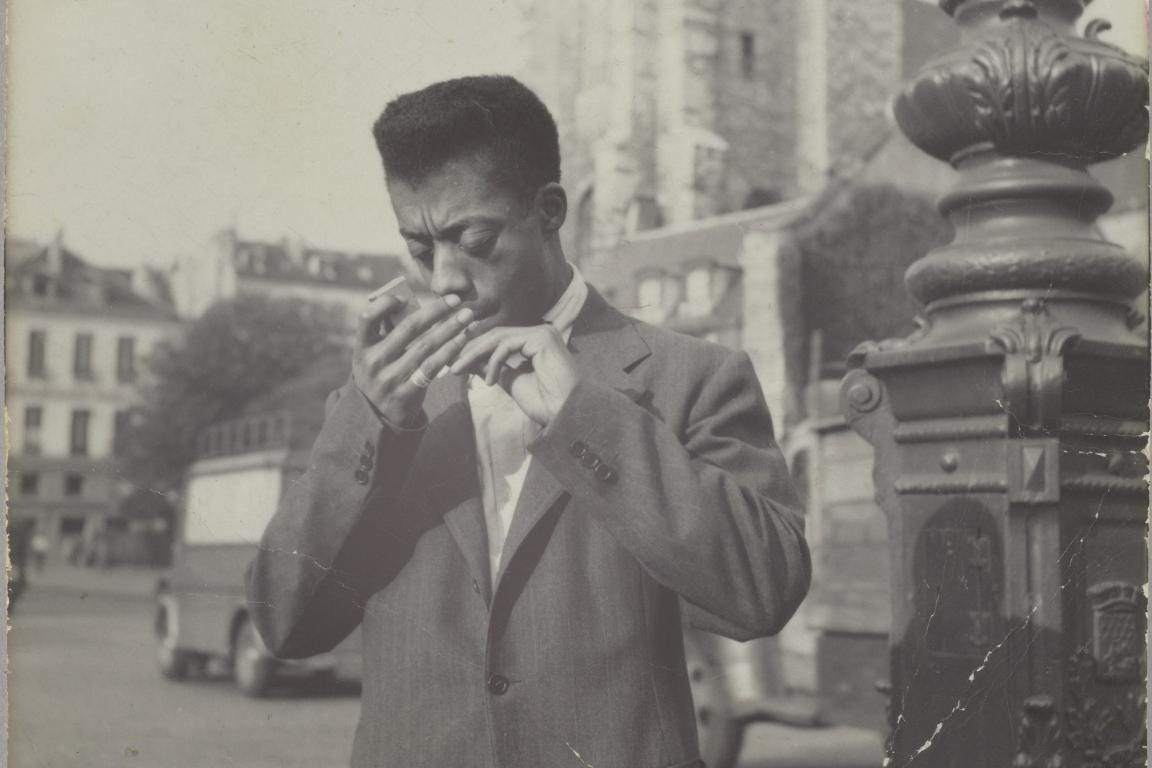
In the fall of 1956, James Baldwin, living in Paris, covered the First International Congress of Negro[1] Writers and Artists for Encounter magazine. There he was, in a room full of African, European and American intellectuals from across the world debating Black identity and freedom, not long after white men had beaten and lynched Emmett Till in the U.S.
A year later he was in the American South, interviewing and observing the people directly affected by America’s racist policies. For him, there was no abstraction: identity and freedom were personal, and became his passion.
“I could, simply, no longer sit around in Paris discussing the Algerian and the black American problem. Everybody else was paying their dues, and it was time I went home and paid mine,” Baldwin wrote in 1972 in No Name in the Street.
He singles out the shock he felt in 1957 when he saw the photograph on the front pages across the world of white teenagers jeering and spitting on Dorothy Counts as she walked into a high school in North Carolina.
Fast forward 70 years and I, too, remember my horror watching ICE and Border Patrol officials kill Renée Good, then Alex Pretti, and then attempt to smear their names. I have learned, as Baldwin did, that when you live abroad, you see your own country with a clarity that your compatriots do not.
I left the United States 40 years ago this year, and reading Baldwin’s essays these last few weeks makes me wonder: What responsibility does a writer who has spent decades abroad owe to a country undergoing a democratic and moral crisis?
Friends back home marvel at how well informed I’ve remained. Here’s a dirty secret expats learn fast: the rest of the world reads America in minutiae.
The average European can name not just the U.S. president and vice president, but their spouses and half the cabinet. Ask an American to do the same for, say, the chancellor of Germany, the continent’s largest economy, and you’ll get a blank stare.
I do not work in any official capacity or speak for the United States. I have no power over policy, yet because I’m an American living abroad, my European friends and even strangers speak to me about my native country as though I did.
Since 1986, I’ve been lauded for Reagan’s fortitude against the Soviets and mocked for his economics; laughed at over Clinton’s infidelity and scorned for his near dismantling of welfare. Yet on the night of September 11, 2001, the people of Zurich spontaneously held a candlelight vigil for a country not their own, an evening I will cherish forever. Months later, some of those same people snarled at me over Abu Ghraib.
In January 2020, European TV stations replayed footage of the assault on the capitol, stunned that the country once seen as the bastion of democracy was under attack. And since 2025, they’ve asked me repeatedly why Americans would vote back into power the man who orchestrated it.
Literally the week I got back to Switzerland this summer my neighbor greeted me with a snide comment about my country. It gets personal when gas prices in Switzerland skyrocket 20 percent because a foreign president started a war or when Washington slaps tariffs on a country whose constitution already bans the very labor practice it’s being accused of violating.
By dint of our passports, we become mini-ambassadors whether we want to be or not. There are proud moments when I’ve sung “Country Roads” at Oktoberfest, but there was also a time when I was so embarrassed, I pinned a Canadian flag to my backpack.
Once, I fielded a call from a Croatian mother asking me if her daughter would be safe from mass shootings if she attended a U.S. university.
Over the past four decades, I’ve watched America become less exceptional in the eyes of the world. I’ve seen admiration for American boldness, spontaneity and creativity turn into suspicion of ulterior motives and now ridicule.
“I love America more than any other country in the world, and, exactly for this reason, I insist on the right to criticize her perpetually,” Baldwin wrote in Notes of a Native Son.
Baldwin believed that writers have an obligation to stop observing history from a safe distance. Writing this essay forced me to confront my own self-censorship. Baldwin did not hold back.
Decades before the word intersectionality was coined, Baldwin’s work crossed racial and sexual boundaries. Writing openly about gay relationships (illegal at the time) while simultaneously serving as a leading voice of the civil rights movement, he challenged everyone not to compartmentalize humanity.
Today we try to downplay trans, Palestinian or immigrant rights, as if those weren’t our concerns, or as if we faced more immediate crises, like affordability. But diminish the rights of one and we denigrate the dignity of all of us.
Baldwin believed good writers are like documentary photographers: they use wide lenses to see a bigger picture, then switch to telephoto ones to zoom in.
Those of us who have had the good fortune to step outside our borders can take fresh perspectives and develop them into clear stories, correcting the blurred focus of conventional telling. We just need to be brave enough to put the words to paper.
Having lived in Germany, it’s impossible not to think of how ordinary citizens reacted to Adolf Hitler in those years between 1933 and 1938, before the war. They, too, had affordability problems, and worried about housing, jobs and health care. They, too, occasionally winced at the outrageous things their leader said.
I always thought I’d be a Sophie Scholl type or a French resistance fighter, opposing tyranny and fascism with all my heart. But it’s 2026, and because I worry about offending my friends and relatives on my visits home, I sometimes stay quiet and censor myself. That makes me complicit.
Baldwin, coming of age just after World War II, dragged the country’s unacknowledged truths into the light. But that clear sight came at a cost.
He was under nearly constant surveillance for more than a decade. His FBI file stretched to 1,884 pages. In The Devil Finds Work, Baldwin described his encounters with the FBI as frightening and humiliating — like being “spat on, or pissed on, or gang-raped.” He called FBI chief J. Edgar Hoover “history’s most highly paid (and most utterly useless) voyeur.”
I doubt I possess his courage.
Every nation tells stories about itself that are entirely fictitious when viewed from afar.
We can’t truly know ourselves without that perspective. Baldwin’s gift was his ability to explain America to itself. He linked relationships other people didn’t see, and changed how people understood race, identity, religion and power.
Seventy years ago, Baldwin challenged other Americans to face the hard truths and push forward in spite of personal hardship. It’s encouragement we need reminding of today.
Waiting for the Republicans to be voted out of power isn’t a coping mechanism. When the opponents’ strategy is to scatter the fires until everyone gives up, the most Baldwin-esque thing anyone can do is to keep pointing out how those fires are connected. And hand out the water.
[1] A note on language: “Negro” was the standard term of the era and appears here in a historical name.
No posts
Comments
Nothing yet. Say the first thing.
Sign in to join the conversation.