
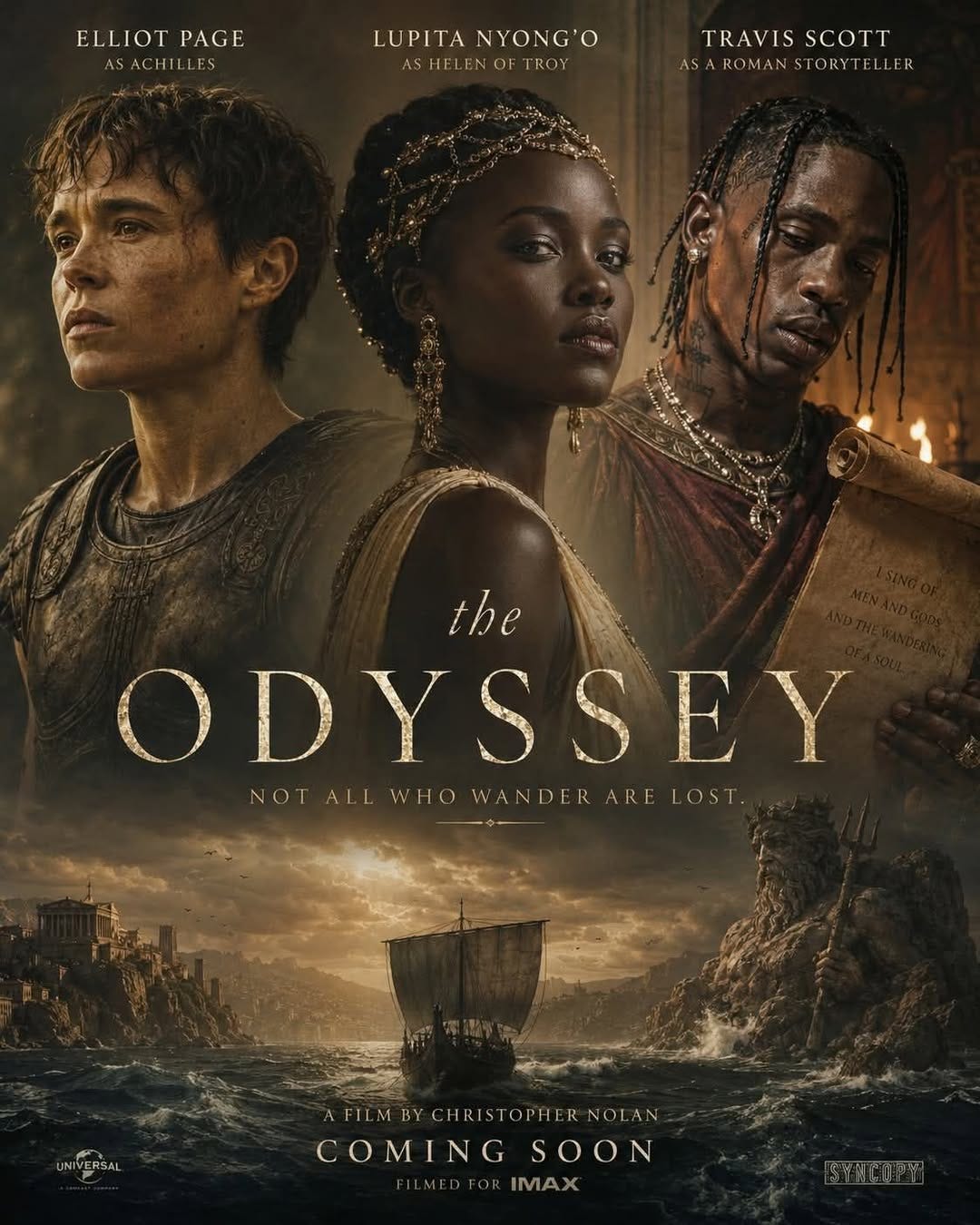
My wife and I saw Christopher Nolan’s The Odyssey with a friend and her daughter this week, which was pretty much as I expected: Lots of star power, many visually compelling scenes, but a story that left me (almost) as cold as when I had to read it over and over again in school. (I moved a lot growing up, and I felt like every high school in every grade made me read The Old Man and the Sea and The Odyssey, both of which were hypermasculine and tedious. Then I had to read them again in college.)
One thing I liked about this version of The Odyssey is the race-blind casting, which, like the stage play Hamilton, handed out roles to actors of various shades and backgrounds with no mention ever made of race. I found this graphic on Reddit:
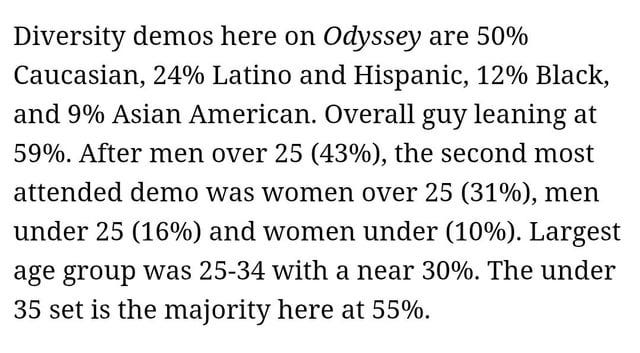
You may have heard about this casting after the racists of Twitter (particularly X’s racist-in-chief Elon Musk) went berserk about Lupita N’yongo being cast as Helen, the most beautiful woman in the world, but I hadn’t realized the racially diverse casting was consistent across the whole film, so I enjoyed that surprise. I also appreciated that the prevalence of domestic violence was highlighted when we see what Helen’s husband does to Helen when he gets her back (though some viewers thought this was proof of Nolan’s misogyny, as Helen and her husband are happy together once she’s returned home in the original story). I also appreciated the central role given to xenia—mandatory, mutual hospitality—referred to in the movie as Zeus’ law, which required that everyone take in any stranger and feed them before even asking their name. (Imagine if this kind of thinking had prevailed how different our society would be.) I thought it was cool that Elliot Page got to be a soldier. And in a reinforcement of the Save the Cat premise, we get to know who the real bad guy is by how he treats an innocent animal.
But mostly this is a movie that spends the majority of its time on violence: sword fights, chase scenes, giant battles, monsters eating people, soldiers spearing, stabbing, and impaling one another with arrows. Odysseus (played by Matt Damon) seems to have a moment of regret as he recalls how mean a trick it was to fill that Trojan horse with soldiers and destroy Greek society, rejecting every social norm about hospitality—but then he almost immediately rejects those norms again as he violently attacks all the guests who’ve been courting his wife for the years he’s been away. Basically, despite all the visually stunning imagery and celebrity appearances, I felt no moving message I could take away from this very long movie.
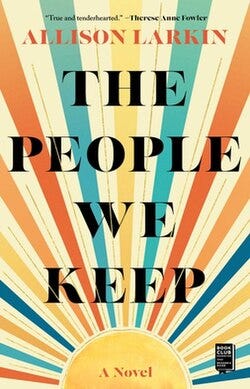
At the recommendation of friend and subscriber Sarena, I read the coming-of-age novel The People We Keep by Allison Larkin. I thought it was a new book, but I’ve discovered it was published in 2021 and she actually has a newer, very well reviewed novel that I’m adding to my TBR list, Home of the American Circus. But back to this novel, which was about a 16-year-old girl who is basically thrown away by her terrible parents and must make her own way in the world and pull together a found family. She has a kind of shocking amount of sex, often just to have a place to stay, which I guess is probably what an attractive 16-year-old on her own would do, but I was still surprised at the portrayal of her having a consensual affair with a 27-year-old man (though he didn’t know how old she really was). I was often frustrated by the main character’s naivety; I moved out on my own at age 16 and don’t think I was as clueless as she was. Still, this was an excellent novel, and I enjoyed it as an audiobook read by the excellent narrator Julia Whelan.
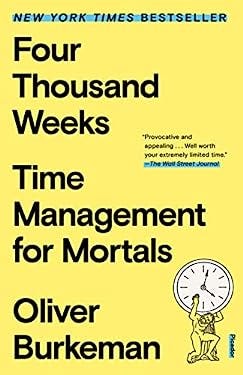
I also listened to the audiobook Four Thousand Weeks: Time Management for Mortals, which was read by its delightful author Oliver Burkeman, whose English accent and self-deprecating personality makes the book a pleasure of a listen. I loved this book, which isn’t offering new organizational systems, but is rather encouraging you to think more about how you want to spend the approximately 4,000 weeks you have on this earth. As the author writes, “The day will never arrive when you finally have everything under control,” so your only hope is to make hard choices about what matters to you. Among Burkeman’s suggestions is to make a decision about what you won’t do so that when you don’t get to it, you can know that was part of your plan. Instead, he says, most of us keep trying to do everything and are thereby always feeling like we’re failing. (Or is that just me?) He also suggests keeping a done list, a list on which you write every accomplishment as you complete each task so you have a list you can feel good about at the end of the day, instead of a to-do list that will only make you feel like a loser at the end of the day. I highly recommend this book and, in fact, liked it so much I’m probably going to buy the print version to share with Renee.
![This Is How You Lose the Time El-Mohtar, Amal [Used - Good] [Softcover]](https://substackcdn.com/image/fetch/$s_!5wX4!,f_auto,q_auto:good,fl_progressive:steep/https%3A%2F%2Fsubstack-post-media.s3.amazonaws.com%2Fpublic%2Fimages%2F4a475f9c-6747-478e-a545-c13fc0688d0a_225x300.webp "This Is How You Lose the Time El-Mohtar, Amal [Used - Good] [Softcover]")
Finally, at the recommendation of one of my local librarians, I read This is How You Lose the Time War, a book the librarian said she loved. Unfortunately, I just didn’t get it, and I probably wouldn’t even have finished it if it hadn’t been put into my hands by someone excited for me to read it. It’s a sci-fi romance written by two authors. Max Gladstone and Amal El-Mohtar, and from what I’ve read of the reviews, people either love it or hate it. I’m sadly in the latter camp. Here’s what I think is happening: two people (? at least one of them has been engineered so they don’t need food or sleep, so I’m not sure they still qualify as a person) work for different factions trying to determine the course of history by traveling up and down the threads of time and tweaking things. They encounter one another and start exchanging letters. They store these letters in super-weird places, like inside a seed or in a fire, and I’m not at all clear on how they read them (nor how they store them in these odd forms). They fall in love. They are not allowed to fall in love, because like Romeo and Juliet, they are from different factions, so they must conceal their growing obsession with one another. It took me at least 70 pages to even understand this much. The writing is beautiful, poetic, lyrical, and just super hard to parse. If you like that kind of thing, enjoy yourself.
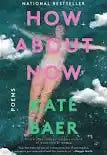
Continuing my attempt to participate in The Seeley Challenge (to read a book of poetry every day in August, especially by poets from diverse backgrounds), today I am reading Kate Baer’s latest collection, How About Now. I love Baer’s poems; they are full of humor and life and use accessible language and make me think and laugh out loud. Her backstory is fun, too: After a sheltered Mennonite childhood, she discovered Margaret Atwood and other authors who challenged her way of thinking. While married and raising her four children, she wrote a popular blog about marriage and motherhood, which she turned into essays for Huffington Post. An agent spotted her writing and signed her as a client, working with her for several years on a novel she was writing. She then started “cheating on” the novel by writing poems, and when she put one on Instagram, it went viral. Her agent was totally accepting of her choice to switch from fiction to poetry, and there were two big publishing houses interested in her first collection. first book came out as the pandemic started and shot immediately to the top of the best-seller list. Pretty wild origin story for a middle-aged woman poet. You can read an interview with her here.
I’m also reading Maya Angelou Poems, which seems to be a compilation of her first four poetry collections: Just Give Me a Cool Drink of Water ’fore I Diiie (1971), Oh Pray My Wings Are Gonna Fit Me Well (1975), And Still I Rise (1978) and Shaker, Why Don’t You Sing? (1983) I just read a biography of her and was absolutely blown away by how little I knew about her extraordinary life: she danced and performed across Europe with Alvin Ailey, sang for years in caberets, acted in films and plays, wrote screenplays and was a playwright, directed films, was the first African American conductor on a train line in North America, endured rape at age 8 by her mother’s boyfriend, who was convicted, found guilty, and sentenced to just one day, after which he was murdered, likely by her uncles, leading Maya to stop speaking for five years. She wrote 30 books: mostly memoirs and essay and poetry collections. She got pregnant in high school, graduated, but never went to college; however, she liked to be called Dr. Angelou after she was later awarded dozens of honorary degrees, an inspiring story to tell anyone having a baby in her teens. She was a prostitute and madam for lesbians. The more I read about her, the more amazed I am. I need to pick up her first autobiography, still considered her best, I Know Why the Caged Bird Sings.
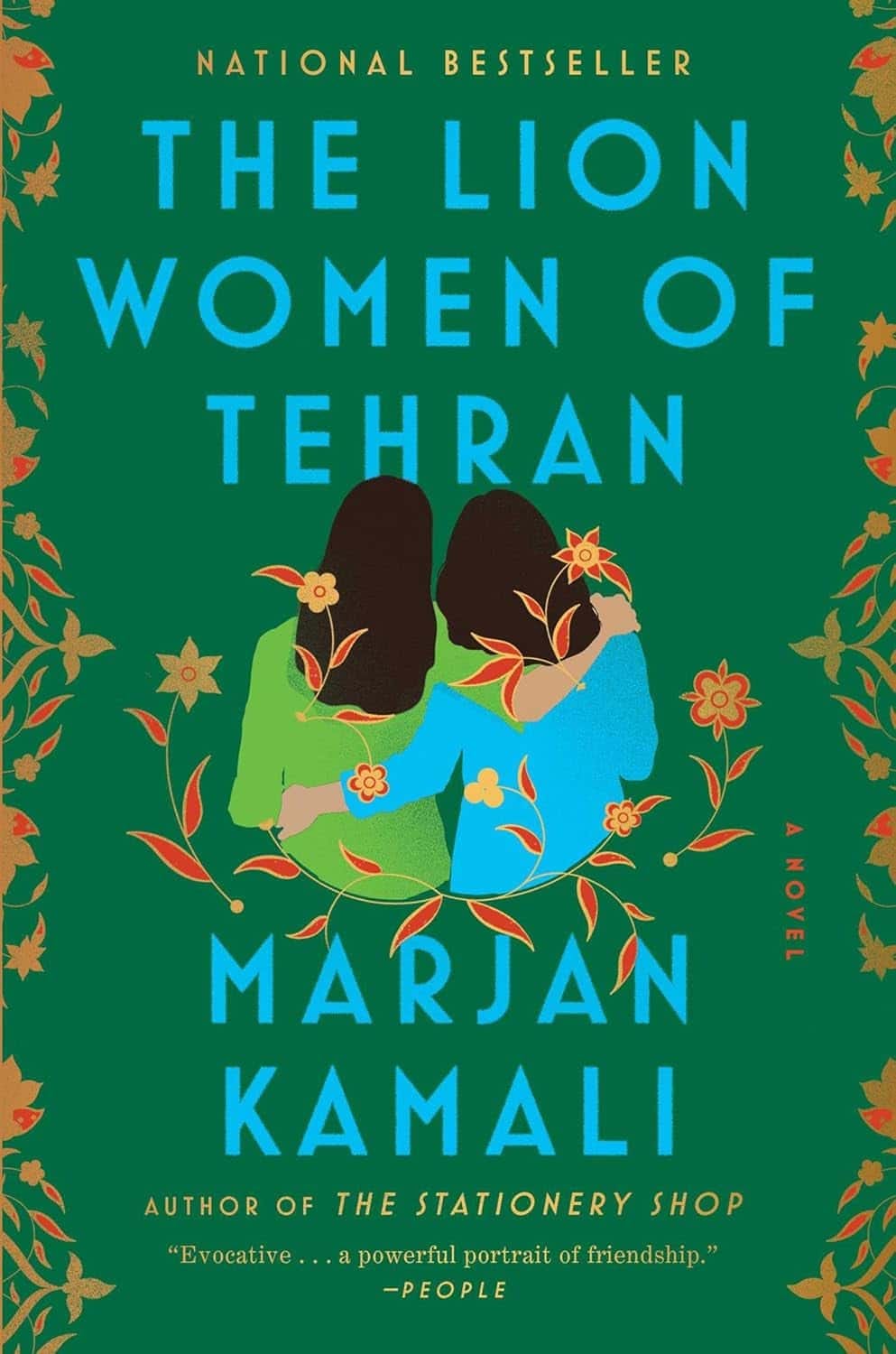
We finally had our book club for Lion Women of Tehran, an excellent book, despite its flaws. Here are some questions we considered:
I loved the book but some readers on Goodreads found it tedious and said it read like YA (not that there’s anything wrong with YA). One commenter noted, the book “reads like a crash course on Iranian culture aimed at white women reading on floaties in the pools of their vacation homes. The dialogue was cringeworthy and so was the narration and both seemed to assume the reader to be incapable of thought.” What did you think of the book?
How did you like the technique the author used of including an Iranian word and them immediately following it with its English translation?
On page 17, Ellie recalls, “At that moment I saw Homa the way my mother would have: a lower-class girl below your dignity with whom you are stuck in a dinky school.” How much do we see our own world’s through our mother’s eyes? How does this help or hinder us? How does Homa do at changing her lens?
What do we think of the uncle—good guy or bad guy? He’s always kind to Ellie but if he could afford to help her and her mother live in a better home, why did he place them in a slum? I felt he was a shallowly developed character. You?
On page 38, the phrase “Lion Women”is first introduced. Do you think Homa and Ellie became Lion Women?
On page 51, when Ellie catches her mother, why in the world does she wink at her daughter? Ewww! This scene haunted me and I didn’t understand it.
On page 69, we see a lot of holiday traditions described, and I’m always amazed at the similarities across all our cultures: kisses at New Year’s, for example. This book was about Iranian culture, but what similarities did you see between that culture and your own?
On page 93, Homa is frustrated by Ellie’s lack of interest in politics. Do you find it hard to have friends who are more or less political than you? How much of a role does guilt or your desire to look good in front of others play in the political actions you take?
On page 185, we encounter the central trauma of the novel, after which the character feels “there is no path back” to her confidence, “no space” for her old energy. Do you think this character ever recovers?
On page 209, we learn some of the methods used in this character’s recovery: walking, talking back to herself, and the library. What, besides time, have you seen work to help someone recover from a severe trauma.
On page 253, Ellie’s mother explains that she’s relied on her ideas about the evil eye because it’s easier to blame superstition than oneself for unfortunate events. Do you think jealousy cast an evil eye over any of these characters? (One of our book-group participants noted that Ellie’s jealousy cast an evil eye over herself. What do you think of this idea?)
Why doesn’t Homa want to let Ellie confess and apologize when they are finally together again? Why did she send her away in the first place?
Do you think Abdol and Homa ever have sex? Is Homa ACE (asexual)? Might she be attracted to women? (I didn’t think so, but some readers did.)
What do we think of Bahar nearly drinking herself to death at her first party despite her aunt warning her repeatedly about the dangers of drugs and alcohol? (I thought that was unrealistic, but Renee mentioned that she had scraped up many young girls off the floor at Mt. Holyoke who were encountering alcohol for the first time.)
In the acknowlegements and afterword, the author mentions Masa Amini, a young woman who was beaten to death for improperly wearing her hijab. Journalists who wrote about Amini’s death were imprisoned for five years. There are still women’s freedom protests going on in Iran, despite the obvious dangers to the protesters. How might we compare our own protest movement to that one?
Doing a re-read of this book and coming up with these questions (because I didn’t connect at all with the questions provided online and in the back of the book) really gave me a deeper appreciation for this novel. In case you haven’t read it, I made sure these questions didn’t include any spoilers.
In my original post, I forgot to mention the article I reference in my subhead: https://www.newyorker.com/news/the-lede/are-psychedelics-right-wing-now, a mind-blowing piece (see what I did there?) about Rick Perry and Joe Rogan’s embrace of psychedlics. They’re particularly excited about ibogaine, one of the few things I still wish I’d tried to save my son from his terminal drug addiction. I just love how the right wing can change its mind as soon as something effects them personally.
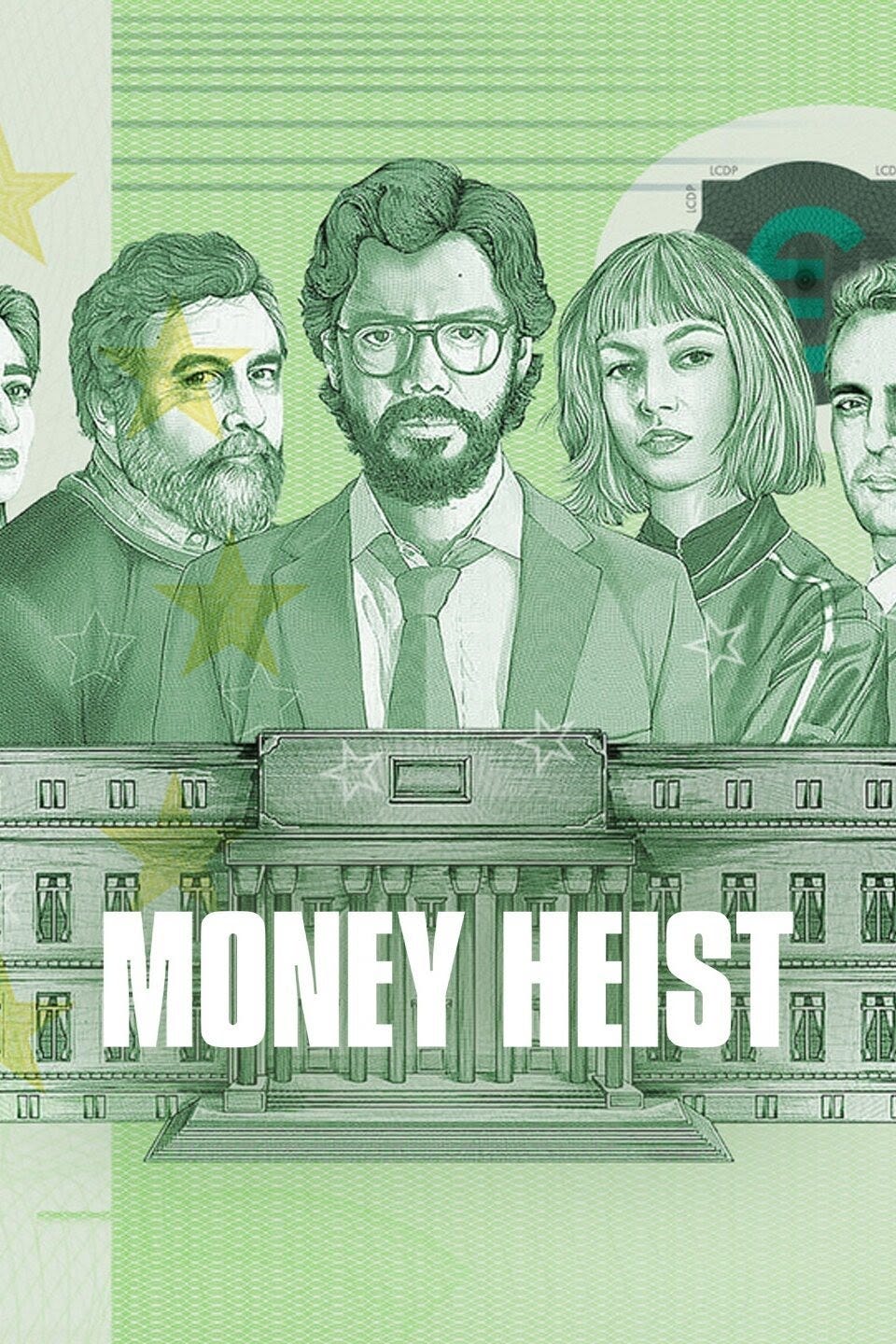
And you, my fine friends? What have you been consuming? Renee and I continue to spend our evenings watching season two of Money Heist on Netflix. Something awful happens in every single episode (if you’re on the bank robbers’ side, which we definitely are). I have begun to be a bit annoyed by one actor’s overacting (looking at you, Arturo), but mostly this continues to be an amazing, gripping show. Please let me know what you’ve been reading, watching, and listening to.
No posts
Comments
Nothing yet. Say the first thing.
Sign in to join the conversation.