City Council is changing petition law, making it harder for residents to take direct democratic action. These changes come after successful citizen petition measures against unpopular City Council laws, such as zoning. The proposal involves many substantive changes, despite city officials saying several times that this was not the case. The overall effect is to make it harder for residents to raise their voice.
City Attorney Alison McKenny Brown says these changes are codifying “current standard practice”. This is somewhat deceptive because “current” practice is different from past practices. Current staff, including the attorney, made new interpretations of law. Therefore, staff have arguably changed the law, leading to the necessity for codifying current standard practice.
Some of the policy changes involved include:
Limiting time for signatures
Tougher signature verification
Different definitions of registered voters
Confusing ballot language remains
Moot hearing
Limiting Time for Referendum Signatures
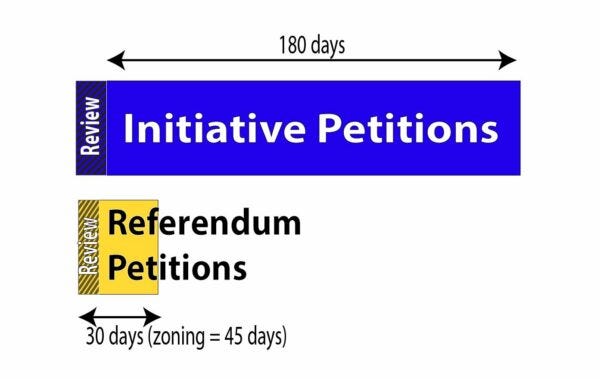
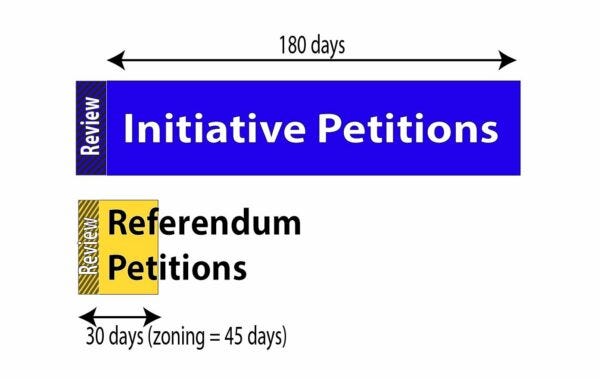
A new interpretation of the referendum law reduces the time to collect signatures by 30%.
The zoning referendum marks the first time that petitioners were required to get City Clerk approval for a referendum petition. In the past, City Clerks did not require this step because it was purposely left out of municipal law. For example, long-term City Clerk Margy Greer did not require review of the successful 2090 Wright St referendum.
Lakewood staff say they added this requirement for referendums because initiatives were required to get City Clerk approval. However, initiatives are different because they are resident initiated laws that require a new summary and title that reads clearly to voters.
Referendums don’t need review time. A referendum calls for the repeal of City Council ordinances, rather than substantive descriptions. Requiring a review of a simple repeal eliminates 10 days off the time allowed for signature gathering.
Lakewood is not extending the time for signature gathering to compensate. All non-zoning referendums have a 30-day time limit to gather signatures, leaving 20 days to reach the goal.
This time issue was made known to Lakewood with no resolution.
The new interpretation is buried in the definition section. There is no new section explaining how to go through the title setting and review process for referendums, so many residents are unaware of the change happening, and will not know it is necessary later.
This is a case of a new interpretation of law. Lakewood is passing it off as “current standard practice” while making a substantive change that makes it harder for residents to take direct democratic action.
Tougher Signature Verification
In Wheat Ridge, 40% of referendum signatures were removed through signature verification. Councilors Low, Shahrezaei and others want that same process for Lakewood. No one could fully describe the process, which seemed unimportant. The important part seemed to be the ability to remove large amounts of signatures.
You may have noticed the 50% increase in the storm water fee being accessed this year. Such drastic increases usually indicate mismanagement and the failure to perform routine maintenance of a system in the years and decades prior. A properly financed maintenance program that is well run with periodic, but reasonable, rate increases does not need drastic assessments. Then again, this is Lakewood, Colorado. A city in a state that… Well, just look around.
Drainage ditch and pipe (poorly maintained, if at all) down the hill from the intersection of Jewell and Wright, behind the Dunstan Middle School.
I guess a part of me that’s like a squirrel that gets zapped on an electric fence, but keeps climbing on it thinking there is a stash of peanuts on the other side, so I started asking about how is storm water fund allocated amongst the city wards a little while ago. Here is the language of the CORA request I sent to the City in April of 2023:
“Accounting of dollars spent on storm water improvements in Ward 4 for the period from 2018-2023. This can be a table of projects with dollars or, if there is one, a website location showing the expenditures.”
At the City of Lakewood, we track organizational revenues and expenses at the organization level and do not break it up by Ward. With that being said, we do not have the information that was requested as that is now how the information is stored.
Lakewood is expanding the definition of campaigns to apply to any City Council decision, not just elections. The move comes in response to a successful citizen-initiated referendum to roll back a Council decision. The change is purported to increase transparency but will also make things significantly harder for grassroots efforts.
Stop sign-red yard signs brought the zoning discussion into public focus. Many people credit the signs for making them aware of the initial zoning matter. Without them, there may not have been a successful referendum. Naturally, pro-density zoning advocates hated them…a lot.
However, at the time of their placement, the signs were only influencing a City Council vote, not an election. Who knew that it would grow to be more? The hope was that City Council would listen, making a referendum unnecessary.
Green “Save Bear Creek Lake” signs are still up in yards, also raising awareness and influencing Lakewood actions. But no one has suggested they be subject to campaign finance filings, perhaps because Lakewood officials agree with those signs.
In similar fashion, in 2025, transgender supporters held protests with coordinated t-shirts and pizza parties at City Council for months. More recently, anti-ICE and “No Kings” protests have been popular. All of which may have added up to $200 in spending.
Under the new municipal code section 2.54.040(A)(1)(i), any protest that spends $200 will now have to register like an election campaign because no one knows if the matter will be on a ballot later.
Collaboration Causes Misunderstandings
Before any citizen-initiated petition, residents try to get City Council’s attention. This is generally unorganized, with everyone having their own message and their own ideas for moving forward.
Adversaries may assume collaboration where none exists. Just like more official campaigns, it may be hard to tell who is paying for what.
For example, there may be some overlap between savebelmarpark.COM and savebelmarpark.ORG but their finances were different. Only one group actively worked on the parkland dedication petition, but it may not have been successful without the combined efforts of Belmar Park supporters in general.
Now all these costs that were meant to influence Council actions will be subject to campaign finance disclosures because of what they MAY turn into.
Again, parkland dedication didn’t start as a citizen petition, but since Council didn’t listen, it grew into one. If Council did NOT listen to the trans activists that spent time and money advocating for police oversight, that might have grown into a citizen petition as well.
However, Council was not concerned with how much money was used for those protests.
Council seems to be treating people they agree with differently than people they don’t agree with.
We have an important update regarding the citizen initiated charter amendment petition.
Effective immediately, we are stopping signature collection and suspending circulation of the petition following new information provided by the City regarding the election process and legal requirements for charter amendments.
This was not the outcome any of us expected when the petitions were approved on June 2.
On Tuesday, June 9, at approximately 5:25 PM, the City Clerk notified us that after a second legal review, the City had determined that our proposed charter amendment could not be placed on the November 3, 2026 ballot under the signature requirements originally provided to us.
According to the City, because November 3, 2026 is not a regular municipal election under Colorado law and the Lakewood Charter, the proposed charter amendment would instead be treated as a special election measure requiring signatures equal to 10% of registered electors, approximately 12,260 valid signatures, rather than the 5% threshold originally provided.
On the morning of June 10, Karen Gordey and John Frogge met with attorney Suzanne Taheri to review the information received from the City. Suzanne then began discussions with Assistant City Attorney Gus Schenck regarding both the signature requirements and the timing requirements associated with citizen initiated charter amendments.
Serenity Mental Health Centers, a leader in innovative psychiatric care and one of the fastest-growing mental health providers in the nation, today welcomed a new provider to its Lakewood clinic and is now accepting new patients.
Psychiatric Nurse Practitioner Duandelyn Wilson, DNP, PMHNP-C,FNP-C, NNP-BC, earned her Bachelor of Science in Nursing from the University of New Mexico before completing a Master of Science in Nursing with honors at Regis University in Denver, where she trained as a neonatal nurse practitioner. She later earned a post-master’s Family Nurse Practitioner certificate from the University of Colorado Anschutz Medical Campus, completed her Doctor of Nursing Practice at Washburn University, and added a post-master Psychiatric Mental Health Nurse Practitioner certification. Her unique clinical journey, spanning neonatal, family, and psychiatric care, has given her a rare perspective on health and wellbeing across the lifespan.
Wilson’s approach to care is grounded in compassion, respect, and shared decision-making. After years of working in high-stress and specialized clinical environments, she saw firsthand how often mental health needs go unaddressed and how profoundly that impacts overall wellbeing. Drawing on trauma-informed practices and evidence-based care, she listens carefully, communicates clearly, and develops individualized treatment plans that align with each patient’s goals while remaining open to a range of therapeutic approaches when appropriate.
“Duandelyn’s diverse background in the military, dedication to lifelong learning, and commitment to personalized mental health care reflect the values we strive to bring to every patient interaction. We’re excited to welcome her to the Serenity team,” said Tricia Pease, COO and co-founder of Serenity Mental Health Centers.




Comments
Nothing yet. Say the first thing.
Sign in to join the conversation.