
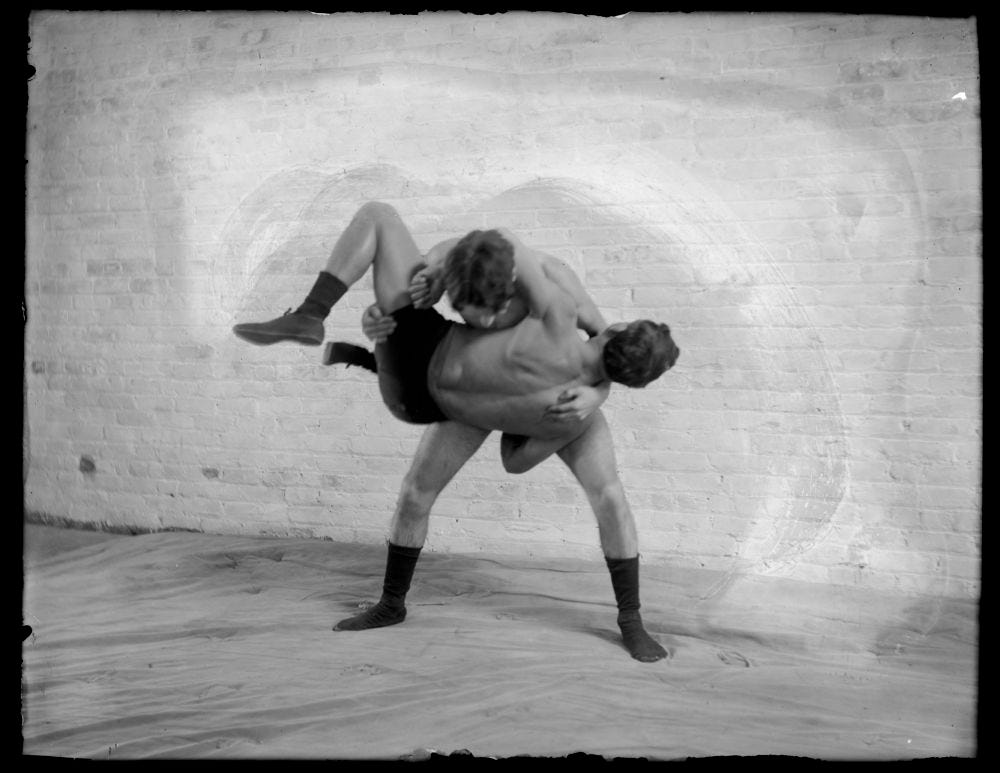
A company called World Wrestling Entertainment, or WWE, which was founded in 1952 under the name Capitol Wrestling Corporation, reported $1.7 billion in revenue in 2025.
I can’t claim to have ever been a fan of professional wrestling – it’s just not my thing – but there’s no disputing that it’s one of the most popular forms of entertainment in the U.S.
Notice that I said “entertainment,” not “sports.”
It’s an open secret that the type of professional wrestling you see in the WWE and some of its counterparts is entertainment, not a true athletic competition. Yes, it’s physical. Yes, it can even be dangerous. No, I wouldn’t care to get one of those wrestlers mad at me and run into him in a back alley. But the matches are scripted, in the same way that “Matlock” is scripted, or “NCIS,” or “The Simpsons.” Before anyone steps into the ring, the outcome has already been decided. The bad guys have been told to play the part of a bad guy; the good guys have been told to play the part of a good guy. The winners and losers have already been chosen.
They used to try a little harder than they do now to keep this a secret. There is a term called kayfabe, which came from the world of carnivals, and it meant the illusion that wrestling was real. If you broke kayfabe, if you gave away the secret, you were in big trouble, not only with the promoters but with your fellow wrestlers as well.
But in 1989, there was a dispute about whether or not the WWE – which was then known as the WWF -- should fall under some of the regulations and fees which applied to professional sporting events, such as boxing matches, in New Jersey. Those rules were designed to ensure fair and honest competition.
Vince McMahon, the owner of the WWF, knew that his company didn’t and couldn’t abide by the rules, and so when he testified before the New Jersey State Senate, he admitted, in general terms, that what his company produced was entertainment, and not a bona fide athletic contest. That meant it didn’t have to obey New Jersey’s rules for sporting events.
Later, a trademark dispute with the World Wildlife Fund forced the WWF to become the WWE, and they put the word “Entertainment” right in the name.
In the years since that time, the rise of the Internet has made it even easier for fans to find out the truth about their favorite performers and the behind-the-scenes workings of professional wrestling. Performers have moved back and forth between the WWE and the big screen, reminding us that they are, when it comes right down to it, actors as well as athletes.
But the fact that the WWE is now known to be scripted hasn’t seemed to hurt its popularity among the people who enjoy it. After all, when we go to see a magician we know that what we’re seeing is trickery rather than a miracle. But that doesn’t make it any less fun. And we certainly know when we go to see a superhero movie or a Star Wars movie that it’s all made up. We can suspend our disbelief and just enjoy the story as it plays out. Apparently, the people who enjoy professional wrestling can do the same thing – it doesn’t matter so much whether what they’re seeing is “real” or scripted, only whether or not they find it entertaining.
Some people have criticized the appropriateness of WWE’s storylines and the wrestlers’ behavior as it applies to young children, who make up a big part of the WWE audience. But that’s a separate issue, and since I don’t watch wrestling, it’s one I’m not qualified to get into here and now.
There is, of course, another form of wrestling – one that’s not scripted, but rather a legitimate athletic competition. There are high school students, college students and Olympic athletes who take it very seriously. These Greco-Roman wrestlers sometimes are heard to grumble about how their good name has been tarnished by the shenanigans that go on in professional wrestling.
But what if I told you that the very first wrestling match of which we have a written record had a pre-determined outcome? What if I told you that, just like the WWE, it wasn’t a real competition?
Genesis 32:22-31 (CEB)
Jacob got up during the night, took his two wives, his two women servants, and his eleven sons, and crossed the Jabbok River’s shallow water. He took them and everything that belonged to him, and he helped them cross the river. But Jacob stayed apart by himself, and a man wrestled with him until dawn broke. When the man saw that he couldn’t defeat Jacob, he grabbed Jacob’s thigh and tore a muscle in Jacob’s thigh as he wrestled with him. The man said, “Let me go because the dawn is breaking.”
But Jacob said, “I won’t let you go until you bless me.”
He said to Jacob, “What’s your name?” and he said, “Jacob.” Then he said, “Your name won’t be Jacob any longer, but Israel, because you struggled with God and with men and won.”
Jacob also asked and said, “Tell me your name.”
But he said, “Why do you ask for my name?” and he blessed Jacob there. Jacob named the place Peniel, “because I’ve seen God face-to-face, and my life has been saved.” The sun rose as Jacob passed Penuel, limping because of his thigh.
Jacob, one of the most fascinating characters of the Old Testament, treated his life as if it were a competition. There were times when he came out a winner, and times when he came out a loser. But he was always trying to get the upper hand. The competition started at birth. Jacob and Esau were twins, the sons of Isaac and the grandsons of Abraham. Esau was born first, and Jacob was born grasping at Esau’s heel, almost as if he’d been competing to come out first himself.
The status of being the first-born, even between two twins, was all-important in that day and time, and Jacob, as he was growing up, knew it. With the cooperation of his mother, he eventually tricked Esau into giving up his own birthright and Isaac’s final blessing.
Esau was furious and vowed to kill Jacob once the period of mourning for their father had ended. So Jacob fled the country, and ended up working for a kinsman named Laban. Jacob fell in love with Rachel, Laban’s younger daughter, and had to work for Laban for seven years before he could marry her. Then Laban tricked Jacob into marrying Leah, the older daughter, first. Jacob had to work for Laban for seven more years in return for being allowed to marry Rachel as well.
But Jacob got the upper hand. Jacob tricked Laban into an agreement that increased Jacob’s flock of sheep at the expense of Laban’s. That ended up souring the relationship between Jacob and his father-in-law, and Jacob found himself on the move once more – this time, though, Jacob was the head of a family, responsible for wives and children and servants and livestock.
Jacob left Laban, and God commanded him to head home. Jacob could only hope and pray that the years which had passed had cooled his brother Esau’s temper.
As he approached his homeland, Jacob got word that Esau was on the way to meet him, with a company of four hundred. Jacob was accompanied by four women and 11 boys, according to the account in Genesis. Jacob didn’t know whether those 400 people waiting somewhere out there in the dark were a welcoming party or an army bent on revenge. So Jacob tried to take out some insurance in that regard by sending ahead some gifts to soften his brother up.
Then, as another little bit of insurance, Jacob decided to move his traveling party – his family, his servants, and all his livestock – across the Jabbok river in the middle of the night.
Perhaps that was intentional; perhaps Jacob wanted to move under the cover of darkness. If his brother was really coming to kill him, Jacob didn’t want to be ambushed – he wanted the meeting to take place in the light of day. So he moved his camp in the middle of the night to create some confusion about his exact location.
That was the scene. Jacob knows he’s about to encounter his brother for the first time after years of absence, but he doesn’t know whether it will be a friendly meeting or a hostile one. His background taught him to expect the worst. Much of his life to that point had been about seeing the world in adversarial terms. You either did unto others or else they would do unto you. If you wanted something, you had to take it – and you constantly had to be on guard against someone else taking what was already yours.
Jacob saw the world as a series of contests. Sometimes you came out on top, sometimes you didn’t. But it was always you against the opponent.
And now, Jacob has sent all of his party across the river. For whatever reason, he’s the last one to cross – and before he can cross, he has an unexpected visitor. Was this the ambush he was afraid of? No, this intruder has nothing to do with Esau. He’s referred to in the Bible account only as “a man.” Was he really a man? Was he an angel? Was he some strange manifestation of God himself? In any case, the wrestler was a representative of God, a spokesman for God, someone who could, at a crucial moment, exercise power in a Godlike way.
After showing up out of nowhere, this man wrestles with Jacob – not just for a while, but all through the night, in the darkness.

The acclaimed author Frederick Buechner wrote a novel called “The Son of Laughter” which tells the story of Jacob, and Buechner’s account of the wrestling match is quite moving. I want to read you a few paragraphs from it:
“He outweighed me, he out-wrestled me, but he did not overpower me. He did not overpower me until the moment came to overpower me. When the moment came, I knew that he could have made it come whenever he wanted. I knew that all through the night he had been waiting for that moment. He had his knee under my hip. The rest of his weight was on top of my hip. Then the moment came, and he gave a fierce downward thrust. I felt a fierce pain.
“It was less a pain I felt than a pain I saw. I saw it as light. I saw the pain as a dazzling bird-shape of light. It blinded me with the light of its wings. I knew I was crippled and done for. I could do nothing but cling now. I clung for dear life. I clung for death. My arm trussed him. My legs locked him. For the first time he spoke.
“He said, ‘Let me go.’”
But Jacob refused to let go, even after the man had injured, and clearly beaten, him. Jacob knew he could no longer win, but he refused to lose until receiving a blessing from this mysterious stranger.
And the mysterious stranger asks for Jacob’s name. As you know, names in Bible times were often chosen for their meaning. Jacob meant “heel” or “leg-puller,” which was a reference to him grabbing Esau’s heel as they were being born. But – like Abraham before him, and like Peter and Paul after him – the man gave Jacob a new name, Israel, which means either “wrestles with God,” or “God rules,” or “God judges,” or even “God contends,” depending on which scholar you believe.
Then Jacob asked for the stranger’s name, but the stranger turns that right back at him. “Why are you asking?” Jesus did that frequently – responded to a question by asking a question of his own.
The stranger doesn’t identify himself – he really doesn’t have to – but he blesses Jacob. We aren’t told the content of the blessing, and we’re never given any further details about the mysterious wrestler. Jacob calls the place Peniel, and claims to have seen God face-to-face.
So, what was the purpose of this wrestling match? The Bible makes clear that the wrestler could have dislocated Jacob’s hip at any moment during the match. Jacob was being tested, but Jacob was never going to win, at least in the rules of wrestling as we understand them.
And yet, the wrestler tells Jacob that he did win: “You struggled with God and with men and won,” says the wrestler.
How did Jacob win?
He won by losing.
Let’s back up a bit. Jacob, the ultimate trickster, the man who saw every transaction as a way to win or lose, leaves his father-in-law Laban – and he could have gone anywhere. But God told him to go home – back to the land that had been promised to his grandfather Abraham. Jacob listened to God, Jacob heard God, and Jacob obeyed God, even though Jacob seems at the time to have believed it might be a death sentence. Jacob thought there was a very real chance that his brother was going to welcome him home by trying to kill him. And yet, Jacob followed God’s command. Jacob was willing to give up his life in obedience to God.
That made Jacob a winner before the wrestling match even started. When we surrender ourselves, our destinies, our security to God, when we are willing to lose everything for God’s sake, that’s when we ultimately win.
Jacob, at some point in this wrestling match, knew that he was dealing with an opponent who was beyond his control. And yet, he would not let go. He wanted a blessing. The man who once tricked his own father out of a blessing knew that this was God, or God’s representative, and Jacob saw the chance to receive from this stranger a much more powerful blessing than the one he received from his father. While Jacob could trick his brother, his father and his father-in-law, there was no way to trick God out of a blessing. The only thing Jacob could do was hold on and hope for the best.
Jacob had learned his lesson – the secret to success is not defeating your enemies but surrendering to God. And Jacob was given a limp, an injury from his wrestling match, as a reminder of the lesson.
The image that this story gives us of Jacob wrestling with God is a strange one, one that it’s hard for us to understand. We can’t defeat God, and we know it, even though we go through periods of denial.
For most of us, the battle is not so much between me and God as between me and myself. Will I go this way or that way? Will I be obedient or disobedient? Will I be faithful and patient, waiting on God’s timetable? Those were Jacob’s challenges as well. Jacob could never have beaten the mysterious wrestler. His challenge was whether he’d be able to hold on until dawn. Our challenge, too, is to hold on through the night, not to let go of our faith, to wait for the dawn of God’s blessing.
Daniel Parkins wrote this on the Relevant Magazine web site in 2012:
“God will always win the wrestling match; if we were smart, then the sooner we submit, the better.
“In the upside-down Kingdom, where to be poor is to be rich, to mourn is to be comforted, we see the profound reality of the Gospel in Genesis’ account of a wrestling match. Having come into contact face to face with the Lord of hosts, with the ever patient and faithful One, we see at long last a broken and contrite spirit humbled to the core. We see a man dependent upon God, rather than dependent upon himself. We see in Jacob a picture of a man renewed by the power of God, now remade in His own image, finally surrendered to the will of God for his life. We see in no small measure great faith worked out.”
Jacob saw the face of God by letting go of his own security and his old ideas of winning and losing, and by holding on to God for dear life, until God’s blessing became clear. Psalm 17:15 says this: “As for me, I shall behold your face in righteousness; when I awake I shall be satisfied, beholding your likeness.”
May it be said of each of us that we behold God’s face, by letting go of ourselves and our own ideas of security, and instead clinging to God’s promise and God’s blessing until, at last, the dawn comes.
No posts
Comments
Nothing yet. Say the first thing.
Sign in to join the conversation.