
Welcome to Detour America, a newsletter on organizing and strategy by L.A. Kauffman. The newsletter is 100% free, but paid subscriptions make it possible. Please share widely and support if you are able.
Seven years ago today, a small team and I fanned out in front of the White House and distributed copies of the Washington Post that featured a dramatic headline:
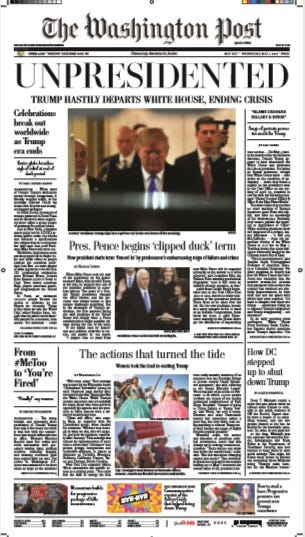
UNPRESIDENTED: TRUMP HASTILY FLEES WHITE HOUSE, ENDING CRISIS
The paper described how, after months of mounting protests and pressure from all sides, Trump had simply given up and abandoned the White House, slipping out of the country quietly in the dead of night. “Celebrations break out worldwide as Trump era ends,” read one front-page headline. “Entire globe breathes sigh of relief at end of dark period.”
Another front-page story detailed the colorful and exuberant protest actions that turned the tide, including nonviolent direct action blockades by young women in quinceañera dresses forming a “wall of floof” around the offices of their protest targets. (You can find a PDF of the paper here.)
The paper was obviously – alas -- a work of fiction. “This paper is a dream; it’s not a deception,” I explained to one of the many media outlets that reported on our stunt, all of whom had dutifully inquired whether we were just pushing “fake news.”
My co-editor Onnesha Roychoudhuri and I had assembled a wonderful team of writers and creatives, with support from the prankster outfit the Yes Men, to spin out a vision of what it might take to drive Trump from office.
Of course we knew that a skulking, voluntary departure was not the most likely way that Trump would actually exit the presidency, but it was a delight to imagine. Our goal, as much as anything else, was to spread joy and hope at a time of low morale, which the fake paper did in abundance.
Beyond that, however, we based our vision on real historical examples, most notably Otpor!, the popular movement that drove the Serbian dictator Slobodan Milošević from power in 2000. We crafted our fictional narratives based on the real strategic principles developed by Otpor! and other anti-authoritarian movements in history.
And we went further, including a 16-page “Bye-Bye 45” action guide in the center of the paper that drew heavily on the strategic principles of this movement. (We billed it as a “commemorative reprint” of the guide that had ostensibly helped spur the events in our fictional account; unfortunately, the website where it once was posted has now expired.)

Central to this action guide – and our fictional account – was Otpor!’s “pillars of support” framework.
The “pillars of support” framework is based on the insight that all regimes require many forms of cooperation in order to function. The best way to undermine the regime, according to this model, is to target the people and institutions that are enabling it, systematically eroding their allegiance and compliance.
People often imagine a temple or similarly grand structure when talking about this framework, or sometimes an upside-down triangle, but I also find it useful to think of a table. Sure, you can knock a table down by pounding on top of it, but it takes extraordinary force. The better, and more strategic way, is to pull out one or more of the legs. And if the leg is already wobbly or otherwise susceptible to pressure, your odds of success increase.
Throughout this first harrowing year of Trump 2.0, the pillars of support framework has been prominently included in many educational materials and trainings, including the mass trainings in noncompliance that tens of thousands of concerned people have attended since last spring.
Many organizers across the broad spectrum of movements and organizations working to oppose the current administration have incorporated this framework into their strategic planning.
And it’s working. Just last week, amid the cold-blooded murder of Renee Good and the broader assault on Minneapolis, you might have missed news of two important activist victories, each of them pulling a pillar of support and cooperation out from under ICE. After a long and creative campaign, Avelo Airlines was successfully pressured into ending the deportation flights it had contracted to provide the administration, making the logistics of mass removal that much more difficult. And streaming giant Spotify was pressured into dropping the ICE recruitment ads it had been running.
When we wrote our fictional Washington Post back in 2019, we focused in on what we then considered to be the single most strategically important pillar of support for Trump.
What was – and is – that pillar? The answer might surprise you: The leadership of the Democratic Party.
From our fictional paper: “New York City organizer Felicia Wood remembers one specific action as a turning point: ‘You could feel the shift in energy the first time really massive numbers of us marched over the Brooklyn Bridge to protest outside Chuck Schumer’s apartment,’ she said. … ‘Instead of going to Times Square or Trump Tower,’ said Wood, ‘we took it home. Schumer and other Democratic leaders had sometimes talked a bood line, but they didn’t start doing anything to counter Trump until they became the target of highly focused popular pressure.’”
In our imagined story, this initial protest inspired a series of nonviolent occupations, mostly targeting Democrats. “[W]omen – many accompanied by their infants and toddlers – marched to Schumer’s offices and staged occupations that came to be known as the ‘Sippy Cup Sit-ins.’ They refused to leave until Schumer signed a pledge … to commit to using tactics such as denying quorum, withholding consent, and filibustering to ‘throw sand in the gears of this rogue administration.’ … [S]aid one staffer. ‘Babies kept drooling on our keyboards and there were half-chewed Cheerios and dirty diapers everywhere.’”
The sit-ins spread, along with other disruptive tactics, and opposition built until massive street protests surpassed the famous 3.5% threshold identified by scholars Erica Chenoweth and Maria Stephan. Democrats did eventually sign the pledge and began using their powers to block Trump at every turn. In our telling, the final straw came when, after massive protests outside Twitter headquarters – another pillar of support for the regime – a rogue employee deleted Trump’s account, depriving him of his major outlet. (Our story of course predated the creation of Truth Social.)
What a dream, right?
It’s a bit heartbreaking to revisit the UnPresidented Washington Post, given all that has happened since, but our focus on Democratic leadership as an under-recognized pillar of support for the regime is as instructive and vital as it was on the day we handed out those fake papers in front of the White House.
You can pick the moment of collusion or collaboration or weakness that most exemplifies the trend: all those times that Democrats voted for Trump nominees (even puppy-murdering Kristi Noem), all the those times they didn’t use procedural levers at their command, every time they respond to the authoritarian horrors of this time with some stupid talking point about affordability. If you have the stomach for it, you can contrast Schumer’s posture as a so-called opposition leader with how Mitch McConnell operated throughout the Obama presidency, using every single tool at his disposal to derail the administration’s priorities. Me personally, I’ll never forgive Nancy Pelosi for stalling on an impeachment vote in the days immediately following the January 6 insurrection, fatally allowing time for shock to fade and arms to be twisted. We absolutely could have seen Trump not just impeached but convicted, and thus barred from running office again.
We now live in the nightmare. And even as masked white supremacist thugs occupy our cities and attack innocent people with apparent impunity, the big question of this moment is whether Democrats will have the fortitude to block funding for ICE when the Homeland Security bill comes up for a vote later this month.
It’s appalling that it’s even a question. Can they even read a room? Trump and his administration are wildly unpopular. More people by far have participated in protests against the Trump administration over this past year than did during a comparable period in Trump’s first term. ICE is widely hated, and there’s organizing everywhere. The people are leading, with commitment and courage – but will our leaders follow? I keep visualizing a wobbly leg beneath a massive table, and how it can be brought tumbling down.
Thank you for being a reader. If you find this newsletter valuable, I hope you’ll share it with others. Huge thanks to my paid subscribers – your generosity makes this newsletter possible. Want to support my work but prefer not to do so via Substack? I gladly take tips and donations via Kofi and Venmo.
No posts
Comments
Nothing yet. Say the first thing.
Sign in to join the conversation.