
Introduction
"Empathy" comes from the German word, Einfühlung, translated directly as "in-feeling". It was used to describe how we relate to and experience art or nature in its original use.
In Inhabiting an Other, I was trying to understand how we empathize with our environment and the things use, touch, or otherwise experience on a day-to-day basis. I wanted to know how attributing value— based on aesthetics, spatial experience, or materiality— to these everyday items changes their meaning in a significant way.
Table
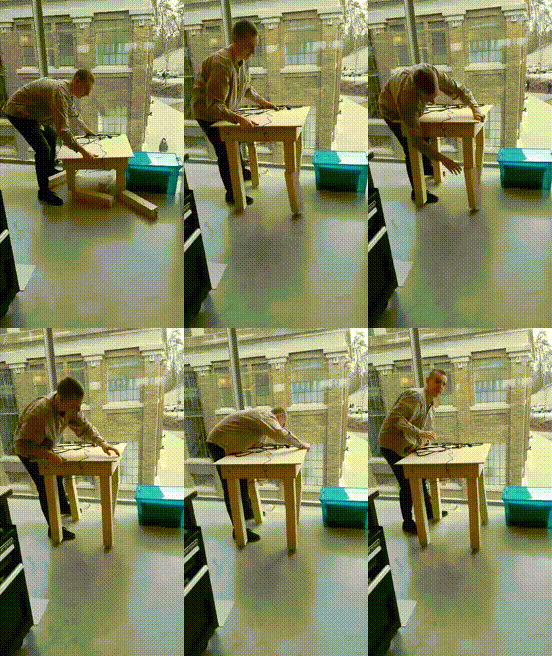
The table that intersects with the wardrobe on one side was made earlier in my school year. It was an attempt to personify an inanimate object, making it fall over and "stand" back up with electrical motors. The movement, the human scale and functionality, were all tools to anthropomorphize the table with a personality.
Attached to the rest of the wardrobe, the motors would periodically buzz— and the legs would twitch. Inside the wardrobe, the table became an altar in a kind of "stage" for reading my stories— memories and events in which objects became special, unique, or even took on a spiritual value.
Wardrobe
The "wardrobe" I built became the setting to read some stories about objects that had transcended their physical value to attain a kind of spiritual significance in my life. The installation was used as an incubator for this alternate language— animistic and anti-modern.
In the space, a light— bright pink— fatigues your blue and red cones; so you actually leave the wardrobe physically changed. The effect forces your surrounding to take on a greenish hue. It's an intimate relationship with the installation and your body. A person of my size would be perfectly framed around the head and shoulders.
It was constructed of mostly salvaged materials. I thought it drew power from these supplied histories. I kept all the internal structure from two sets of drawers; so you almost feel as though you are sitting inside a cabinet. It transforms the scale of your body.
The interior was littered with "generic" objects: a BIC lighter, a little play block with letters on the sides, a deck of cards, some crayons, an alarm clock, and other stuff. These were "memory icons", placed there in an attempt to elicit memories regardless of whomever entered the space.
At the review, many of my critics were reluctant to go inside. Some didn't. I handed out a set of folded construction documents to contrast the emotional space with the stark pragmatism of dimensions and scale.
Comments
Nothing yet. Say the first thing.
Sign in to join the conversation.