
We often hear biologists say that cells "want" to survive, "need" to eat, or "try" to avoid harm. But how can a microscopic bag of chemicals have desires? After all, cells aren't conscious beings. Yet somehow, they persist through time, maintaining themselves against the chaos that threatens to break them. They grow, divide, and adapt with a seeming purposefulness that defies simple chemical explanation.
We know that at the heart of persistence is not a static equilibrium, but a dynamic process. I like to think of a juggler keeping several balls in the air: thermodynamically each ball wants to drop to the ground (lowest energy state), but the juggler's continuous input of energy prevents that outcome. Living systems are somewhat similar. They maintain states far from equilibrium by constant energy input.
But what is the force behind all this? Is this our good old second law of thermodynamics? Is it chemistry kinetics? Or is there something deeper at work?
Lets first look at a few simple examples of complex behavior emergence.
These are chemical systems where the products help create more of themselves. This is huge for achieving stability in a non-living environment, because this means the system can reinforce its own existence. These systems maintain themselves through positive and negative feedback loops.
Thermodynamically, an autocatalytic system is always on the edge – it requires constant influx of resources. But kinetically, it can be very stable, because any loss in one component can be compensated by faster reactions producing it (negative feedback) and any gain can accelerate further gain (positive feedback). This self-correcting, self-reinforcing behavior is essentially homeostasis in a chemical sense, a precursor to biological homeostasis.
Lets look at the formose reaction, a classic prebiotic autocatalytic cycle. In the formose reaction, simple formaldehyde (H₂CO) molecules in solution begin reacting to form sugars. When a little bit of the sugar glycolaldehyde is present, it acts as a catalyst to make more glycolaldehyde out of formaldehyde. This creates an autocatalytic cycle: glycolaldehyde catalyzes its own production (along with other sugars). The reaction, given a “feed” of formaldehyde, will keep producing more sugars. I tried to find a relatively simple visualization of this reaction online, but only found this:
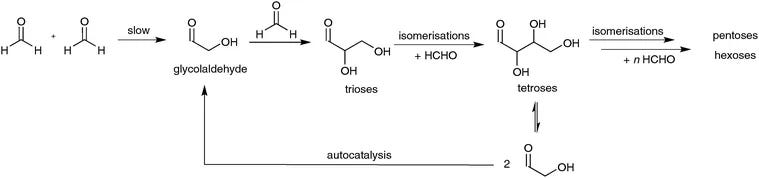
Let's break down this image (feel free to skip this explanation). The process starts simple: two formaldehyde molecules combine to form glycolaldehyde, a two-carbon sugar. What makes this reaction special is its self-reinforcing nature - the glycolaldehyde helps create more of itself. As shown by the bottom arrow, one glycolaldehyde molecule leads to two, creating an accelerating cycle: more glycolaldehyde → faster reaction → even more glycolaldehyde. Along the way, this process also builds increasingly complex sugars, from three-carbon to six-carbon varieties.
Now, lets see how we can build on top of this reaction to experiment with even more complicated behavior.
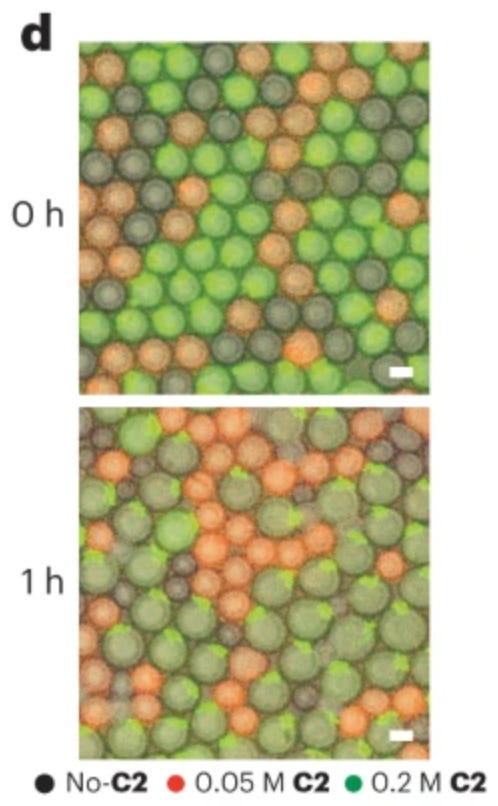
Looking at a very recent experiment (2023) by Philippe Nghe, Eörs Szathmáry, Andrew Griffiths and colleagues achieved a long-sought goal: coupling an autocatalytic chemical reaction to the growth and division (much like a primitive cell). Specifically, they had two types of droplets:
- C2 droplets: Contain formaldehyde plus glycolaldehyde, which acts as an autocatalyst
- No-C2 droplets: Contain only formaldehyde, without the glycolaldehyde catalyst
Over time, we saw that C2 droplets (containing glycolaldehyde) grow larger because the autocatalytic reaction creates more products inside them. These growing droplets pull in water and reactants from neighboring droplets through osmosis. No-C2 droplets shrink as they lose material to their growing neighbors. Also, the growth rate of a C2 droplet depends on how many No-C2 neighbors it has (more neighbors = more resources to draw from).
In addition, they were even able to mimic reproduction. When the droplets are physically divided (mimicking cell division), the larger C2 droplets produce more offspring. We can see some interesting life-like properties like growth, competition, reproduction even on such a basic level.
You probably heard about a leading hypothesis that the first true self-replicator is the RNA. The RNA World hypothesis proposes that early Earth had an abundance of RNA. RNA is unique because it can both store genetic information(like DNA) and catalyze chemical reactions.
The central question is of course: How could RNA form and start replicating? It is indeed the case that nobody was able to show spontaneous RNA self-replicating from scratch. However, experiments back in 2009 created two RNA molecules which could catalyze each other's synthesis. RNA A helps assemble RNA B, and RNA b helps assemble RNA A . It is incredible that this system was able to replicate itself indefinitely(with a doubling time of about 1 hour), with no proteins or cells involved. What makes this system particularly interesting is how it demonstrates the emergence of evolutionary behavior. When researchers introduced variations in the RNA sequences, they observed something remarkable: new combinations of RNA emerged through recombination, and the faster-replicating variants became more common over time. This shows how natural selection could have operated even at this molecular level, favoring RNA molecules that replicated more efficiently.
Lets dive a bit deeper into the technical details of the paper(again, feel free to skip this). E (and E') are the enzymes they started with. These were the complete, functional RNA enzymes. Each E enzyme worked with its partner E' enzyme in a cross-replicating pair. A and B (or A' and B') are the parts that make up each E (or E'). Think of it like this:
- E = A + B
- E' = A' + B'
For example, they had complete enzymes like E1 (which would be made up of its specific A1 and B1 parts). This E1 would work with its partner E1' (made up of A1' and B1' parts).
The fascinating part is what happened during the experiment:
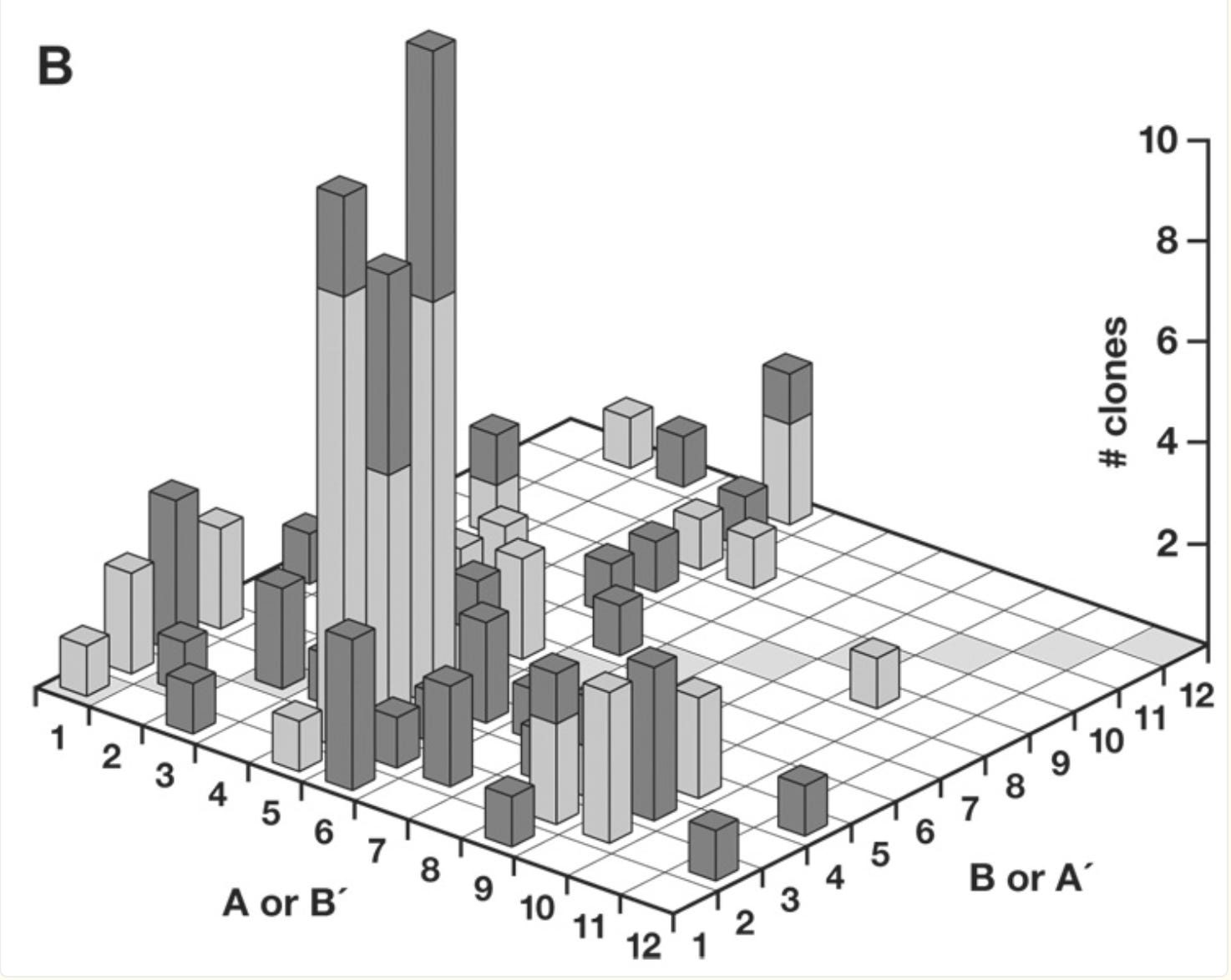
The parts (A and B) could sometimes mix and match to form new combinations For example, the A5 part from E5 might combine with the B3 part from E3 to create a new hybrid enzyme (A5B3). This new hybrid would then work with its corresponding partner (B5'A3'). From the figure, we can see that there was clear selection for certain variants since combinations containing components A5 and B3 (and their corresponding partners B5' and A3') became dominant, making up about one-third of the final population. The distribution was highly non-uniform, showing that natural selection had favored certain variants over others. Components A6-A12 and B5-B12 were rarely found in the final population, indicating they were less fit.
Is it merely random perturbations of electrons that spark chain reactions? Or is this all a part of a huge fundamental autocatalytic set? On a fundamental level, yes—it is all just chemistry, physics, etc... None of these interactions violate the second law of thermodynamics or the principles of chemical kinetics. And yet, even the simplest rules can give rise to the emergence of complicated behavior. The behavior is way too complex to understand from simple mechanistic prospective.
Consider how the autocatalytic droplets we discussed earlier show primitive forms of growth and competition. These aren't just random chemical reactions—they're organized patterns of behavior emerging from simpler components. The RNA world example takes this further: molecules not only self-replicate but evolve, finding more efficient configurations without any external guidance. These systems seem to "climb" toward greater complexity and organization.
Here's how we might think about this climbing: imagine that every molecular assembly exists in an abstract "complexity space." This space has various peaks and valleys, where peaks represent stable, organized states of higher complexity. The formose reaction network we discussed sits at a modest peak—it's more organized than random chemical soup, but less complex than, say, a self-replicating RNA system, which occupies a higher summit.
Now, lets do a thought experiment. Consider a human embryo starting as a single cell. In our complexity landscape, this cell already sits at a relatively high peak—it contains all the information needed to reach an even higher summit of organization: a fully formed human. But where is all this information stored? The embryo doesn't randomly explore possible configurations. Instead, it follows a remarkably precise developmental program, moving through a series of increasingly complex states. Just as our autocatalytic networks showed emergent behavior beyond simple chemistry, embryonic development displays an organizing principle that transcends basic chemical interactions.
This developmental trajectory is similar to what we saw in the RNA world experiments, but at a higher level of complexity. Just as RNA molecules found optimal replication strategies through a form of "exploration" in their possibility space, embryonic cells navigate another part of this landscape of possible states. They don't just react chemically, but they also follow developmental programs, respond to signals, and make "decisions" about their fate.
I am fascinated that this navigation happens without external guidance. The autocatalytic droplets we discussed "knew" how to grow and compete, and the RNA molecules "knew" how to evolve toward more efficient replication, embryonic cells "know" their developmental pathway. Where are all these programs stored? There might be deeper organizing principles in nature. Principles that aren't captured by simply saying "it's all just chemistry.", but rather an organism traversing this complexity plane which results in higher "wants".
No posts
Comments
Nothing yet. Say the first thing.
Sign in to join the conversation.