
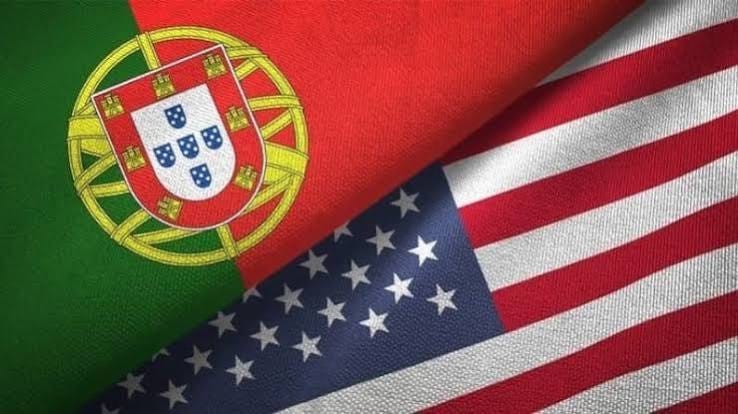
I’m stepping into America’s 250th birthday in Lisbon, contemplating my Americanism. I’m am fully aware that Santa Cruz, San Francisco, Los Angeles, all those cities in which I’ve lived have literally entered my DNA changing the behavior of my inherited genetic code. And of course it’s never nature vs. nurture and always nature and nurture. America has nurtured me.
But while living in the States it was nearly impossible to figure out what parts of American culture, ideals, flaws, strengths, values and biases I’ve internalized and which ones I’ve simply been immersed in.
Now I’m an American immersed in Portuguese culture. And that contrast brings my national identity into sharp relief.
For instance, America is both famous and notorious for its optimism. That optimism sometimes, maybe even frequently, leads to bad choices. For instance it was the wildly optimistic belief that America, using only a military air campaign, could defeat Iran before they had a chance to take control of the Strait Hormuz and wreck havoc on the world economy that led Trump to whimsically start a war. I don’t believe I have internalize that kind of American optimism, the kind that is completely unsupported by evidence and facts.
But conversely, when Martin Luther King Jr. declared, “The moral arch of history is long, but it bends towards justice” he was also expressing a kind of unique American optimism. This idea that in the end, the good guys always win, that while it may take generations, justice will eventually prevail. I really respect that kind of optimism…
…but I don’t share it.
It’s not that I think the moral arch of the universe bends towards injustice. It’s more that I don’t think the universe has a moral arch. There is no guarantee that justice will be achieved or even put within the grasp of individuals or demographic groups that deserve it. Occasionally societies recognize their wrongs and right themselves. other times they simply destroy themselves. The good guys sometimes win. Looking through history, if anything I would say that the universe has a kind of moral seesaw.
Yet I also don’t share the overall cynicism about the future that I’ve observed in many cultures outside of the States. I strongly believe in possibility. I believe in invention and reinvention…both motifs that have been present throughout the American experiment. To borrow a turn of phrase from Michelle Obama, we are all constantly “becoming.” Over the entire course of our lives we have the ability to change our fortunes, our experiences, the way we perceive and are perceived. And I believe that growing up in America has given me that perspective. And as I embark on this amazing new adventure in Portugal, I am grateful that my American mentality helped me see the potential that exists here for my family and that my American gumption helped me take that leap to move here.
There’s another way that Portugal is helping me to examine my personal American spirit. It’s something James Baldwin experienced in France too…
While living in America, my Americanism was hyphenated. In America I’m not simply “American.” I’m African American. For those of us whose American identity exists after a hyphen (even when the hyphen is left unsaid) there are certain assumptions placed on us, certain expectations, stereotypes, suspicions that are quietly (or not so quietly) attached that affect the way we are able to move and act in our home country. Mexican Americans deal with this too as do Native Americans (honestly it would make more sense if Native Americans were just called Americans and the rest of us were called Non-Native-Americans…but I digress).
Here in Portugal, I’m simply American. I don’t sense, at all, that I’m perceived differently because I’m an American with darker skin. People here don’t ask me ot explain things about America through the African American lens. No one here asks me about what the publishing industry is like for an African American author (something I get asked about frequently in the U.S.). Instead they ask me about what the publishing industry is like for American authors. Period. They want to know if I have a sense of what Americans are currently feeling about current events. Obviously those question are too broad to give a good response to because in America we do live in the world of hyphens and our experiences and views are, at least in part, dictated by that. But it’s interesting, finally being able to grapple with my general Americanness while superficially detached from the subcultures I existed in while living in California.
James Baldwin too was taken by how in the States he was a Negro author but once in Paris he became an “American Author.”
That said, there’s a lot I really value about being an African American author. I’m not interested in trashing my hyphen. But living without it for a while is truly enlightening.
12 months a year, I feel like I’m contemplating the history of our country and/or its direction. It’s not uncommon for my husband and I to debate the legacy of our founding fathers (we’re geeky like that). But this 4th of July weekend, I’m turning my focus inward, trying to figure out how much of that red-white-and-blue has seeped in through my melanated skin. I’m figuring out how our country has shaped me, for better and for worse. In the ways that it’s shaped me for the worse, maybe I can start to change that here. For the ways it’s shaped me for the better…maybe I can further lean into that and share it with the world.
I don’t see why not. As an American, I believe in possibility.
Comments
Nothing yet. Say the first thing.
Sign in to join the conversation.