
“Can civility be a vice as well as a virtue?”
Some people think that civility clashes with the virtue of integrity. A person with integrity acts on their best moral judgment even when that means rejecting the social conventions of civility. Where civility counsels politeness; integrity refuses engagement with people that hold horrendous views.
For this clash of virtues to make sense, you have to believe that there are boundaries to civility. As the philosopher Cheshire Calhoun puts it, there must be
“a point where speech and action are sufficiently disrespectful, inconsiderate, and intolerant not to warrant a civil response.” - Cheshire Calhoun, ‘The Virtue of Civility’, p. 267.
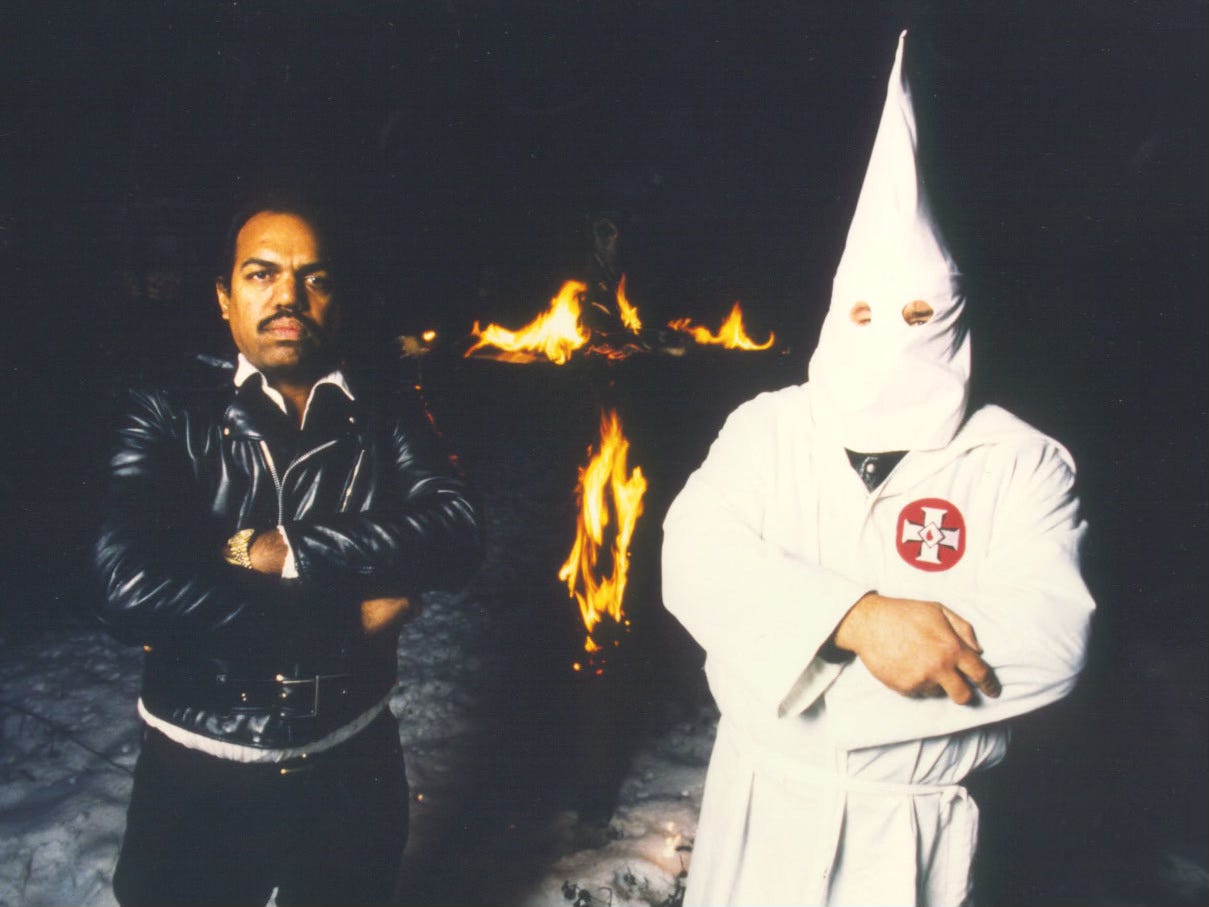
For example, maybe as a prochoicer, I should be civil to the pro-lifer when we debate abortion, but does the KKK member deserve that same treatment? I imagine many would say ‘no’, but why is that the case? Can we draw the boundaries of civility in a principled way? That’s what I’ll try to do in this essay. In so doing, we’ll see if and when civility really does conflict with integrity.
Many people regard civility as a conditional virtue or obligation. This means that we don’t have to be civil all the time or to everyone. There are certain conditions that make it OK not to be civil. What are those conditions? Here are a few answers.
One traditional liberal answer is to draw a sharp distinction between speech and action. On this account, we have to be civil to those with offensive views, but not to those who engage in violent, harmful action. So, while we should be tolerant to racists, civility goes out the window when a White Supremacist tries to burn down a Black person’s house. No one would demand the Black person to now engage in calm rational dialogue about their differences. So, the limits of civility are drawn by harmful actions, not offensive views.
What’s nice about this account is its wide scope. It says people should be civil to basically anyone provided that some person’s speech does not directly result in harmful action. The problem with this view is that it places enormous philosophical weight on the speech-action distinction.
Some pressure points. First, you might worry that it is really hard to identify when speech causes harm. Sure, one lone racist remark will not move a mountain but thousands of them might shift attitudes and support policies that harm racial minorities. Somewhere along that chain, speech has caused harm — but it’s impossible to pinpoint exactly where. And that vagueness cuts both ways. Defenders of the speech–action distinction might take it as reason to keep the boundary broad (“better safe than censorious”), while critics might take it as proof that the boundary is too crude to capture real moral effects.
A second worry about this view is that it ignores how speech can itself be a form of action. As the philosopher J.L. Austin famously argued, when we speak, we don’t merely describe the world — we perform acts within it. Words can apologize, promise, insult, command, or even marry. In other words, language can do things, not just say things.
From this perspective, a racist remark isn’t just an opinion expressed — it’s a degrading act that positions and diminishes its target. It constitutes harm, rather than merely risking it later through downstream consequences. By the traditional liberal’s own standards, then, such speech already counts as a kind of harmful action — one that might justify withholding civility. Ironically, this collapses the liberal’s neat speech–action divide and makes the boundary of civility much narrower than they intended.
The KKK example is helpful because most people agree racism is wrong. What makes people hesitant to be civil toward KKK members is that it reopens a settled moral question to accommodate a small minority of wrongheaded individuals. Perhaps liberals will insist that people are free to express their wrongheaded views, but it doesn’t follow that we must engage them civilly.
Why not build civility’s limits on this idea? As Calhoun puts it, once there is “social closure” on the intolerability of a view – like we have with racism or sexism – then we’re no longer required to be civil. So civility can still be about respecting those we disagree with, but only on those moral issues that we haven’t figured out yet. That’s why the abortion example seems different. It’s not clear whether the pro-choice or pro-life position is right – see Amos Wollen’s Substack for good arguments for both sides – but it’s a lot clearer that racism is wrong. That’s precisely why we should be civil in some moral debates, but maybe not all of them.
I think there’s something to this view. You shouldn’t try to force a social consensus on people trying to figure out a complex moral issue [insert controversial example]. But this view flirts dangerously with relativism. If the boundaries of civility are set by whether there is social closure on a view’s tolerability, then shifts in opinion could change who is owed civility. But that seems way too weak.
Consider the white nationalist rallies in Charlottesville, Virginia in 2017. Had those movements succeeded in persuading others through mass media, Calhoun’s model would imply that civility was once again owed to racists and anti-Semites. This makes civility weirdly hostage to the contingencies of social persuasion, regardless of whether the resulting consensus is morally justified or not.
Oddly enough, the view is also too strong. Let’s say we’ve come to a consensus on racism’s wrongness. There might still be significant disagreement about whether some policy, remark, or behavior counts as racist. Imagine this scenario:
Workplace. Alex and Beth are talking about a new hire at their firm called Charlie. Alex says, ‘I bet Charlie got the job because of DEI.’ Beth then says, ‘that’s racist.’ Alex responds, ‘No, it’s not. DEI-culture make it reasonable to ask whether someone got a job fully on merit-based grounds.’ Beth then says, ‘you’re only saying that because Charlie’s Black.’
If you were observing this disagreement, you would probably say that Alex and Beth are not disagreeing about whether racism is wrong. Yet on the social-consensus view, Beth would be justified in being uncivil to Alex simply because racism is generally agreed to be wrong. The problem is that this justification treats any disagreement involving a settled moral category as settled all the way down. But the dispute here is really about what counts as racist — not whether racism is wrong — which means the consensus view misses a whole layer of moral uncertainty.
Philosophers sometimes describe concepts like racism as thick concepts — they both describe and evaluate. To call something racist is not just to label it, but also to condemn it. This means people can share the evaluative attitude (that racism is bad) while disagreeing about the descriptive criteria (what behaviors count as racist). The Workplace case is exactly like this. Both Alex and Beth are engaged in a game of deciding what it is correct to describe as ‘racist’.1
My view is that many moral and political disagreements between good-faith speakers share this same structure. Once we recognize that people are often uncertain about how to apply thick moral concepts, a practical demand follows: we need a way to navigate such uncertainty. That way, I suggest, is civility. To be civil is to treat your conversation partner as someone who might be — however clumsily or objectionably — trying to negotiate the meaning of our shared moral concepts, rather than as someone who openly endorses racism or sexism.
What does my view say about civility’s limits? It says one has to be civil with people while we figure out whether the view a person holds genuinely falls under the bad moral category. You no longer have to be civil if the person is openly affirming racism, or when, after a genuine attempt at negotiating some concept’s meaning, they continue to deny or distort the concept. If Alex now says, ‘Look people of Charlie’s race just aren’t as intelligent,’ then Alex is clearly being racist and Beth needn’t be civil.
You might be thinking that the bar is pretty high. I think it is and that’s because of civility’s relationship to tolerance. The value of tolerance lies in its willingness to risk engaging with difference. Civility involves a similar gamble: the gamble of conversing respectfully with those whose commitments (may be) uncertain. That kind of openness – acknowledging uncertainty and proceeding civilly until clarity emerges – is, in the long run, far healthier politically than a premature certainty that forecloses dialogue. Yes, this can feel naïve in a polarized world. But moral certainty can itself become a kind of vice — one that civility keeps in check.
This might have seemed like a detour but the virtue of integrity is intimately bound up with civility’s limits. Let’s briefly examine what the three accounts have to say here.
The traditional/classical liberal maintains that one need be civil toward offensive views but not toward violently intolerant action. The liberal might say this: “Civility is how I express my moral integrity. Acting on my best moral judgment as a liberal just is to follow the social conventions of civility. Therefore, if you’re a liberal, there’s no conflict with integrity.”
I’m generally friendly to this view, but I worry about the weight it places on the speech-action distinction to make its case. There aren’t just fuzzy boundaries here; some forms of speech both say and do things to others. By missing these points, the traditional liberal might lead people to sit and wait until they’re absolutely certain something has gone wrong. But it can’t be denied that this sitting and waiting does tax one’s integrity.
On the second account I examined, Calhoun explicitly notes that she gives us a way to resolve the tension between integrity and civility. If there’s “social closure” on the intolerability of some view, we need not be civil. As a result, there need not be any damage to our integrity.
Calhoun’s account resolves the tension but in the wrong way. While she doesn’t opt for the nebulous speech-action distinction, she doesn’t attend to our uncertainty-laden thick moral concepts. I think appreciating this point has important implications for integrity.
Here’s how. Acting on your best moral judgment requires you to give weight to competing plausible hypotheses to explain other people’s moral beliefs. One hypothesis is that the disagreeable people you encounter are simply irredeemably racist or sexist — they explicitly hold these views and knowingly support a morally corrupt ideology.
The alternative hypothesis is that they differ over the content of a moral concept. They don’t see how it’s “racist” or “xenophobic” to oppose immigration, for example.2 In saying so, they’re implicitly suggesting that such views shouldn’t count as part of racism’s definition — a claim others reject. Of course, some people genuinely do hold abhorrent moral views. But we need a way to tell which case we’re in.
If integrity means acting on your best moral judgment, then it also requires doing that due diligence. Civility is the way we do it. In that sense, civility isn’t opposed to integrity at all — it’s one of integrity’s demands.
Of course, civility can still be a vice when it’s used to suppress moral conviction or disguise indifference. But those failures stem not from civility itself, but from abandoning the uncertainty it’s meant to honor. The virtue of civility lies in knowing when to keep the conversation open — and when the conversation has, in good conscience, run its course.
To be clear, I am not saying it is necessarily racist or xenophobic to be anti-immigration – I’m merely reporting that some people think it is.
No posts
Comments
Nothing yet. Say the first thing.
Sign in to join the conversation.