
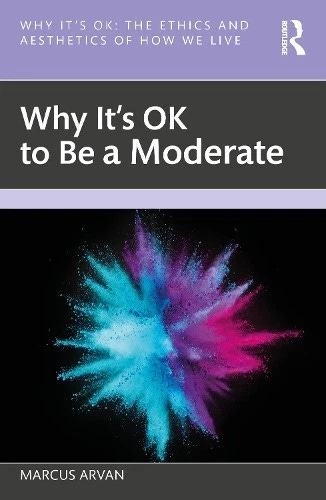
I recently read Marcus Arvan’s book ‘Why it’s OK to be a Moderate’.1 If you’ve not read any books in Routledge’s Why it’s OK series, you really should. You’ll learn why it’s ok to own a gun, eat meat, and not to care about politics (haven’t read that last one…) These books tend to strike a nice balance between accessibility for the non-specialist and interestingness for the academic.
My first thought was surprise that a book like this even needed to be written. And yet, here we are. What follows is a short review that taught me a fair amount about myself as a political moderate: why moderates matter, how they can work productively with radicals, and where their vices lie. I end with an objection about whether it is rational to be a moderate, as opposed to merely OK or prudent.
First things first, what does it even mean to be a moderate? Sometimes, people define moderate and ‘centrist’ interchangeably. Of course, everyone hates centrists, so if this were true, then maybe it’s not so surprising the book had to be written. Arvan rightly points out that the moderates history remembers well are not centrists at all: George Washington, Abraham Lincoln, Theodore Roosevelt, Truman, Clement Atlee etc., are examples of politicians on the left and right of the dreaded center.
This leads Arvan to suggest that moderate is best understood as a modifier, not a position on the spectrum. You can be a moderate progressive or a moderate conservative. He treats moderation as a family resemblance concept — not defined by one essential trait but by a web of overlapping similarities, like members of a family who share some but not all features.
A moderate, on Arvan’s view, tends to display four qualities.
First, they are pragmatic: they take feasibility seriously. When Lincoln ran for office, he opposed slavery privately but avoided provoking the powerful racist party of his time — a strategic silence that may have helped him win.
Second, moderates tend to be value-pluralists. They think liberty, equality, stability, and other political values must be balanced rather than subordinated to a single master value.
Third, moderates are willing to accept principled compromise with people whose values differ from their own. Compromise isn’t a betrayal of the cause; it’s the mechanism by which moderates aim for durable outcomes. And this points to a fourth characteristic of moderation: a preference for gradualism over abrupt—or brittle—political transformations.
Now, Arvan is quick to point out that radicals may have these traits too but moderates tend to exhibit them more often. If that’s what moderates look like, then radicals—at least in Arvan’s view—are defined largely by their opposites.
According to Arvan, radicals on the left and right tend to exhibit the following vices: (1) moral extremism (unwilling to entertain they are wrong), (2) Manichaeism (dividing the world into good and evil) (3) moral grandstanding (overdoing moral talk) (4) dehumanization (5) polarized on beliefs and emotions (6) misperception of political differences (7) motivated reasoning (8) conspiratorial inclinations (9) magical thinking (believing complex problems can be resolved simply) (10) crude consequentialism (‘this is bigger than you’), (11) more accepting of violence (12) authoritarian.
Is that all? In all seriousness, most readers — regardless of political orientation — will recognize these traits in radicals they’ve encountered. And at a group level, these tendencies often lead to gridlock, wild policy swings, and in the worst cases, violence and war.
To be completely clear, Arvan doesn’t say that radicals are unimportant. On the contrary, radical activism has driven civil liberties, racial equality, gender equality, and more. His argument is that politics works best when radicals and moderates operate together, but in tension: radicals expand our moral imaginations; moderates translate it into durable policy.
A good example of this is the gay rights movement in the UK. Radical activists raised awareness and pushed the movement into public consciousness but were often reluctant to pursue marriage, seen by some as a “heterosexual institution.” Moderates recognized that reclaiming the language of marriage could win over skeptical citizens. By appealing to widely shared values — love, commitment — moderates forged coalitions radicals alone could not. Radicals made the unthinkable thinkable; moderates made it achievable.
This is what leads to Arvan’s answer
“It’s OK to be [a moderate] in part because not everyone should be one. Things tend to go badly in politics not only when radicalism runs out of control, but also when moderates have continued misguided radical policies.” (p.112)
Moderates are looking pretty great so far, but Arvan concedes they’re not perfect. Perhaps their greatest vice is that they can uphold a bad status quo. Moderates are often unwilling to call a spade, a spade or take action until they’ve ‘got all the information’ (I confess I’ve done this once or twice…). If that’s the worst thing moderates do, I’ll take it. Better to be careful and occasionally wrong, then reckless and occasionally right.
Still, while I agree with much of Arvan’s argument, he doesn’t say much about whether it is rational as opposed to merely OK or prudent to be a moderate. Much of his defense appeals to stability, tempering the vices of radicalism, and enabling the sustainable pursuit of political goals over time.
But from an agent’s perspective, things look different. Given uncertainty about long-term political trajectories, the often limited impact of individual political action, and the reputational costs of not conforming to your social group’s views, it might be entirely rational to favor short-term social rewards over the long-term benefits of moderation. For instance, if your social world rewards you for taking radical stances—and punishes moderation—you may be (instrumentally) rational in doing what’s individually costly to avoid: being labeled lukewarm, uncommitted, or traitorous.
Now, the book isn’t called Why it’s Rational to Be a Moderate. But I think this bears on why being a moderate is not all that popular a choice, especially when polarization radically reshapes our incentives to practice politics in a haphazard, ‘morally righteous’ way.2
Arvan’s book is enjoyable to read, easy to follow, and hard to disagree with. It was reassuring to understand why it’s OK to be a moderate even when it feels like everyone around you believes otherwise.
What do you think? Does Arvan miss something important about moderation? Has he misunderstood radicals in any way? I sometimes wonder: can a moderate ever be the leader of a political movement, or are they doomed to follow radicals?
Any discussion welcome. Thanks for reading!
To be fair, he discusses important institutional problems like the news and social media promoting rage-bait that systematically makes moderate takes less popular. There’s also a bunch of interesting discussion of designing elections and government institutions that I couldn’t quite work in here, but you really should just read the book!
No posts
Comments
Nothing yet. Say the first thing.
Sign in to join the conversation.