
A teacher reads another story about record heat, hears students talk about the future with a mix of concern and resignation, and thinks, “I should be doing something with this.” Then the practical questions arrive. Where does sustainability fit in an already crowded curriculum? How much does a teacher need to know? How can students examine complex or contested issues without being told what to think? What would meaningful participation even look like?
Those questions point to a problem that is easy to miss. Many people may not need another argument that sustainability matters. They need help moving from concern to capability. I use the term concern-to-capacity gap to describe the space between recognizing that an issue matters and having the knowledge, confidence, judgment, tools, and opportunities to respond well.
The gap is especially visible in education, but it is not confined to teachers. Anyone can care about climate change, biodiversity, inequality, community wellbeing, or the future and still wonder where to begin. Capacity can be developed, but it is not the endpoint. A second gap can appear between having the ability to respond and actually putting that ability into practice. I think of this as a capacity-to-action gap, one that begins to close through practice, feedback, reflection, and repeated opportunities to participate.
We may be starting with more concern than we realize, which means raising awareness cannot be the whole strategy.
In spring 2026, the Yale Program on Climate Change Communication and George Mason University Center for Climate Change Communication surveyed a nationally representative sample of 1,068 U.S. adults. Sixty-six percent said they were at least somewhat worried about global warming, while 65 percent said the issue was at least somewhat important to them personally. Yet 69 percent said they rarely or never discuss global warming with family and friends (Leiserowitz et al., 2026).
Concern, in other words, can be widespread without being highly visible. There is also substantial support for education as part of the response. In fall 2025, 73 percent of registered voters agreed that schools should teach children about the causes and consequences of global warming and potential solutions (Leiserowitz et al., 2025).
These findings do not show that most Americans embrace Education for Sustainable Development, or ESD, agree about climate policy, or share one understanding of sustainability. Climate change is only one part of a wider field involving ecological, social, economic, cultural, institutional, and ethical questions. What the surveys establish is narrower but still useful: climate concern is already common. Once we recognize that starting point, a better question comes into view. If concern exists, why does it not automatically become informed action?
Awareness, caring, and activity are different dimensions, and people can occupy many combinations of them.
Stephen Sterling (2026) recently shared a simple thought model built around those three variables: whether people are aware of climate, nature, and related crises; whether they care beyond their immediate personal interests; and whether they are active in intentional change. He describes caring as an affective “system of concern” (Sterling, 2026, para. 3) and explicitly notes that the model simplifies a much more complicated reality. Its value lies partly in reminding us that people do not all begin in the same place and may therefore need different educational strategies.
Sterling is one of the sustainability education thinkers I return to most often, particularly for systems thinking and educational change. I appreciate how clearly he can expose the structure of a complicated problem without pretending that the problem itself is simple. His three variables create eight possible combinations.
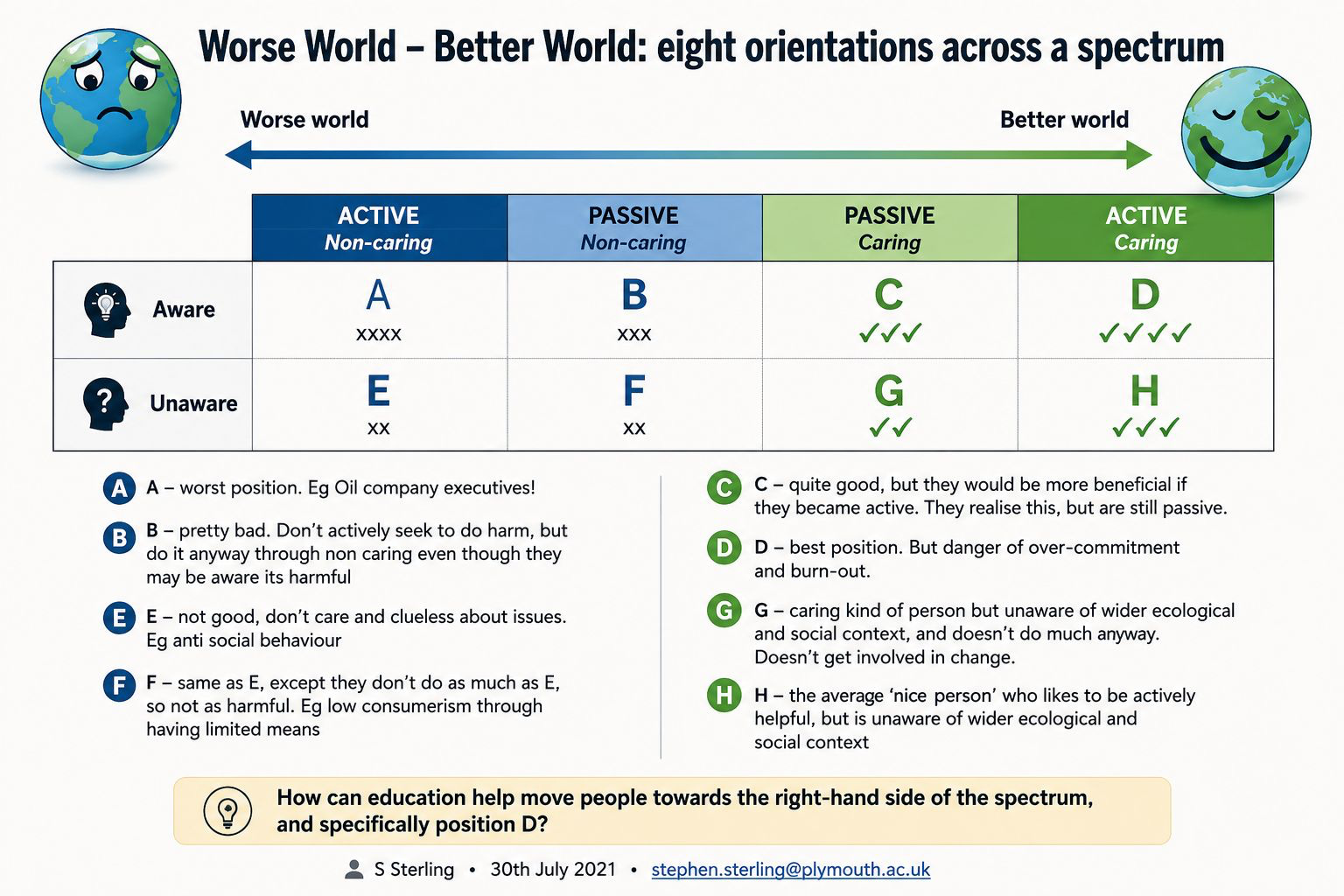
The examples that follow are my own illustrations of the eight positions generated by Sterling’s model, not descriptions supplied by Sterling.
Someone who is not aware, not caring, and not active may simply be disengaged. Someone who is aware but neither caring nor active may understand the evidence while seeing little reason for personal involvement. Someone who is caring but neither aware nor active may care deeply about children, animals, fairness, or community but lack a wider map connecting those concerns to sustainability.
A person who is aware and caring but not active may understand a problem and care strongly while feeling overwhelmed, powerless, or unsure where to begin. This may be the clearest example of the concern-to-capacity gap. Someone who is active but neither aware nor caring might follow a workplace recycling policy because it is required, while someone who is aware and active but not especially caring might reduce energy use because doing so saves money or helps an organization meet a target.
A person who is caring and active but not very aware might volunteer at a food bank, restore habitat, or organize neighbors during extreme heat without yet understanding the wider systems surrounding the issue. Finally, someone who is aware, caring, and active brings understanding, concern, and intentional practice together while remaining open to learning and revision.
These positions are not permanent personality types. The same person may occupy different positions on climate change, poverty, biodiversity, or another issue. Their educational value is diagnostic. Someone who lacks understanding may need knowledge. Someone who cares but lacks a wider map may need systems understanding. Someone who understands and cares but feels stuck may need examples, practice, community, confidence, or a realistic place to begin. More information will not address every gap.
Low familiarity with ESD or the Sustainable Development Goals should not be mistaken for indifference toward the problems they address.
In my dissertation, I examined perspectives related to ESD and the SDGs among K–12 music educators in the Southwestern United States (Bartlett, 2025). Among the 57 respondents who answered a question about SDG familiarity, 24.6 percent reported being not at all familiar with the goals and 26.3 percent were only slightly familiar. Together, 50.9 percent fell into those two categories.
Those results establish limited SDG familiarity within that part of my sample. They do not establish that those educators were unconcerned about climate change, poverty, equity, democracy, biodiversity, cultural continuity, community wellbeing, or students’ futures.
A teacher can care about those questions without knowing the acronym ESD. Educators may encounter related concerns through climate literacy, environmental education, civic learning, global competence, human-rights education, place-based education, or other traditions. Some may already be engaging related questions. A class investigating neighborhood heat, examining inequality through literature, maintaining a community garden, or exploring cultural continuity may be encountering sustainability without naming the work ESD.
Recognition therefore comes before prescription. If we mistake unfamiliarity for indifference, we are likely to offer educators the wrong kind of support. Helping teachers recognize relevant relationships already present in their subjects, schools, and communities gives them a better basis for deciding whether those relationships deserve further investigation and what capacities they might need next.
Goodwill alone is not enough to enact ESD responsibly. Educators also need conceptual understanding, pedagogical tools, opportunities to practice, and room for contextual judgment. UNESCO makes “building capacities of educators” one of the five Priority Action Areas of its ESD for 2030 framework and calls for educators to have opportunities to develop the capacities needed to foster learning for sustainable development (UNESCO, 2020).
In practice, that capacity involves answering ordinary professional questions. What is genuinely relevant to this subject and these students? Which relationships are worth investigating? What evidence is needed? How should uncertainty and disagreement be handled? What can students reasonably investigate, design, decide, or influence? When is a sustainability connection useful, and when would it be forced or lower priority?
These questions help distinguish thoughtful ESD from simply attaching a sustainability label to existing instruction. ESD need not mean making every lesson about sustainability or steering students toward predetermined conclusions. A responsible teacher may examine a possible connection and decide to develop it, adapt it, postpone it, or leave it alone. Professional capacity includes making that judgment well.
Teacher education has an important role here. Future and practicing educators need opportunities to see examples, develop foundational ESD literacy, practice systems thinking, design learning experiences, receive feedback, protect student judgment, and examine what students actually learn.
Developing capability, however, raises the next practical question: how does capacity become action? Knowing how to map a system, design an inquiry, or facilitate a difficult discussion is different from using those abilities in an authentic setting. The capacity-to-action gap begins to narrow through practice. A teacher might test one redesigned lesson and examine what students noticed or understood. A teacher educator might incorporate one ESD design exercise into a methods course and revise it after seeing how candidates respond. Someone outside education might investigate one local system, join an existing community effort, or try one informed change and examine what follows. Capacity becomes more usable through experience, feedback, reflection, and revision.
ESD becomes especially useful when it helps people notice consequential relationships, investigate them carefully, and identify proportionate next steps.
Systems thinking directs attention toward relationships, causes, consequences, feedback, power, and interdependence. Futures thinking creates space to ask what may happen next and what alternatives are possible. Participatory learning invites people to investigate, deliberate, create, decide, and contribute rather than remain passive recipients of information (UNESCO, 2020). Sterling similarly distinguishes reactive or “default” learning from anticipative learning: learning that is proactive, reflexive, critically self-aware, and directed toward informed action (Sterling, n.d.).
For a teacher, a first experiment can be modest. Take one lesson you already teach and ask what consequential relationship students might notice more clearly. Then ask what question could help them investigate that relationship and what they might reasonably do with what they learn. They could compare alternatives, map a system, examine evidence, create something, deliberate a decision, or investigate a local condition.
That exercise does not prove that students will change their behavior or transform a wider system. It creates an opportunity to see more clearly, ask better questions, reason with greater care, and practice informed judgment. If the teacher then examines what happened and adjusts the next attempt, the experience becomes part of building professional capacity rather than a one-time sustainability activity.
The same invitation extends beyond classrooms. You do not have to teach sustainability to participate in it, and you do not need to become an expert before beginning. Anyone can choose one system that touches everyday life, learn more about how it works, notice who makes decisions, examine who receives benefits and bears costs, find people already working on the issue, and decide whether there is a meaningful role to play.
This is what excites me about ESD. Sustainability can become less like an impossible list of crises and more like a disciplined way of seeing, learning, judging, imagining, and participating. For educators especially, my work is increasingly about making those pathways easier to see: translating complex frameworks, identifying legitimate curricular entry points, developing practical tools, and helping teachers build capacity without assigning them responsibility beyond their power.
The concern-to-capacity gap is encouraging in one important respect: capacity grows through use. None of us has to understand every system or solve every problem before beginning. We can learn to see one relationship more clearly, investigate it with greater care, decide what a responsible next step might be, try it where appropriate, and revise in response to what we learn.
That leaves a question worth carrying into a classroom, a teacher-education course, a workplace, or ordinary life: What relationship can I see more clearly now, and what would be a responsible next step from where I actually am?
If any of this resonated—or if you think I am getting something wrong—I would genuinely like to hear from you in the comments. And if there is a topic you would like me to dig into—something that has been sitting with you, something you cannot quite find good writing on—please reach out. That kind of signal genuinely shapes what I write next.
If you are finding value here, subscribing—even at the free level—helps this work reach more people. So does liking, commenting, and reposting. In a crowded information environment, those small actions matter more than most people realize. I notice every one of them, and I am sincerely grateful for each.
Thank you for reading. It means more than I can easily say.
I am an independent scholar with a PhD in education, writing about sustainability, Education for Sustainable Development, and the future of learning. I am available for research collaboration, consulting, and teaching opportunities—linkedin.com/in/kylecbartlett.
Share Teaching for a Complex World
Bartlett, K. C. (2025). Education for Sustainable Development in K–12 Music Education: A Survey Study of Teacher Perspectives and Practices in the Southwestern United States [ProQuest Dissertations & Theses]. https://www.proquest.com/docview/3281118753?pq-origsite=primo&accountid=4485
Leiserowitz, A., Kotcher, J., Rosenthal, S., Goddard, E., Carman, J., Verner, M., Myers, T., Ettinger, J., Fine, J., Richards, E., Goldberg, M., Marlon, J., & Maibach, E. (2025). Climate change in the American mind: Politics & policy, Fall 2025. Yale University and George Mason University. https://climatecommunication.yale.edu/publications/climate-change-in-the-american-mind-politics-policy-fall-2025/
Leiserowitz, A., Kotcher, J., Rosenthal, S., Goddard, E., Carman, J., Verner, M., Myers, T., Ettinger, J., Fine, J., Richards, E., Goldberg, M., Marlon, J., & Maibach, E. (2026). Climate change in the American mind: Beliefs & attitudes, Spring 2026. Yale University and George Mason University. https://climatecommunication.yale.edu/publications/climate-change-in-the-american-mind-beliefs-attitudes-spring-2026/
Sterling, S. (n.d.). Key ideas: “Bite-sized Sterling.” Retrieved August 10, 2026, from https://sustainableeducation.co.uk/key-ideas/
Sterling, S. (2026, August 6). Worse world – Better world Some five years ago, I considered a simple thought model based on three variables: i) how [Post]. LinkedIn. https://www.linkedin.com/posts/stephen-sterling-sused_worse-world-better-world-some-five-years-activity-7491083903991054336-fiUJ/
UNESCO. (2020). Education for sustainable development: A roadmap. https://doi.org/10.54675/YFRE1448
No posts
Comments
Nothing yet. Say the first thing.
Sign in to join the conversation.