
Samuel Jeffery Veale and David McCready were neighbours at the Kyeburn Diggings in Central Otago, New Zealand. They had their differences.
On a number of occasions, Samuel and David found themselves on opposing sides of Court proceedings. This article is about four of those occasions—the ones I have found so far!
David McCready was born in Ireland. in about 18351. He married Jane Dunn at Ballyscullion, Derry, Ireland in 18572. David and Jane emigrated to New Zealand via Victoria, Australia3. They were at the Kyeburn Diggings by November 1871 when their daughter Martha was born4. David had several freehold and leasehold properties in the area5. He died at the Kyeburn Diggings on 11 September 1893 at the age of 586.
Samuel Jeffery Veale was born in Devon, England on 25 December 18437. He probably arrived at the Kyeburn Diggings in 1866—6 years before he married Isabella Jane Blythe in nearby Naseby on 26 December 18728 . Samuel, Isabella and family lived at the Kyeburn Diggings until around 18869 when they moved to the West Coast. Samuel died in Westport, West Coast on 25 July 1929 at the age of 8510
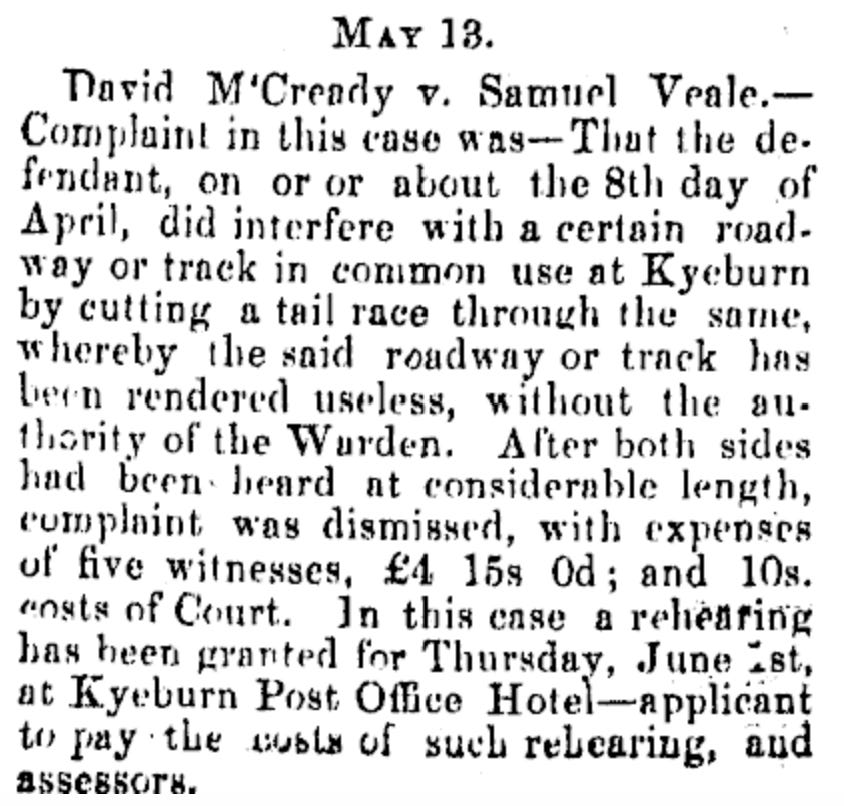
A complaint laid by David McCready (plaintiff) against Samuel Veale (defendant) was heard on 13 May 1876 in the Warden’s Court.
David alleged that ‘on or about the 8th day of April ’, Samuel had interfered with a road in common use by cutting a tail race (without the Warden’s authority) thereby rendering the road useless.
The complaint was dismissed with expenses—five witnesses (£4 15s 0d) and Court costs (10 shillings)—presumably payable by the plaintiff, David McCready.
David requested a re-hearing. It was granted for Thursday 1 June 1876—to take place at the Post Office Hotel—expenses to be met by the applicant. The Post Office Hotel was located in the Middle Kyeburn as was the road under contention. What happened at the re-hearing, I don’t know. I have been unable to find a record of it.
The 13 May 1876 hearing was reported in the Mt Ida Chronicle of 19 May 187611:
A complaint laid by Samuel Veale (plaintiff) against David McCready (defendant) was heard on 10 January 1878 in the Resident Magistrate’s Court, Naseby. From available information, it isn’t clear what the complaint was.
The case was dismissed with expenses—Court costs (20 shillings), three witness (50 shillings), and professional costs (21 shillings)——presumably payable by the plaintiff, Samuel Veale.
The hearing was reported in the Mt Ida Chronicle on 12 January12 and on 17 January 187813:

During 1879, David McCready applied under the Homestead clause—Clause 66—of the Mines Act 1877 to purchase 50 acres of land, and lease a further 270 acres. Samuel Veale was one of several miners who objected to David’s application.
It appears there were at least three hearings into this matter. I‘ve found newspaper reports of two of them. They were held in the Warden’s Court before H.W. Robinson Esq., Warden.
The hearing on 25 July 1879 was reported in the Mt Ida Chronicle on 31 July 187914. It was a continuation of an earlier adjourned hearing from 11 July.
At this hearing, four miners gave evidence in opposition to David McCready’s application. They were: J. F. Christian, Samuel Veale, John Swan, and William Parker.
Much of the evidence given in Court related to the value of the land for mining and, in particular, the existence of payable gold on the land being applied for. For his part, Samuel said he had seen a payable gold prospect washed from the 16 foot shaft in the 50 acre block. He had also seen a payable gold prospect washed in the 270 acre agricultural lease block. Furthermore, he had taken coal out on the side of the gully next to the land applied for and had been resident on a portion of the land under application for some thirteen months.
There was also some discussion around whether it was appropriate under the Act for someone to be given permission to both lease and purchase land. The Warden had received a letter from the Undersecretary of Goldfields written on behalf of the Minister of Mines asking that the decision be further deferred pending advice from Wellington.
The hearing was adjourned until 22 August while awaiting advice from Central Government in Wellington.
The case resumed on 22 August 1879 and was reported in the Mt Ida Chronicle of 30 August 187915. Central Government in Wellington had ruled that David McCready could not be leased 270 acres of agricultural land. This left the Warden free to rule in relation to the purchase of 50 acres of land.
As in the previous hearing, evidence focused on the extent to which the 50 acres of land was auriferous and, if it is, the consequent loss to the objectors if David McCready’s request is approved. David McCready’s witnesses testified that, after testing the ground, it was their belief there was no payable gold in it. The objectors represented by J. F. Christian and supported by Samuel Veale provided their reasons for believing the ground was payable ground.
In the end, the Warden ruled that David McCready could purchase 50 acres of land but, after taking into account testimony about payable areas, the 50 acres granted to him did not match entirely the 50 acres originally requested for purchase.
You can read in more detail about this case here.
In early 1883, Samuel Veale initiated a Trespass case against David McCready. The case was heard on 19 February 1883 in the Resident Magistrate’s Court, Naseby before John S. Hickson, Esq., Resident Magistrate.
Mr Rowlatt appeared for Samuel Veale, the plaintiff and Mr McCarthy appeared for David McCready, the defendant.
Samuel’s case as plaintiff was that, on the 2nd, 3rd, 4th and 8th of February 1883, David’s horses trespassed on his paddock damaging a growing crop of oats. At the time, Samuel had 7 acres of land, which were growing oats. David countered that the horses had been stabled and could not have trampled Samuel’s crop.
In reality, it may have been Isabella, Samuel’s wife, who initiated the case against David in Samuel’s name. According to the reports of court proceedings, Samuel was absent for the hearing and was living in Reefton at the time16. Isabella admitted her husband had not authorised her to initiate the case specifically but she had been authorised to sell the oats which had now been trampled.
David’s Counsel, Mr McCarthy, sought to have the case struck out. He argued that it wasn’t appropriate for Isabella to act for Samuel without Samuel’s specific authorisation . He further argued that Samuel shouldn’t be allowed to bring a case of trespass against his neighbour without being present.
Samuel’s solicitor, Mr Rowlatt, successfully countered Mr McCarthy’s argument. He said Isabella was merely a principal witness in the case. He was not acting for her. Rather, he was acting for Samuel. He argued that it was acceptable for him, as Samuel’s solicitor, to act on Samuel’s behalf in his absence. The case was allowed to proceed.
Witnesses for the plaintiff (Samuel), in addition to Isabella, were: William Parker, and John Robertson. Witnesses for the defendant (David) were: Robert Glenn, John Scott, Walter Morgan, and William Currie (David’s son-in-law)
The Court ruled in Samuel’s favour. The magistrate found the testimony of Samuel’s witnesses more credible than the sometimes contradictory testimony from David and his witnesses. Samuel was awarded 10 shillings in damages and 17 shillings Court costs. Also awarded were £1 each for his two witnesses; and £1 1s for professional fees.
The details of the case—as reported in the Mt Ida Chronicle of 22 February17 and 24 February18— can be read below. The same article appeared on both days.
Interestingly, the heading of the article is “Kyeburn Again !”. This—along with some of the contents of the article—suggests the area had gained somewhat of a reputation.
KYEBURN AGAIN !
Samuel Veale v. David M’Creadie — TRESPASS — To damage sustained by plaintiff on the 2nd, 3rd, 4th, and 8th of February, 1883, by reason of defendant’s horses trespassing on his (plaintiff’s) paddock, and damaging a growing crop of oats thereon:— Three days at 20s per day, and one day at 6s, £3 6s. Mr Rowlatt appeared for the plaintiff; and Mr M’Carthy for the defendant. Plea, “Not Guilty.”
Mr Rowlatt briefly opened his case. Mr M’Carthy suggested that, as the case was from Kyeburn, all the witnesses be ordered out of Court.
Isabella Veale, wife of Samuel Veale, and living at Kyeburn, being duly sworn, said:
That her husband owned a seven-acre paddock, which was securely and substantially fenced. One side of the enclosure abutted on a paddock held by M’Creadie, in which, he kept horses and cattle. There were seven acres in plaintiff’s area, five of which were under oats. On the 2nd instant, three of defendant’s horses trespassed in the paddock. She first discovered them at 7am. After the horses were turned out, she instructed her daughter to tell Mr M’Creadie to look after his animals, or he might get into trouble. Witness rose early on the mornings of the 3rd and 4th, and found the animals in the enclosure. She complained to M’Creadie of the trespass on the 3rd instant, and she afterwards saw William M’Creadie (defendant’s son) drive them back home. She also went to defendant’s early on the 4th, and told him he had better get an assessor to appraise the damage. One horse trespassed on the 8th, and the son again drove it out. Mrs Veale could not estimate the amount of damage sustained by the crop. That question she left for the Court to decide, upon which she depended for justice. Witness expected to realise £14 on the crop previous to the trespass, but she had been glad to sell it for £9. Last year witness sold three acres of oats in the same paddock to Mr Messent for £9.
Cross-examined: Her husband was now residing at Reefton. He had not authorised her to bring the present proceedings, although he had instructed her to dispose of the oats when they were ready for cutting. She was positive the paddock was seven acres in extent. She knew the horses in question to be M’Creadie’s. One was a grey mare with a dark foal, and the other was roan-colored. When she went to M’Creadie’s on the 4th instant, she knocked at the door, and defendant spoke to her from inside. She did not see anything particular at the front gate that morning.
To Mr Rowlatt: The black foal was not very old, but it would do more damage than its mother.
William Parker, miner, Kyeburn, stated distinctly that he had seen M’Creadie’s horses trespassing in Veale’s paddock several times. (Mr Parker corroborated Mrs Veale’s evidence as to the trespasses of the 2nd, 4th and 8th instant). He had seen the crop since the 8th inst., but had not carefully examined it to see what damage it had sustained.
Cross-examined: His house was about 500 or 600 yards off Mrs Veale’s. At that distance he thought it possible to recognise horses that he had known for years. He would swear that the horses were defendant’s.
John Robertson, miner, Kyeburn, corroborated several material points of the evidence of the previous witness.
Cross-examined: He knew that the horses in question belonged to defendant. On one occasion he saw some one (whom he took to be defendant’s son) drive them out of Veale’s into M’Creadie’s paddock.
This was the plaintiff’s case.
Mr M’Carthy, before going into the evidence for the defence, raised a preliminary objection. It was a well-known rule of law that a married woman could only act for her husband in his absence, without express authority, to a limited extent—e.g., she could, if left in charge of the house, enter into contracts on her husband’s behalf for domestic supplies. Mrs Veale had sworn that, although her husband was in communication with her, she had no authority from him to commence the proceedings. Mr Veale was at a considerable distance from Naseby, and the Court ought to have before it something to show that he had authorised the proceedings. Suppose that the case resulted in a verdict for the defendant, and that he issued a distress-warrant for his costs. Suppose, further, that Mr Veale suddenly appeared on the scene, and said that he had not instructed any one in the matter. Could Veale’s goods be distrained upon? Counsel submitted not. A man could not be made a party to a cause without his consent. Mr M’Carthy asked that, in the absence of any authority from plaintiff to commence the proceedings, the case be struck out.
Mr Rowlatt failed to see that his learned friend’s objection had any reference to the case. He was acting for the husband—not for the wife. It was purely a matter between himself and the plaintiff, Samuel Veale. Could not a plaintiff appear by his solicitor?
Mr M’Carthy answered Mr Rowlatt’s interrogation in the affirmative, but remarked that it appeared to him his learned friend was acting upon instructions supplied by Mrs Veale.
Mr Rowlatt replied that the counsel of the defendant was evidently laboring under a misapprehension as to the true state of the affair. Mrs Veale was simply the principal witness in the case; she came to Court not as the plaintiff, but simply to prove what she could in her husband’s favor. In reply to a remark made by Mr M’Carthy, he (Mr Rowlatt) said it was not necessary that he should show his authority for instituting the present proceedings. And, besides, it had not been shown that he had not received express instructions from the plaintiff to bring the action against defendant.
Mr M’Carthy argued that the wife had not been instructed to take the action. There was nothing before the Court to show if Mr Rowlatt had received any authority.
After counsel had further argued their respective cases, His Worship ruled that it was not incumbent on Mr Rowlatt to produce his authority. Mr Rowlatt would not say who gave him his instructions, but he had no hesitation in saying that he did not receive them from Mrs Veale. His Worship remarked that Veale could appear by his solicitor. There was nothing to prevent him doing so.
Mr M’Carthy considered that a solicitor had no [?] making an action of his own free will.
His Worship replied that he did not think it right that he should direct Mr Rowlatt to produce his authority. This put a stop to further discussion, and the case for the defence was then gone on with.
Mr M’Carthy briefly alluded to the facts that would be adduced in his client’s favor. The defence would be that the horses in question had never been in the plaintiff’s paddock.
David M’Creadie, plaintiff, being duly sworn, deposed:
That he examined Veale’s paddock on February 15th in company with Messrs Glenn, Morgan and Scott. At that time the ground was rather soft. He failed to discover foot-prints or any other sign that would have led him to believe that horses had been in the enclosure recently. There was a good, substantial fence between his (defendant’s) and plantiff’s paddocks, and at the time of his inspection was in a thorough, state of repair. He was confident that his horses had never been in the place. It was possible for sheep to have done the damage his horses were stated to have been the cause of. Sheep were always depasturing in the immediate vicinity of Veale’s, and it was very easy for them to gain access to the paddock: there were seven different places where entrance could be effected. He possessed a grey mare with a dark foal at foot and a dark grey horse. The former animals were stabled every night, and let out in the morning. This had been done regularly since the New Year, the grey mare being used for a particular purpose. Witness considered that there were only 2½ acres in Veale’s paddock.
Mrs Veale (from the body of the Court): “You make a mistake ! You “ ---- Constable Willis : “Silence!”
His Worship (to witness): “Do you mean to say there are only 2½ acres in plaintiff’s paddock?”
Witness: “Well, your Worship, I” ----
His Worship : “ Answer my question in a straightforward manner, sir ! Reply either ‘ Yes ‘ or ‘ No.’ “
Witness : “ Well,. Veale’s paddock is next to mine, which is “ _____
His Worship : “ That will do, sir. You need not answer the question. I shall know what value to put upon your answers.”
Witness (evidence continued): He knew nothing of the damage done to Veale’s paddock until he received the summons.
His Worship : “ This is more Kyeburn ! “
Mr Rowlatt: “It is, your Worship:”
Cross-examined: Mrs Veale had never sent him in a bill for damages, and no demand of any kind whatever had ever been made on him. The result of his examination of the paddock was that he authorised Mr Scott to offer Mrs Veale 10s, on his behalf, to square the case. He did this to prevent it going into Court, although he was certain his horses did not do the damage cornplained of. Judging from the appearance of the oats, he was of opinion that the late rains had caused the crop to lie down.
His Worship remarked that there, was no crop of oats at Kyeburn that the rain would beat to the ground.
Cross-examination continued : He could not swear that the grey mare. and foal were stabled on the nights of the 1st, 2nd, 3rd and 7th of February.
His Worship: “ I have only one question to ask you, Mr M’Creadie, and it is this: Did or did not Mrs Veale go to your house on the morning of the 3rd and complain to you that three of your horses were trespassing in her oat crop ? And, further, did she ask you to get an assessor to appraise the damage already done? “
Mr M’Creadie: “I mean to say, your Worship, that she never spoke to me on any occasion about the matter.”
John Scott, farmer, Kyeburn, stated that he examined Veale’s paddock on the afternoon of the 16th inst. He found no footprints or other traces of horses. The soil was moist enough. Judging from the appearance of the paddock, he would say that there were about 2½ acres in it.
Mrs Veale: “ That’s not true. I’ll go and get a man to measure it!”
Witness: He did not measure the area. He could not say if the fence between plaintiff’s and defendant’s properties was in a thorough state of repair on the 16th instant. He noticed that the crop had been damaged, which damage he thought might have been caused by some large cattle. There was a possibility that sheep might have done it. He estimated that 10s would adequately remunerate plaintiff for the injury done to his crop. The value of the whole of the oats was about £3 10s. When he made an offer to Mrs Veale of 10s on defendant’s behalf, he told her that he thought 10s would meet the requirements of the case. Mrs Veale replied that 5s would content her, provided that Mr M’Creadie would pay the Court and other costs incurred to date. Defendant had never acknowledged to him that his cattle had been in plaintiff’s paddock.
Mr Scott was then cross-examined, but nothing fresh was elicited from him.
Robert Glenn, storekeeper, Naseby, stated that he went to Mrs Veale last week, and asked her to show him where her oats were injured. She replied, “If you had been here earlier you would have seen it all.” Witness inspected the paddock, and found the crop uninjured and the fence unbroken. Looking at the crop, he would say its full value would be about £3.
Wm. Currie, farmer, Swinburn, corroborated defendant’s evidence as to the absence of foot-prints, etc., in the paddock, also as to the condition of the fence last Thursday. It was possible for sheep to gain access to Veale’s holding: Witness had been residing at defendant’s since February 2. On the night of the 2nd and 3rd instant the grey mare and foal were put into the paddock.
Mr Rowlatt: “ Mind you, sir, you said ‘paddock’”
Witness: “ That was a mistake. I should have said stable.”
Mr Rowlatt: “You distinctly said ‘paddock’ “. “Much value cannot be attached to your evidence. You all appear to have been pretty well tutored for the occasion. I would inform your Worship,” said Mr Rowlatt to the Bench, “ that this witness is a son-in-law of defendant.”
Witness then gave further evidence, the gist of which was that the grey mare and foal were stabled on the nights of February 1st, 2nd, 3rd and 7th, and therefore could not have been in plaintiff’s oats, as Mrs Veale had stated.
Mr Currie also stated that the distance between plaintiff’s and W. Parker’s residences was fully half-a-mile, and —in consequence of the view being obstructed by a bank— that it was impossible for a man standing at Parker’s to see what was going on in Veale’s paddock. Witness was at defendant’s on the 4th, but did not see or hear Mrs Veale there. She could not have approached the house without being heard. He had two dogs (one was tied up) at the front gate on the 4th, and Mrs Veale could not have gone in that way as she had stated, because the dogs in question would not have let her pass them.
Witness was put through a severe cross-examination by Mr Rowlatt.
Walter Morgan, butcher, of Kyeburn, was called for the defence. His evidence —which was corroborative of Mr Scott’s—was fairly given, and was rather in favor of plaintiff’s case than against it. His estimate of the damage was 5s.
Mr M’Carthy said that no credence should be attached to the evidence of Robertson and Parker, because of its unreliability. There was at least contradictory evidence. Mrs Veale had sworn to having seen the grey mare and foal, while Mr Currie had unhesitatingly stated that they were stabled at the time the trespass was said to have occurred. Mr M’Carthy thought Mrs Veale’s evidence untrustworthy, and asked for a judgment in his client’s favor.
Mr Rowlatt was astonished that the case for the defendant had been closed without W. J. M’Creadie having been called upon to give evidence. He it was who was said to have removed the horses from Veale’s, and, despite the fact that he had been in and out of the Court all day, he had not been called upon to refute Mrs Veale’s statements. The proceeding was, to say the least of it, very extraordinary, and he thought the subject was one for comment. Regarding defendant’s evidence, it should be thrown aside. Mr M’Creadie was too good for his own case. The laughable part of the affair was the evidence of the experts, which was of a very contradictory character. The fact that the defendant had asked several of his friends to assess the damage conclusively proved that he acknowledged his client’s claim.
His Worship adjourned the Court for 15 minutes, to allow him time to go through his notes. When the Court resumed, he delivered the following judgment :-----
“In this case, as in others from the same locality, I find that there has been some very hard swearing. I am inclined to believe that Mrs Veale has given her evidence very fairly. I can hardly believe that she could have mistaken defendant’s horses for sheep. She swears positively to their being on the crop of oats on the 2nd, 3rd, 4th and 8th of February. She, also describes the animals pretty accurately (as admitted by defendant). She cannot swear to the extent of the damage, and leaves it to the Court to assess, if any. William Parker swears to seeing the same horses (described by Mrs Veale) on plaintiff’s oats on the 2nd and 4th, and one on the 8th. He cannot say what, damage was done. John Robertson also swears to seeing the three horses described—two mares and a foal—on Feb. 3, and that he saw M’Creadie’s son (presumably) drive them into defendant’s paddock. He also is unable to say what damage was done, We have, therefore, three witnesses who swear to seeing the horses in Veale’s paddock on the 2nd, 3rd, 4th and 8th of February.
The defence set up is that the horses were stabled every night, and could not have done, the damage, and that it must have been done by sheep. John Scott’s evidence bears about it a faithful aspect, as also does Walter Morgan’s. The former distinctly gives it as his opinion that horses or cattle caused the damage, and not sheep. His estimate of the damage appears small, but, as a practical man, I have very little doubt about its correctness. Mr Morgan corroborates Mr Scott’s evidence in every particular. David M’Creadie swears he could see no appearances—either foot-prints or dung—that would lead him to believe that horses had been in the crop, which two of his own witnesses contradicted, as regards the foot-marks. From the fact of their having been some rain in the interim between the 8th (the date of the last trespass) and the 15th, when defendant went on the ground, it is quite possible that the foot-marks and manure would be obliterated and washed away. Although M’Creadie swears that the mare and foal were stabled every night since the beginning of the year, he cannot state positively that they were stabled on the nights of the 1st, 2nd, 3rd and 7th of February. He (defendant) estimates the damage at 3s or 4s, and from the fact of his so estimating it, it appears to me as an admission that he was to some extent liable, which is confirmed by the fact of his employing Scott and others to look at the crop, make an estimate of the damage, and an offer of a certain sum to Mrs Veale to stay proceedings. Mr Glenn’s evidence is practically valueless. Mr Currie’s is also practically valueless, as there is nothing to corroborate his statements as regards the horses being stabled.
Taking all the evidence into consideration, I am of opinion that the weight of it is in favor of plaintiff, and I therefore give judgment for him for 10s, damages; costs of case, 17s; two witnesses, £1 each; and professional fee, £1 1s.”
The Court then rose.
If you are already a subscriber to this publication—Kyeburn Diggings One-Place Study—thank you!
If not, and if you would like to receive future posts direct to your email inbox, please subscribe (it’s free!):
The information in this post is drawn from my one-place study website on the weare.xyz platform
You may like to check out my other Substack publication as well:
Death registration 1893/5139, David McCready (born 1835) passed away aged 58Y on 11 September 1893. “Births, Deaths & Marriages Online” [digital index] - New Zealand Department of Internal Affairs (bdmhistoricalrecords.dia.govt.nz: accessed 24 May 2026)
Ireland, Marriages, 1619-1898. Ancestry.com Operations, Inc.: FamilySearch, 2013 via
Ancestry.com. Ireland, Select Marriages, 1619-1898 [database on-line]. Provo, UT, USA: Ancestry.com Operations, Inc., 2014. Accessed 23 July 2026.
Their 5th child Annie was born in Ballarat East, Victoria in 1868 - Victoria, Australia, Birth Index, 1837-1921. The Victorian Registry of Births, Deaths, and Marriages, Melbourne, Victoria, Australia via Ancestry.com. Victoria, Australia, Birth Index, 1837-1921 [database on-line]. Lehi, UT, USA: Ancestry.com Operations, Inc., 2018. Accessed 23 July 2026.
Birth registration 1893/15272, Martha McCready was born to Jane and David on 26 November 1871. “Births, Deaths & Marriages Online” [digital index] - New Zealand Department of Internal Affairs (bdmhistoricalrecords.dia.govt.nz: accessed 2 May 2026)
Dunedin probate and Letters of Administration files (I) [Archives Reference: Code: 9075 Item: R22076163; Box Number 509; Record Number 16992] Archives New Zealand Te Rua Mahara o te Kāwanatanga. Dunedin Repository. Also available digitally: IE71597334. (https://tinyl.co/4m9n : accessed 26 July 2026).
Death registration 1893/5139, David McCready (born 1835) passed away aged 58Y on 11 September 1893. “Births, Deaths & Marriages Online” [digital index] - New Zealand Department of Internal Affairs (bdmhistoricalrecords.dia.govt.nz: accessed 24 May 2026)
Samuel’s birthdate is on his baptism record: London Metropolitan Archives; London, England; Reference Number: p76/TMS/004 via Ancestry.com. London, England, Church of England Births and Baptisms, 1813-1917 [database on-line] Provo, UT, USA: Ancestry.com Operations, Inc., 2010 (https://tinyl.co/4m95 : accessed 3 August 2026).
See:
When he married in 1872, the Intentions to Marry Notice says he had been in the district for 6 years (1866). Notices of Intention to Marry 1872 [Archives Reference: R2840384, Record number: 17, Box number: 14] Archives New Zealand Te Rua Mahara o te Kāwanatanga. Wellington repository (https://tinyl.co/4m9o : accessed 19 July 2026) via Luke Howison’s NZ Intentions to Marry Project (https://itm.howison.co.nz/ : accessed 19 July 2026)
Marriage Registration Number 1872/7646 Births, Deaths & Marriages Online [digital index], New Zealand Department of Internal Affairs (https://www.bdmhistoricalrecords.dia.govt.nz/ : accessed 17 July 2026)
A copy of the marriage entry was obtained by the author—Jane Chapman—in 2001. The Minister who officiated was the Rev. James McCosh Smith. Witnesses to the marriage were: John Hardane, miner, Kyeburn and Marion Forrest, Naseby.
The move was probably around 1886 because:
the latest year I have found, in City and Area Directories, of Samuel being at the Kyeburn Diggings is 1886 (https://www.ancestry.com/search/collections/62727 : accessed 16 July 2026) ; and
and the first reference I have found to him being on the West Coast is listed on the Greymouth Electoral Roll for 1886 - 1886, 1887 - Greymouth Electoral Roll via Microfiche, Manukau City Reference Library Microfiche. Viewed by Author in 1993.
Death registration 1929/9923, Samuel Jeffrey Veale passed away on 25 July 1929. "Births, Deaths & Marriages Online" [digital index] New Zealand Department of Internal Affairs (bdmhistoricalrecords.dia.govt.nz: accessed 23 July 2026).
A copy of the death entry is held by the author—Jane Chapman—obtained in 2001 from the New Zealand Department of Internal Affairs.
Reefton is on the West Coast and some distance away from the Kyeburn Diggings. In those days the trip entailed travel both overland and by sea. It is likely Samuel had gone to the West Coast to check out his likely prospects there because around three years later (1886) he and Isabella and their children moved to the West Coast
Comments
Nothing yet. Say the first thing.
Sign in to join the conversation.