
Many Americans first learned how laws are made from an animated cartoon.
In the 1970s, the educational series Schoolhouse Rock! aired a short segment called I’m Just a Bill. In the cartoon, a rolled-up bill sits on the steps of the U.S. Capitol explaining its journey through Congress. A member introduces the bill. A committee studies it. The House and Senate vote. The president signs it.
The story unfolds in a straight line.
That simple story still shapes how many people imagine the legislative process works.
But real legislatures do not operate in a straight line.
The Kentucky General Assembly follows a formal process for passing laws, but inside that process are several decision points where legislative leaders can redirect a bill, accelerate its movement, or substantially change its content.
Those decision points are where the process can become difficult for the public to follow.
Understanding them is one of the most important steps toward understanding how power actually operates in Frankfort.
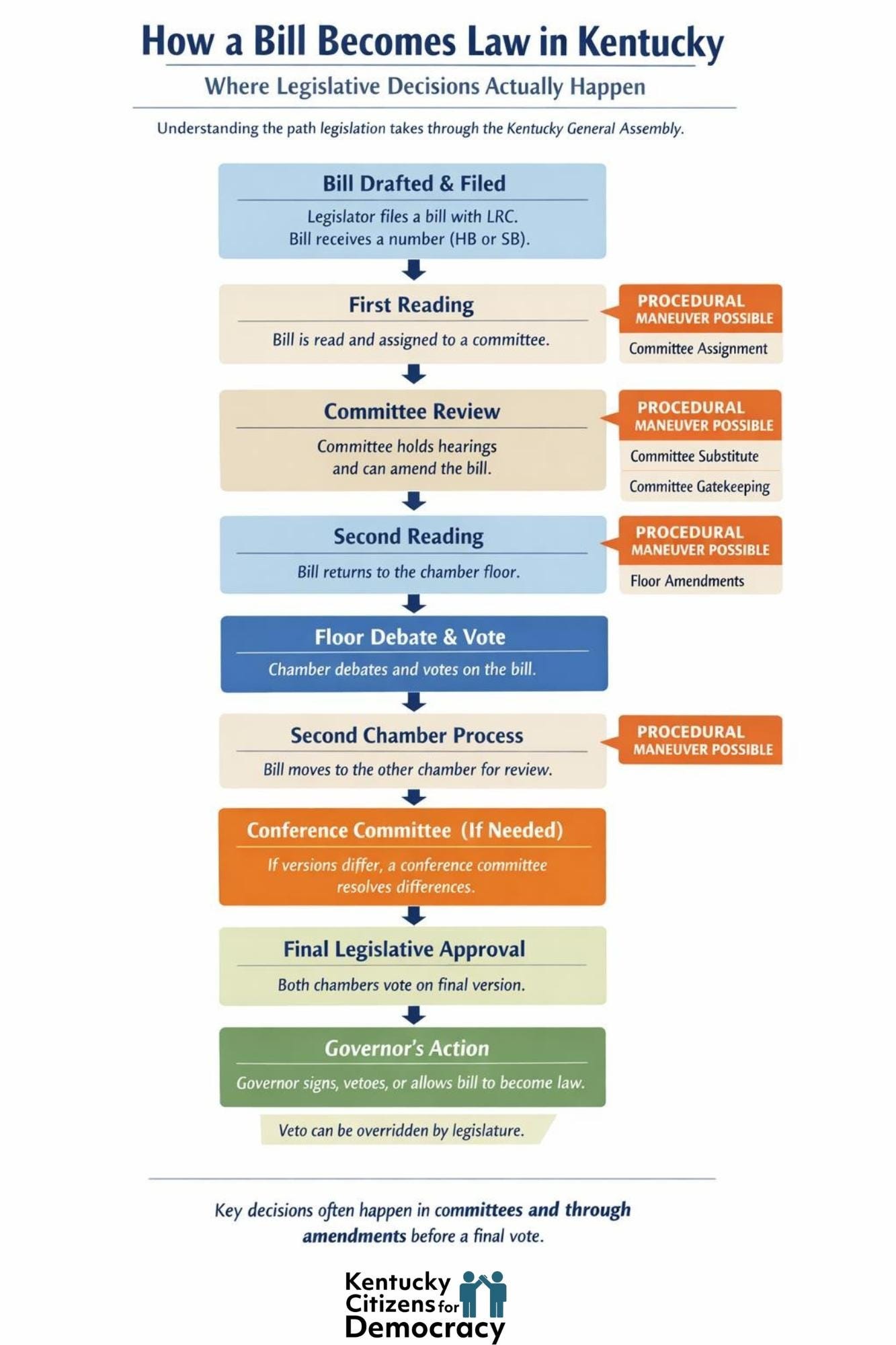
The diagram above shows the official route a bill takes through the legislature. What it cannot show are the moments where procedural tools allow lawmakers to move legislation quickly, reshape it, or place it on a path that favors passage.
Those moments tend to occur at five key stages.
Every piece of legislation begins with the filing of a bill.
During each session of the Kentucky General Assembly, lawmakers introduce hundreds of bills. Some contain detailed language describing a specific policy change. Others appear broader or leave room for later revisions.
Occasionally, legislators file what are commonly known as shell bills.
A shell bill is a bill that contains only minimal or placeholder language when it is introduced. The title may describe a general topic, but the bill itself does not yet contain the full policy proposal. Later in the process, lawmakers can insert detailed language through a committee substitute or floor amendment.
This tactic allows legislation to remain procedurally active even before the final policy language is ready.
Shell bills are not unusual in legislatures. They can be used for practical reasons, such as when lawmakers are still negotiating details of a proposal. But they can also allow significant policy changes to appear later in the session after the bill has already moved through earlier procedural steps.
Because of this, the first version of a bill is not always the most important one to watch.
For example, HB 76 (Kentucky) was introduced as legislation addressing pretrial release procedures. As the bill was examined more closely, its language connected pretrial release decisions to proof of citizenship or lawful presence and required jails to contact federal immigration authorities in certain circumstances.
Another bill drawing attention during the current session is HB 314 (Kentucky), which addresses appointment authority within state government. Although the bill appears procedural on the surface, debate surrounding the proposal raised questions about whether it alters powers traditionally exercised by the governor, Andy Beshear.
These examples illustrate a basic lesson of legislative watching: the title of a bill rarely tells the full story. The details that ultimately shape public policy often emerge later in the process as language is revised or expanded.
For citizens following legislation, the most important habit is to look beyond the title and read the actual text of the bill as it evolves.
After a bill is filed, it is assigned to a committee.
Committees are intended to provide detailed review of legislation. Members can hear testimony, debate policy implications, and decide whether the bill should advance to the full chamber.
In the House, committee assignments are directed by the Speaker, David Osborne.
That authority matters.
The committee reviewing a bill determines which lawmakers will shape its early debate and whether the bill receives a favorable recommendation. Assigning legislation to a committee whose members are already supportive of the policy can significantly increase the likelihood that the bill moves forward.
For example, HB 62 (Kentucky), legislation addressing employment of individuals classified as unauthorized immigrants, was assigned to the House Judiciary Committee. Placing the bill in a committee focused on criminal law framed the discussion around enforcement rather than labor policy.
Committee assignments rarely attract public attention, yet they often provide the first indication of how leadership intends to handle a piece of legislation.
Once a bill reaches committee, lawmakers can change its language before sending it to the floor.
Sometimes those changes are small technical adjustments.
Other times they can substantially reshape the legislation.
Two procedural tools are especially important here: committee substitutes and floor amendments.
A committee substitute replaces the original language of a bill with a revised version drafted by lawmakers or legislative staff. The bill number stays the same, but the contents may change.
During the current legislative session, HB 470 (Kentucky), a bill dealing with behavioral health provider regulations, went through multiple revisions. The bill accumulated both House and Senate committee substitutes along with a floor amendment, each adjusting provisions related to provider standards and reimbursement structures.
Similarly, SB 4 (Kentucky), dealing with school leadership programs, was modified through a Senate committee substitute that changed aspects of the proposed partnership structure for leadership training.
When these revisions occur quickly, the version of a bill debated on the floor may look quite different from the one originally introduced earlier in the session.
Even after a bill leaves committee, legislative leaders still control when it appears for a vote.
The Speaker of the House and Senate leadership determine which bills appear on the calendar and when they will be debated.
That control allows leadership to move legislation slowly through extended discussion or quickly through a compressed timeline.
Sometimes a bill receives multiple days of debate. Other times legislation can move from committee approval to a floor vote in a short window.
For example, SB 178 (Kentucky), which addressed environmental regulatory standards in Kentucky, moved through the legislative process on a relatively accelerated schedule once leadership prioritized the bill.
Scheduling decisions can determine whether the public has time to follow legislation before a vote occurs.
When the House and Senate pass different versions of a bill, the chambers must reconcile the differences before the legislation can become law.
This step takes place in a conference committee composed of members from both chambers.
The conference committee negotiates a final version of the bill and issues a conference report. Lawmakers then vote on the report as a single package.
Conference committees often meet late in the legislative session, sometimes when the public and media are focused on several bills at once.
Because conference reports cannot be amended on the floor, the negotiated language must be accepted or rejected in its entirety.
This stage can produce final changes that differ from earlier versions of the legislation.
Help other Kentuckians understand how the legislative process works. Share this guide with friends, neighbors, and community groups.
The Kentucky legislative process still follows the structure taught in civics classes. Bills are introduced, reviewed in committee, debated, and eventually brought to a vote. What many citizens do not see are the procedural pressure points inside that structure. A bill may be written broadly enough to allow significant revisions later in the process. Committee assignments shape which lawmakers guide the early debate, and committee substitutes can rewrite major sections of legislation after a bill has already begun moving. Leadership scheduling decisions can accelerate the timeline, while conference committees may introduce final language changes near the end of the session.
None of these tools are secret. They are part of the rules governing the legislature. What gives them influence is how little public attention they usually receive. When Kentuckians understand where these procedural pressure points exist, it becomes easier to recognize when legislation is changing course and when the most important decisions are being made.
Understanding the legislative process is not just an academic exercise. It helps citizens recognize the moments when public engagement can still make a difference.
When procedural maneuvering occurs, timing matters.
Legislation often moves quickly once leadership decides to advance it. A bill can move from committee to a floor vote within a day. Amendments can appear shortly before debate. Conference committee reports may be released only hours before final votes.
When those signals appear, citizens who want to influence the process have several practical options.
Legislators pay the most attention to communication from their own constituents. Phone calls and emails to district offices can alert lawmakers that people are paying attention to a bill’s movement.
If a bill has just been scheduled for a vote or has been amended suddenly, contacting legislators quickly is often more effective than waiting until after the vote.
Messages are most effective when they clearly reference the bill number and the specific concern.
Many procedural maneuvers become visible through the legislature’s public calendars.
Committee agendas often appear shortly before meetings. Floor calendars reveal which bills leadership intends to move that day.
Monitoring these documents can give citizens early warning that legislation is about to advance.
Legislation can change several times during the process.
A committee substitute or floor amendment may introduce language that was not present in the original bill. When a bill suddenly begins moving quickly, it is worth checking whether a new version has appeared.
Reading the most recent version of a bill is often the only way to understand what lawmakers are actually voting on.
When procedural changes occur, confusion spreads quickly.
Citizens who follow legislation closely can help by sharing clear, accurate explanations of what has changed and where the bill stands in the process. This allows more people to understand what is happening before a vote occurs.
Local organizations, community groups, and civic watchdogs often play an important role in translating complex legislative developments into plain language.
Committee hearings and floor sessions are open to the public. When controversial legislation is moving quickly, public presence can signal that citizens are paying attention to the process.
Even when testimony is not allowed, public observation reinforces the principle that legislative proceedings belong to the people of Kentucky.
The Kentucky legislative process contains many procedural tools that allow lawmakers to move legislation efficiently.
Those tools can also make it difficult for the public to follow what is happening in real time.
But the process is still public.
Bills, amendments, votes, and committee meetings are recorded and accessible to citizens who are willing to watch closely.
When Kentuckians understand where the procedural pressure points are, they are better prepared to recognize when legislation is moving unusually fast or when a bill has changed significantly from its original form.
And when citizens recognize those moments, they have the opportunity to speak up while the process is still unfolding.
The infographic at the beginning of this article highlights four points in the legislative path where procedural maneuvering can occur. Those moments are not hidden parts of the process. They are built directly into the rules that govern how the Kentucky General Assembly operates. What often makes them difficult for the public to follow is the speed at which decisions can happen once a bill begins moving. Committee assignments, substitutes, leadership scheduling, and conference negotiations can all shift the direction of legislation while it is still moving through the process. When Kentuckians know where those pressure points exist, it becomes much easier to recognize when a bill is changing course and to pay attention while the decision is still unfolding.
Comments
Nothing yet. Say the first thing.
Sign in to join the conversation.