
Hi folks,
I’ve been busy moving Kültürkampf HQ to the İzmir-İstanbul line for the remainder of the summer. Posting will remain fairly light in July-August, with priority to paid subscribers. I’ll return to my regular pace starting in September.
But this past week had two big days: Tuesday was Bastille Day, commemorated for the storming of the Bastille during the French Revolution, and Wednesday was the 10th anniversary of the failed coup attempt in Turkey. This was the day when a covert Gülenist element in the military launched a coup against the Erdoğan government of the day, and failed.
The first, of course, is France’s national day, but has also come to be celebrated as the day humanity has embarked on the adventure of self-government. The second is still new in the annals of history, and its meaning has yet to take shape. Is it a furthering of the ideals of republican government? Is it a counter-revolution of sorts, a return to the forces of rule by divine right? Or is it a dud, a mere squabble between two regressive forces who couldn’t share the pie?
Every July 15, I read my notes from that night, and try to remember the conditions and events of the time. It’s also a good time to reflect on the nature of the Erdoğan regime, and its direction.
It seems that others have had a similar thought. I’ll share with you two of the leading thinkers of the Erdoğan regime, and how they think of July 15. I’d like to note that neither of them are originally from the Islamist tradition that makes up the core of the regime. This is to be expected, since Islamist romantics themselves rarely engage in serious theoretical writing.
Below I’ll share with you the first one, with a second coming up soon.
The first account is from Mehmet Uçum, who is a chief consultant to the president and Deputy Chairman of the Presidential Legal Policies Board. The presidency isn’t exactly a transparent institution, so we can’t know for sure, but Uçum is considered to be the Schmittean figure behind the design of the presidential system.
Unusual for people at the palace, Uçum comes from a hard-left background: when he was “12 or 13 years old,” by his own reckoning, he joined the youth wing of the “illegal” Turkish Communist Party (TKP), so-called because they believed in waging a clandestine revolutionary struggle. Uçum was detained on the eve of the 1980 coup and tortured. Upon release, he worked as a labor and social security lawyer in Istanbul for almost thirty years, and in the 2000s, during the left-liberal convergence with the AK Party, he joined in the fight against the Kemalist dominance in the military and judiciary establishment. He joined the “yetmez ama evet” campaign in the 2010 referendum, was a “wise man” during the first peace process, and became an AK Party MP from Kars in the 2015 parliament.
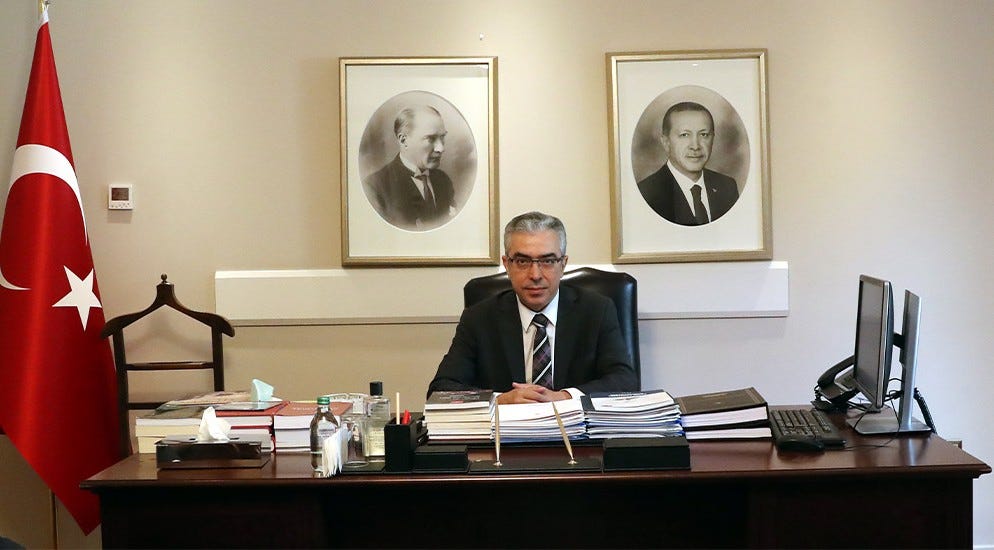
He’s 61 now, and his language is still laced with hard-left terms and concepts. Every once in a while, Uçum will put out a long historical and theoretical statement backfilling the actions of the Erdoğan presidency, and it’s always interesting to read. His latest column on July 15 appeared in AA on that day, and didn’t disappoint.
As one might expect, he frames July 15 as a chapter in Turkey’s epic, centuries-long struggle against “imperialist powers,” by which he means the wider West:
Having launched an assault on the Ottoman Empire with the goal of completely liquidating it—or at least downsizing it and bringing it under total control—the imperialist powers were unable to fully achieve these objectives. Out of resentment and spite, they immediately initiated operations against the young Republic, the successor to the Ottoman Empire. And these operations have been ongoing for nearly a century.
Atatürk’s war of liberation did beat back Western imperialism, Uçum claims, but his Republic was exclusionary, and suppressed the nation’s identities and natural strengths.1 Western imperialists then found other ways to seep into Turkey’s body politic, namely through the Kemalist establishment, and more recently, the Gülenist movement (Fetullahist Terrorist Organization, or “FETÖ” in Erdoğanspeak). Uçum, of course, wisely omits the fact that the Gülenists were tightly allied with the Erdoğan movement almost from its get-go.
Either way, you know what comes next: the July 15 “peaceful peoples’ revolution” destroyed the last remains of the undemocratic system, removed the Gülenist element from the state, and finally unleashed the dormant powers of the nation. The “global fascist forces” were beaten back, and the Turkish state was finally put in the service of the people:
In the first liberation, we succeeded thanks to a world leader like Atatürk and the self-sacrificing struggle of the Anatolian people. And in the second liberation, we achieved success with President Recep Tayyip Erdoğan—the most important direct/organic leader of the 21st century—and the great resilience of our people. Both of our Wars of Independence were illuminated by the lives and blood of our martyrs and veterans.
This is how Erdoğan himself also always puts it, equating July 15 with the War of Independence.
Note also how Uçum describes Erdoğan as a “direct/organic leader.” There is a reason for that. Erdoğan’s revolution succeeds where his predecessor failed, Uçum thinks, specifically because he avoids Western-style democracy. This is where the analysis gets more original:
Comments
Nothing yet. Say the first thing.
Sign in to join the conversation.