
You bought the tool. Someone on the team uses it every day. The invoices clear every month.
Now answer one question. What does your AI do when it is wrong? Not what the tool does. What your business does.
Most operators pause on that. The pause is the whole point.
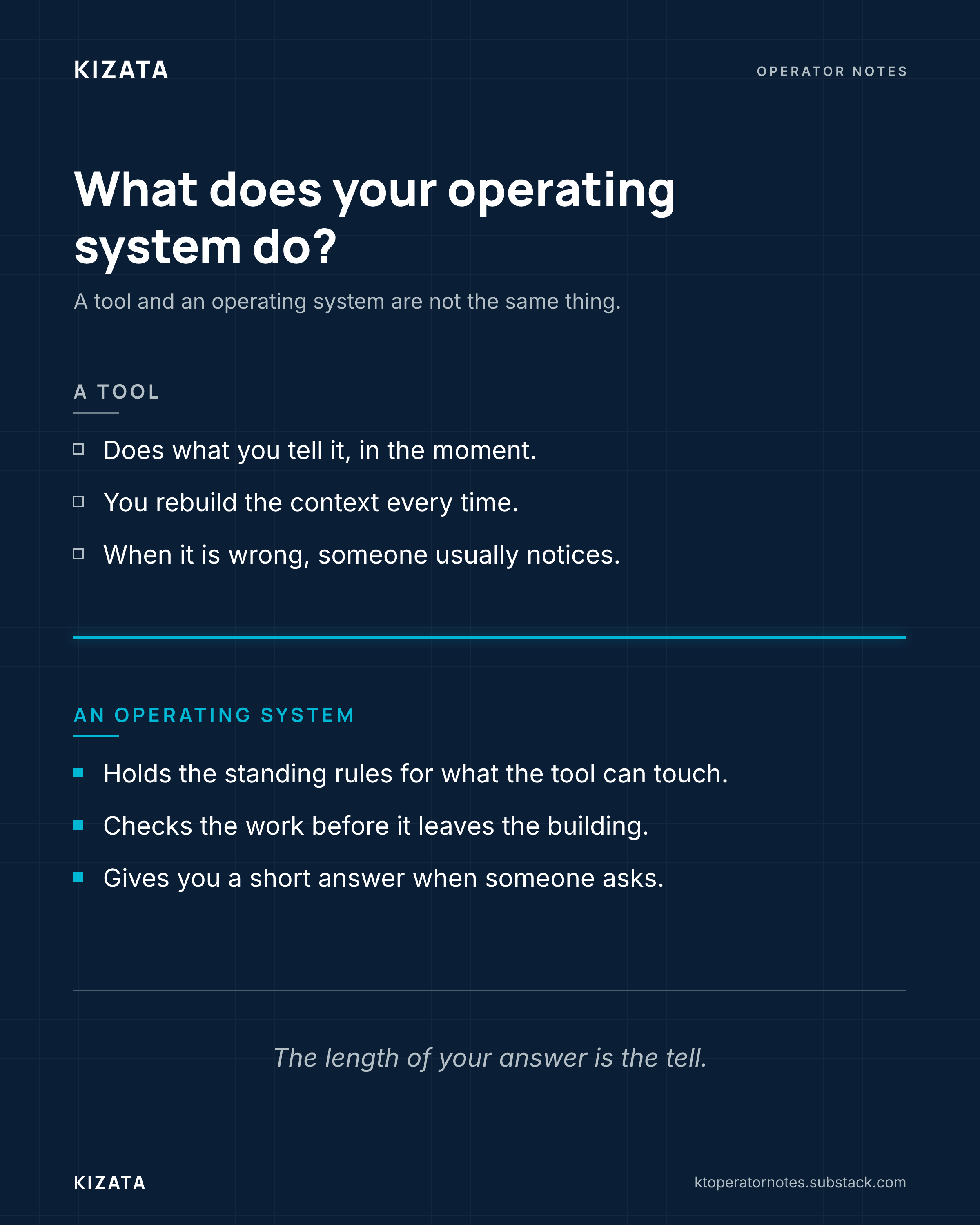
A tool does what you tell it in the moment. An operating system holds the standing rules: what the tool is allowed to touch, who checks the work before it leaves the building, what happens when something is wrong.
We call that the Operator Playbook. Most operators do not have one. They have invoices.
Read these slowly. Notice whether you have an answer or a habit.
When your AI gets something wrong, what catches it before it goes out? If the answer is “someone usually notices,” that is not an answer.
Which of your AI outputs should never leave the building without a second set of eyes? A board memo. A regulatory note. A capital-partner update. Do you have a rule, or a feeling?
If a funder asked you tomorrow how you handle AI, how long would your answer be?
That last one is the real test. A short, clean answer means you built a system. A long one means you have tools and hope.
The policy exists in your head, which means it does not exist.
Think about this week. How many meetings did you walk into fully prepared? Not adequate. Fully prepared. The prior commitments, the open questions, the likely asks, all in front of you before you sat down.
For most operators I talk to, the honest number is one or two.
The rest run on one of two settings. Thirty minutes of manual prep you do not have, or improvisation you pay for later. Both are expensive. The first costs time. The second costs the room.
An operating system prepares you for every meeting in the time it takes to read this paragraph. The difference compounds, meeting after meeting, quarter after quarter.
Here is the part most operators will not say out loud. They carry a low-level worry about whether what they are doing with AI is defensible. Not dramatically wrong. Just ambiguous.
No clear line between what the AI touches and what it does not. No confidence that the team follows the policy you think you have.
The fix is not more caution. It is a documented position, and a way to check that what you are doing matches what you decided.
That is what makes this easy to ignore. On a normal week, nothing is wrong. The work gets done and nobody asks how.
It shows up the week a partner, a funder, or an auditor asks the question. And then you are answering on their timeline, not yours, building the system you should have built six months earlier, in the one week you cannot afford to.
That is the cost of running tools without an operating system. Not a daily tax. One large bill, due on demand.
If someone asked you today to describe your AI operating system, not your tools, your system, what would you say? If the answer is still forming, that is the conversation worth having before someone forces it.
I am running a closed session June 11 for a small group of operator-CEOs. 60 minutes. No pitch. The AI conversation most rooms will not have.
Prefer a one-to-one first? Book time with Kirk Tramble: AI Governance Conversation
Kirk Tramble is Founder and Principal of Kizata, an AI governance practice for $5M to $25M firms. He spent years operating across Chevron, Oracle, Apple, and Nitro before launching Kizata in 2025.
No posts
Comments
Nothing yet. Say the first thing.
Sign in to join the conversation.