

Back in November 2024, I wrote a piece about why I felt that AI will not replace great investors, and I still keep that stance today. The focus of that article was on creativity, arguing that creativity plays an important role in achieving success as an investor. But there were a couple of things I left out that are worth mentioning.
What does it mean to be creative in the investment game?
Bill Miller once stated that there are 3 competitive advantages in investing:
Informational - this means having some sort of edge through information gathering. It could be a combination of facts that produces an insight overlooked by the market.
Analytical - This just means spending more time and effort analyzing companies and as Buffett says “turning the page”. Digging through 10Ks, books, magazines, and F2F interviews, and putting it all together to produce a unique insight.
Psychological - these are behavioral advantages. Thinking long term when the market is short sighted, being fearful when others are greedy, and just being ice cold and holding positions when others are selling. These are human factors that go against our evolutionary nature, and that allow us to step away from the crowd when the crowd is wrong.
Today, being creative means being good at all three.
But being good at 1 is not enough, because 1 has been solved by AI.
Information is everywhere and in your fingertips when you need it.
Stating something exciting and new is likely discovered by the market, and already analyzed by LLMs before any trader can even digest it at a high level.
I do believe 2 and 3 gives the edge.
Why?
Being Analytical
Here are some facts:
75% of retail trading globally are done through smart phones.
~ 50% of options trading is done through retail investors. The highest it’s ever been in history.
Same day options dominate volume along with growth in short term daily trades.
Never has it been higher .
What social media and AI have done is create an environment that sucks out attention, drawing people to quick conclusions based on what social media spits out. It’s not surprising that 75% of retail trading globally are now done through smart phones.
The more people get drawn to short termism, the more the analytical legwork pays off.
Being analytical is not about having the most information. It’s about using that information with pre-existing information to produce something special. What LLMs will do is gather previous cases to generate views based on immediate information. These old cases have already been done. Think of it like the case study method on steroids. It looks at all the previous cases, and extrapolates the future based on the information that it gathers today. What it cannot tell you is every permutation and combination of facts and all outcomes based on all knowledge gathered.
In the book Purpose & Profit, Dan Koe mentions David Deutsch, in which he says “It starts with the need for creativity. The process by which all knowledge that is created happens through conjecture and criticism. Trial and error. Variation and selection (in Darwinian terms).” It is an interesting book and I agree mostly with Koe’s views on perspective and how humans can shift perspectives backed by experience and consciousness that AI cannot fully grasp.
AI can gather knowledge quickly and faster than any human, but taste, love and feelings is not something AI will ever experience. It can copy sure, but it will never produce something new. So the point is that yes you do need knowledge to succeed, but you need the right perspective to transform that knowledge into something new and useful to the world.
And this is what it means to be analytical. Using knowledge and bridging ideas with other concepts and relying on your own experience to make judgements. Charlie Munger and Warren Buffett state that they read 6 hours a day. It gives them unique information that they can cross pollinate as they dive into companies, which gives them an edge vs those that don’t.
Think about how Buffett discovered the 5 Japanese companies. It wasn’t through some consultant or investment banker. It was all because he was looking through a random Japanese Handbook. Imagine that. Berkshire would not be where they are today if it wasn’t because of him flipping through an old Japanese handbook:
Turning every page is one important ingredient to bring to the investment field. And very few people who turn every page are going to tell you what they find, so you've got to do a little of it yourself. [In 2020 I found] five [Japanese] trading companies going through a little handbook that had two or three thousand Japanese companies in it.. They were selling at ridiculously low prices. So I spent about a year acquiring them and then we got to know the people better. And everything that Greg and I saw we liked better as we went along. In the next 50 years, we won't give a thought to selling those. Japan's record has been extraordinary actually. They have different customs…that's true around the world. We don't have any intention in any way of trying to change what they do, because they do it very successfully. We will not be selling any stock. That will not happen in decades, if then. We've got $20 billion invested, but I'd rather have $100bln. We really do hope to do incremental things with them globally…and that's why we're building that long-term relationship with them.
The world has tools that gather information quicker than ever, but attention is collapsing. What AI tells you is what it tells everyone else who asks it the same questions.
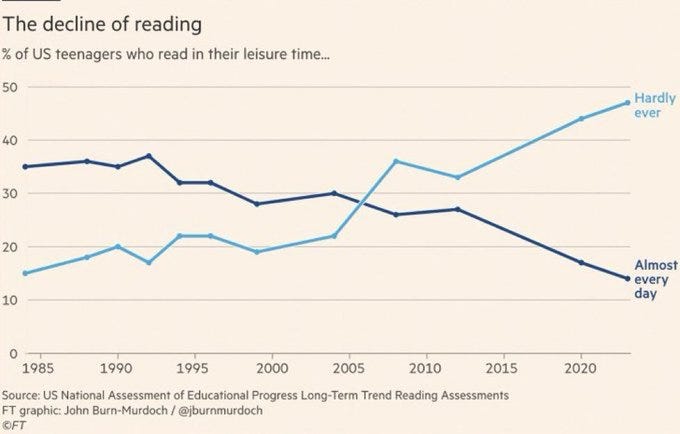
The fact that almost 50% of the US teenage population hardly ever reads means that it isn’t that hard to be in the top 25% of readers (I wouldn’t be surprised if adult statistics are similar). That already gives you an edge as an investor.
Winning in Psychology
Jeff Bezos once asked Buffett why people can’t copy Berkshire despite it being rather simple and with all the publicly available information out there.
His reply: ‘Jeff that’s easy. My approach is a get rich slowly scheme. People don’t like those’
This is true then and it is true now.
Short termism will never go away. Emotions swing markets in the short run, fundamentals don’t. By nature, being a fundamental investor means going against the heard in psychology. Being fearful when others are greedy, and being greedy when others are fearful. There is no LLM that can trigger when to be greedy while the markets are crashing, and when to structure a preferred share with long dated warrants. That is the realm of creativity and patience combined.
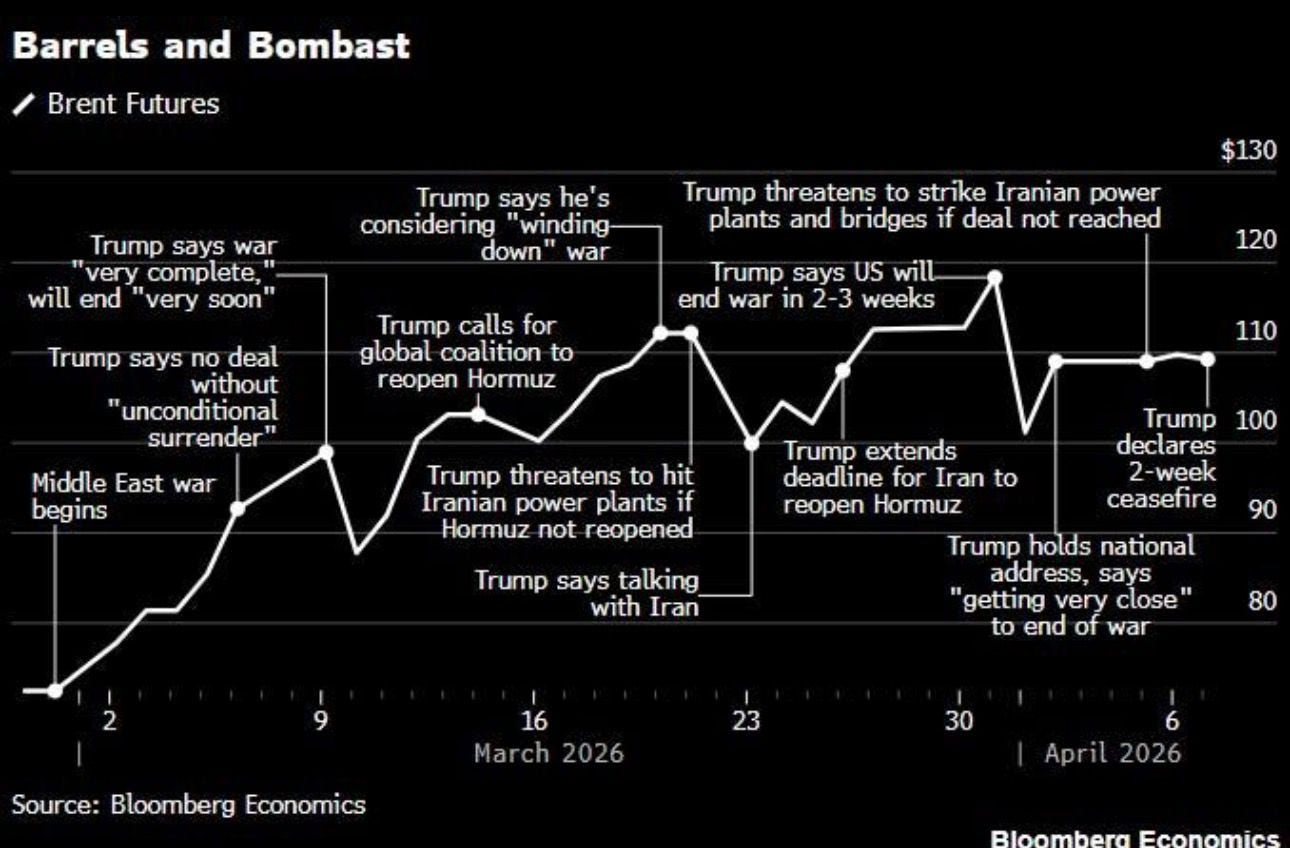
Just look at how markets see-sawed as Trump shifted his ultimatums, exposing how sentiment driven they can be. The speed of these swings suggests a herd mentality, fueled by media cycles and an audience more responsive to headlines than to deeper analysis.
As technology progresses and information becomes more accessible, humans will still be humans, and the edge will belong to those who master psychology and analytical effort, because most people won’t.
ABOUT THE AUTHOR
Keenan Ugarte is Managing Partner at DayOne Capital Ventures, an independent private holding company that invests in and builds high-growth, early-stage businesses that serve the Philippine mass market.
No posts
Comments
Nothing yet. Say the first thing.
Sign in to join the conversation.