
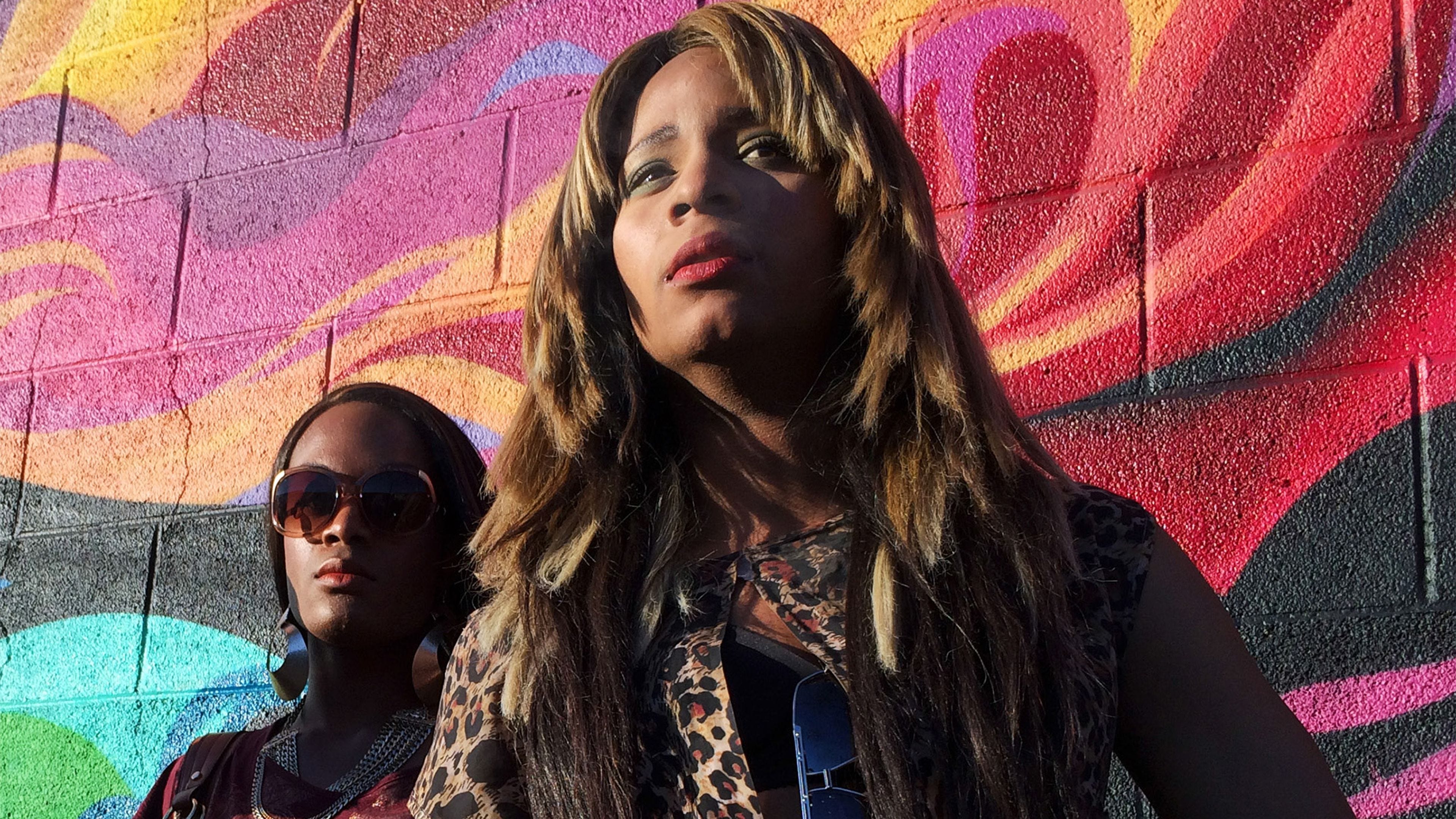
In Spring of 2019, I stumbled upon a wonderful opportunity — a mentor of mine, who was a full professor in my department, had to give up her upper-division Feminist Film Theory seminar due to scheduling conflicts. She tapped me to take over her class, which she’d began to formulate with a Queer Feminist focus. “Do whatever you want with it — use it to experiment and narrow your focus for your future Queer/Trans theory course.” In that first course, I cast a wide net. We covered the canon of Queer Feminist theory through the lens of 4 films, covering topics such as camp (But I’m a Cheerleader), hybrid spaces (Tangerine), gaze theory (Paris is Burning), and queer temporality (The Favorite).
The course achieved exactly what I had hoped — it opened the field, inviting us to trace common threads and weave our own arguments. Two films in particular, Tangerine and The Favourite, crystallized my own research interests. I became passionately drawn to instances of hybridity and to the ways queer and trans cinema complicates space & time on screen: Tangerine blurs the boundaries between public and private space, while The Favourite experiments with hybrid temporalities through costuming, set design, and language. In conversation with my work on queer horror and the monstrous-feminine — where I had been examining queer space/time, monstrosity, utopia, and borderlands in A Girl Walks Home Alone at Night and San Junipero — I found really beautiful connections and a means to explore queer & trans cinema’s formulation of emergent spaces.
One year later, I was assigned the same senior seminar, giving me the opportunity to teach a fine-tuned version of my research and focus the course specifically on Hybridity in Queer & Trans Cinema.
Course Description: “In this course, we will dive into issues of representation and spectatorship that exist at the intersection of feminist film theory and queer theory/cinema. Our direct focus will be on issues of hybridity and queer space and time — how do queer film texts use space to illustrate embedded systems of power and the queer possibilities inherent in hybrid, emergent spaces? Through in-depth analysis of four queer film texts — A Girl Walks Home Alone at Night (2014), Tangerine (2015), San Junipero (2016), and The Favourite (2018) — we will explore key theories of queer space/time, including works by José Esteban Muñoz, Gloria Anzaldúa, Jasbir Puar, Jack Halberstam, Barbara Creed, and more. Some of these topics include: heterotopias, hybrid public/private spaces, queer temporalities, and borderlands.”
While all of the courses I had taught up until this point in my career were focused on department needs & student interests — creating courses that fulfilled a requirement (in the coolest, queerest way possible) — this course felt like it derived from my own needs as an academic. In this semester I created and taught two courses for the School of Cinema that showcased my own unique focuses as a filmmaker and theorist within the department (this course, and my Essay Film production seminar). It was the moment I felt most like a real deal professor, bringing students into my work and wrestling with these ideas together. It was new territory, to be less of an expert and go somewhere unestablished in the curriculum, but I found it to be really invigorating.
The Favourite (Yorgos Lanthimos, 2018)
Jack Halberstam, “Queer Temporalities and Postmodern Geographies”, 2005.
In this section, we analyzed how Lanthimos plays with our perception of historical time and queers history in The Favourite, blending absurdity & disparate historical markers (costuming, set design, language, etc.) with historical fidelity/facts. We read theories of queer temporality and drew connections between the personal/social, trauma & time, and non-normative temporalities.
A Girl Walks Home Alone at Night (Ana Lily Amirpour, 2014)
Barbara Creed, “The Monstrous-Feminine,” 1986.
Shadee Abdi & Bernadette Marie Calafell, “Queer Utopias and a (Feminist) Iranian Vampire,” 2017.
Gloria E. Anzaldúa, “La conciencia de la mestiza: Towards a New Consciousness,” Borderlands/La Frontera: The New Mestiza, 1987.
In this section, we analyzed the queer spatiality of A Girl Walks Home Alone at Night, which transforms the Iranian ghost-town setting — “Bad City” — into a liminal, in-between space that defies heteronormative and nationalistic boundaries. We looked at how the town itself becomes a queer geography, a borderland outside normative surveillance and control, and how the figure of the feminist vampire mirrors queer/trans characters and outcasts within this space, imbuing them with power and destablizing patriarchal structures.
Tangerine (Sean Baker, 2015)
Jasbir Puar, “Intimate Control, Infinite Detention,”Terrorist Assemblages: Homonationalism in Queer Times. Durham: Duke UP, 2009.
Jane Gaines, “White Privilege and Looking Relations,” Cultural Critique No.4, Autumn 1988.
bell hooks, “the oppositional gaze: black female spectators,” Black Looks: Race and Representation, Routledge, 1992.
José Esteban Muñoz, “Performing Disidentifications,” Disidentifications, 1999.
In this section, we analyzed how Tangerine and trans existence blurs and expands traditional boundaries between public and private spaces. The film showcases several key scenes that unfold in hybrid spaces (the hotel room open to the street, the car, the laundromat), each demonstrating core sites of kinship, intimacies, tension, and survival.
San Junipero (Owen Harris, 2016)
Eleanor Drage, “A Virtual Ever-After: Utopia, Race, and Gender in Black Mirror’s San Junipero,” 2018.
Angela Jones, “Queer Heterotopias: Homonormativity and the Future of Queerness,” 2009.
Lee Edelman, “The Future is Kid Stuff: Queer Theory, Disidentification, and the Death Drive,” 1998.
José Esteban Muñoz, “Introduction: Feeling Utopia, “ Cruising Utopia: The Then and There of Queer Futurity, 2009.
In this section, we analyzed queer utopia, technological heterotopias, and queer futurity through the science fiction text San Junipero. We looked at how the world of the film presents a digital, liminal space where norms around age, death, and sexuality are suspended or rewritten, and queer identities can be performed and embraced free from societal constraints. Cautiously optimistic, the film’s landscape disrupts linear life/death narratives and breaks from heteronormative, cisnormative temporalities.
Comments
Nothing yet. Say the first thing.
Sign in to join the conversation.