
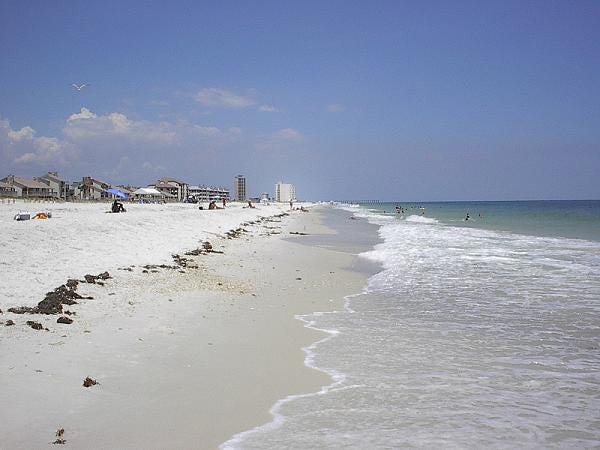
For me, the technological revolution that upended my life and career began during Easter break in Pensacola, Florida in 1985.
My father took the family there for a vacation while he attended a computer course. It was a week of DOS days and steak nights, with ice cream sundaes as big as the heart desired. I remember flying kites on the beach, listening nonstop to the brand-new Tears For Fears Songs From the Big Chair and Power Station cassettes. Even now, I can feel the salt breezes slapping my Sun-In-doused hair against my burned face as the soprano saxophone swirled across “The Working Hour”… and the stiffness of the sand beneath me after I spread my towel to lie down and stare up at the sky in dime-store sunglasses and an ill-fitting bikini. “When will there be a harvest for the world?” I pondered as Andy Taylor’s voice reintroduced me to the Isley Brothers’ lyrics.
In our kitchen back at home, we had a Texas Instruments machine on which I programmed Beatles melodies. It was like coding a wooden abacus that spat out a brief series of off-beat, off-pitch beeps. But that year, with its magical musical summer and the satellite synchrony of Live Aid that changed me and the planet forever, the first ultra-modern computer arrived in our house. I can’t remember if it was a Commodore or IBM, but I’m so proud of my parents for being forward-thinking. We also had some sophisticated stereo equipment at the dawn of the CD era.
It was all up-and-up then … a smorgasbord of technological promise meant to bring the world together around communication and human achievement. As long as we escaped nuclear war, everything else was kosher. Dreams seemed real, like they could be achieved. I could be a writer, and I could write about music. That dream came true.
Fast-forward 41 years, and I’m in the height of the most bizarre midlife existence. Data centers across the way could make our drinking water dirty and scarce. Music is being made by robots. Politics makes the Cold War look like a cakewalk. AI is stealing jobs, and journalism is under fire. Writers exist, but we’re huddled here on Substack together like it’s a deserted island (don’t get me wrong, the weather here is nice).
I learned every program I could throughout my career and became an early adopter of Apple and Adobe products and everything in between. But new tools are quickly supplanting those skills, and my natural instinct is to try learn them all. In the current landscape where humans are 90% more productive than in the 1980s, and one person does the work of five, I’m awash in a sea of software subscriptions to keep up, and my social calendar is practically empty.
I am grateful to my work colleagues and company (and family) for allowing me to contribute in a meaningful way with stories for our NPR stations and statewide audience, with the occasional national story, too.
Recently, I went part-time at my job to work on improving my physical health issues and I started a personal podcast (unaffiliated with my job) in order to do more of what I love – talking with artists everywhere about their art and why putting it out into this world is an act of hope.
After the past few weeks of being out of state for a family health emergency, I am grateful everyone is well. I’m taking comfort in these conversations and the music, as always!
Several folks have reached out to offer podcast advice. Fantastic new guests and changes are coming and it will grow, if people listen. It’s back to the old conundrum of the tree falling in the forest: Did it fall if no one heard it?
P.S. And returning to the Florida theme: If you are one of those folks who thinks Tom Petty and the Heartbreakers are the best band from that state, let alone the country, you don’t want to miss my latest podcast episode with MIKE CAMPBELL and what he has planned for Atlanta.
Our conversation about technology and AI dovetails everything above.
This episode is a keeper!
Sending peace to everyone. Please click the blue button to make sure you get all my updates.
Below are two lists of my favorite fallen trees of the past year or so: my arts segments for GPB/NPR and my podcast episodes 1 to 22 on Apple and Spotify. I’d love for you to like, subscribe, read, download, listen and share. It helps me know the sound from the forest reached the clearing, and to believe I —and all my fellow writers and creators— are not in this alone.
CLICK MY BIO IMAGE FOR GPB STORY ARCHIVE.
Comments
Nothing yet. Say the first thing.
Sign in to join the conversation.