
The old curse, may you live in interesting times, seems fashioned for our current turbulence. At the same time, everything is also sooooo tediously boring because we’re playing the same domination game over and over again ad nauseam. Sure, this version comes with shiny new multiplayer screens, with rogue AI agents juicing the stakes, and with newish teams remixed from old friends and old rivals. But, for all the drama, we’re just recycling the same fraying arguments. To keep this from sprawling into cognitive madness, I’ll focus on the big three economic thought loops, but the core argument could extend to most any political, religious, social, and economic ideology stridently singing their verse of the domination game song. Here we go:
Capitalism inevitably concentrates wealth, so socialism must be the answer.
Socialism failed, so, duh, markets are the obvious answer.
Communism has never been properly tried, and when it has…well, let’s just say the record is spotty.
The arguments are (usually) historically informed, morally passionate, and backed by an impressive assortment of often cherry-picked statistics. The problem is that the arguments themselves are trapped in a tiny cognitive box with no air holes to let in a fresh breeze of new ideas.
Capitalism, socialism, and communism make different claims about ownership, markets, labor, equality, freedom, and the role of the state. The differences are real and have real consequences. But in practice, all three currently function as vehicles for an ideology most focused on concentrated, centralized power operating in a simplified model of reality. In a word: domination. Meaning, domination by the few over the many.
James C. Scott’s Seeing Like a State explores this problem from multiple directions that cross ideological lines. His examples range from eighteenth-century scientific forestry to Soviet collectivization, socialist villages in Tanzania, modernist city planning, revolutionary political parties, and industrial agriculture. All of which, despite the model, use different forms of exclusion and coercion to enforce the chosen system.
Here’s the pattern:
Someone far from the ground develops a model for how a complicated human or ecological system ought to work—If you’re a Marxist, think Karl Marx, and so on.
The model—which is just an idea of how a slice of reality works or should work—identifies what matters, creates the measurement systems, and codifies the system as a working model.
The creators establish an authority to reorganize life around this made-up system, to partition within it who counts and who doesn’t, and use the levers of power to fashion a collective Truman Show version of reality where people more or less abide by the rules because the rules, once embedded, become so invisible that participants consider the rules to be reality itself.
Actual reality becomes a casualty of ideologically constructed systems, as do those people, things, and values that don’t fit the new model or who are too inconvenient to count.
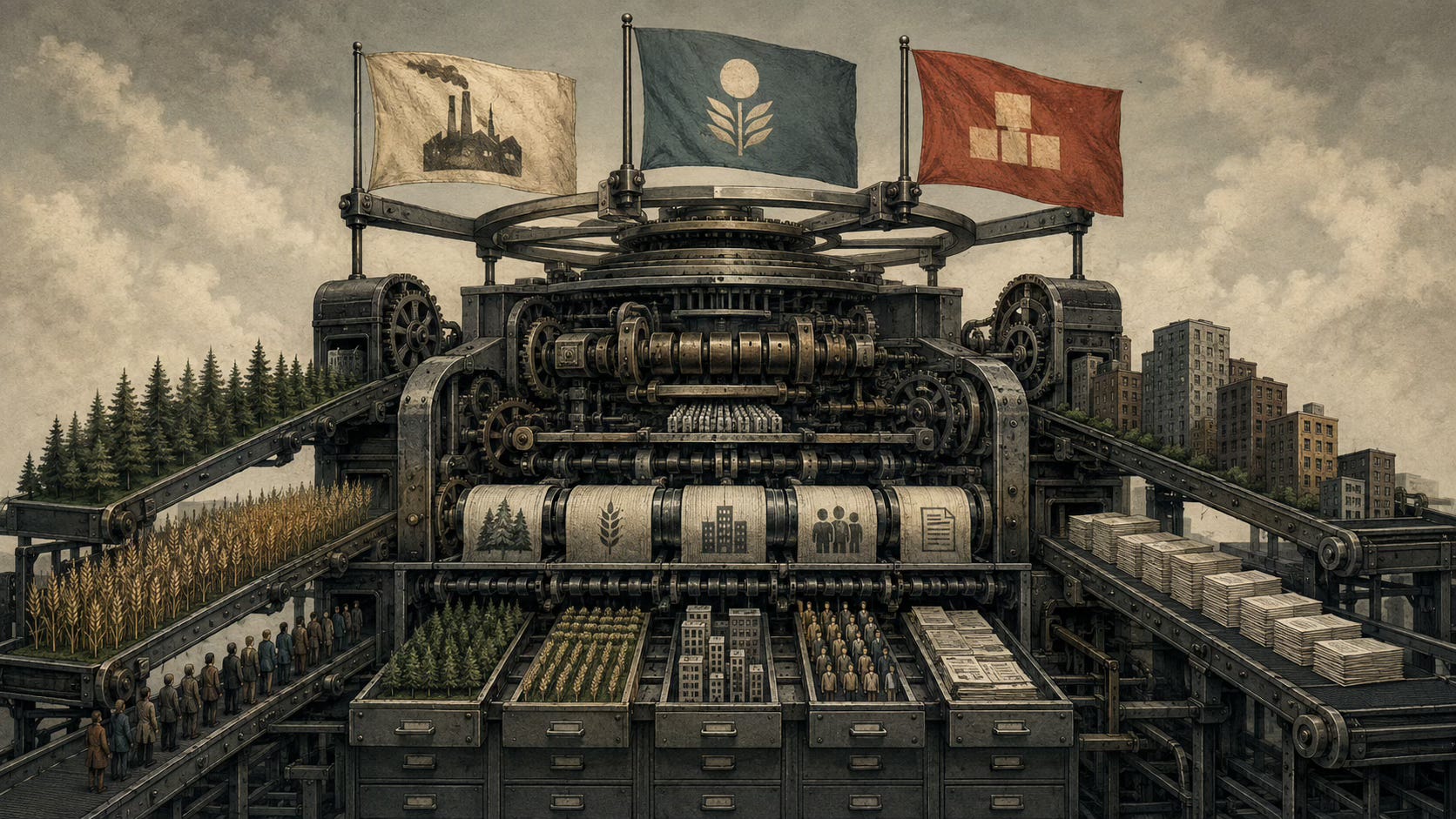
To simplify the world into a compact ideological story or goal, you must start by making a messy reality legible, which means, in James C. Scott’s Seeing Like a State, making people, places, and resources easy for institutions to identify, count, and manage.
Scott then shows how states and institutions (and, I’ll add, ideologies) simplify the world so it can be managed to reflect the values touted by the ideology or system.
The world has gone through layers of legibility over the centuries, many of which are so familiar that their initial intent to control is now invisible. Atop these layers of legibility, we’ve built both the control mechanisms and the benefits of our modern world.
Permanent surnames initially (and still do) helped the state identify and track people for taxes or military service, but they also help establish inheritance, legal identity, and family relationships across generations. A mapped parcel of land becomes easier to commodify and assess, but it’s also easier to sell, defend in court, or pass to your children. Standard weights and measures make taxation and commerce simpler by facilitating large-scale trade without negotiating the meaning of a bushel in every transaction—frustrated sigh from a person who lives by inches and miles in a metric world.
National boundaries and a common language extend government power into regions once united by local dialects and customs that outsiders could barely understand. They can also give people a larger sense of identity, as well as access to national schools, laws, literature, employment, and communication far beyond a home village.
Legibility allows large societies to function. In fact, without some legibility, we can never unite as a global population, reimagining ourselves and our systems from an orientation of personal and collective well-being—a fact I’ll return to later.
The trouble with legibility comes when the categories created to organize reality begin replacing reality in the minds of the people running the system, not always for nefarious purposes, but most often to dominate, control, and extract benefit for the few over the many.
Scott’s forestry story is a clear example. When 18th-century European states decided to turn their old-growth forests into mono-crop timber forests, profitable timber was all they saw. They ignored the larger ecology of diverse trees, shrubs, fungi, animals, and regenerative fallen wood. They also discounted the medicinal plants, grazing, foods, building materials, firewood, and other forest resources used by nearby communities.
Forest managers clear-cut the old forests and planted commercially valuable trees in straight rows, which were easier to inventory, harvest, and account for on a government ledger. Predictably, from an interconnected view, but blindsiding from a financialized one, the ecological system holding the forest together quickly collapsed—soil deteriorated, trees became more vulnerable as pests spread, and productivity declined.
The mono-forest calculation captured theoretical value, but it left out the foundation that kept a healthy forest alive.
Regardless of the ideological system, once a government creates a simplified picture of people, land, work, or production, that picture becomes a seductive playbook for governing. What fits the model is visible and valuable. Anything outside it is ignored, discounted, or vilified for not fitting into the system.
Scott calls the broader twentieth-century version of this confidence high modernism, in which experts embraced science, planning, engineering, and administration (and now Palantir and AI) to structure society with the same precision used to build a bridge or run a factory.
High modernism ideology crossed political and economic borders. The model was embraced by capitalist industrialists, socialist planners, communist revolutionaries, as well as colonial administrators, architects, agricultural scientists, development agencies, and national governments of every variety.
The flags change. The machinery is repurposed to suit the dominator du jour.
In Scott’s example of Soviet collectivism, the ideal imagined centrally controlled, managed production with its slick shared machinery and happy workers organized into legible units. What they started with were independent peasant farmers making locally relevant, well-reasoned decisions about crops, labor, livestock, food, weather, and trade grounded in knowledge gleaned from lived experience.
Both the Soviets and their capitalist foes shared a vision of large-scale farming, even if the two systems differed over ownership. Each admired the enormous fields, mechanized production, specialized labor, standardized crops, and managerial oversight of modern industrial-scale farms that could be overseen from somewhere else, whether central party headquarters or the New York office of a corporate conglomerate.
The Soviet version enforced its vision using the coercive power of the state, making invisible the farmers who resisted by taking their land, their food, their freedom, or their lives.
Capitalist agriculture creates standardization through markets and relies on voluntary compliance. Farmers trying to compete with larger producers have to expand, specialize, borrow, mechanize, and grow what processors or retailers will buy in bulk. Costs outside this transaction become invisible, even though they are vital to the larger system’s survival. Soil loss, polluted water, declining farm communities and biodiversity, and dependence on a narrow range of crops can decimate individual farms and farmers over time are the price of keeping the market strata operating smoothly—and market stability is what’s valued and counted.
Even ideologies with the best intentions can follow this route.
In Scott’s chapter on Tanzania, leader Julius Nyerere wanted rural Tanzanians to have better access to schools, healthcare, clean water, agricultural support, and roads. A noble vision.
But providing those services was difficult because the households were widely scattered. The solution? A planned village with an orderly pattern of homes and centralized services. From an administrative standpoint, it seemed perfect. What could go wrong?
Turns out, quite a bit. Households were scattered because people living on the land organized themselves around things like water sources, soil quality, grazing access, disease patterns, kinship ties, or seasonal work. When people resisted relocation, officials labeled them obstructive, and, in some cases, destroyed old houses to force compliance with what, on the surface, seemed like a noble idea.
Without changing the underlying driver of the domination game, any ideology will inevitably betray us once it gains enough authority to rearrange people and resources in accordance with its whims, no matter how noble its vision. This is the yellow brick road from revolution to authoritarianism or dictatorship.
When a model, rather than actual reality, decides what matters, a centralized institution or ideology creates a simplified fantasy representing the whole picture and scripts everyone’s role accordingly. Lived reality skews to conform—to a point.
Because people living inside the system are privy to snippets of reality that are unaccounted for in the system, the imposed system begins to move toward a funhouse mirror version of reality. Bosses manipulate the numbers to reward quarterly targets while managers learn to report numbers their bosses want and subordinates hide failures to avoid retaliation. Government officials polish statistics to support a regime’s ideology while discounting or denying evidence that challenges it. Workers find unofficial workarounds to bypass rules that make their jobs impossible. Citizens comply on the surface while undermining the imposed order in private.
Corruption often grows in the space between the formal system and the world people have to live in. The more top-down a system is, the wider the gap between it and reality, and the greater the opportunity for corruption by people who hold the administrative levers that control everyday life. Bribes help people get around absurd restrictions. Black markets supply what the official economy won’t provide. Bureaucrats either ignore rules that would make a situation worse or enforce ridiculous requirements to keep their jobs. Employees bend and break rules behind the scenes to maintain function despite official requirements.
When enough lived reality sits outside the official model, people build another system underneath it. In this time when all our systems are fraying, I find hope as I peruse Substack and see all the ways we’re scaffolding a new system beneath the one that is crumbling. This will likely work best if we can keep open to the possibility of this moment in time and don’t get co-opted by power systems that promise new versions of old models with bad track records—and if we can wean ourselves, individually and collectively, from our addiction to the domination game.
Our current nation-state and economic systems developed in a world where information moved slowly, and central governments needed records and measurements simple enough to administer multiple needs for millions of people. The legibility created to run this system made simplicity necessary.
But technology has changed. And so has the tide of information flow.
People communicate across continents instantly, and communities can coordinate without sharing physical space. Large groups can contribute knowledge to a common project without needing an administrative center. Digital tools make public records easier to access and inspect. Citizens can participate in deliberation from wherever they live, and we can see how local experiments unfold in real time and help them spread quickly when they work. Artificial intelligence, utilized wisely, may eventually help us handle forms of complexity that paper bureaucracies couldn’t because humans couldn’t process them at scale.
True, those technologies harbor their own dangers—but they also change what is possible.
We inherited political systems built around the need for large-scale coordination, centralized information, and centralized control.
But in the world I envision, we don’t need this same structure anymore.
So maybe we can ditch the old labels and models and use the tools we have to reimagine what we want our world to look like and what counts as valuable.
It takes imagination to shift away from the learned habit of valuing a quantifiable resource like timber and toward valuing shared resources like a watershed or old-growth forest, and of utilizing distributed intelligence to address problems rather than trusting CEOs, government officials, and influencers. It takes trust and technology to let everyone participate in governing systems that affect them rather than handing the job off to some bought-off, full-time politician.
But we can do this. We’re humans. We’ve survived multiple population bottlenecks, developed agriculture—more than once, and despite bringing ourselves to the brink again and again, we find ways to step back from the cliff’s edge and, for a moment or two, hold hands and sing Kumbaya.
We can do hard things. Scott even has a word for the kind of knowledge that becomes important as we create a new system based in well-being.
He calls it metis. It’s a practical knowledge formed through experience, adaptation, memory, improvisation, relationships, and close contact with a particular place or problem.
Combined with emerging technologies that let us, as commoners, communicate, organize, collaborate, and experience, metis is a useful concept as we start imagining what might come next.
More on Scott’s metis in the next essay. And if you need to see how I use AI in my writing, you can do so HERE.
A Conversation with Henry Sullivan on Ideology
Here’s the conversation I had with Henry L Sullivan III about the danger of turning an ideology into a proxy for reality. Enjoy!
Peace, Kristine
PS—Need a little escape from so-called “real” life? Check out my novel God in Dragand/or read the first chapter for free!
.
Comments
Nothing yet. Say the first thing.
Sign in to join the conversation.