
Anyone Doug Wilson threatens to sue is a friend of mine.
Actually, Sarah Stankorb and I were friends before she irked Wilson and his cronies with a piece she wrote for Vice, “Inside the Church That Preaches ‘Wives Need to Be Led with a Firm Hand.”
Sarah is a journalist, essayist, and author, who has published hundreds of pieces in places such as VICE, ELLE, The Washington Post, The Atlantic, The New York Times, The Guardian, The New Republic, Cosmopolitan, Marie Claire, and others. Her writing on religion, politics, gender, and power, is always informed by questions of basic morality.
Sarah was born in Youngstown, Ohio, and studied world religions and philosophy at Westminster College. It was while studying abroad in Northern Ireland and then in Israel that he eyes were opened to how faith (and conflict) can shape people’s everyday existence. (She also has a master’s degree from the University of Chicago’s Divinity School.)
I was reading Sarah’s work long before I met her in person. When I was researching Jesus and John Wayne, evangelical women were sharing stories of abuse mostly on personal blogs. Then, reporters started paying attention. Some of these reporters did excellent work. Others, not so much. Sarah has a reputation among women—among abuse survivors in particular—for being the best of the best. She centers women’s voices and speaks truth to power, even when it costs her.
Her first book, the bestselling Disobedient Women: How a Small Group of Faithful Women Exposed Abuse, Brought Down Powerful Pastors, and Ignited an Evangelical Reckoning, does justice to the immense courage of women who told their stories and tried to bring reform to predatory systems and resisting institutions:
A generation of American Christian girls was taught submitting to men is God’s will. They were taught not to question the men in their families or their pastors. They were told to remain sexually pure and trained to feel shame if a man was tempted. Some of these girls were abused and assaulted. Some made to shrink down so small they became a shadow of themselves. To question their leaders was to question God.
All the while, their male leaders built fiefdoms from megachurches and sprawling ministries. They influenced politics and policy. To protect their church’s influence, these men covered up and hid abuse. American Christian patriarchy, as it rose in political power and cultural sway over the past four decades, hurt many faithful believers. Millions of Americans abandoned churches they once loved.
Yet among those who stayed (and a few who still loved the church they fled), a brave group of women spoke up. They built online megaphones, using the democratizing power of technology to create long-overdue change.
Now, she’s back with another book that centers the stories of Christian women, Damned if She Does: Why Women Quit Church and What It Means for the Future of Religion.
What a title, and what a cover!
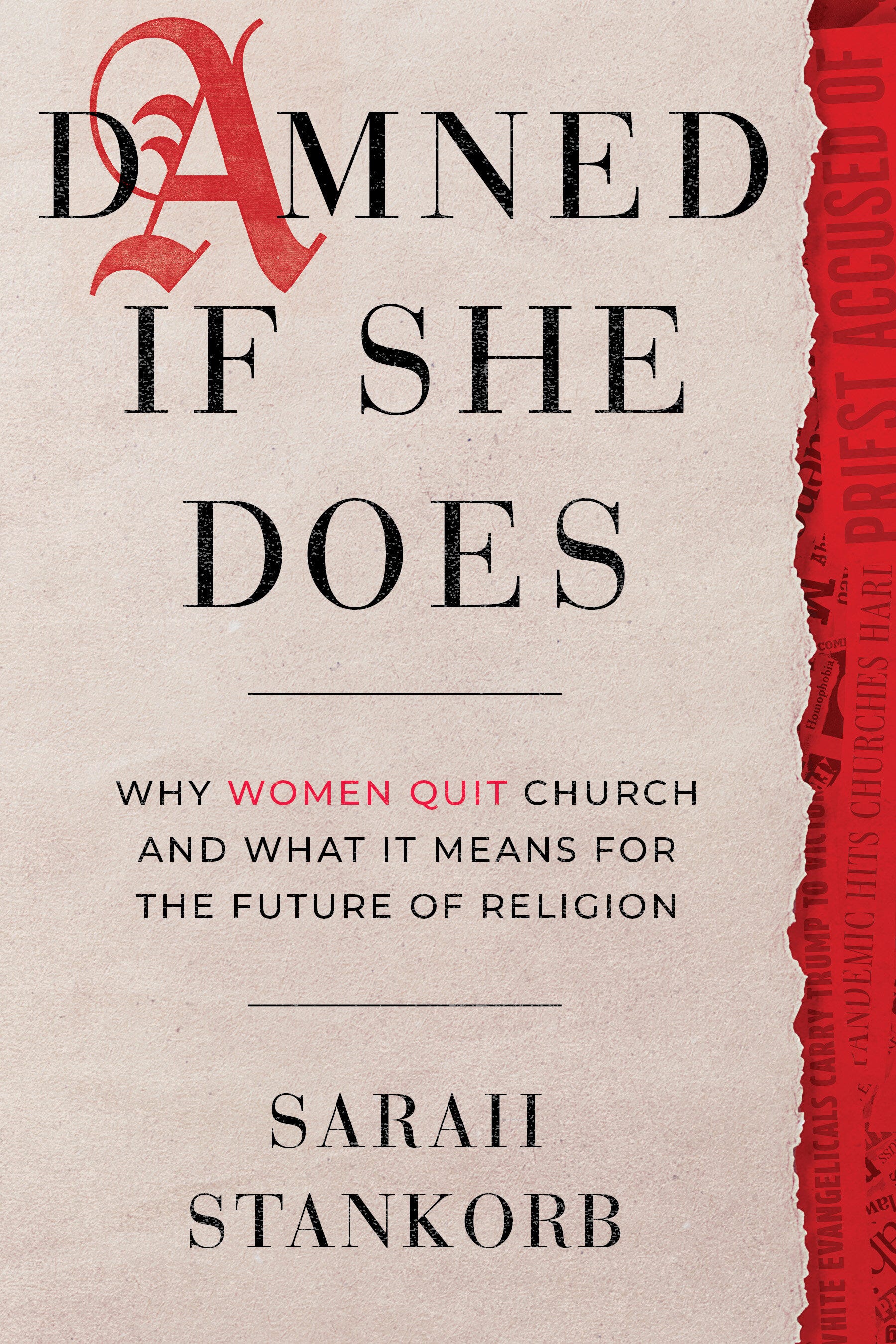
Ordinarily, women are more religious than men. But these are no ordinary times….In the past decade, 16 million women have left the church. Younger women are disaffiliating from religion faster than men. For some women, leaving is like a dramatic divorce; for others, as one woman tells Stankorb, it’s more like women and the church “stopped calling each other.”
Exploring trends from the 1980s to today, Damned If She Does is an intimate account of women whose stories got missed during the Christian Right’s headline-grabbing rise to power. Their exodus is marked by harm, disillusionment, and drift: from pastors’ wives and a national Christian TV show host, to girls whose horrific abuse gives another face to the Catholic sex abuse crisis. Some couldn’t stand by a church that cast out their queer friends. Others were maligned for who they loved. Churches with strong opinions on sexual purity and abortion stood beside men with histories of assault. With horror, women who loved the church watched the rise of Christian nationalism and saw their faith bastardized.
Damned if She Does releases this September, but the independent Joseph-Beth Booksellers currently has a special preorder promotion: Order Stankorb’s book and receive a signed copy and a special candle:

Order soon, since there are only 100 candles, but once the candle supply runs out, preorders will still receive a special bookmark.
In honor of her special candle preorder deal, I asked Sarah to share a bit more about the book and about her broader work with CONNECTIONS readers:
Let’s start with your first book, Disobedient Women. What prompted you to write that book? What did you learn in writing it, or how did it change you?
By the time I was writing Disobedient Women, I had already been reporting for about a decade on women recovering from various aspects of evangelicalism. Despite having studied religion in college and graduate school, I came at the topic sideways, stumbling first onto a story about a Quiverfull woman who had left the church, her marriage, her community, and become an atheist. To go from having as many babies as possible to help populate the world with Christians to becoming a nonbeliever was obviously a stark change in this woman’s life. And as part of that change, she started trying to make sense of her old beliefs online. In those earlier days of the internet, her words became a gateway for other women who had started to find their lives unsustainable.
From there, I found a generation of kids raised in families like hers. They were connecting online, realizing that the specific challenges they’d faced repeated across the country, in families that read the same books, believed in the same sorts of authority and hierarchy.
I was an outsider who cared about faith, a reporter who was puzzled by a system of beliefs and influences that were all new to me. Somehow, over time, I became a person women came to when they started challenging figures of authority they’d been raised and taught to respect, but who also covered up abuse or were culprits themselves.
Disobedient Women is a hard book to read. It is full of true but dark stories of what people do with too much power. But it is also a book about people finding their voices, often online, and claiming a little power back—not out of greed or self-service, but because they want to prevent harm for others.
How did it change me? Well, I was a very religious kid who lost my own faith in my late teens (though I was heartbroken over that loss for years). By the time I wrote Disobedient Women, I was an agnostic. I bring this up, because after years reporting on abuse within religious communities and the coverups—I realized I don’t know if I believe in God, but I know evil exists.
I don’t know if I believe in God, but I know evil exists.
But I could also get up in the morning because of the beautiful resilience of these survivors, my sources. I think much as reporting on predators changed my lens for how some people can exploit others’ faith and vulnerability, I also learned how from that place of vulnerability, people have a tremendous capacity for hope, for courage, and for fighting for justice.
How did you know you needed to write Damned If She Does?
Honestly, when I started seeing the number of women nones (atheists, agnostics, nothing in particular) increasing in national surveys, I started putting together a book proposal. This was years ago, before Disobedient Women. Then, no one was interested and I am SO grateful that I didn’t write this book then. So much has changed. So many more women have quit the church. The reasons women say they have quit are so much louder and impossible to ignore now.
And tell us how you came up with the title. It’s so perfect. Did you have the title before you started, or did it come to you at a certain point?
I honestly can’t remember. This idea has been knocking around for me for a really long time, with this title, since about 2015.
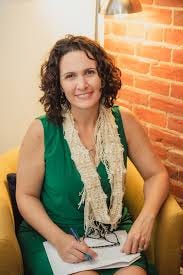
Can you give us the big picture? What’s going on with women leaving churches? Is it a trend?
It’s nearly a statistical given that in most faiths around the world, women outnumber men. And usually, we inherit faith from our mothers. They are often a vital link to faith between generations. Women are a vital indicator for the stability of religion in a culture.
And when a society begins secularizing, it’s men who leave first. There are lots of theories about why. Some sociologists have speculated that women are more risk averse and so are less likely to be willing to take on the social stigma of rejecting a culturally predominant religious group. But women’s biology places them in alignment with many religious rituals. For birth, and often, death, women are there. Whatever the reasons, there are theories that once women start to leave in numbers nearing men, a culture is really tipping toward secularization. The social stigma is largely gone.
We’re at a point in the U.S. where, in Gen Z, women are now less religious than men. The gender gap is pretty much gone among Millennials. Women of all ages are less likely to affiliate with a church than their grandmothers were. I know there is an impulse for some—especially evangelicals—to jump on anecdotes about men showing up more in some churches. This has a lot to do with the fact that men have been a coveted population by churches for a long time, in part, because in the past, women could be counted on to stay in the pews. And in most places, the difference is not a factor of more men, but the gender gap is closing relative to fewer women.
Much as I’m interested in telling stories from women who don’t usually get to share their “testimony” of leaving the church, I also think churches really need to be paying attention to what’s going on here.
Why are women leaving?
I wanted to gather stories from as wide a range of women as possible, and the book spans geography, age, race, denomination. Their reasons are varied and extremely personal. And most don’t leave for just one reason. People don’t change a core part of their identity lightly. More than a few quit, go back, then get fed up and quit again.
But if you zoom out, there are certainly clusters of reasons, and I think a lot of it comes down to many of these women having really believed in a Jesus figure who loved and spoke up for the oppressed, and when their churches didn’t do the same, the hypocrisy drove them away. For some, homophobia became repellent. Others saw the reality of systemic racism and couldn’t stomach being part of a church that wouldn’t even acknowledge its toll. For others it was sexism, or sex abuse and coverup, and for many, it was an entanglement between Christianity and far-Right politics. Christian nationalism might be a powerful political ploy, but it’s gutting mainline churches. Even when people’s home churches aren’t guilty of any (or most) of this, it has all tarnished the church and made many women want to leave. And they don’t feel like they can trust the church with their kids.
Your reporting unearths so many poignant stories. Can you share with us one story with us that conveys the human side of these statistics?
This is hard! These women’s stories are so different. One I think a lot about though is Denise. She is the sort of “super volunteer” that really makes up the true social fabric of a lot of churches. She described mission trips and local mission work when she assisted asylum-seeking families who were getting dropped off by the busload at a nearby airport. She lives her faith.
But she’s also at the nexus of a lot of other pressures that have changed the way people see their neighbors and their churches. Denise is white, her husband is Black. They’ve supported a bunch of kids over their lives, and their two biological children are biracial. Her story includes her eldest attending a Turning Point USA event and coming home wanting to convince them we live in a post-racial society. Meanwhile, at his Christian, private school, their younger son was dealing with blatant racism. Over the course of the pandemic, and especially after George Floyd’s murder, she noted how her church’s ministers seemed to be walking a sort of social tightrope. Maybe they attended a few marches, but also weren’t plain about white supremacy. Her family moved and used it as an excuse to quit church. She just didn’t feel like she could trust what the people down the pew from her family really believed.
In her case, she still follows Jesus and loves people in her life who call themselves Christians. But for her, the label “Christian” is too tied up with white supremacy and Christian nationalism to claim the word for herself anymore.
Who do you hope reads this book, and what do you hope they take away from it?
I have a big dream of drawing together two very different audiences. I wouldn’t even believe this would be possible if not for my prior reporting. (Often, my stories connect nonbelievers who have been hurt by the church with believers who want to build a church that doesn’t do such harm.) In an ideal world, I want to talk to churches. I want to sit with ministers and church leaders and help them see that valuing women may feel radical in a national culture swinging patriarchal, but it may be the best way to mark their church as different from the version that is repelling so many.
But I also really want to break what is (to me) a very confusing taboo. Millions of women have left the church in the past decade, and somehow, it still feels like disclosing a secret to explain why. I don’t think it’s fair for anyone to have to bury this sort of hurt. And I don’t think it does justice to what these women find after. Even I was surprised by the sort of spiritual freedom women find outside institutions. Many have deeper faith in Jesus, but they are also lonelier. Others do astrology. Some have reconnected with the faith of their ancestors, finding that historic connection that might have tied them to their church, instead in their blood.
And last, I think together, we’ll all figure out more of what this means for religion in America. There was a time when Christianity was predictably the majority religion in America. And some of the slide away from religion generally is stabilizing, for now. But there are also a couple of other things happening: people who used to attend church are becoming spiritual in a wider variety of ways. And a lot of the factors that drove women away in the past decade are only more obvious—and perhaps repellent—now. Older, more religious Americans are dying off. I don’t think the trend lines are set, but if things continue as they are, and especially if Christian nationalists keep their grip on the mic, publicly representing the church in total, the exodus will not be over.
If you want a special Damned if She Does candle (and who wouldn’t?), preorder now through Joseph-Beth Booksellers:
And be sure to follow Sarah here on Substack at In Polite Company.
Comments
Nothing yet. Say the first thing.
Sign in to join the conversation.