

For the last four Fridays in a row, I spent 9–4:30 in a room with about twenty other immigrants for French civics class. As of January 2026, non-tourist visas now require you to not only take this class, but pass an exam in order to renew.
We met for the OFII (l'Office Français de l'Immigration et de l'Intégration) formation civique on one floor of an office building twenty minutes from my apartment. My class had a French teacher named Salima and, because the class was for English speakers, a French translator named Irina. On the first day we were all given a little headset where Irina would speak in English, summarizing everything the teacher said about the slides projected on the wall: French history, laws, rights, civic duties, France’s symbols, what they stand for and why.
By our last day no one was using the headsets anymore; Salima spoke, Irina would translate, it all flowed naturally and we were all finally comfortable. Not just that, but we felt confident about the exam, that we knew what would be asked and we knew the answers.
We now know what comes next.
—
Having been here already for four years, there wasn’t much that I learned that I didn’t already know. I knew you have your rights and freedoms, but they cannot infringe on another’s. So, for example, you can’t legally stand naked in your windows! The way rights are enshrined for French citizens, residents, and nonresidents alike—I mean, simply for humans—is, in theory, very similar to the way rights are enshrined for Americans. I did not know that when Thomas Jefferson was ambassador to France from 1785–1789, he helped the Marquis de Lafayette draft the Declaration of the Rights of Man and of the Citizen, which the Marquis presented to the French National Assembly on July 11, 1789, during the French Revolution.
So the language in our foundational documents is quite similar: That all men are born and remain free and equal in rights. The rights to liberty, property, safety, and resistance to oppression. That liberty consists in being able to do anything that does not harm others. That you are innocent until proven guilty. The freedom of ideas and opinions. And so on.
Fun fact: France abolished slavery in 1848; the U.S. in 1865. Yet France only gave women the right to vote in 1944! The U.S. granted women the right to vote in 1920, when the 19th amendment was certified, after 7 decades—since 1847!—of protest, imprisonment, and perseverance by feminists. (Our history is rife with examples of protests that changed laws and culture.)
Also: the Declaration of the Rights of Man and of the Citizen does not mention gun ownership. Gun ownership is not a legal right in France; licenses and registration are involved. (Imagine that!) Which is one reason why I want to live here. An acquaintance of mine, a deeply beloved and talented musician the same age as me, Jillian, was killed in the Lafayette movie theater shooting of 2015. It was an Amy Schumer film. I would prefer to live in a safer society. One that values human life.
And on that note, I have never lived in such a pro-family society, where healthcare, childcare, and education is accessible and affordable. And, yes, abortion is a legal right. This is what it ought to mean to be pro-“life”: to help women make decisions for their own bodies and health, to trust doctors to make those decisions with women, to support pregnant women, to support children, and to support families.
For me, the result is a saner, better educated, and more trustworthy population. Americans live with a lot of fear. Of each other.
—
What really struck me during the class is that any minor who is in France, for any period of time, resident or not, has a right to attend school. Your young kids can be placed in French school for a short visit, if there’s room. It’s seen as a universal right.
As is healthcare. A resident has the right to the healthcare system after living here for 3 months.
I do not, after 4 years, have access to the healthcare. I applied a few years ago, was denied because I made an administrative mistake, and I gave up. I didn’t feel it was ethical to receive the healthcare when I wasn’t paying social security or taxes or working here. I also had to buy private travel insurance anyway, to renew my visa. But once I established my “micro-enterprise” here last summer, successfully changed my visa to a working visa, and began paying social security and taxes, I tried harder to get my Carte Vitale.
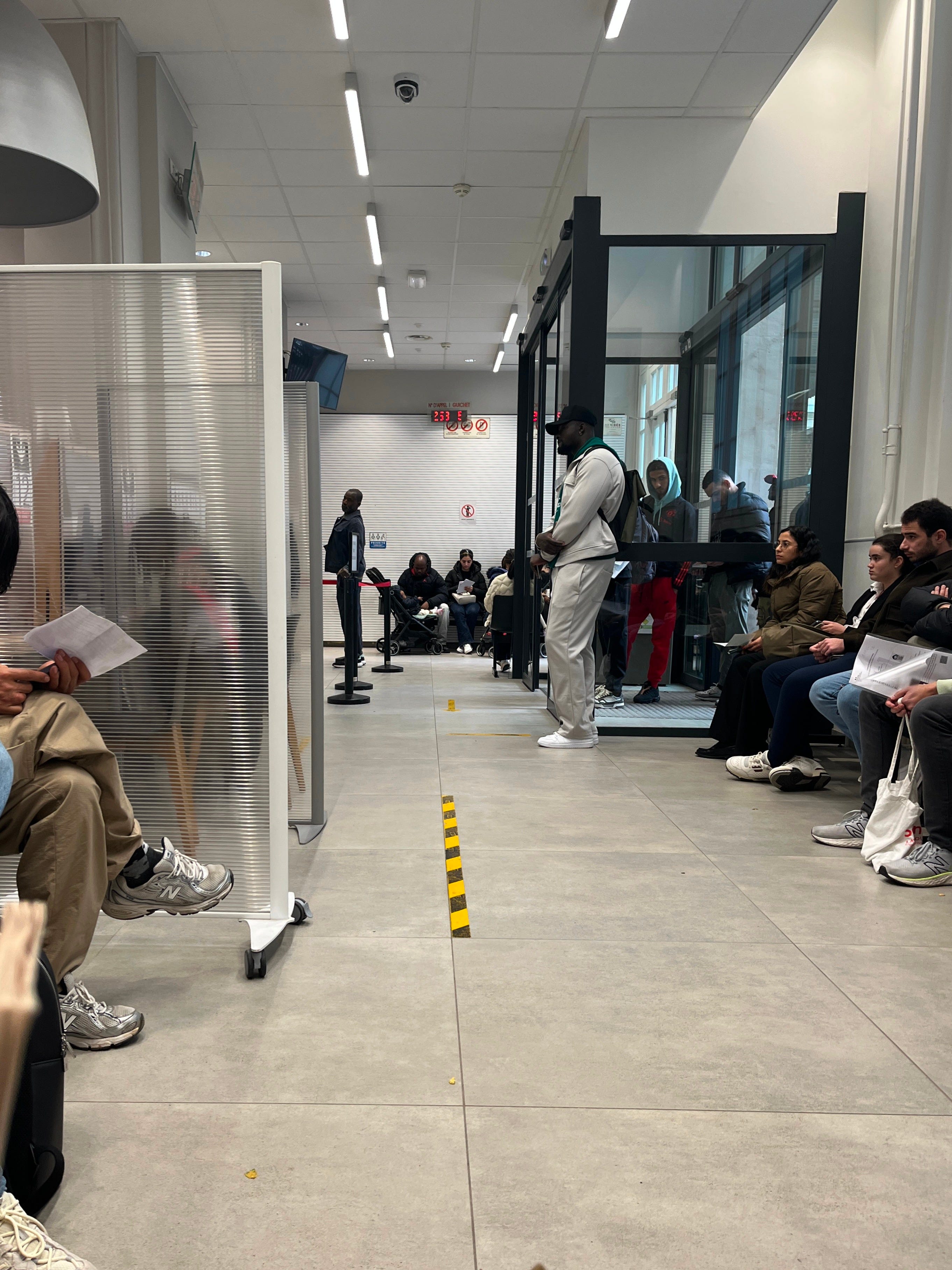
First, in July, the Ameli office for l'Assurance Maladie wanted my birth certificate again. (I have a photocopy of my original Santa Barbara birth certificate.) I sent the copy and translation, which has been sufficient thus far for every administrative thing in France. But not anymore! Apparently they now need a copy of my birth certificate “certified within the last year.” That’s not how birth certificates work in the U.S. but okay.
So I will pay $75 to get a new copy of my birth certificate, which implies that I have lost it when I have not, and which requires $50 in notary fees (the first notary did it wrong, it’s $25 each time), and then my sister will send a digital copy of it for me to submit. After processing, my birth certificate is set to arrive in… June!
There are so many examples of these random bureaucratic hassles. $100 or $200 dropped here or there for something I need or thought I needed. (I did not, for example, need to spend 120€ to get fingerprinted in Paris to receive my police record; the business visa application at no point asked for proof of having no police record in your home country.)
Every year I apply to renew my visa, which costs 225€. This year, I’ll apply for a visa that will last 4 years. I am a resident. I will, once I manage to set up my health care, have a social security number. I have been filing taxes here every year, and, due to reciprocity between the U.S. and France, I only need to pay in one of the countries.
—
It’s all very confusing and frustrating, and you’re lucky if you have money to spend on lawyers who can help you. Laws change. Blogs or other information on the internet could be outdated. I paid 270€ for an hour-long consultation with one of the immigration lawyers at Cabinet Daniel Tostado, who I highly recommend. I paid 1200€ for a tax accountant, then decided it was a fine foundation but I can take it from here. Other than those expensive experts, I have relied on the internet and my friend Charles, who has helped me set up my business, my monthly social security payments, my monthly tax payments. I could not have done it without him.
In the U.S., the laws change rapidly, even between presidents. Imagine trying to navigate that!

—
While I have been in my French civics classes, learning about how France treats immigrants and refugees and residents-who-are-not-citizens with dignity and respect, given France’s fundamentally humanitarian, ethical beliefs in the value of every human, the current U.S. leadership is doing the opposite. Even though our constitutions are so similar. Even though the current U.S. leadership positions itself as “Christian.” I think we can all agree that there is nothing Christian in the way people are being treated in the U.S. right now, immigrants, green card holders, people married to U.S. citizens and living in the U.S. for 20 years, people taken while attending their administrative meetings, doing it “right,” people without legal papers who are still working and contributing to their communities, people protesting, people articulating their right to civil disobedience—ideas which are so fundamental to this rather new experiment of “democracy” and “America.”
And yet there are some people in my life who don’t see the problem. They are good-hearted Republicans, “fiscal conservatives, social liberals” I used to say, who aren’t, for example, anti-gay marriage.
I was raised in a rural town, Santa Maria, that was populated by the Chumash and by actual Mexicans long before the U.S. claimed California in 1850. When we sold our family home to a winemaker in 2017, he shared that his family has been ranchers on the land for 9 generations. So I know we all get it, the complexity of who “belongs” here, of who is “American,” whatever the hell that even means.
—
I will add that the French do not hyphenate their identities. There is no “African-French,” “Asian-French.” You assimilate, yes. You learn the language, slowly because it’s incredibly hard, yes. (In my experience, sorry but the French are very sweet when you try your bad French!) And sure, you stand out with your accent, with your foreignness, and you are possibly never quite French, even if you’ve been here for decades.
There is pride, but there is not a brutal and unintellectual nationalism, is what I’m trying to say. Extreme patriotism, at a certain point—and of course Europe learned this the hard way—becomes dangerous.
—
What I wanted to show you is how jarring it is to be in French civics class, feeling like a very lucky immigrant indeed, privileged because I can spend my small freelancing income and my abundantly flexible freelancing schedule on these administrative requirements and errands into the wilderness of trying to live in a country whose values you respect, nay, prefer, while watching as your home country refuses to honor the fundamental humanity of every person and sinks into fascism.
On the last day of class, as we filled out evaluations, I said I wished we had all introduced ourselves on the first day, by our names, country of origin, and what we do. We knew each other’s personalities, of course, knew a few origins, had guessed. There was the gay Russian guy who had shared a vulnerable story. There were the two in the back who had never spoken a word.
Everyone agreed to do it, there in the last 10 minutes of class. I went first.
And so we introduced ourselves.
Americans, Canadians, Russians, Filipinos, Koreans, Japanese, Somalians, Montenegrins, Brits, Algerians, Moroccans, Indians. We were business owners, chefs, researchers, PhD holders, project managers, computer engineers, nurses, students, writers, married to French citizens, gay, parents, single, expecting.
After each person spoke, we clapped and cheered for them, meeting them, suddenly and in all of their humanity, as if for the first time.
No posts
Comments
Nothing yet. Say the first thing.
Sign in to join the conversation.