
I went out walkin’ through streets paved with gold
Lifted some stones, saw the skin and bones
Of a city without a soulI went out walkin’ under an atomic sky
Where the ground won’t turn and the rain it burns
Like the tears when I said goodbyeYeah, I went with nothin’
Nothin’ but the thought of you
I went wanderingI went drifting through the capitals of tin
Where men can’t walk or freely talk
And sons turn their fathers inI stopped outside a church house where the citizens like to sit
They say they want the kingdom
But they don’t want God in itI went out searching, looking for one good man
A spirit who would not bend or break
Who would sit at his father’s right handI went out walking with a Bible and a gun
The word of God lay heavy on my heart
I was sure I was the one— Johnny Cash & U2, “The Wanderer”
All across America, skirmishes are breaking out, so small they barely ever catch the notice of the Discourse, let alone the local media. On the scale of human problems — ahem, opportunities facing us today — which include the collapsing fertility rate, the U.S. debt, the AI apocalypse, the coming war with China, the pressure cooker of the Middle East, all nestled within the ever-present specter of nuclear holocaust — it makes sense that no one would give particular attention to a spat in the Diocese of Charlotte1 where some of the faithful are opposing the bishop’s recent prohibition of the altar rail at diocesan high schools or, similarly, the banhammer coming down from the Vatican upon the Traditional Latin Mass at the Church of the Holy Ghost in the Diocese of Knoxville.
To the ordinary reader, this all may seem so uneventful in the grander scheme, even tiresome, mere and entirely dull liturgical disputes, a petty narcissism of small differences, and it would make every sense that such drama only plays out across the replies of Fatima-themed X accounts with fewer than 274 followers or else the comment sections of tiny, hyper-niche warring blogs. From that perspective, such a conclusion would only be entirely understandable.
I would suggest, however, an alternate view: that these events, while they may seem like a pittance, are actually not such a pittance at all, but rather the very latest fronts of the greatest time war that was ever waged in the West.
Why Is the Vatican Long Brazilification?
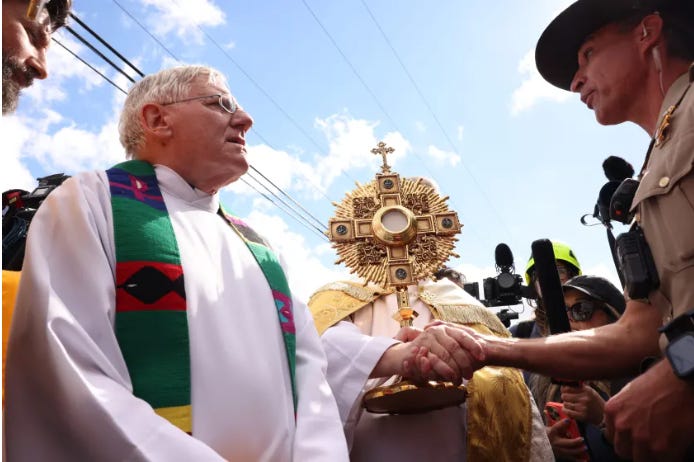
It is manifestly clear to any practicing American Catholic that the Vatican’s recent posture toward the United States prizes one political-social-religious issue above them all — above religious freedom, above the Eucharist, above abortion, above the ever-collapsing fertility rate, above the death penalty, above even the restriction on Holy Orders to men — and that is immigration, which is always messaged in tones as immigration from Central and South America. (The focus is always on immigrants as beleaguered refugees — which, of course, many of them are — and never on immigrants as nation-state actors with agendas of their own beyond life, liberty, and the pursuit of happiness, such as members of ISIS.) The message is constantly soft-peddled into every diocese, down to the pastor’s weekly messages in parish bulletins that will speak in broad but nonetheless subtly forceful terms of “loving the alien”, “remembering Christ’s flight into Egypt” and “God’s love is beyond borders”.
The Vatican’s prioritization of this issue became manifestly clear last year, when it issued an unusually scathing letter to the U.S. Catholic bishops as a proxy for reaching an American audience and responding to Vice President JD Vance’s assertion that the theology of “ordo amoris” could govern a Catholic-informed immigration policy. For context, bear in mind that many things have happened over the last several years in areas over which the United States has considerable, if not sole, influence: the Russia-Ukraine war (which could always end in a nuclear holocaust), the military offensive by Azerbaijan on a region inhabited by Armenian Christians, the Israel-Hamas war (which could also end in nuclear holocaust). To my knowledge, no such similar letter has been sent from the Vatican to the audience of the United States on any of these other topics. Therefore, we can conclude that the issue of immigration, for the Vatican, outweighs the persecution of Christians across the world and even the threat of ending all life on Earth.
The letter opens directly addressing the U.S. bishops, noting that we have faith in a God who is “always close, incarnate, migrant and refugee” as the Holy Family took refuge in Egypt because of a risk to the life of Christ after King Herod’s order to kill all the young children in the region of Bethlehem, the Holy Innocents. The Vatican speaks in the strongest theological terms and emphasis: the Catholic is reminded that the very life of the Savior Himself is on the line. If the Catholic refuses liberalized immigration, the Vatican implies, she would as good let the throat of the Infant Jesus be slit in her arms.
Francis states, in Popperian tones, that:
Christians know very well that it is only by affirming the infinite dignity of all that our own identity as persons and as communities reaches its maturity. Christian love is not a concentric expansion of interests that little by little extend to other persons and groups. In other words: the human person is not a mere individual, relatively expansive, with some philanthropic feelings! The human person is a subject with dignity who, through the constitutive relationship with all, especially with the poorest, can gradually mature in his identity and vocation. The true ordo amoris that must be promoted is that which we discover by meditating constantly on the parable of the “Good Samaritan” (cf. Lk 10:25-37), that is, by meditating on the love that builds a fraternity open to all, without exception.
But worrying about personal, community or national identity, apart from these considerations, easily introduces an ideological criterion that distorts social life and imposes the will of the strongest as the criterion of truth (emphasis added).
The spirit of this letter was amplified recently when the United States Conference of Catholic Bishops (USCCB) issued a “Special Message” from its Fall 2025 Plenary Assembly (216 votes in favor, 5 against, 3 abstaining). The Special Message makes token remarks on the necessity of immigration reform in a lot of contextualizing about dignity, which is fair enough, but does not address thornier political questions like what to do about violent men currently in the country illegally, or the recent interesting phenomenon of women contemplating calling Immigration & Customs Enforcement (ICE) on abusive, cheating boyfriends (“Should I Report Him to ICE?”; “Sicking ICE on Physically Abusive Greencard Boyfriend”; “AITA for Calling Immigrations and Customs on My Boyfriend?”; “How Can I Report My Ex to ICE?”). (The Church may be reminded to heed the warning of Kipling: “But the Woman that God gave him, every fibre of her frame / Proves her launched for one sole issue, armed and engined for the same, / And to serve that single issue, lest the generations fail, / The female of the species must be deadlier than the male.”) The issue was so important to the USCCB they even took the trouble to tape a special pastoral video message:
The Vatican’s comments on immigration seem always focused on this particular relationship between the United States and Central & South America. As far as I am aware, the Vatican has never commented on the immigration policies of, say, China or Japan, which are much more stringent, nor does it seem to have attempted to offer Vatican citizenship on its own to beleaguered refugees. This creates an intriguing fraction in the Church, as Letters From the Provinces observes in “The Papist Question”:
Now, the Catholic Church plays a central role in American politics once again. […]. The last president (Joe Biden) identified as a “devout Catholic,” and the likely next president, J.D. Vance, is a convert. The current makeup of the U.S. Supreme Court is 1 Baptist (Jackson), 1 Jew (Kagan), 1 former Catholic-turned Episcopalian (Gorsuch), and 6 Catholics (Alito, Thomas, Roberts, Sotomayor, Kavanaugh, Barrett). Catholics fill the Congressional ranks of both parties, and currently hold the offices of Vice President, Secretary of State, Secretary of Transportation, and White House Press Secretary, and Under Secretary of Defense for Policy, among others. Meanwhile, Catholic bishops and even the Pope seem unable to talk about anything but America’s immigration policy.
We should ask why exactly the Vatican promotes the Brazilification of the United States so earnestly. To edify ourselves, we should always start with the wisdom of Bertolt Brecht from Die Dreigroschenoper: “Erst kommt das Fressen, dann kommt die Moral…” Catholic Relief Services, which supports migrants, was one of the top recipients of USAID, receiving $4.6 billion over a nine-year period: no paltry sum, we could surely all agree. It is surely a simple coincidence, then, that USAID happened to be in process of being publicly gutted like a pig at the same time that the Vatican penned its letter.
However, we are no mere materialists like Brecht. It is also important to note that the Vatican’s short America play has been a strategy that far predates even the beginnings of USAID. In 1899, Pope Leo XIII penned an Apostolic Letter, Testem benevolentiae nostrae, which bears an intriguing subtitle: “Concerning New Opinions, Virtue, Nature and Grace, with Regard to Americanism”. Pope Leo XIII writes:
From the foregoing it is manifest, beloved son, that we are not able to give approval to those views which, in their collective sense, are called by some “Americanism.” But if by this name are to be understood certain endowments of mind which belong to the American people, just as other characteristics belong to various other nations, and if, moreover, by it is designated your political condition and the laws and customs by which you are governed, there is no reason to take exception to the name. But if this is to be so understood that the doctrines which have been adverted to above are not only indicated, but exalted, there can be no manner of doubt that our venerable brethren, the bishops of America, would be the first to repudiate and condemn it as being most injurious to themselves and to their country. For it would give rise to the suspicion that there are among you some who conceive and would have the Church in America to be different from what it is in the rest of the world (emphases added).
Testem benevolentiae nostrae is essentially a response to Isaac Thomas Hecker, an American convert to Catholicism who became a Redemptorist priest and later founded the Paulist Fathers, a religious organization with the goal of evangelizing Catholicism in America. Father Hecker was much less a problem for Pope Leo XIII in his own right — America not really being any sort of concern for Catholicism except as a constant thorn in the Vatican’s side against her consolidation of power — than in his posthumous adoption and celebration by the French, of whom the Vatican was rapidly losing control by the end of the 19th century.
The Imaginative Conservative explains:
Hecker believed that the Catholic faith and American political culture of small government, property rights, civil society, and a republican government were not opposed but could be reconciled for the benefit of all. […]
Father Hecker was encouraging American Catholics to break out of their isolation and to take an active part in the intellectual life of their country, a sort of social amelioration into the culture in America—and thus his association with that phrase “Americanism.” […] Such was considered especially by French authoritarian clerics to be a symptom of modernism and liberalism because it meant giving lay people too much power and breaking down the established distinction between priest and parishioner.
Of course, the Vatican ultimately lost this particular battle on “Americanism”— about which we will discuss later — and it is far more helpful a lens to us if we understand the Vatican’s keen interest in the U.S.’s immigration policy as an extension of its very long attempt to resist the United States.
Even the recent election of Pope Leo XIV signals the Vatican’s short America/long Brazilification strategy. While Pope Leo XIV himself is as American as apple pie, being born and raised in Chicago, he also spent his entire adult life not in the United States, but serving in South America. His first Apostolic Exhortation, Dilexi te, which is concerning the poor, is dripping with the long Brazilification strategy borrowed from his predecessor. The thrust of the letter originates from Latin America:
It is easy to understand, then, why we can also speak theologically of a preferential option on the part of God for the poor, an expression that arose in the context of the Latin American continent and in particular in the Puebla Assembly, but which has been well integrated into subsequent teachings of the Church.
“Latin America” is mentioned seven times in the document while the “United States” is mentioned only once, and then simply by reference. Curiously, neither Africa (~281 million; one out of five Catholics in the world lives in Africa) nor India (~23 million Catholics) merit a single mention. The sole thrust of this papal document that is supposed to speak to a global Catholic Church is to develop frameworks laid out in Medellín by the Conferences of Latin American Bishops — and discusses Latin America as its only focus.
A close reading of Dilexi te supports an argument that this is much less about Latin America as Latin America — that is, as a subject — and much more about launching subtle but very real volleys against the Vatican’s greatest enemy, that bastion and engine of capitalism, the United States:
We must continue, then, to denounce the “dictatorship of an economy that kills,” and to recognize that “while the earnings of a minority are growing exponentially, so too is the gap separating the majority from the prosperity enjoyed by those happy few. This imbalance is the result of ideologies that defend the absolute autonomy of the marketplace and financial speculation. Consequently, they reject the right of states, charged with vigilance for the common good, to exercise any form of control. A new tyranny is being born, invisible and often virtual, which unilaterally and relentlessly imposes its own laws and rules.” There is no shortage of theories attempting to justify the present state of affairs or to explain that economic thinking requires us to wait for invisible market forces to resolve everything. […]
As it is, “the current model, with its emphasis on success and self-reliance, does not appear to favor an investment in efforts to help the slow, the weak or the less talented to find opportunities in life.” The same questions keep coming back to us. Does this mean that the less gifted are not human beings? Or that the weak do not have the same dignity as ourselves? Are those born with fewer opportunities of lesser value as human beings? Should they limit themselves merely to surviving? The worth of our societies, and our own future, depends on the answers we give to these questions. Either we regain our moral and spiritual dignity or we fall into a cesspool. Unless we stop and take this matter seriously, we will continue, openly or surreptitiously, “to legitimize the present model of distribution, where a minority believes that it has the right to consume in a way which can never be universalized, since the planet could not even contain the waste products of such consumption.”
Therefore, we have sufficient evidence to understand that the Vatican is long Brazilification against the values of the United States — which has long preached the frontier-minded values of every man for himself with God alone, “walking with a Bible and a gun”. There is really no record of pro-American Catholic engagement with the innate culture of the States because none has ever happened. The Vatican, even if it cannot help but sometimes crumble from the overwhelming American influence, has still always fundamentally eyed the American project with a deep suspicion, if not outright loathing. This is not to say that there are not many American Catholics who care deeply about American Catholicism — Bishop Robert Barron and Father Mike Schmitz, both sons of the Midwest, chief among them — but this concern is entirely homegrown and does not originate from the Vatican itself.
To be fair to the Vatican, however, the American project has felt the same way about papistry, questioning every Catholic politician’s allegiance to the pope above the pantheon of America. It took the United States 171 years to elect an openly Catholic president, and even then he was killed in broad daylight in the Protestant capital of the world just two years into his first term.
While this explains the backstory between the Vatican and the United States, it still does not explain its root cause or its ultimate resolution: which brings us to the time war.
A House Divided
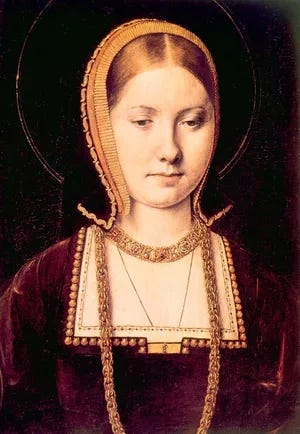
A brief recap of history that that is well-understood by all for the sake of the narrative development: in 1509, King Henry VIII married the Spanish princess Katherine of Aragon, whose nephew was Charles V, the Holy Roman Emperor. While the trend of the kings of the House of Lancaster had been to marry French women, the trend of the kings of the House of York was to marry English women, and Henry VIII’s first marriage to Katherine broke from this tradition of his predecessors with a pivot to Spain. This marriage represented England coming into its own, uniting with the Continent in a way it had never done before by solidifying an alliance with the Holy Roman Emperor Charles V, whose vast empire extended from Florence to Bremen, Strasbourg to Vienna.
However — nominally, at least, although certainly the charms of the-girl-next-door Lady Anne Boleyn were at play — Katherine’s failure to give Henry VIII a surviving male heir (and conspiracies abound here) and the pope’s refusal to annul the marriage owing to the sensitivities of the Holy Roman Emperor’s very proximate involvement to the situation, led Henry to seek more extreme options. With the Reformation fever in the air, Parliament issued the Act of Supremacy in 1534, declaring the English monarch the head of the Church of England and revoking its submission to the authority of Rome. This Act essentially formalized the dissolution of the marriage between Katherine and Henry and the subsequent marriage of Lady Boleyn to Henry from the previous year that had been carried out by the Archbishop of Canterbury, Thomas Cranmer.
Of course, it seemed to [Henry VIII] no more than one of these recurrent quarrels with the mundane power of Rome, which all Kings (and Saints among them) had engaged in for many hundred years. All real powers thus conflict in all times. But, had he known it (and he did not know it), the moment was fatally inopportune for playing that game. Henry never meant to break permanently with the unity of Christendom. A disruption of that unity was probably inconceivable to him. […] But the moment was the moment of a breaking-point throughout Europe, and he, Henry, blundered into that disaster without knowing what the fullness of that moment was. He was devout, especially to the Blessed Sacrament. He kept the Faith for himself, and he tried hard to keep it for others. […] There was no largeness in him nor any comprehension of this complexity, and when in this Jacobin, unexampled way, he had simply got rid of that which he should have restored and transformed, of what effect was that vast act of spoliation? It paralyzed the Church. It ultimately brought down the Monarchy.
— Europe and the Faith by Hilaire Belloc
No single decision may have been more accelerating of the development of the modern world than the refusal of the pope to annul the marriage of Katherine and Henry VIII. Despite various fits and starts, struggles over claims to the throne between Protestants and Catholics, efforts to either hyper-Protestantize or moderate the developing liturgy of the English Book of Common Prayer, the seesaw tensions between the de-facto post-schism Catholicism of Henry VIII to the Elizabethan Settlement, the rift was already beyond repair, and England was never truly a Catholic society again.
Even as the early modern Roman Church was religiously separated from the ever-increasing fragmentation of the Christian religious communities outside of it as a result of the Reformation, it hardly remained immune to its effects.
There was the Protestant Reformation itself with which to contend, which was no longer ignorable for Holy Mother Church as a number of German princes, together with their considerable tithes, had also succumbed to its blood fever. Beginning in 1545, the Church met recurrently to hammer out a number of details cleaning up all manner of doctrinal details that had admittedly gone awry, ultimately coming to resolution nearly 20 years later in 1563.
For our purposes, two key decisions came out of the Council of Trent: first, the Latin-language Vulgate Bible was decreed the official Biblical text of the Church, and second, a new missal was issued to promote standardization and unity of ideas within the life of the Church. The Latin-language missal, issued in 1570, necessitated a transformation to the pinnacle of the life of the Church, the liturgy at which the Holy Mass is said and the Body and Blood of Christ confected for the faithful. This Mass, which would be the Church’s liturgy the world over for the next 400 years, would take its name from the Council which codified its missal: the Tridentine Mass.
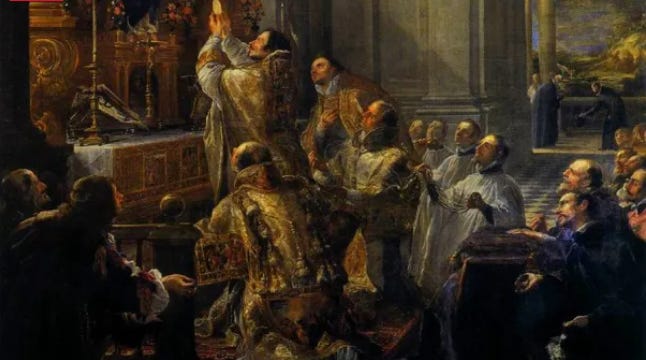
Then, by 1570, the Church had reaffirmed its commitment to the use of Latin, standardized its beliefs and its Mass, and still remained separated from its Protestant brethren. However, even if there would be no coming rapprochement with the Protestants, Rome would still have to contend with the world the Protestants were going on building without them, and that world was still spinning on to the spirit of revolution and ever-increasing industrialization. By the early 20th century, the Protestants to the north and west had been firmly married up with the mission of liberal capitalism and the Russians to the east had become atheist materialist Marxists. But, either way: the old, traditional monarchical-feudal system to which Rome had been so long accustomed was fast crumbling. “The Emperor no longer sought homage but money, the Cities widened their domains more by gold than arms. Bankers became masters of cities without striking a blow. Gold paved the way and opened the gates to new tyrants.”2 The beat of the cotton looms, the whistle of the steam train heralded the arrival of the modern world, and Capital had begun to assert itself as judge, jury, and executioner.
We refer to that state of Christendom that is conveniently called Constantinian, but is more especially medieval. It is characterized by the fact that the monarchs, that is, the Church’s counterpart of authority in the sphere of government, are so integrated into the Church that they are like her minister for external affairs, the temporal and the spiritual being fused into a single body politic, governed in principle by the hierarchy. The Church (“holy Church,” as she began to be called after the end of the thirteenth century, referring the juridical person, subject of rights, privileges, and powers) obviously found this to her advantage: she could govern the conduct of men in accordance with her ends and her laws. For a long time she enjoyed a monopoly on he manifestations of culture, beauty, and opinion. Even those who rebelled against her exercise of authority claimed to have no other Mother and to seek no hearth but hers. […]
A complete world, enclosed, homogeneous, sure of herself, Medieval Christendom hardly knew what dialogue meant. Who was there to engage in it with her? It was as if she held a sleeping world cradled in her arms: tanquam sopita civitate mundi, wrote Otto Von Freising in the middle of the twelfth century. And when the world awoke, when it began to loosen the clasp and go its own way, the Church for a long time did not quite take the change seriously. She tried to go on holding society by the hand, correcting it, making it recite its lessons. But it was already too big, too strong, and too far away.
— Ecumenism and the Future of the Church by Yves Congar
The Men of the Nouvelle Théologie
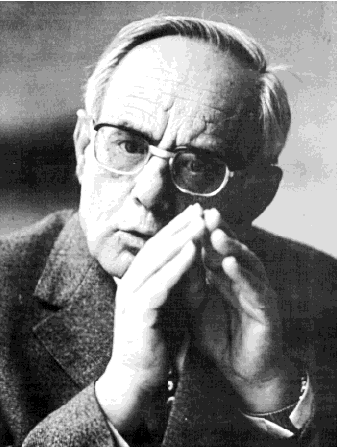


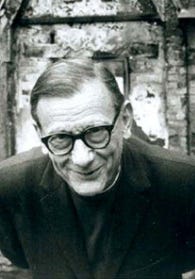
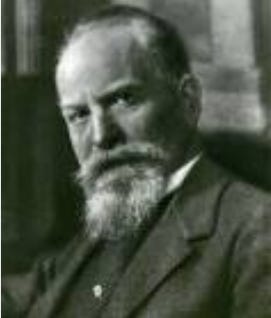

And the sun will respect
Every face on the deck
The hour that the ship comes inThen the sands will roll
Out a carpet of gold
For your weary toes to be a-touchin’
And the ship’s wise men
Will remind you once again
That the whole wide world is watchin’— Bob Dylan, “When the Ship Comes In”
By the time of the early 20th century, then, like every other institution in the West, the Church found itself seized in fits trying to work out the “modernist crisis”, reacting to this oncoming freight train in typical fashion: by hitting the breaks while also swerving into a rigid neo-Scholasticism, a position most strongly advanced by Pope Pius X in his 1950 encyclical Humani generis.
Like Hegel’s Owl of Minerva, Humani generis refused any concession to the nascent philosophical schools of thought developing in the Church that would totally reshape it just a decade and change later. Though it never references it by name, the pointed thrust of Humani generis was entirely against a nascent Franco-Alemannic school of thought that was putting Catholic theology in conversation with phenomenology and Continental philosophy and understood itself as a movement toward ressourcement back to the Church Fathers (“there’s-a-reason-he’s-not-a-saint” Origen among them), correcting some of the the hard-right errors of neo-Scholasticism. Its many haters who helped shape Humani generis derided this thought in sneering French — what other language would one use to sneer? — as the “nouvelle théologie”.3
The men of the nouvelle théologie were both religious and lay, but all were highly educated intellectuals.4 A number were Jesuits who eschewed traditional clerics and the Roman collar for the smart tweeds-and-tie that had become fashionable, perhaps subconsciously seeing themselves as priests in professorial disguise. Many of them faced various degrees of censure by the Vatican throughout their lifetime for their troublesome views: Henri de Lubac was removed from his professorship; another compatriot, Yves Congar, had his writing restricted for almost a decade, followed by a prohibition on his teaching; Marie-Dominique Chenu — whose doctoral advisor became the self-appointed arch-nemesis of the nouvelle théologie, the hardline Thomist Father Garrigou-Lagrange — had a book placed on the Vatican’s infamous Index Librorum Prohibitorum and was stripped of his rectorship; Rahner briefly required advanced permission to publish or even give lectures.5
No one, however, faced a greater cloud of suspicion than the man who, especially through his personal friend and later biographer de Lubac, center of the nouvelle théologie, who had perhaps somewhat inspired them all: the French Jesuit priest Pierre Teilhard de Chardin. Teilhard de Chardin himself had been taken by the work of French philosopher Henri Bergson, in particular his book Creative Evolution. While he was never formally declared a heretic, and nor did he ever have a book placed on the Index Librorum Prohibitorum, Teilhard de Chardin still faced a prohibition on publishing any of his books during his lifetime and was functionally exiled to China, where it was assumed he would be less troublesome than in Europe.
But the winds of change were blowing in, and no man could stop them: by 1960, de Lubac was appointed by Pope John XXIII as a special consultant for a new Council he would convene in 1962, the Second Vatican Council — “Vatican II” — with Rahner and Joseph Ratzinger appointed as lead experts, where Ratzinger would meet de Lubac for the first time.
Three years later, the Vatican concluded the Council, and, in 1969, the conforming changes to the Mass were rolled out that would upend the half-millennia old Tridentine Mass: Mass would now be said in the friendlier, more egalitarian posture of the priest versus populum, facing the people, as opposed to ad orientem, facing the altar, most of the Mass would be simplified and streamlined, and, most significantly, all of the Mass would be said in the vernacular, not in Latin. Officially, this Mass was the “Mass of Paul VI” or the “Roman Rite” but later came to be colloquially known as the “Novus Ordo”, the “New Mass”.6
These changes were a seismic shift in the Catholic Church, making a number of concessions to the points of the nouvelle théologie, and the modernist movement more broadly, that traditionalism had become too stifling, and the Church was desperately in need of a more fresh and up-to-date engagement with the age. “Talk of irreformable teaching and immutable dogmas, according to these progressives, was anachronistic in a world of rapid flux.”7 While the modernist reforms of Vatican II led to the formation of the ultra-traditionalist Society of St. Pius X, the “SSPX”, which ultimately became canonically irregular if not semi-schismatic from the Vatican, the SSPX never peeled away any remotely meaningful number of Catholics from the ordinary course of things, and the Church soldiered on its bright, new, ecumenical path, now much more at home with the American culture. It had put away the dusty Latin missals, old ladies clutching precious crystal rosaries for clean, modern sanctuaries so stripped of statues such that a Methodist would feel right at home, threw up swirls of color in lieu of the stately court of saints for stained glass, and turned in Gregorian chants for the simple peppy hymns easily accompanied by guitar or keyboard — “eaaaat this bread, driiink this cup”. Water had met its own level with the broader culture, the Church had modernized, and it seemed entirely natural, in lockstep with the development of liberal democracy, that this new status quo would go on forever.
“A Fabrication”: Ratzinger’s Road to Summorum Pontificum
Then, in 2005, in an event that surely would have seemed impossible to the members of nouvelle théologie fifty years prior: the heavy-hitting theologian and academic Joseph Ratzinger, who in the intervening decades had made his way to the cardinalate and then to the Congregation for the Defense of Faith — where he earned the moniker “God’s Rottweiler” — was elected to the papacy, taking the name Benedict XVI.
It seems that Ratzinger, however, had in the interim developed at least some second thoughts about the results of Vatican II. In his 2006 book Christianity and the Crisis of Cultures, he wrote:
The political moralism of the 1970s, the roots of which are far from dead, was a moralism that succeeded in fascinating even young people who were full of ideals. But it was a moralism that took the wrong direction, since it lacked the serenity borne of rationality. In the last analysis, it attached a higher value to the political utopia than to the dignity of the individual, and it showed itself capable of despising man in the name of great objectives. The political moralism we have experienced, and still witness today, is far from opening the path to a real regeneration: instead, it blocks the way. Consequently, the same is true of a Christianity and a theology that reduces the core of the message of Jesus, that is, the “kingdom of God” to the “values of the kingdom”, identifying those values with the great slogans of political moralism while at the same time proclaiming that these slogans are the synthesis of the religions. In this way, they forget God, although it is precisely he who is both the subject and the cause of the kingdom.
[W]e must ask whether this Enlightenment-laicist culture is truly the culture — finally revealed in all its universality — of a reason that is common to all men, a culture that must be accepted everywhere, even if it is rooted in a soil that is historically and culturally diverse. And one must ask whether this culture is truly complete in itself, so that it does not need any roots outside itself. (emphases added)
Ratzinger had already begun asking questions of Vatican II by as early as 1991, when he wrote the preface to the French edition of a little book called The Reform of the Roman Liturgy: Its Problems and Background, written by Klaus Gamber. The general argument of Reform (made in charmingly grouchy German tones) is that the pope does not have the authority to change the Mass, and that the Novus Ordo mass is invalid on its face, as well as riddled with all sorts of other theological errors. Ratzinger writes in the preface which was penned after Gamber’s death:
What happened after the [Second Vatican Council] was something else entirely: in the place of liturgy as the fruit of development came fabricated liturgy. We abandoned the organic, living process of growth and development over centuries, and replaced it—as in a manufacturing process—with a fabrication, a banal on-the-spot product.
At the very least, by 1991, Ratzinger realized, perhaps horrifyingly, that the Vatican II Council in which he very much participated and helped promulgate, had actually not quite represented the natural end stage of Catholicism. In July 2007, Benedict XVI acted in accordance with Gamber by writing a very brief letter that did not order a change to the Mass, but rather noted that it was always permitted for priests to say the Roman Rite of the Mass.
The brief and to-the-point letter, Summorum Pontificum, would seem to be a “traditionalist” document, promoting “traditionalism”, but actually, nothing could be further from the truth. As Novus Ordo Watch, a sedevacantist outpost in outright schism from Rome, noted in “Ratzinger, Hegel, and ‘Summorum Pontificum”:
Pope Benedict saw his role as that of a reconciler. […] Pope Benedict tried to transcend any such confrontation [between the two masses] by opting for a hermeneutic of continuity, saying: The old and the new Ordo [=order of Mass] are two different forms of the same rite. That was a bold thesis for anyone who uses his eyes and ears. I view it as a diplomatic formula [which Benedict advanced] to help heal the obvious rupture. Based on this, Pope Benedict then expressed his hope that the old and the new Ordo would be able to influence each other, perhaps in order to arrive at a synthesis of old and new Ordo in accordance with the Hegelian model of dialectics. However, this would require the old Ordo to be celebrated in a great many places — otherwise there could hardly be a fruitful exchange concerning it. Moreover, one would have to accept that the old [rite of] worship cannot change — it would surely then have to be the Novus [=new] Ordo which gradually moves towards the sacredness of tradition so that the commonality of both forms can be recognized. (emphases added)
Novus Ordo Watch correctly recognizes (and naturally opposes) Ratzinger’s latent Hegelianism, but what it of course fails to appreciate is that Ratzinger, in issuing Summorum Pontificum, and whether or not he realized it, did something much greater than opening up a channel for a mere synthesis of the old and new rites within the Catholic Church.
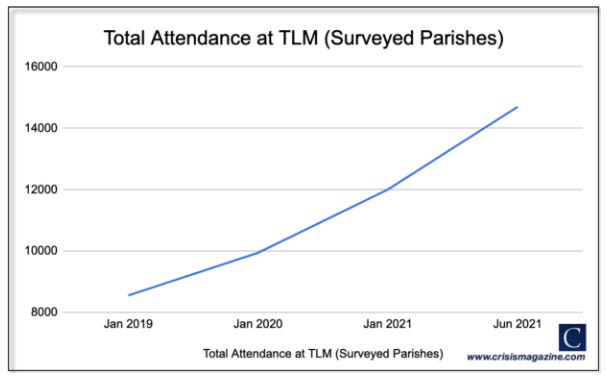
Summorum Pontificum spread like like a small but hungry wildfire across the United States. All across the country, priests began to learn the Tridentine Latin Mass, called “TLM” in its shorthand, offering one-off services on Sunday afternoons, odd times juxtaposed against the normative suite of offerings of the Novus Ordo. With its return to an old, unfamiliar form of the Mass said in a dead language, and its subculture which encouraged a much more rigid and modest dress, as well as the arcane practice of receiving the Eucharist kneeling, from the priest and on the tongue (as opposed to receiving standing and on the hand from Susie-from-Parish-Council, which had become the default reception of the Eucharist in almost all Novus Ordo masses), the TLM gathered the energy of an underground, slightly forbidden band. Just seven years later, almost 500 parishes in the U.S. offered the Latin Mass. While this was a small number to the some 15,000-odd parishes in the U.S. total, it represented an ever-growing clip:
All of this was going fairly swimmingly until Benedict XVI stepped down from the papacy, becoming only the second pope in 2,000 years to resign as opposed to die in the office. On the heels of his red shoes, an Argentine of immediate Italian descent, Jorge Bergoglio, was elected, taking the name Francis. Bergoglio was a Jesuit, which immediately incited the attention of the TLM faithful, who not only were staunchly opposed to the Society of Jesus on the basis of its coziness with modernism and liberalism, but also because of the unanswered questions around the circumstances of Ratzinger’s resignation.
Francis immediately rejected all the traditionalist-coded trappings of the papacy that Benedict had practiced, choosing to wear white instead of the mozzetta, and taking up residence at a guesthouse in Vatican City as opposed to living in the Apostolic Palace. He signaled as left-liberal-coded, setting the radtrads hot on his trail. As a result, TLM communities became infested with a kind of Francis-skeptical sentiment, with some traditionalist-minded bishops and priests becoming more publicly vocal about their opposition to him as pope than the Vatican — which has always revered the Sicilian principle “don’t ever take sides against the family” — would have preferred. The temperature continued to climb into slow boil over the years with the release of the left-coded Laudato si', Amoris laetitia, and Fratelli tutti.
Francis gave as good as he got, and the air of the entire intra-group conversation of the Holy Roman Catholic Church during the Francis reign became taken up by a disgruntled battle between the TLM traditionalists and the Vatican II liberalizers. Everyone could read the writing on the wall when, in 2020, Francis ordered the Congregation for the Defense of the Faith to survey the bishops on the implementation of Summorum. When the results rolled in, he was apparently so horrified that he rather quickly issued a new landmark document in the TLM saga, Traditionis Custodes, in July 2021.
Traditionis Custodes was the opposite document of Summorum: Summorum offered clarity, Traditionis offered confusion; Summorum “sever[ed] the link between pre-conciliar liturgy and anti-conciliar theology”, while Traditionis “judged that project a failure”;8 Summorum deferred the authority of the pope to change the liturgy, Traditionis asserted it; Summorum was simple; Traditionis was obscurantist.
But both the TLM faithful and the Vatican II liberalizers immediately understood the objective: Traditionis was curbing the use of the Tridentine Mass by requiring multiple checkpoints in the process which could serve as an effective throttle on the spread Mass toward eventual total eradication. Certainly, the opponents of the Tridentine Mass saw it that way. Covering the publication of Traditionis at the time, the pro-Francis Jesuit magazine America wrote:
Francis’ decision as pope to overturn in this way the decisions of his two predecessors is extraordinary. One would have to go back to the Second Vatican Council to find such a precedent in the modern history of the church. It required courage to roll back their decisions on such a sensitive and highly charged subject as the pre-Vatican II liturgy and the Latin Mass of the Roman Missal of Pius V, edited by John XXIII in 1962, knowing that it would provoke a mighty strong reaction from the traditionalists in the church, especially in the United States, France, Germany, Austria and Switzerland.
He did so nevertheless because, as he explains in the letter, the faculty was given by his predecessors to promote unity in the church and it has not done that. On the contrary, it is creating more division. His decision, in response to bishops’ requests, aims to stop it from developing as a movement against the council.
Traditionis may have been constructed to allow for a slow-boil of the ending of the Latin Mass, but instead — in an outcome entirely to be expected given the Vatican’s complete lack of interest in keeping its finger on the pulse of the American culture — it became a knock-down drag-out catfight the likes of which the Church had not seen since the Protestant Reformation. Fur and lace mantillas flew everywhere; angry hissing mothers-of-seven sharpened their perfectly-groomed claws to take to YouTube channels and Facebook groups and banded together to become a true thorn in the side of their bishops, in the way only wronged women can be, even as they clutched rosaries and prayed for Bergoglio to die a happy — and ideally very much repentant — death, which did eventually come to pass on Easter Monday in 2025.
Just a few months after his death, Vatican reporter Diane Montagna scooped the inside story on the survey: that it had actually said the opposite of what Francis implied.
The previously undisclosed text, which forms a crucial part of the official report by the Congregation for the Doctrine of the Faith on its 2020 consultation of bishops concerning Summorum Pontificum, reveals that “the majority of bishops who responded to the questionnaire stated that making legislative changes to Summorum Pontificum would cause more harm than good.”
The overall assessment directly contradicts, therefore, the stated rationale for imposing Traditionis Custodes and raises serious questions about its credibility.
Of course, as Larry Chapp observed, the liturgy wars were really a proxy for cultural control of the future of the Church:
Traditionis Custodes is about whose interpretation of the post-conciliar reforms will be ascendant in the Church going forward, and the Pope making it clear that he wants it to be his vision of the Council and not that of the traditionalists. This is Pope Francis applying his hermeneutic to the Council and imposing it on the rest of the Church through an exercise of raw papal authority. And what is the hermeneutic of Pope Francis you might ask? Who knows? We are eight years into his pontificate and he has not yet articulated a “theology of the Council” that comes anywhere near the profound theological appropriation of the Council by his predecessors. But perhaps the lack of theological clarity on the level of doctrinal and moral issues is precisely the “tell” here since Pope Francis does not view “proper theology” or even “proper doctrine” as the engine that drives the Church. […]
Pope Francis is clearly not a moral relativist but he is clearly a moral gradualist who views the Church’s moral and doctrinal truths as “ideals” that we all fall short of in varying degrees on a sliding scale. And no matter where you fall on that scale, the Church must be there to greet you with open arms. Thus, Pope Francis seems most comfortable in the thought world of the pastoral latitudinarianism of the immediate post-conciliar era, which I define as the “here comes everybody” vision of Catholicism where “all are welcome” regardless of where they fall on the yardstick of orthodoxy or orthopraxy. […]
When I hear Pope Francis invoke the term “rigid” to describe modern conservative Catholics, and when I see him making the Church’s doctrinal and moral teachings an “ideal” that is actually at odds with “real people” in their “real lives,” and when I see him using vague buzzwords like “openness,” “dialogue,” and “accompaniment” in a weaponized way, I am led to believe that he is, as I have written before, an unreconstructed post-Vatican II pastoral liberal since his actions and his words are exactly the same as those of the seventies. […]
What is at play here has nothing whatsoever to do with maniples or Latin or the missal of 1962 or 1955 (or whatever missal is deemed “most pure” by the traditionalists). What concerns the Pope here is the deeper theological and pastoral mindset of these young traditionalist priests.
Finally, one imagines the aged liberalizing cardinals in the Vatican saying with a sigh of relief, this entire fool’s errand can be put to rest and we can continue where we left off in 1965.
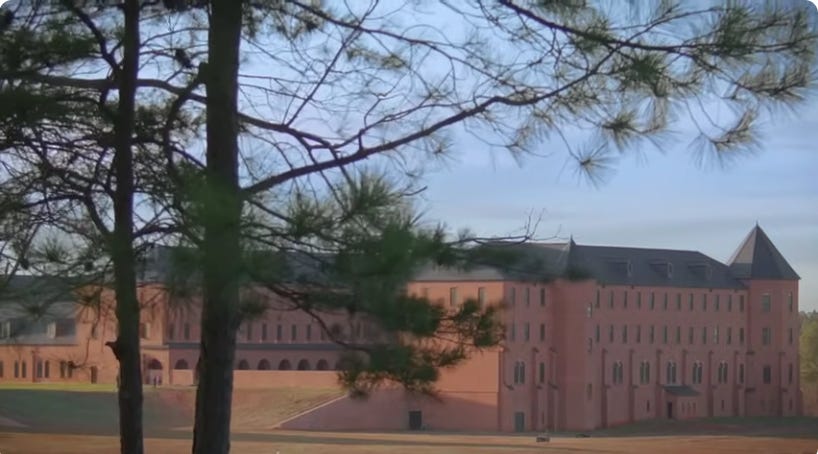
Traditionis has had the opposite effect, however. In making the TLM increasingly banned, and treating it with the desperate energy of stamping out a growing fire, the Vatican has clearly forgotten the appeal of taboo. Only in the wake of Traditionis did the tiny little ragtag band of semi-schismatics in the Society of St. Pius X begin a significant growth pattern, recently welcoming in 25 American men to the stunning St. Thomas Aquinas Seminary in Virginia:

Not to mention a beautiful new church building, the Immaculata, in St. Marys, Kansas, where the rapid growth of the insular SSPX community seemingly practicing Rod Dreher’s “Benedict Option” merited coverage in The Atlantic:
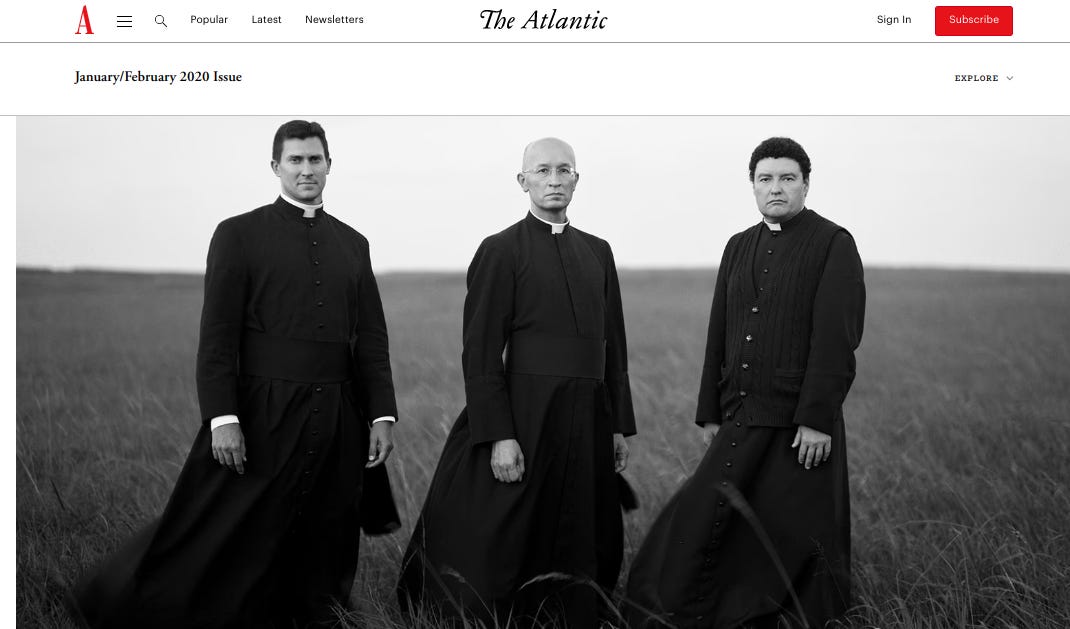
[H]ints of the town’s utopian project are everywhere. On a recent afternoon, I visited the general store, where polite teens played bluegrass music beside rows of dried goods. Women in long, modest skirts loaded vans that had enough seats to accommodate eight or nine kids—unlike most American Catholics, SSPX members abide by the Vatican’s prohibition on birth control. At housewarming parties and potluck dinners, children huddle around pianos for sing-alongs.
In their four decades in St. Marys, the followers of SSPX have more than doubled the town’s size. Even with six Masses on Sundays, parishioners fill the Society’s chapel to capacity; overflow services are held in the gym of the Society’s academy, which inhabits an imposing campus built by the Jesuit missionaries who called St. Marys home in the 19th century. The school is constantly running out of classroom space. The parish rector, Father Patrick Rutledge, has to scramble each summer to accommodate rising enrollment. Real estate sells at price points closer to those of Kansas’s big cities than of its other small towns.
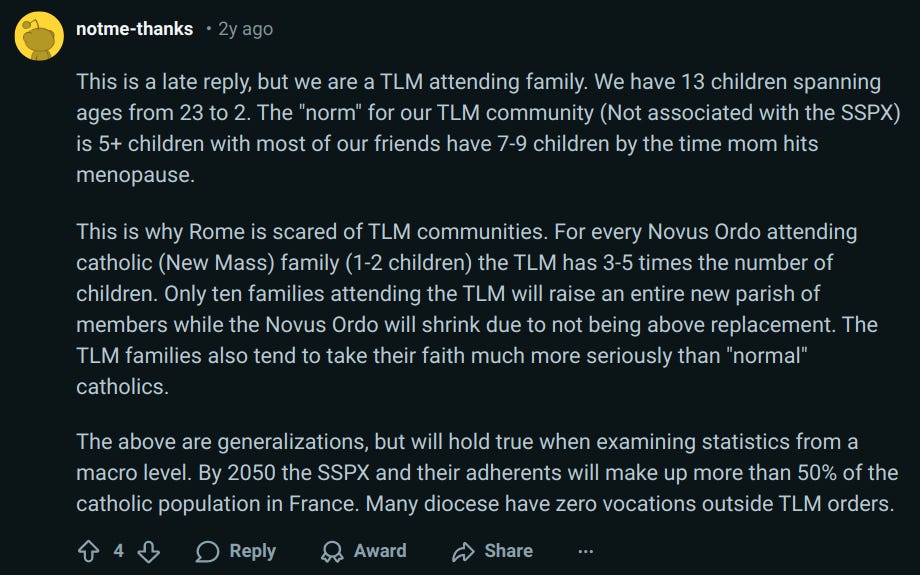
A TLM Redditor opines in r/Natalism of the coming demographic shift between those raised in the modern Novus Ordo versus those raised in the traditionalist Extraordinary Form:
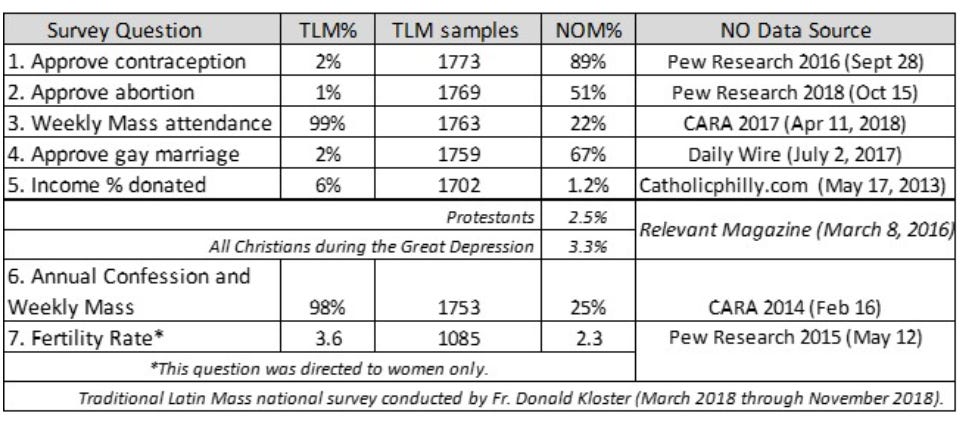
A compilation of survey data made in 2019 of TLM attendees and NOM (Novus Ordo Mass) attendees, show the stark difference not only on praxis and adherence to Catholic teaching, but also on fertility rate: TLM communities have a fertility rate 56% higher than Novus Ordo communities:9
A 2022 report conducted by the Catholic University of America compiling responses of more than 3,500 priests across 191 dioceses shows that the Francis-supporting, liberalizing wing of the Church is losing the war of the future:
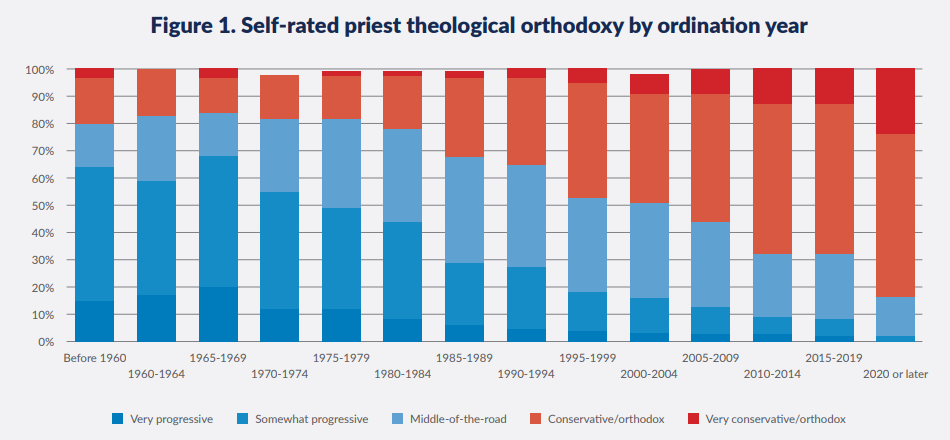

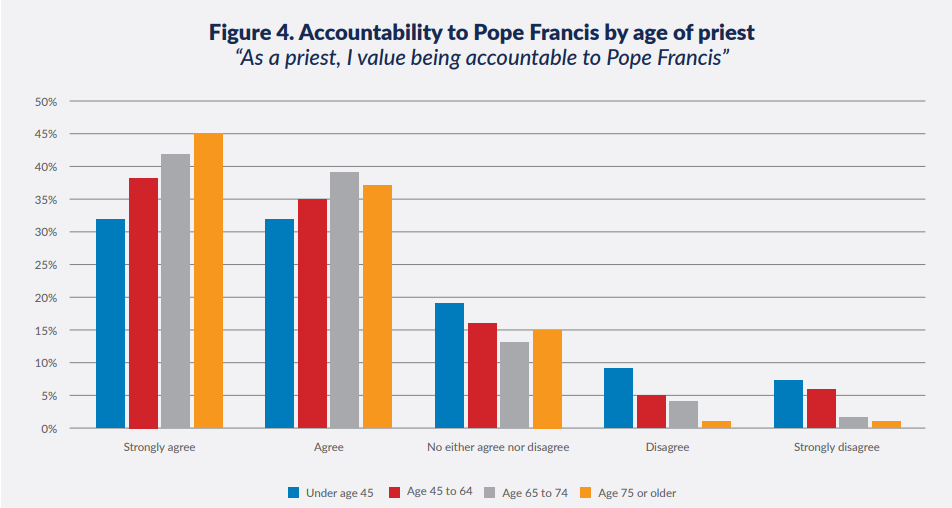
The report concludes in simple but shocking tones:
Self-described liberal or progressive priests, considered both politically and theologically, have been declining with every successive cohort for more than 50 years. Self-described liberal or progressive priests have all but disappeared from the youngest cohorts of priests.
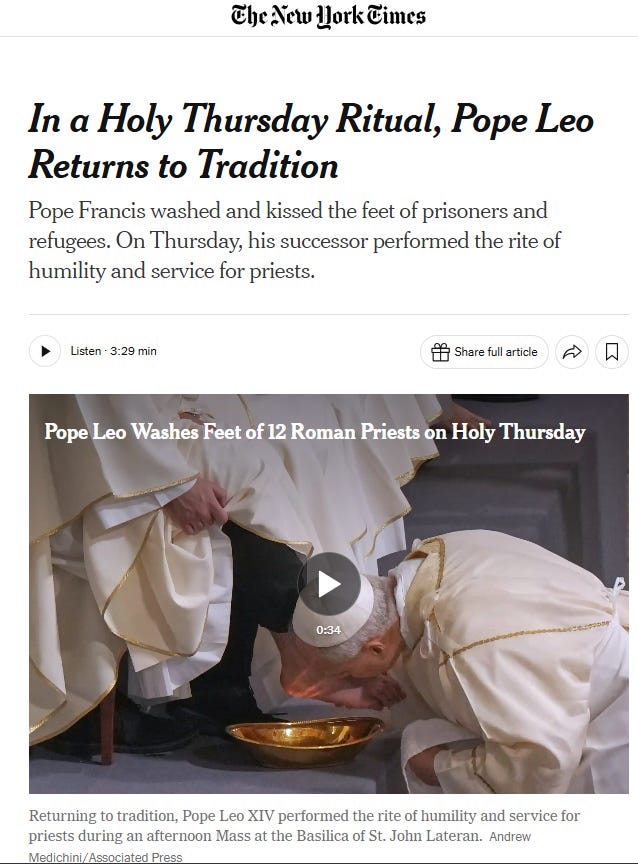
As of the time of this publication, Traditionis has so far survived into the papacy of Francis’ successor Pope Leo XIV, and it remains unclear how he will address the present drama. For the time being, the Vatican is still here and there rescinding permissions for the Latin Mass to be said, but is permitting the use of Latin in the Novus Ordo rite. For his part, Pope Leo has seemed to signal a more moderate line, donning traditional garments, allowing the Latin Mass to be said at St. Peter’s, returning to the Apostolic Palace, meeting with the Priestly Fraternity of St. Peter (FSSP), and, in the immediate wake of the election of the first-ever female Archbishop of Canterbury, the highest-ranking cleric in the Anglican Communion, reaffirming the all-male priesthood. However, even with these overtures, Pope Leo still seems to remain somewhat committed, as discussed above, to the Southern European strategy, and it is not known how his papacy will ultimately adjudicate the dispute, if at all.10
Notably, the SSPX, who have met with Pope Leo, clearly still feel emboldened to ordain their own bishops this summer: this will mark the second time they have ever ordained bishops in their history, the first since 1988. This is a critical inflection point because the ordination of more bishops ensures that the SSPX can continue to ordain new priests who have Apostolic Succession for the Holy Sacraments through the founder Archbishop Lefebvre. In rejecting Vatican dialogue and moving forward with one of the worst acts that they could do the Vatican’s eyes, it is kind of an “all-in” bet on the future of the SSPX — and traditionalism more broadly — against the Vatican.
What is totally fascinating, and telling, is the Vatican’s utter refusal to engage with any of the facts laid out above: the upswing of traditionalism, the increasing hard line orthodoxy among the youth, the growing demographic shifts, and the general rejection of many of the tenets of Vatican II that form the foundation of the modern Church. Crisis discusses in “Our Incurious Bishops” :
Recently the traditionalist Society of St. Pius X (SSPX) consecrated a new church in the small town of St. Mary’s, Kansas. At first glance, this seems to be non-news. However, consider that the consecration was attended by more than 3,000 people (the town’s entire population is less than that!); the church is now the SSPX’s largest church in America; the new church is a sign of the SSPX’s growth in recent years; and many Catholic dioceses are in the midst of closing churches. That makes it newsworthy.
This contrast—the SSPX growing and building churches while Catholic dioceses close churches—should raise questions in the minds of Catholic leaders, especially our bishops: Why is there a contrast in the first place? What is attractive about the SSPX? Why is it growing in this country while ordinary Catholic parishes are declining?
Sadly, it appears that our bishops are not asking these questions; in fact, they seem wholly incurious, even at times antagonistic, about this juxtaposition. [..]
Almost two years ago we did a survey of TLM-celebrating parishes (it was conducted right before Traditionis Custodes was released) and we found dramatic attendance growth at these Masses over the previous two years, at a time when attendance at regular Catholic parishes was significantly declining. Why? Are any bishops or chancery officials asking this question? Are they conducting studies to find out?
The answer, of course, is no.
“Imagine No Felt Banners”: The Synthesis of Dr. Taylor Marshall
Imagine no chaos
It isn’t hard to do
A Mass to live and die for
And true religion too
Imagine all the people
Receiving on the kneesYou may say I’m a dreamer
But I’m not the only one
I hope someday you’ll join us
And the world will be as one— Taylor Marshall, “Imagine No Felt Banners”
One of the most interesting people in the radtrad American-Catholic synthesis, and almost surely even the very tip of its spear, is a Dallas-area gentleman, father-of-eight Taylor Marshall.
He tells a moving story of his interior conversion to Catholicism while in Rome at a Papal Mass for the Feast of the Presentation that was celebrated by Ratzinger, Pope Benedict XVI:
In 2006, I was an Episcopalian priest—Father Taylor Marshall. I wore a collar and was struggling with my vocation as an Anglican cleric. My wife and I had been married for five years, and she was pregnant with our fourth baby, whom we would name Jude. We were planning to take a fifth-anniversary trip, perhaps to Europe, and at the same time we had both been studying Catholicism.
I was an Anglican—an Episcopalian—with a high-church, Anglo-Catholic outlook. I prayed the rosary and had a devotion to Mary. Theologically, I was already very close to Roman Catholicism, but I wasn’t quite there yet. […]
So we decided we would go to Rome for our anniversary. While we were there, we went on the Scavi Tour beneath Saint Peter’s Basilica and saw the bones of Saint Peter. I don’t know how else to say it except that something mystical happened. I felt a deep connection with Saint Peter as I saw his relics. After the tour ended, everyone else left, but I stayed behind, knelt, and prayed before the bones of the first Pope. I don’t remember the exact words, but I prayed sincerely.
Afterward, the young priest who had guided our tour approached us. We had been asking many questions, and when he learned that I was an Episcopal priest, he told us he was doing a dissertation on ecumenism and asked if we wanted to attend Mass with the Pope. We said yes. He led us past the Swiss Guards, told us to wait, disappeared for a few minutes, and returned with two tickets to Mass with Pope Benedict XVI.
The date was February 2, 2006. It was an evening Mass, the Feast of the Presentation. St. Peter’s was dark, and Pope Benedict entered holding a candle. While waiting to go in, I noticed that most of the people there were nuns. I was wearing clerics—either a cassock or black clerical clothing—and I was with my wife, who was visibly pregnant. I could feel the nuns looking at us, wondering who this “priest” was with a pregnant woman.
We were seated very close to the high altar. I remember Pope Benedict celebrating Mass—some of it in Italian, some in Latin. I was standing right next to the large bronze statue of Saint Peter, the one whose foot people rub. And during the Consecration, and again during Communion, a nun kept urging me forward to receive. I desperately wanted to receive Communion, but I knew I couldn’t. I wasn’t Catholic, and to receive would have been a sin.
In that moment, while standing there so close to Pope Benedict, I believe the Holy Ghost came upon me. I suddenly knew—with absolute clarity—that I was a heretic and a schismatic because I was not in union with the Pope. That very morning, I had prayed before the bones of Peter beneath the altar, and now there was his successor celebrating the Holy Sacrifice above those bones. It hit me with certainty: if I did not enter the one, holy, Catholic, and apostolic Church, I would be damned. Some may say that’s harsh or not ecumenical, but that is what I knew interiorly. I knew Rome was the Apostolic See, that the Pope was the Pope, and that one must be in communion with Peter.
Dr. Marshall, of course, is a former Anglican priest who had more sympathies toward a harder orthodoxy, who now expresses this in an Americanized, Catholic form through his radical traditionalism. He not only supports a return to the Traditional Latin Mass and calls for “true religion”, but he also has a utopianism in his vision of America, laid out in his book Christian Patriot, with cover art that evokes the metamodern effort to inhabit — in a progressive fashion — the nostalgia of the American past. (Here, his discussion of the book.)
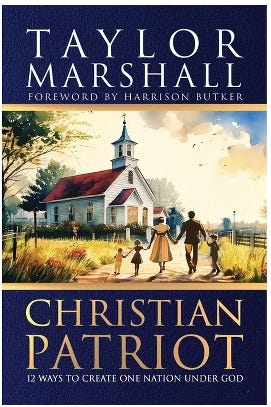
Dr. Marshall, contra the Vatican, is not only a reformer, but a reformer toward a goal: utopianism. Actually existing utopianism is much less common among human communities than one would think: it is a movement in only very narrow certain types of Christian expression (charismatic dominionists, radtrad Catholics, and post-Christian radical environmentalists-cum-social-justice-warriors), liberal universalist Jews, and probably some strains of Islamists.
In the very excellent book A Rational Millennium, James Holstun writes:
In The Philosophy of History Hegel says that the progress of reason is like the path of the sun, with a determinate east in Asia and a progress to full European self-consciousness. Utopia argues that this progress has an unlocalized but no less determinate west in the New World and the various waste grounds and disorganized peoples of the Old World who are to be submitted to a process of rational organization. The advancement of learning is an irreversible scientific, geographic, and historical advance. […]
This conversation between the traveler and the philosopher about two different places, Europe and the utopian west, is also a conversation Europe has with itself about its own future, present, and past. [….] [U]topia is a rationalization and an acceleration of the social displacement of the social displacement of Europe’s own present. [….]
[T]he orthodox Utopian religion is already a form of Roman Catholicism (monotheistic, priest-run, based on a belief in an afterlife of punishment and reward, including to persecute Mortalist heretics), as the Utopians themselves notice. […] Utopia is neither England nor anti-England, but an England whose historical tendencies […] have been accelerated and rationalized.
Dr. Marshall’s more notable book, however, may be the one that is most telling. This book, Infiltration: The Plot to Destroy the Church from Within, broadly argues that the Catholic Church has been “infiltrated” by “modernists and Marxists”. Dr. Marshall, never one to shy away from boldness, gave a copy to Francis — who was long suspected by many radtrads of being both a modernist and a quite possibly also a Marxist sympathizer himself:
One wonders about the Freudian slip in Dr. Marshall’s choice of title, Infiltration, and whether it is really the case that the Church is being infiltrated by a modernist/Marxist alliance or whether the Church may actually be being infiltrated by people like Dr. Marshall.
Dr. Marshall’s most infamous act to date even directly speaks to the Anglo-Puritan strategy against the Brazilification of the Church, when he supported the taking of idols on display in a church in Rome as part of Francis’ Amazon Synod done by a young Austrian convert, as retold in part here:
It isn’t yet light when Alexander Tschugguel and his cameraman sneak into Rome’s Santa Maria in Traspontina Church to steal the statues. A lone elderly parishioner sits in the pews as Tschugguel—a young Austrian convert to Catholicism, so neatly dressed he might work there—quickly genuflects, then steps behind the rail of a side altar and picks the statues up: five slim wooden carvings, less than two feet tall, of a naked, kneeling woman with long dark hair, Indigenous features, and a heavily pregnant belly.
No one stops him as he carries them outside and down the Bridge of Angels, where, in the shadow of the hulking Castel Sant’Angelo—the setting of both a purported medieval miracle and an action sequence in a Dan Brown novel—the two men abruptly pitch one statue over the side. Sensing a need for greater ceremony, Tschugguel aligns the remaining four on the bridge’s ledge, then shoves them, one by one, into the Tiber. On their YouTube video, you can see the last one land with a splash, stirring a chorus of seagulls as the current carries it away.
(An interview of Herr Tschuggel in the National Catholic Register here; his interview by Dr. Marshall here.)
Dr. Marshall is, by and large, considered by the Vatican II liberalizers as one of the vanguard of the radical traditionalists, who are a great thorn in the side, as their interesting litany of offenses is listed in “Reasons Behind Restricting the Use of the Latin Mass” for Where Peter Is:
Calling the pope a heretic or otherwise constantly criticizing his teachings and decisions as contrary to the Catholic faith.
Claiming that official teachings — such as Amoris Laetitia, Fiducia Supplicans, or the revision to the Catechism on the death penalty — are doctrinally erroneous or incompatible with tradition.
Accusing major papal documents of promoting Marxism, Freemasonry, or other ideological corruption (e.g., Fratelli Tutti, Laudato Si’, the Document on Human Fraternity, Dignitas Infinita).
Attributing the liturgical reform to Masonic, Jewish, or Protestant infiltration.
Signing petitions or open letters accusing the pope of heresy or calling on the cardinals or bishops of the world to rebuke the pope.
Insisting that synods and synodality are part of a coordinated plot to destroy the Church or undermine its doctrine.
Declaring that traditionalism is “true Catholicism,” while dismissing the Church after Vatican II as a different or false religion (“Novusordoism,” “NuChurch,” etc.).
Treating Bishop Joseph Strickland, Cardinal Raymond Burke, Father James Altman, or the excommunicated Archbishop Carlo Maria Viganò as martyrs for defying the pope and his teachings.
Giving platforms to figures like Strickland, Burke, Viganò, Altman, Fr. Chad Ripperger, Bishop Athanasius Schneider, Taylor Marshall, Peter Kwasniewski, and so many others — all of whom routinely undermine or reject papal authority and post-Vatican II magisterial teachings.
Falsely accusing Indigenous Amazonian Catholics of idolatry and stirring moral panic during the Synod on the Amazon in 2019.
Falsely accusing indigenous Canadians of paganism during the pope’s visit.
Referring to the older liturgy as the only true “Roman Rite,” in contrast to the current liturgy used by almost the entire Church.
Praising the founder of the Society of St. Pius X (SSPX), Archbishop Marcel Lefebvre, who was excommunicated for the “schismatic act” of illicitly ordaining bishops as a prophet or future saint.
Deriding Pope Paul VI as unworthy of canonization or as a disastrous leader.
The refusal of many traditionalist clergy, such as members of the FSSP, to have anything to do with the Vatican II liturgy, not even concelebrating the annual Chrism Mass with their local bishop and brother priests.
Promoting nationalistic ideologies, praising 20th century political movements such as Action Française or Franco’s Spanish dictatorship (and even Vichy France), as the political ideal.
Denigrating members of other religions, such as Muslims and Jews, and minimizing the Vatican II teachings pertaining to them.
Praising and promoting antisemitic and racist figures of the past like Fr. Denis Fahey and Fr. Charles Coughlin.
Calling religious liberty “heretical.”
Promoting conspiracy theories — this became especially public and widespread during the Covid pandemic.
Subscribing to Judeo-Masonic conspiracies, including circulating antisemitic tracts like The Permanent Instruction of the Alta Vendita and The Protocols of the Elders of Zion.
Rejecting science and promoting pseudoscience, including theories like Young Earth Creationism and Geocentrism. In many cases, supporters will insist that Catholics must accept these pseudoscientific ideas as dogma.
There are many other examples.
This list, such as it is, should surprise no one, but it surprises the Vatican and her champions because they do not understand it properly, and least of all, where it comes from. The Vatican is very correct to see the movement as other to itself, even as it takes on the trappings of the most historical, traditional Catholicism. Culturally, the radtrad movement, and its preferred modus operandi — aggressive zealotry forever teetering on or leaning to sedevacanticism coupled with high fertility rates — looks much closer to the Calvinists of yore than it does to anything in contemporary or historical Catholicism. Compare the above litany to Michael Walzer’s description of the early Calvinists in The Revolution of the Saints:
In politics as in religion the saints were oppositional men and their primary task was the destruction of the traditional order. but they were committed after that to the literal reforming of human society, to the creation of Holy Commonwealth in which conscientious activity would be encouraged and even required. The saints saw themselves as divine instruments and theirs was the politics of wreckers, architects, and builders, hard at work upon the political world. They refused to recognize any inherent or natural residence to their labors. They treated every obstacle as another example of the devil’s resourcefulness and they summoned all their energy, imagination, and craft to cover come it. Because their work required cooperation, they organized to carry it through successfully and they joined forces with any man who might help them without regard to the older bonds of family and neighborhood. They sought ‘brethren’ and turned away if necessary from their relatives; they sought zeal and not affection.
Puseyism Is Not Enough
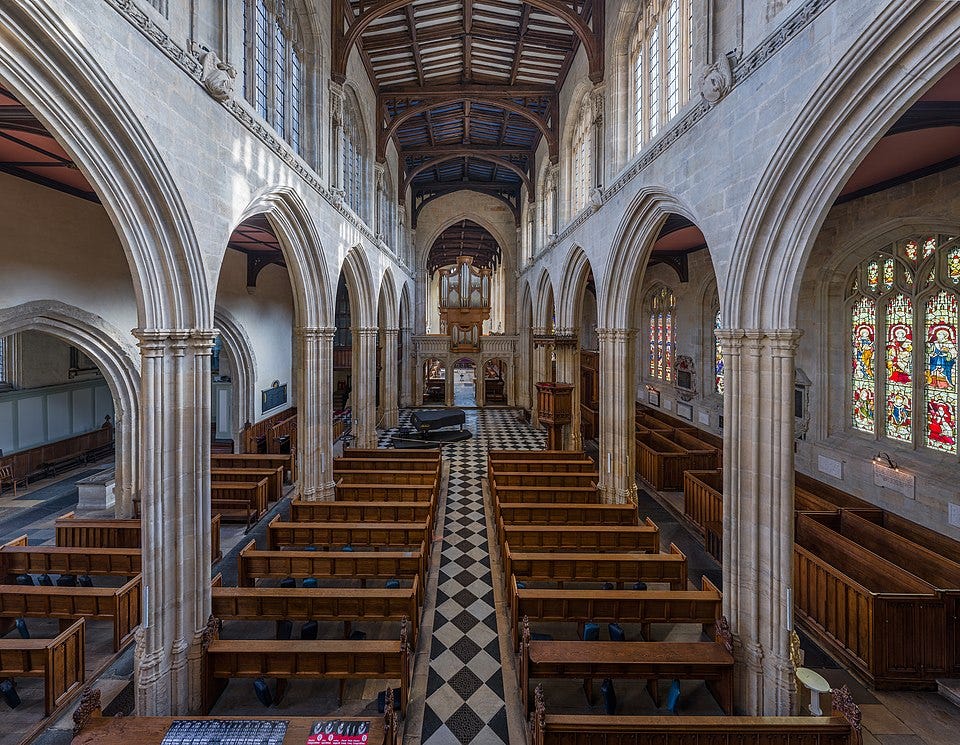
To be deep in history is to cease to be a Protestant.
— John Henry Newman, “An Essay on the Development of Christian Doctrine”
Whenever the question arises regarding the Anglo-Catholic synthesis, or the Protestant-Catholic synthesis more broadly, there is always a temptation to claim that it has been answered by Puseyism. E.B. Pusey was one of the most prominent promoters of the Oxford Movement, the tractarians, which arose in the mid-19th century around Oxford University and continued into the early 20th. Seeking to course correct from earlier anti-liturgical movements within the Church of England (which, as suggested above, had been confused since its founding as to which level of adherence to or rejection of Roman Catholic orthodoxy was to form it), the tractarians were continuing the work of the Caroline divines into the modern era by advocating for a return to liturgical traditionalism and promoting adherence to orthodox tenets of Christianity against the modernizing de-evolution. Ultimately, many in this movement, rather than incorporating Catholicism into their Anglicanism, instead fell to Rome (although Pusey himself never did): John Henry Newman, Henry Manning, Hugh Benson, Ronald Knox, and Frederick William Faber among them. In A Spiritual Aeneid, Knox looks back on an explanation for his motivation for remaining Anglican:
[…] [T]he Church of England did as a matter of history make every reasonable concession in order to include within her borders the Puritans, who had too little belief in supernatural religion; it made no effort whatever to include the Roman Catholics, who believed too much. Thus all Anglican formularies were conceived as a minimum of belief; no clear attempt had been made to define the maximum. [...]
I once even constructed, in a half-serious moment, a teleological explanation of the existence of the Anglican Communion. Providence, in allowing for the necessary rise and growth of heresies in the eighteenth and nineteenth centuries, applied a sort of tourniquet to one arm of the Church (the arm is the Church of England), so as to stop the free circulation of the blood between it and the main body — thus the arm could be infected with the poison of Modernism, and the virus could be allowed to work itself out there. When the virus had worked itself out, it would be time for the removal of the tourniquet, i.e., for the reconciliation of the Anglican Communion. I do not know if the allegory is medically accurate; theologically it is at least ingenious.
Even given the dramatic number of converts from Anglicanism in the period of the Oxford Movement and beyond— and, one must stress, converts from the elite and intellectual classes of England who still came to Rome, many times, at great personal cost — there still remains a latent question when approaching the Anglo world: why can’t the Anglos be Anglo-Catholic? “Imagine the Thames and the Tiber as one and the same,” an Anglo-Catholic might say, “but for simplicity’s sake let’s call it the Thames.” After all, there is a huge swath of Anglican liturgical expression that looks like a high Novus Ordo Mass, or even better, for it was crafted by the most silver-tongued in the English language, and not, shall we say, by American Catholics still heady with the memories of Woodstock ‘69. So much of Anglicanism, advocates might argue, is so close to a high church Catholicism, but without all the incredible awkwardness and, quite frankly, poor taste that came with suddenly Englishing Catholicism with an American accent and in ‘70s slang.
This is a vector of engagement with the Anglos that the Vatican has explored with some interest. In 2009, the Vatican established the Anglican Ordinariate, designed to receive Anglo-Catholic, high church parishes of the Anglican Communion that wanted to jump ship to Rome. Accordingly, the high church Anglican rites were slightly revised to comport to orthodox Catholic teaching and norms, but for all and intents and purposes they retained a distinctly Anglican flavor. The Vatican also extended a generosity to the exiling Anglicans seldom seen: an easier on-ramp for Anglican priests, even married ones, to be ordained into the priesthood as Catholics.
To further this, in October 2025, Pope Leo XIV and King Charles III — the head of the Church of England — prayed side-by-side in a public service, the first time in history such a public prayer service occurred between the highest representatives of the Churches of England and of Rome. To my knowledge and research, a similar such public prayer service between the Pope and the SSPX has yet to occur, which is quite striking, and telling of the order of the Vatican’s preferred vectors of engagement outside of itself.
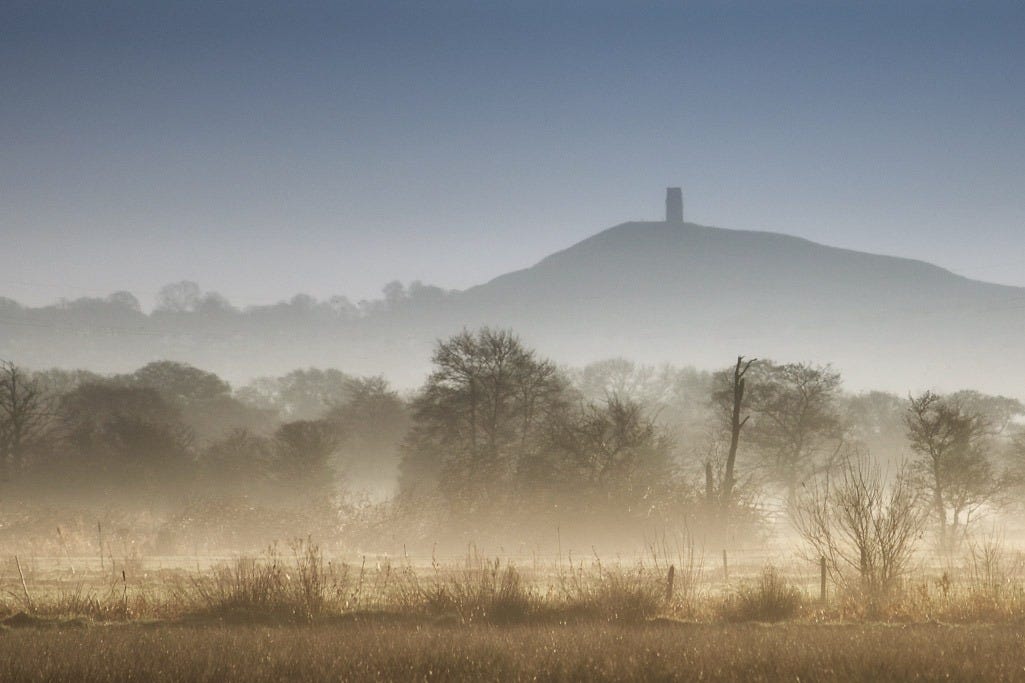
However, it is not the Church of England that is the answer, even in her most Anglo-Catholic form, but rather it is the Tridentine Latin Mass is the heritage of the Anglos: it is what the Anglos ultimately would have experienced had no schism from Rome occurred. The keen new interest by Anglo-Americans specifically in the Tridentine Latin Mass is their rightful reclamation of a past that was lost to them, of which the Church of England is a pale shadow. In Rebuilding a Lost Faith:
What makes the crimes of Henry VIII and Elizabeth peculiarly atrocious is the fact that the Church which they discarded, plundered and persecuted, was the Church which had been for a millennium the Church of all the English. […] [The Church of England] is a House of Confusion. It has not even the right to call itself “Catholic,” if we employ that term in its legitimate meaning of “universal,” for it is national in its establishment and limited in area. The Roman Catholic Church, on the other hand, is fettered by no confines of nationality or of geography. It enters every country in the world, preaching the Gospel to every creature, and uniting men of every race in a religion whose doctrines, discipline, language, and ritual are everywhere the same. […] The Church of England is consoling, beautiful and inspiring precisely in those features which it borrows or inherits from Catholicism, yet it reminds me of a costly lamp, hung in a small side-chapel of a vast cathedral. It certainly emits a mellow radiance, but its pale light illumines only a restricted area, falls on comparatively few, and grows continually fainter with advancing years.
The Church of England is intentionally divorced, structurally and linguistically, from the Continent. But a path to unification of the Continent together with England lies through the ritual use of Latin, which once bound together the entire culture of Europe:
In such a crux there remains the historical truth: that this our European structure, built upon the noble foundations of classical antiquity, was formed through, exists by, is consonant to, and will only stand in the mold of, the Catholic Church.
Europe will return to the Faith, or she will perish.11
Most importantly, the insistence on the use of Latin by radical traditionalists is not only a means of laying claim to the very foundations of the Vatican, but that transmogrification of the ultimate earthly power that the Vatican represents: the Roman Empire itself.
Hannah Arendt explains in Between Past and Future:
[…] [T]he original conflict between politics and philosophy, between the citizen and the philosopher, no less than the experience of foundation in which the Roman trinity of religion, authority, and tradition had its legitimate source. The strength of this trinity lay in the binding force of an authoritative beginning to which “religious” bonds tied men back through tradition. The Roman trinity not only survived the transformation of the republic into the empire but penetrated wherever the pax Romana created Western civilization on Roman foundations.
The extraordinary strength and endurance of this Roman spirit — or the extraordinary reliability of the founding principle for the creations of bodies politic —w ere subjected to a decisive test and proved themselves conspicuously after the decline of the Roman Empire, when Rome’s political and spiritual heritage passed to the Christian Church. Confronted with this very real mundane task, the Church became so “Roman” and adapted itself so thoroughly to Roman thinking in matters of politics that it made the death and resurrection of Christ the cornerstone of a new foundation, erecting it on a new human institution of tremendous durability. Thus, after Constantine the Great had called upon the Church to secure for the declining empire the protection of the “most powerful God”, the Church was eventually able to overcome the antipolitical and anti-institutional tendencies of the Christian faith, which had caused so much trouble in earlier centuries, and which are so manifest in the New Testament and in early Christian writings, and seemingly so insurmountable. The victory of the Roman spirit is really almost a miracle; in any event, it alone enabled the Church to “offer men in the membership of the Church the sense of citizenship which neither Rome nor municipality could any longer offer them.” […]
The politicization of the Church changed the Christian religion. The basis of the Church as a community of believers and a public institution was now no longer the Christian faith in resurrection (though this faith remained its content) or the Hebrew obedience to the commands of God, but rather the testimony of the life, of the birth, death, and resurrection, of Jesus of Nazareth as a historically recorded event.
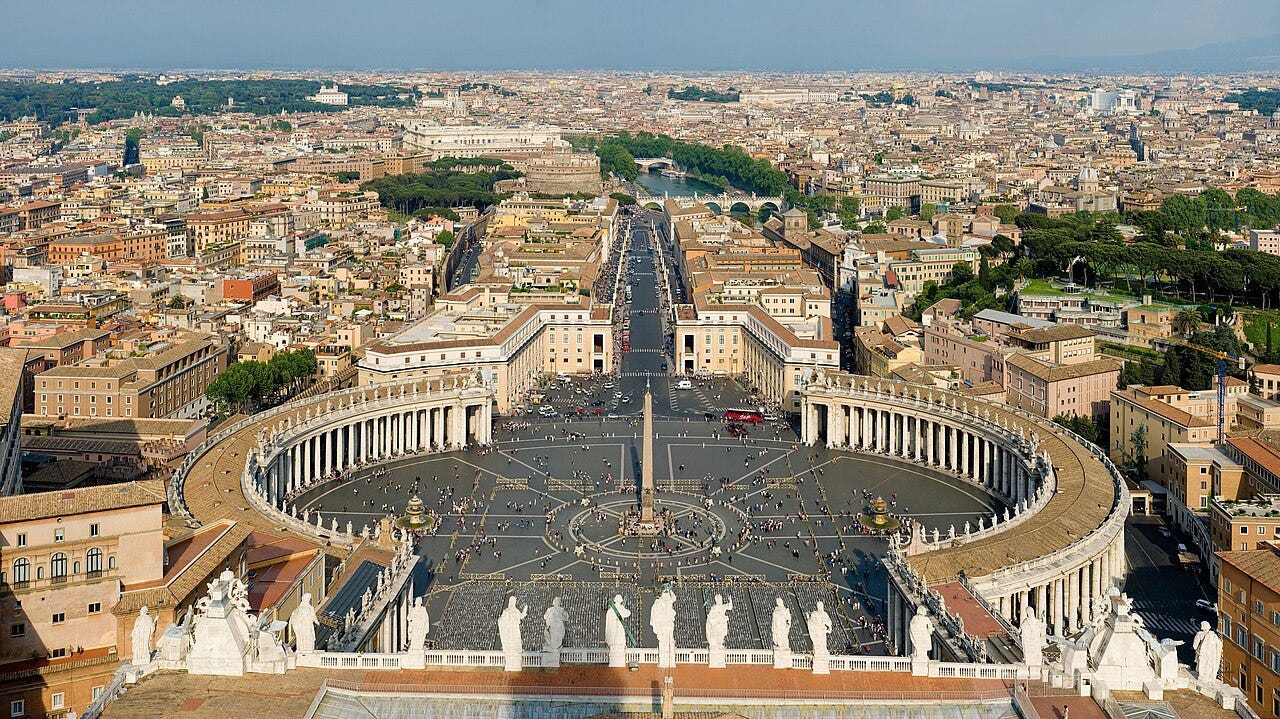
It is, perhaps, too narrow-minded to consider the radtrad movement as opposed to Vatican II, even if they understand themselves as such. Perhaps instead we should take the view that the radtrad movement is actually not only birthed by, but is the one and only natural heir apparent to all the work done in Vatican II.
To accommodate modernity, the Church cast out wide her net, melded into the vernacular, and cloaked the strangeness that had so long kept her separate from the clean, modern West. Without Vatican II, the Puritans may never have felt the safety to come rushing in for her treasures buried deep within, including the greatest treasure of them all, a new path to cultural and religious power over the globe that the Anglos have never had: the unity of St. Peter in the Seat of Rome. Thanks to the men of the nouvelle théologie and their papal standard-bearer Joseph Ratzinger, for the first time in history, a new Puritan-Catholic synthesis has emerged.
What magic bolts, what mystic bars
Maintain the will in these strange wars!
What fatal, yet fantastic bands
Keep the free heart from its own hands!
So when the year takes cold we see
Poor waters their own prisoners be;
Fettered and locked up fast they lie
In a sad self-captivity.
The astonished nymphs their flood's strange fate deplore,
To see themselves their own severer shore.
Thou that alone canst thaw this cold,
And fetch the heart from its stronghold,
Almighty Love! end this long war,
And of a meteor make a star.
Oh, fix this fair indefinite,
And 'mongst Thy shafts of sovereign light
Choose out that sure decisive dart
Which has the key of this close heart,
Knows all the corners of 't, and can control
The self-shut cabinet of an unsearched soul. […]
Unfold at length, unfold, fair flower,
And use the season of Love's shower;
Meet His well-meaning wounds, wise heart!
And haste to drink the wholesome dart,
That healing shaft, which Heaven till now
Hath in Love's quiver hid for you.
O dart of Love! arrow of light!
O happy you, if it hit right!— Richard Crashaw, “To the Noblest and Best of Ladies, The Countess of Denbigh”
Contra Brazilification

A short digression: we discussed at length earlier the Vatican’s curious interest in promoting Brazilification as a part of the time war, a Southern European strategy against Anglo-American values, but why, exactly, should Brazilification be opposed? For want of time and consideration of length, I cannot give here the detailed discussion it deserves, but allow me to set up a quick gloss on the case against Brazilification.
First, I am generally of the opinion that Brazilification cannot coexist with technological progress, and technological progress, second only to religious-spiritual development, is of existential importance. As seen in Dilexi te, which says nothing about the world being actively shaped by humans to be made materially better, Brazilification is too accommodating to host cultures, too willing to meld back into the jungle from whence humans came. (I am hardly the first to notice this. In The Reshaping of Catholicism, Avery Dulles explains that Fredrich Heiler’s 1923 Der Katholizismus: seine Idee und seine Erscheinung — an interesting book but one not translated into English that I could find — found that the weakness of Catholicism “was its openness to innumerable contrasting elements, many of them not specifically Christian. Catholicism, in his view, could not be authentically Christian unless its universalism were balanced by evangelical concentration, and this balance he found wanting in the Roman church.”) The last battle is always man versus nature (1 Corinthians 15:26); this reality requires an ideological framework to meet it, and Brazilification, the Southern European strategy more broadly, is too comfortable to be that framework. To terraform Mars, become an interplanetary species, and significantly increase human healthspan will require an ideological framework that encourages its adherents to set their faces like flint, act with a grit, determination, and stubborn single-mindedness toward a goal. The current Southern European strategy cannot provide this, but an Anglo-Puritan one surely can.
Second, as suggested above in our discussion of the Protestant Reformation walling off the Catholic Church from the capitalistic project (necessary, it would seem, for the technological progress we desire), a synthesis is very much needed between Catholicism and the Protestant capitalist world. There are a small handful of thinkers, Michael Novak primarily among them, who have tried to advance the idea that capitalism and Catholicism are not only unopposed to each other, but are totally complimentary. Certainly, in some sense this is true: Rodney Stark argues strongly in Bearing False Witness that the institutions of European Catholicism become the breeding ground of the capitalist algorithm as early as the Middle Ages:
Because of the immense increases in agricultural productivity that resulted from such significant innovations, such as the switch to horses, the heavy moldboard plow, and the three-field system, the monastic estates were no longer limited to mere subsistence agriculture. Instead, they began to specialize in particular crops or products and to sell these at a profit, allowing them to purchase their other needs, which led them to initiate a cash economy. They also began to reinvest their profits to increase their productive capacity, and as their incomes continued to mount, this led many monasteries to become banks, lending to the nobility—as they did to so many Crusaders. […]
[T]hey evolved a more sophisticated and far-seeing management. This was facilitated in the monastic estates by virtue of the fact that, unlike the nobility, their affairs were not subject to the vagaries of inherited leadership. The essential meritocracy built into the orders could ensure a succession of talented and dedicated administrators having the capacity to pursue plans of long duration. […] In this way, the medieval monasteries came to resemble remarkably “modern” firms—well-administered and quick to adopt the latest technological advances.
As Stark lays out, the monasteries were truly the first corporations: organized profit-seeking institutions that had longevity past the human lifespan, with cultural coherence, shared missions, and objectives of their own.
That being said, because of the Protestant Reformation, the Church is missing a substantial amount of dialogue with the later development of capitalism after about the mid-16th century, and certainly it is wanting for a dialogue with industrialization, which was solely the domain of the Protestants and the Marxists (of course, is there any difference? The Protestant Reformation was the first Marxist revolution). In my view, this split with the Protestants seizing the means of production put the Catholics on the back foot with respect to capitalism. Catholic thought began to associate capitalism with Protestantism, thus becoming rather opposed to capitalism rather than integrated into it. The advancement of the Anglo-Protestant project in the shape of these United States, which became the greatest capitalist economy in human history, only furthered these deep suspicions of the Catholic Church. While Stark’s suggestion about the origins of capitalism being with the monasteries, it seems strongly evident that Catholicism is not currently in harmony with capitalism. As Amintore Fanfani explains in Catholicism, Protestantism, and Capitalism:
Our outline of Catholic social ethics will have made it clear that Catholics, so long as they held closely to the social teachings of the Church, could never act in favour of capitalism. Certainly no one can deny that such men as the EBardi, Pitti, Datini, acted in a capitalistic manner, and though baptized Christians, introduced a capitalistic mode of life among their Catholic contemporaries. But we deny that in so doing they were acting in conformity with Catholic social teaching. […]
Only unawares can Catholics truly conforming to their faith have favoured the development of capitalism — as understood in the sense we have already many times defined. […]
A detailed investigation of this kind would show us that the actions of Catholics in this sense—inasmuch as they would be inspired by a special ideal of the ought-to-be, which, as we have already seen, does not coincide with the capitalist ideal of the ought-to-be—-favors capitalism up to a certain point, but in the final analysis opposes it. [….] It is in a diverse manner of conceiving all the values of life that Catholicism is opposed to capitalism, not as a complexus of instruments and means, but as an organization directing these means to a certain end. Catholicism finds no reason to object to mechanical looms or wireless. But so long as Catholicism remains Catholicism it can never accept a society like our own in which wireless and mechanical looms are the instruments for attaining quite other goals than those proposed by Catholicism. (emphases added)
The Catholic hears at length about “Catholic social teaching”, but “Catholic industrialization teaching” has yet to be fully fleshed out. Therefore, there is a much-needed dialogue between Catholicism and capitalism — not one that is rooted in Catholic social teaching, but rather as entirely de novo as it is possible to be, one that picks up where the Church left off in the 1500s.
Because radtrad culture represents a novel Anglo-Puritan engagement with Catholicism, it provides a new opportunity for dialogue between these two worlds of capitalism, the spirit of which may be led by the Weberian “Protestant ethic”, and Catholicism. Indeed, to the extent that capitalism as a force deliberately split from Catholicism, now seems the time for a bold new fusion, and no other group may be more suited to do it.
And what will they at best say of us, and the whole English name, but scoffingly as of that foolish builder mentioned by our Savior, who began to build a Tower, and was not able to finish it: where is this goodly tower of a Commonwealth which the English boasted they would build, to overshadow kings and be another Rome in the west?
— John Milton, The Ready and Easy Way
The Necessity of Neo-Gothic Horror
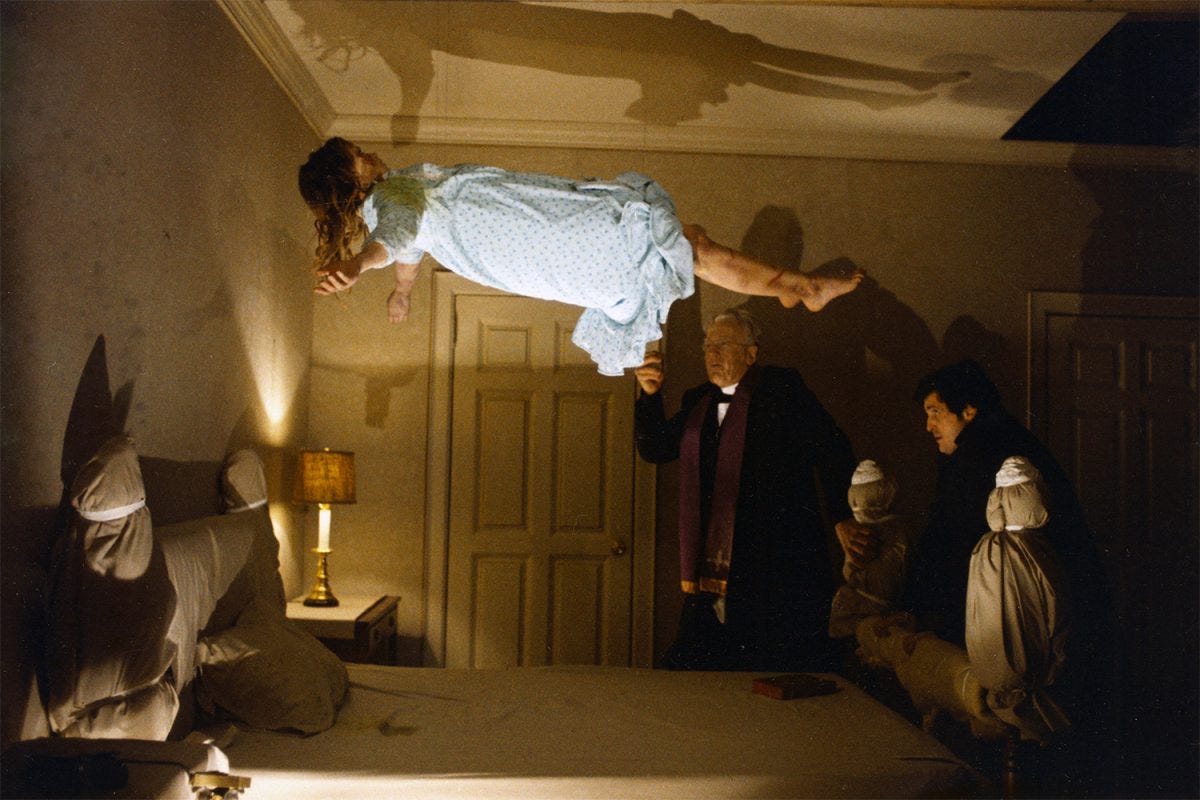
From the dusty mesa
Her looming shadow grows
Hidden in the branches of the poison creosote
She twines her spines up slowly
Towards the boiling sun
And when I touched her skin
My fingers ran with bloodWhen the last light warms the rocks
And the rattlesnakes unfold
Mountain cats will come to drag away your bones
And rise with me forever
Across the silent sand
And the stars will be your eyes
And the wind will be my hands— The Handsome Family, “Far From Any Road”
Vatican II Catholic culture is highly modern in its sensibilities, every creature of the Enlightenment values. The layperson who is feeling an episode of depression or anxiety would be encouraged to pursue talk therapy, perhaps, if all else fails, to see a psychiatrist — the standard recommendation that would also be given to any off-the-shelf atheist in our society. Radtrad culture, however, would generally pivot to a much less materialist understanding of a world enmeshed in far more complex and often sinister forces.
This is consistent with the Puritan ethos, which was also fascinated with demonology, witches, and all things occult:
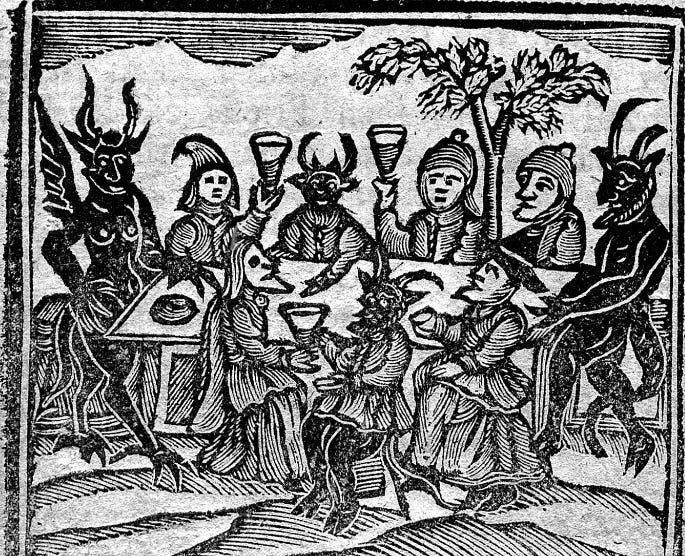
I did say yes
O at lightning and lashed rod;
Thou heardst me truer than tongue confess
Thy terror, O Christ, O God;
Thou knowest the walls, altar and hour and night:
The swoon of a heart that the sweep and the hurl of thee trod
Hard down with a horror of height:
And the midriff astrain with leaning of, laced with fire of stress.— Gerard Manley Hopkins, “The Wreck of the Deutschland”
The glories of the neo-Gothic horror on a culture are innumerable. In our modern world, horror has become too sanitized, too much front-and-center, too co-mingled with our everyday living, such that we have become much too inured to horror. When the singer Sam Smith can dress in a hat with devil’s horns and perform the sultry, transgressive song “Unholy” on every major television network in America, then there is no longer the necessary friction between order and disorder to generate anything new. Everything in our culture today has become a fragmented, swirling kaleidoscope without any discernible pattern or meaning to clearly illuminate the way forward; the gargoyles have come from the exterior of the cathedral all the way to the altar.
Effective, meaningful encounter with the margins has become almost impossible because we have so intermingled “the extremes outside our everyday experience” within it, and Vatican II culture is no exception. For example, in Germany (admittedly a country not recently known for its adherence to orthodox praxis), a Catholic priest conducted a Halloween-themed prayer service while dressed as Count Dracula:
The entire structure of radtrad Catholicism, however, is situated to provide the set and the setting to feed the hunger for horror in a way that is generative. It has the set and the setting for a return to the neo-Gothic. and it has arrived at the perfect time. Gothic is returning to America, and not a moment too soon. Even the recent release of The Adaptation That Shall Not Be Named hints to a resurging interest in the neo-Gothic movement of the 1800s.
In Wyoming, Carmelite monks are using new technologies to build Gothic monasteries in the heart of the American West:
In a recent feature in Arena magazine, “A Telos in Stone”:
The project of the New Mount Carmel Monastery is not an act of nostalgia. Gothic is not a style so much as metaphysic in stone. Each rib, arch, and pointed vault is like some frozen gesture of reaching out toward the divine. That the Carmelite monks have resurrected such forms with precision robotic tools suggests that technology, rightly ordered, can be drawn back into the service of transcendence. The same KUKA robotic arm which might otherwise be used to assemble the next generation of Meta products is, in their calloused hands, carving echoes of Heaven.
(Support the monks with a purchase at Mystic Monk Coffee.)
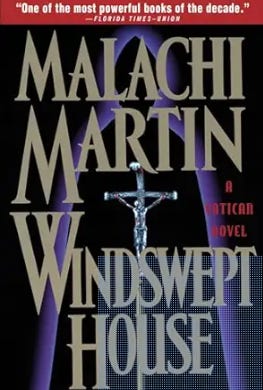
One of the most prominent clergy in the radtrad community is Father Chad Ripperger, an exorcist, radtrad, frequent guest of Dr. Marshall, and, as of late, has ascended into the heights podcast fame with his recent interview by Tucker Carlson:12
Functionally, this makes a perfect complement to the high sense of order in radtrad culture, and indeed, it could not exist without it. Instead of occupying some extremely bland middle ground like Vatican II Catholicism, radtrads seek out and elevate the extreme of order (soaring naves, beauty, distinct ritualistic language and dress) while also being fixated on the extreme of disorder. This gives radtrad culture conscious awareness of and engagement with what is sometimes referred to in Landian circles as “The Outside”: a highly fragmented, disassembled, almost disjointed Deleuzian schizophrenia which at once highly dangerous and highly generative.
Therefore, radtrad culture and the neo-Gothic within it provides a frontier for engagement with the Outside that has the opportunity to be productive. To be clear, by this I do not mean literally summoning demons — although, clearly, exorcising them is fine and commendable for those called and appointed — but rather in the sense that the radtrad framework of the world understands it in a way that is much more functional than the soupy Vatican II Weltanschauung. Gothic is the art and aesthetic of the Anglo-Saxons: haunting, ethereal, stressing a distance between the natural world and the worlds above and below it, in a way that is not confused, but generative toward something new.
Furthermore, the Gothic aesthetic reinforces hierarchy in a way that provides a necessary structure for human societies. As Philip Rieff lays out in The Triumph of the Therapeutic:
… [T]he failure of Christianity resembles that of Communism; both have been wrecked by success; neither could resist incorporation into social orders that were partly their own creation. […] The Church, as an institution, is vital inasmuch as its symbolic is detached from the established social order, thus preserving its capacity for being the guardian critic of our inherited moral demand system….
A cultural revolution occurs when the releasing or remissive symbolic grows more compelling than the controlling one; then the inherent tensions reach a breaking point. […] [T]he greater freedom to choose does not cure anybody—in the sense in which, for millennia, Western man has yearned to be cured.
It is the function of the sacralist to help both an individual and an entire community carry out their pledges to some communal purposes. In this sense the sacralist manages the artifacts that symbolize the cultural super-ego. […[ The sacralist cures, therefore, by recalling the individual to some principle of legitimacy, by reinforcing, through sacramental action, the cultural super-ego, and by re-enacting its internalization. He speaks for some corporate identity within which the individual feels secure in his personal identity.
The Christian myth was no longer therapeutic. […] discharge the vital cultural function: externalize the religious life, reuniting the spiritual with the material. […] What had to be recovered was not the action of the irrational but its symbolism. Not cannibalism itself but its motif, re-enacted in a ritual ceremony […] was to be the therapeutic device by which men might save themselves both from cannibalism and from too thorough a suppression of it. (emphases added)
The Gothic-like hierarchy of the priest above the people that is so stressed in traditional Catholicism allows for a kind of “magic”:
We want people to be very low-status, but we don’t want to feel sympathy for them — slaves are always supposed to sing at their work. In my view the man who falls on the banana skin is funny only if he loses status, and if we don’t have sympathy with him. This is why tragedy has always been concerned with kings and princes, and why we have a special high-status style for playing tragedy. A sacrifice has to be endowed with high status or the magic doesn’t work.
— Impro by Keith Johnstone
Gothic is orderly, encompassing everything from hideous gargoyles on the outside of the church to vaunted ceilings around the altar. It provides an authority that does not exclude the Outside, but properly incorporates it13:
Life does not exclude order, nor does it exclude authority. The opposite is true. life, particularly spiritual life, can only flourish in an orderly environment. It follows that it can flourish in a type of order which, at first glance, may appear to be outmoded—for example, the traditionally rite. p…] [O]nly a Church strong and secure in its faith and spiritually fertile will be able to create something really new and lasting.
— Klaus Gamber, Reform of the Roman Liturgy
The Coming and Last Revolt: A New American, Puritan Catholicism
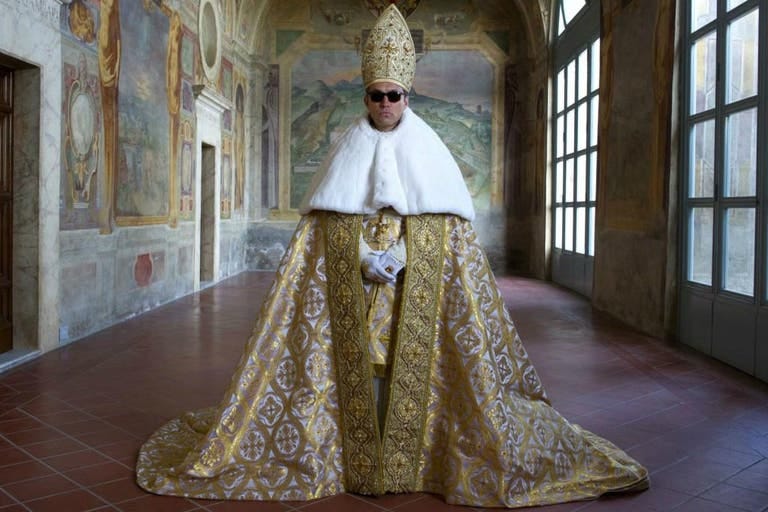
Taken together, we can see that the Anglo-Puritan culture wants for traditional Catholicism to enter its final state of being: indeed, it is already moving toward it. Reports of mass conversions of young Protestants, agnostics, atheists, those Americans who have had no familial connection to the Roman Catholic Church, are everywhere:14
The radtrad movement is the final consummation of Vatican II. Curiously, in the fight between the radtrads and the liberalizers, we can see that it is the liberalizers who are the actual conservatives, issuing banhammers on the popular old liturgy like children at whack-a-mole. Strangely, one could read Maurice Blondel today — one of the more liberal advocates of the reform of Vatican II — as arguing in favor of allowing the radtrad movement to prevail against the “bed of Procrustes” that has become Vatican II culture in our day:
[…] [T]o conserve the past and to prepare the future, Tradition adopts reasonable and even rational processes whose laws can be made clear and whose organon can be established. Thus we are no longer exposed to the objections of those who would tie us to a bed of Procrustes, mutilating us and forbidding us growth, or of those who only see the Protean metamorphoses of an indefinite evolution where they should see a development governed and unified by the internal finality of an organization.
— “The Letter on Apologetics and History and Dogma”
Similarly, in Concern for the Church, Vatican II architect Karl Rahner writes:
The Second Vatican Council marks a fresh start in the dialogue of Christianity and especially the Catholic Church with the present historical situation. But the beginning of this dialogue is not its end. From the very outset, correctly understood, this dialogue does not mean a faint-hearted compromise with any sort of spirit of the age. (emphasis added)
This reactionary, vigorous, American-led traditionalist movement is the very summation of Vatican II and was, in a way, its ultimate objective, even if this was not fully recognized at the time. The ends of things judge the origins: “[I]n the biblical Weltanschauung the nature of things is determined out of the future. What they are is determined by what becomes of them. Therefore, creation happens from the end even more than from the beginning.”15
Crisis astutely observes in “Why the Attempt to Ban the Latin Mass is Failing”:
But the Church, for all that it remains a “perfect society,” will run on more voluntary lines in the future. It simply lacks the coercive power to simply make people adhere to doctrines they dislike, or expel members who want to remain in the Church despite rejecting this or that teaching. This is a serious problem and a very uncomfortable reality because the Church is not a voluntary institution. It means that instead of trying to herd together factions with contradictory ideas of what the Catholic Faith is, as it has done for many decades now, the Church will operate more through the voluntary commitment of its members to a common set of beliefs than its ability to enforce adherence to its commands.
Both sides in the post-Conciliar “unpleasantness” realize this at some level, and that is partly what the struggles over this or that doctrine are about—which set of shared beliefs will define the Church. In many ways, this battle is symbolized by the two local Churches that have the means to alleviate the Vatican’s financial problems: the American and the German. (Though that may be changing in the case of the Germans.)
The Latin Mass is a symbol for one side in this conflict, and its adherents are unfortunate casualties of it. The good news is that this battle cannot go on forever, and by all accounts it appears it is being decided in favor of the American side. A recent article in The New York Times highlighted the “conservative” nature of most young priests and the lack of those who want to follow the agenda of Pope Francis. They are correct. The efforts of Catholic “progressives” to eliminate markers of traditional, orthodox Catholic identity could only succeed if they had something to replace them with. But they do not. (emphases added)
In the Washington Post’s recent article “Why Catholicism is Drawing in Gen Z Men”:
Parishes in Catholic strongholds like New York, Washington and Chicago have all anecdotally reported renewed interest from young people, particularly young men.
Meanwhile, the Rev. Dwight Longenecker, the pastor of Our Lady of the Rosary Church in Greenville, South Carolina, said that his parish has attracted “a startling number of young men” who were growing disillusioned with the experience of worshiping in the “big box” churches of the Bible Belt.
“I don’t want to be too disparaging about them because they’re our Christian brothers and sisters, but worshiping in a big former supermarket with dry ice machines and a pop band, it’s not really traditional Christianity,” Father Longenecker said.
His new parishioners are attracted to “very traditional worship with lots of incense and altar boys and sacred music in the traditional style.”
“In other words, they want it to look and sound Catholic,” he added. [….]
“I absolutely think it’s a phenomenon,” said Professor David Gibson, the director of Fordham University’s Center on Religion and Culture. […] “If you have this smaller cohort of theo-bros coming in and you have everybody else leaving, that changes the nature on the ground,” he said.
Thomas L. defined the theo-bro as “the extremely online religious man — that usually is a convert — who experiences the faith in either a rules-based or power-based understanding rather than a service- and community-based understanding.”
That’s basically how Clavicular — a 20-year-old internet personality obsessed with physical beauty and blasé about racial slurs — described Catholicism to the influencer Alex Eubank between weightlifting sets during a live stream: “Why I became Catholic in the first place is I really liked the order it followed, right? It’s having some sort of authority that I believe to be one that’s virtuous, kind of keeping people in line.” […]
On a Thursday night in late March, in the penthouse of an office building in Manhattan’s Midtown South, 75 Catholics convened for a monthly Fides Entrepreneurship dinner. The dress code was strictly business formal.
Fides Entrepreneurship was founded by Luca Zocche, a 25-year-old parishioner at the Basilica of Saint Patrick’s Old Cathedral in the Nolita neighborhood of Manhattan. He organizes the monthly dinners as a space to learn about how Catholicism and business intersect. […]
Other guests included a young woman organizing a “Holy Girl Walk” — modeled after the TikTok “Hot Girl Walk” trend — at which women would pray the rosary while walking in Central Park; a pair of enthusiastic young men who founded an organization called “Civitas Dei” whose mission is “to usher in the Kingdom of God on Earth through the establishment of Catholic civilization”; a co-founder and chief executive of a start-up called Verso Jobs who later said, “It’s insane how common becoming Catholic or being Catholic is in the founder/tech world.”
These younger converts are drawn to the historicity of the Church, as was noted by bishops themselves in Mrs. Montagna’s reporting of the Summorum survey:
A constant observation made by the bishops is that it is young people who are discovering and choosing this older form of the liturgy. The majority of the stable groups present in the Catholic world are composed of young people, often converts to the Catholic faith or those returning after a time away from the Church and the sacraments. They are drawn by the sacredness, seriousness, and solemnity of the liturgy. What strikes them most, also amid a society that is excessively noisy and verbose, is the rediscovery of silence within sacred actions, the restrained and essential words, preaching that is faithful to the Church’s doctrine, the beauty of liturgical chant, and the dignity of the celebration: a seamless whole that is deeply attractive.
Italians, culturally if not always religiously intertwined with the affairs of the Vatican, have already playfully explored what a real Puritan-Catholic synthesis would actually look like in the 2016 HBO series The Young Pope. Matthew Schmitz explains at First Things in “Waiting for a Young Pope”:
Just as AMC’s Mad Men offered its viewers the frisson of watching natty and unpleasant people smoke and drink in the office (a relief from casual Fridays, anti-smoking campaigns, and corporate sponsorship of every enlightened cause), The Young Pope depicts a Church that no longer seeks the favor of the world—and is all the more fabulous for it.
Upon his election, the young pope takes the name Pius XIII to signal a return to the past. When he addresses his cardinals, he lays out his anti-modern program: “Tolerance doesn’t live here anymore. It’s been evicted. It vacated the house for the new tenant, who has diametrically opposite tastes in decorating.” Diametrically opposite, and much improved. “The liturgy will no longer be a social engagement,” he declares. I confess that when I heard him say, “The Vatican must immediately buy back the papal tiara,” I let out a whoop. […]
The Young Pope reveals the exhaustion of attempts to make the Church attractive by conforming it to the world. Reveling in supposedly old-fashioned garments like the papal red shoes and wide-brimmed saturno, it shows how attractive an unapologetically traditional Catholicism can be.
The Young Pope shows so well the tensions between the hardliner, idealistic American pope and the Vatican’s Southern Europeans: the empathically-written Cardinal Secretary of State Voiello, nominally the pope’s right-hand man, is the Italian frenemy of Pius XIII, softening where Pius XIII wishes to harden, and trying to keep the general liberalizing spirit alive against the reactionary force. While I do believe it inevitable that there will be one day a hardline American Puritan Catholic pope ala Pius XIII — it has been hyperstitioned — and while it is clear that Pope Leo XIV is not that pope but rather a strategically chosen avoidance of it, The Young Pope is clearly holding a mirror up to the existing reality of the tensions in the Church, and prophesying how this more extreme, American-minded bent will ultimately seize the throne. As the show’s creator told the Hollywood Reporter, “It’s possible that after a very liberal pope, there is someone that might have very different ideas. I think it’s an illusion that the church has a long-term idea towards modernity.” (Remarkably, even he did not anticipate the levels of scheming by the Southern Europeans, stating in another interview in 2017 that he did not anticipate that there would be an American pope after Francis, because “Rome and Washington need to keep some distance from each other in many different ways.”)
A kind of Protestant-Catholic fusion through Puritanism may have been anticipated long before the 2016 show, however. In The Principle of Protestantism, compiled from lectures given in Pennsylvania in 1845, the Swiss theologian Philip Schaff observes:
Protestantism is the principle of movement, of progress in the history of the church; progress, not such as may go beyond the Bible and Christianity, but such as consists in an ever-extending knowledge of the Bible itself, and an ever-deepening appropriation of Christianity as the power of a divine life, which is destined to make all things new.
It is coming to be felt that the present posture of things cannot be rested in, as permanent and ultimate, and along with this is waking the desire for something better. Single voices are heard here and there, from the bosom of the evangelical church, calling for a true union among all who belong to the household of faith, ins spirit, soul, and body, and find a lively echo in many a breast. […]
Romanism directs its eye mainly toward the West, well knowing that this must hereafter give law to the whole land. “Give us the West,” says one of its bishops, “and we will soon take care of the East.” […]
The creature, in the widest extent of the word, is earnestly waiting for the manifestation of the sons of God, and sighing after the same glorious deliverance. The whole creation aims toward redemption; and Christ is the second Adam, the new universal man, not simply in a religious but also in an absolute sense. The view entertained by Romish monasticism and Protestant pietism, by which Christianity is made to consiet in an abstract opposition to the natural life, or in flight from the world, is quite contrary to the spirit and power the gospel, as well as false to its design. Christianity is the redemption and renovation of the world. It must make all things new. […]
Protestantism cannot be consummated without Catholicism, not in the way of falling back to the past, but as coming into reconciliation with it finally in a higher position, in which all past errors shall be left behind whether Protestant or Catholic, and the truth of both tendencies be actualized, as the power of one and the same life, in the full revelation of the kingdom of God.
Puritanism may be considered a sort of second reformation, called forth by the reappearance of Romanizing elements in the Anglican Church, and as such forms the basis to a great extent of American Protestantism. […] Its highest recommendation […] is presented in its deep practical earnestness as it regards religion, and its zeal for personal piety. […] However, it falls far behind the German Reformation by its revolutionary, unhistorical, and consequently unchurchly character, and carries in itself no protection whatever against an indefinite subdivision of the church into separate atomistic sects.
Protestantism has formed the starting point and the center of almost all important world movements in the history of the last three centuries, and constitutes now also the main interest of the time. […] Its grand maladies at this time are rationalism and sectarianism. […]
Puseyism is to be viewed then as nothing more than a simple reaction, which has served to bring to light the evils of ultra pseudo-Protestant individualism, but offers no remedy for it save the perilous alternative of falling back to a standpoint already surmounted in the way of religious progress.
The truth standpoint, all necessary for wants of the time, is that of Protestant Catholicism, or genuine historical progress.
Puseyism then looks backward; we look forward. It tends toward Rome, and is there in spirit already, even though it should never outwardly complete the transition. We move toward Jerusalem, the new, the heavenly, the eternal. […] Before us still moves the fiery, cloudy pillar of Israel; at our side, fresh water flows from the rock at the bidding of God; and full in view is the lifted brazen serpent, the symbol of the promised Messiah, to which every sin-wounded soul may look and be healed. Patience only, under the weight of our weary way Canaan must be reached at last. […] The Lord himself will help his people, and complete the work of the Reformation, in due time, by a new and more glorious creation. […]
The true standpoint, all necessary for the wants of the time, is that of Protestant Catholicism, or genuine historical progress. […]
As in the first centuries, the theology of the Catholic Church gradually developed itself through scientific struggles with the two ground heresies — Ebionism or christianizing Judaism, and Gnosticism or christianizing heathenism — so now also we are to look for a higher orthodoxy, overmastering inwardly both forms of Protestant rationalism, which shall bring the real and the ideal into the most intimate union and recognize in full as well as the eternal spirit of Christianity as the historical body. […]
The further advancement of the American church, consequently, must proceed mainly from a special combination of German depth and Gemuetlichkeit with a force of character and active practical talent, for which the English are distinguished.
The Reformation is the legitimate offspring, the greatest act of the Catholic Church.
That America would become Catholic was prophesied by Alexis de Tocqueville, who concluded his seminal Democracy in America thus:
America is the most democratic country on earth, and it is at the same time the country where, according to reliable reports, the Catholic religion is progressing most rapidly. At first sight this is surprising.
Two things must be carefully distinguished: equality encourages men to want to judge for themselves, but it also gives them a taste for, and an idea of, a single social power that is both simple and the same for all. Men who live in democratic centuries are therefore highly inclined to shun all religious authority. If they do consent to submit to an authority of this kind, they want it to be unified and uniform. Religious powers that do not at all converge toward a single center are inherently an affront to their intelligence, and it is almost as easy for them to conceive of a situation in which there is no religion as of one in which there are several.
Now more than in the past we see Catholics becoming unbelievers and Protestants turning Catholic. If we look at Catholicism internally, it seems to be losing. If we look outside it, it is winning. There is an explanation for this.
People today are by nature not particularly inclined to believe, but if they accept religion at all, they soon discover in themselves a hidden instinct that propels them unwittingly toward Catholicism. Any number of the doctrines and customs of the Roman Church astonish them, but they harbor a secret admiration for the way it is governed, and its great unity attracts them.
If Catholicism were ultimately to escape from the political animosities it has stirred up, I have virtually no doubt that the spirit of the age, which now seems so hostile to it, would become quite favorable, and that it would suddenly make great conquests. […] [O]ur progeny will tend to increasingly fall into one or the other of two categories: those who abandon Christianity entirely, and those who join the Roman Church (emphasis added).
Recently, however, it would seem that this relationship between America (especially in its Protestant sense) and Catholicism has been on the rocks. While some tensions had been on a slow-boil in the background, it seemed to begin to come to a head when the U.S. ambassador to Israel, Mike Huckabee, issued a response in January to the patriarchs and heads of the Catholic and Orthodox churches in Jerusalem, then issued amid the ongoing Israel-Hamas War and the suggestion of coming war with Iran:

Ambassador Mike Huckabee@GovMikeHuckabee
In response to the statement of non-evangelical churches in Israel, I issued the following. I hope you will read prayerfully. I love my brothers and sisters in Christ from traditional, liturgical churches and respect their views, but I do not feel any sect of the Christian

7:38 PM · Jan 20, 2026 · 3.1M Views
4.81K Replies · 1.56K Reposts · 6.23K Likes
In response to the statement of non-evangelical churches in Israel, I issued the following. I hope you will read prayerfully.
I love my brothers and sisters in Christ from traditional, liturgical churches and respect their views, but I do not feel any sect of the Christian faith should claim exclusivity in speaking for Christians worldwide or assume there is only one viewpoint regarding faith in the Holy Land. […]
It’s hard for me to understand why every one who takes on the moniker “Christian” would not also be a Zionist. It’s not a commitment to a particular government or government policy, but to the Biblical revelation as given to Abraham, Isaac, and Jacob. In my faith, there is certainly room for those who “butter their bread” differently than me, and I would hope that there would be room in the hearts of other church bodies for me.
This statement was received as dismissive from Catholics (and Orthodox Christians), and even worse, from their perspective, it was issued in an upstart tone that failed to appreciate the Catholic Church’s role in organizing say, the entirety of Christianity in the West before the 16th century. This was followed a few months later when U.S. Senator Ted Cruz (R-Texas) shared a lengthy article on X by Insurrection Barbie with the added admonishment, “READ every word of this” . The article, “The Long Game”, is here on Substack, and weaves a strangely-written tale of Catholic integralists — naming the Harvard Law professor Adrian Vermule, the Notre Dame professor Patrick Deneen, and Harvard-educated professor Gladden Pappin — essentially teaming up arm-in-arm with the Russian occultist Alexander Dugin, Steve Bannon, and other controversial figures du jour to take over the U.S. government. (Intriguingly, the infamous provocateur Nick Fuentes is called a traditionalist in this article, when he, like E. Michael Jones, ultimately supports Vatican II against radical traditionalism, even if they quibble with some of it. Notably, Fuentes is a cradle Catholic, while Vermule and Deneen are both converts. Pappin was raised Catholic by a convert father.16) All of those points could be argued and disputed, but what is more interesting is that the article totally fails to understand the Catholic position on its merits, European history, and is completely blind in its wholesale acceptance of modern liberalism (which is a religion in and of itself) without any acknowledgment of the many critiques of modern liberalism in terms of its impacts on the well-being of Americans.
Senator Cruz is the representative of Texas, where he has served in that role for 13 years. Catholics represent roughly 30% of his state and even its long-serving governor, Greg Abbott, is a Catholic. Senator Cruz himself is a Southern Baptist, but it is truly fascinating that he appears to have no understanding of Catholicism on its own terms. Ambassador Huckabee could be somewhat forgiven, because Catholics make up less than 5% of the population of his home state where he served as governor, except for the fact that he is now currently serving as the U.S. Ambassador to Israel, and one would presume from the available facts that safely shepherding thousands of American Catholic pilgrims to the Holy Land each year would occupy at least some amount of his attention, and that he might have taken some trouble to educate himself in order to better perform his duties.
However, neither Sen. Cruz nor Ambassador Huckabee seem to understand Catholicism very well at all, or even a little, and your correspondent struggles to think of prominent Protestants outside the mainline denominations in positions of political power or influence who have a decent grasp on Catholicism as Catholics themselves would understand it. Such a dynamic is only to the benefit of the increasing Puritanization of America through the traditionalist Catholic movement, because the main opponents — who would be perfectly content with a broadly Hispanic/Latino coalition of low church watered-down Vatican II culture but seem quite disturbed at the idea of well-educated fellow upper-class Anglos and Northern Europeans advancing more traditional and historical understandings of the Catholic Church — clearly have no understanding of what is happening, nor how their ignorance is considerably weakening their position.
It is clear that Catholicism has always been the subversive position in the United States, a religion once held to only by lower-class European immigrants and then by Hispanics and Latinos. Catholicism has always had to struggle against the Protestant American hegemony and, as discussed above, the Vatican has attempted to deploy several strategies to survive America. The one strategy that the Vatican does seem to resist is the one that seems to have the greatest chance of success: finally incorporating Anglo-Puritanism inside of itself through the traditionalist movement. The modernist liberal Protestants, of all stripes, and the Vatican II liberalizers are both strangely aligned on The Tradcath Question, because both clearly view it as threats to their cultural hegemony. (Even if Vatican II culture cannot overtake the United States, it gives the Vatican comfort that, through Brazilification, it can exercise more influence through the Southern European strategy in the long run, which seems to be preferable to the Vatican than wholesale finally integrating the Puritans and becoming overly formed by the Anglo-Puritan cultural strategy.) Because Catholicism has been so long suppressed that it has had to adapt to the mainstream culture, and clearly, as evidenced by the ignorant pronouncements of high-ranking Protestant officials, has not only come to understand the mainstream culture better than it understands itself, but all the while completely escaping any mutual understanding of the mainstream Protestant culture. This will be to the downfall of the mainstream Protestant culture, of course.
That there is now emerging resurgence of anti-Catholicism among certain sectors of Protestantism, and promulgated from some of the highest offices and positions of influence in the land, is only proof positive of the coming and last revolt: Catholicism is taking over, although not even in its Vatican II-approved form. The White House is now issuing Presidential Messages marking the Feast of St. Joseph or the Feast of St. Michael; Catholics — and traditionalist Catholics to boot — are beginning to occupy and dominate some of the highest offices in the land.
Recently, however, this struggle over anti-Catholicism seems to have come to a head in the highest seats of power, between Pope Leo, the White House, and the current Catholic-convert-in-residence, author of a forthcoming book on his conversion, in the Naval Observatory. From the public view, tensions appeared start when the Secretary of War began mingling war and prayer in his public comments:
Pete Hegseth, the U.S. defense secretary, has asked the American people to pray “every day, on bended knee” for a military victory in the Middle East “in the name of Jesus Christ.”
Pope Leo XIV, the first U.S.-born pontiff, has a starkly different take on what should be done in Jesus’ name.
In a homily during a Mass on Thursday morning before Easter, the pope said that the Christian mission had often been “distorted by a desire for domination, entirely foreign to the way of Jesus Christ.”
Since the United States and Israel began bombing Iran in late February, the pope has consistently called for an end to the violence and a return to dialogue to resolve the conflict. But without naming Mr. Hegseth, he has also pointed out the ways in which Christianity has been marshaled for purposes that the pope says do not align with Catholic teaching. […]
In late March the pope warned against invoking the name of Jesus for battle, saying in a Sunday homily that Jesus “does not listen to the prayers of those who wage war, but rejects them.”
Pope Leo made further comments against the war in Iran on April 7. Then, on April 9, the Pope had a closed-door meeting with Obama strategist David Axelod, which apparently had such riveting discussion that the Pope was then 30 minutes late to his following meeting.17 On April 12, President Trump made a lengthy Truth Social post directly attacking the Pope:
Pope Leo is WEAK on Crime, and terrible for Foreign Policy. He talks about “fear” of the Trump Administration, but doesn’t mention the FEAR that the Catholic Church, and all other Christian Organizations, had during COVID when they were arresting priests, ministers, and everybody else, for holding Church Services, even when going outside, and being ten and even twenty feet apart. I like his brother Louis much better than I like him, because Louis is all MAGA. He gets it, and Leo doesn’t! I don’t want a Pope who thinks it’s OK for Iran to have a Nuclear Weapon. I don’t want a Pope who thinks it’s terrible that America attacked Venezuela, a Country that was sending massive amounts of Drugs into the United States and, even worse, emptying their prisons, including murderers, drug dealers, and killers, into our Country. And I don’t want a Pope who criticizes the President of the United States because I’m doing exactly what I was elected, IN A LANDSLIDE, to do, setting Record Low Numbers in Crime, and creating the Greatest Stock Market in History. Leo should be thankful because, as everyone knows, he was a shocking surprise. He wasn’t on any list to be Pope, and was only put there by the Church because he was an American, and they thought that would be the best way to deal with President Donald J. Trump. If I wasn’t in the White House, Leo wouldn’t be in the Vatican. Unfortunately, Leo’s Weak on Crime, Weak on Nuclear Weapons, does not sit well with me, nor does the fact that he meets with Obama Sympathizers like David Axelrod, a LOSER from the Left, who is one of those who wanted churchgoers and clerics to be arrested. Leo should get his act together as Pope, use Common Sense, stop catering to the Radical Left, and focus on being a Great Pope, not a Politician. It’s hurting him very badly and, more importantly, it’s hurting the Catholic Church! President DONALD J. TRUMP
The next morning, Catholics all over, especially those with relationships to the administration, were forced to issue public responses, including Bishop Barron, who sits on the President’s Religious Liberty Commission and was seen as recently as the week before in a public Easter statement with the President’s spiritual advisor Paula White. Given that the post against the Pope came somewhat concurrently with Trump’s posting an AI-generated image of himself appearing to be as Jesus healing the sick, all manner of confusion resulted among the Christian right. But notably, while the Trump-as-Jesus image had upset Christians of many stripes, the post against Pope had only ruffled the feathers of Catholics, one can well predict which one was rather quickly taken down.
At a Turning Point event on April 14 with Andrew Kolvet, Vice President JD Vance, stuck between a rock and a hard place, responded:
“When the pope says that God is never on the side of people who wield the sword, there is more than a 1,000-year tradition of just war theory,” Vance said at a Turning Point USA event hosted at the University of Georgia on April 14. “We can, of course, have disagreements about whether this or that conflict is just.”
“How do you say that God is never on the side of those who wield the sword?” he asked, citing the example of U.S. troops that had liberated France from the Nazis and freed prisoners from the Holocaust camps.
“I think it’s very, very important for the pope to be careful when he talks about matters of theology,” Vance said. “If you’re going to opine on matters of theology, you’ve got to be careful. You’ve got to make sure it’s anchored in the truth and that’s one of the things that I try to do and it’s certainly something I would expect from the clergy.”
The USCCB then issued another statement the following morning:
“For over a thousand years, the Catholic Church has taught just war theory and it is that long tradition the Holy Father carefully references in his comments on war. A constant tenet of that thousand-year tradition is a nation can only legitimately take up the sword ‘in self-defense, once all peace efforts have failed’ (Catechism of the Catholic Church, no. 2308). That is, to be a just war it must be a defense against another who actively wages war, which is what the Holy Father actually said: ‘He does not listen to the prayers of those who wage war.’
“When Pope Leo XIV speaks as supreme pastor of the universal Church, he is not merely offering opinions on theology, he is preaching the Gospel and exercising his ministry as the Vicar of Christ. The consistent teaching of the Church is insistent that all people of good will must pray and work toward lasting peace while avoiding the evils and injustices that accompany all wars.”
As with everything in the modern-day Kaffeeklatsch that is the Internet, the signal has been totally drowned out by the noise, with various personages of note like Sohrab Ahmari (widely considered a compatriot among the list of problematic Catholic postliberals referenced by Insurrection Barbie in her post above), writing for Unherd in “The Pope Versus the President”:
Is it necessary to compromise with a pro-Israel hawkism [that] faces a negative-47-point favorability deficit among men under 50? Doesn’t it make sense, rather, to offer a Catholic conceptual framework and practical cooperation to rising progressive forces whose economic and geopolitical vision is more congenial to Rome’s? Why should disagreements on some issues prevent such collaboration, when differences with the Right didn’t prevent the formation of an alliance that lasted some 70 years?
Leo can’t force a rethink of the Iran War in Washington. But he has already sounded the death knell for Catholic conservatism of the kind which flourished in the late 20th century and, especially, the post-9/11 years; and which still guides a narrow but influential corridor of Right-wing Catholic punditry and the donors who maintain it. It’s up to American Catholics to figure out how to replace the old compromise.
But the Iran War, while obviously very material in one sense, is almost completely immaterial in the sense of what is actually happening in all this specific Vatican-US fracas. What is most relevant about the Iran War here is that it is sufficiently unpopular amongst a wide swath of the American public. Regardless of the merits of the rest of President Trump’s Truth Social post on Pope Leo, he is completely correct that the Vatican would not have elected an American pope had he not been in office. The Catholic Church, militant, suffering, and triumphant, exists on a metaphysical plane outside of time and space that yearns toward that glory of the City of God; the Vatican is a millennia-old socio-political institution with some tangential relationship to this metaphysical reality. Here, the Vatican is owed its due: the cardinals realized that Francis had been too orthogonal to the United States, too foreign, too other, and came to understand that just as a vaccine must be a copy of the virus it is intended to inoculate against, but rendered inert, the most effective counterweight to a dominant America led by one of the biggest heavyweights of all political history would be a fellow American, but one who advanced the Southern European front. The Vatican could not have dreamed up of a better biography for such a pope than a kindly, scandal-free son of Chicago, fan of the White Sox, who had spent his entire career in Latin America and even became a naturalized citizen of Peru.
It has surprised many on the right that conservative Catholics, even those radical traditionalists who were so long in open opposition to Francis, have suddenly closed ranks to defend Pope Leo in the recent fray. However, this should not be surprising at all. As noted above, Pope Leo represents a new iteration on the Vatican’s Southern European strategy: rather than wading into much more traditionally split culture war issues, as Francis did, or immigration questions, the Vatican has chosen an issue where there is active division within the right itself, where President Trump actually stands with a minority of support. As a piece of political strategy to further worsen the manifold fractures currently on the right, it is brilliant. One can make a convincing case for the Vatican here acting as an accelerationist institution.
Even from a standpoint of opposing the Vatican’s excellent advancement of the Southern European front, however, supporting Pope Leo against President Trump with respect to the Iran War is not only entirely sensible, but exactly what the long-term future of the Anglo-Puritan-Catholic project demands.
As discussed above, there is currently a very virulent anti-Catholic invective within free church Protestantism being advanced by officials in the highest offices specifically against Catholic traditionalism. All of this conversation has been fixated on the State of Israel, where of course the Iran War is also implicated, but here again, the State of Israel is only important insomuch as it is the centrifugal axis around which the post-World War II consensus turns. As the post-World War II consensus collapses with the vanishing of living memory, so too will its centrifugal axis. This is the heart of the matter: what will replace the liberal world order established at the end of the Second World War — and, most importantly, who will rise up on top?18
The Catholic Church is the greatest thorn in the side of the post-post-World War II consensus because everyone realizes that the Catholic Church was the pre-liberal order of the West. The loss of the Church’s power was immediately subsumed into the emerging modern, liberal order (and very directly too, in the seizure and liquidation of the assets of the monasteries)19. Given that it has some thousand years on the reign of liberal modernity, existing infrastructure, clear hierarchies, and billions of adherents the world over, the Catholic Church — whatever cultural strategy steers it — is perfectly positioned to become the postliberal order of the West. This is why the greatest screeds against the Church come from the free church Protestants whose effective religion is liberalism before Christianity. A close scrutiny of the arguments made by these commenters reveal that the greatest concerns are about the preservation of the liberal order.
As John Daniel Davidson writes at The Federalist: in “America’s Catholic Renewal is a Rejection of Liberal Modernity”:
But it is no surprise that the bishops and prelates are confounded. Generally speaking, they tend to be out of touch and far more liberal, both theologically and politically, than the increasingly conservative American laity.
It is not just because they are older, most in their 60s and 70s, and committed to a vision of Catholicism shaped by the changes of Vatican II and the liberalization of Catholic life that came out of it. It is also because they were formed as priests in a post-Vatican II environment that embraced liberalism and modernity while eschewing tradition and older expressions of the faith. At the risk of oversimplifying, theirs is the Catholicism of Pope Francis, marked by a disdain for the Latin Mass, an embarrassment at ritual and hierarchy, a marked ambiguity on moral questions, and a willingness to compromise with liberalism and thereby change the Catholic Church.
As a Catholic convert myself, who was received into the church in 2018 (when the number of new converts had been steadily declining for years), let me suggest that this “Pope Francis version” of the faith is not what is motivating the wave of new converts about to enter the church. Quite the opposite.
Any visitor to a growing Catholic parish in America, wherever it might be, will see the same kinds of things: large families with young children, women wearing chapel veils, parishioners kneeling to receive the Eucharist on the tongue, youth groups learning Gregorian chant, choirs singing polyphonic Medieval Latin hymns, a desire for more frequent Confession, the revival of long-neglected Catholic feasts and solemnities, and so on.
That is, you see a return to tradition, to the fullness of the Catholic patrimony, with all its rigor and seriousness and beauty. And that means, if only implicitly or unconsciously, a rejection of the liberal project that so many older bishops and prelates thought would be ascendant after Vatican II. Put bluntly, liberal Catholicism is not the Catholicism of the future, but of the recent and quickly fading past. The liberal revolution that our bishops thought they were inaugurating in the 1970s and ‘80s will die with them. There is no one left to whom they can bequeath it. […]
What the new convert data and news stories about them reveal is not the growth of Catholicism in America, not a “revival” in the traditional sense of a mass movement, but rather a quiet transformation — a return to an older form of the faith and a turning away from the liberalism of the last century. In the near term, that will mean the emergence of a smaller but more faithful Catholic laity, and from them will come a zeal for Christ that will in time transform America.
The present anti-Catholicism, then, is really a last gasp of liberalism, made far too late against a novel, vigorous Puritan Catholicism which will see a unification of throne and altar — “as it was in the beginning, is now” — an entirely American-centric caesaropapism.20 This is why conservative and radtrad Catholics must close ranks around the Pope when it is possible: because they understand correctly, whether it be intuitively or consciously, that the attacks against the Pope in this specific context — where it is not explicitly a left/right issue — is actually a proxy for attacks on them, via attacking the power that they are on the ascent to holding themselves.
This American-led traditionalist Catholic movement will be victorious against its foes within and without, because it is actually the true progressive force, because it is subversive against both the mainstream Protestant culture in America and the Vatican. Because it not only has been dually subjugated, but also infiltrated by mainstream Protestant Americans, it has come to understand America, and the Vatican, better than these institutions understand themselves. Vatican II Catholicism will turn out to be a failed Southern European strategy as opposed to this Catholic Anglo-Puritanism. That is because, in whole or in part, the Southern European strategy accepts too many premises of its host cultures, which is why it is prone to veering into idol-worship of Pachamama in the Amazon or becoming virtually indistinguishable from your nice grandmother’s Methodism in Jackson, Mississippi. Adopting to host cultures is a key feature of the Southern European strategy: it ensures long-term survival by not being overly provocative, but it is not a forward-moving force and by design is not strong enough to make meaningful change. In short, it is, in its current form, a strategy that ensures more stagnation of the status quo than it does any meaningful forward progress.
Walzer in Revolution of the Saints:
It is hardly enough to say that Calvinism included a group of interesting—if rather unoriginal—political ideas, which take their place in the intricate history of theory, nor that it provided a new (and newly necessary) justification for political order, nor that it suggested a Utopian scheme of edification and moral discipline. Its most characteristic productions were, in fact, quite different; they tended to be practical and social, programmatic and organizational. Manifestos, exhortations, polemics—these were the forms of its literary expression; covenants, assemblies, congregations, and holy commonwealths—these were the results of its organizational initiative. Lutheranism was not similarly expressed, nor did it have similar results. The Lutheran saint, in his pursuit of the invisible kingdom of heaven, turned away from politics and left the kingdom of earth, as Luther himself wrote, “to anyone who wants to take it”. Calvin was driven by his worldly and organizational commitments to “take” the earthly kingdom, and to transform it. […]
The power of an ideology […] lies in its capacity to activate its adherents and to change the world. Its content is necessarily a description of contemporary experiences as unacceptable and unnecessary and a rejection of any merely personal transcendence or salvation. Its practical effect is to generate organization and cooperative activity. […]
Whereas Anglican preachers worked within a long literary tradition, so that their words carried meanings and intonations that they could neither discard nor deny, Puritans worked with new symbols and were quite capable of denying, perhaps even to themselves, their most apparent meanings. For the saints, simile and metaphor were frequently means of concealment. Nevertheless, the central images of their literature suggest clearly enough the new politics. The soul’s torturous progress toward salvation, the bitter and prolonged struggle with Satan, the voluntary covenant with God, all these might readily describe, indeed, were eventually used to describe, revolution as well as salvation. […]
The more important object of Puritan attack in the sixteenth century […] was the Anglican hierarchy. This struggle too was waged largely over various technical questions of church government and scriptural interpretation. But it had its echoes in other areas of thought, for the bishops to most of their contemporaries were but parts of an universal system of order. And the world view of the Puritans may most conveniently be explored in terms of an attack upon this system, a critique of the traditional idea of hierarchy.
Therefore, Puritan Catholicism, in the form of the radtrad movement, may not only be a very strong vector for the kind of cultural cohesion that is very much needed in America, the Anglophone world, but also become the force by which this world can gain cultural dominance in the future.
It is clear that the post-World War II consensus will dissolve as the last generation that remembers it, the Baby Boomers, begins to die: it was the world that they were born into and it will die with them. This is the way of things. Therefore, it is of no use to absolutely anyone to try and hold together with spit and hope that which must die and it will be much more productive an endeavor to try to imagine what the new post-post-World War II order would look like and advance new frameworks for socio-political belonging.
This essay suggests, therefore, that the radical traditionalist movement, imbued with a sense of hierarchy and neo-Gothic horror, is the engine of America's future and her unification with the Seat of Rome. It is this fire, coupled with this zeal of Anglo-Puritanism, city on a hill, driven to differentiation, that will take Rome, and with it, the globe, to build, in the end, the coming Jerusalem:
Bring me my Bow of burning gold:
Bring me my arrows of desire:
Bring me my Spear: O clouds unfold!
Bring me my Chariot of fire!I will not cease from Mental Fight,
Nor shall my sword sleep in my hand:
Till we have built Jerusalem,
In England’s green & pleasant Land.— William Blake, “Jerusalem”
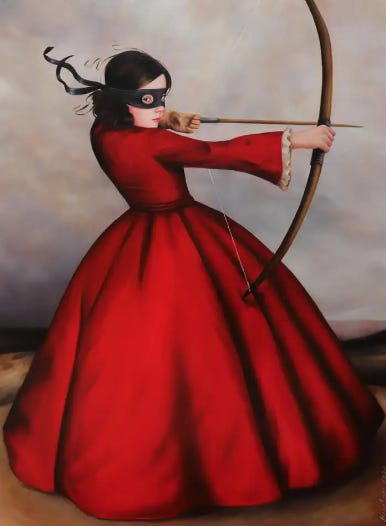
N.b.: This post may contain Amazon affiliate links. Proceeds support the writer’s vices: books, coffee, and the occasional pain au chocolat.
It is important to distinguish between the nouvelle théologie and the modernist liberalizing movement more broadly. The nouvelle théologie is completely orthodox in and of itself (although most radtrads would disagree with this assertion, many conservative adherents of Vatican II would not) but there were participants in the nouvelle théologie who were less orthodox than others, and, given that the nouvelle théologie understood itself as a return to tradition (for the sake of reinterpretation), it was certainly seized upon by many much less orthodox as a vehicle for liberalizing the Church.
Today, “nouvelle théologie” is considered a derogatory term for this school of thought, with its contemporary proponents preferring the term “ressourcement” instead. I have several problems with this: first, “ressourcement” in English sounds so much like resentment; second, we should not hesitate to wear the badges given to us by our enemies; and lastly but most importantly, nouvelle théologie is so much more fun to say.
In The Suspended Middle, Anglican theologian John Milbank calls de Lubac “one of two truly great theologies of the twentieth century”, stating that de Lubac’s landmark work Surnaturel was “almost as important an event of cultural revision as Being and Time”.
Another variation used colloquially is the “Ordinary Form” (Novus Ordo) versus the “Extraordinary Form” (Tridentine Latin Mass). A Novus Ordo Mass can also be said in Latin, and, theoretically, the Tridentine Mass could be promulgated in an English translation, but regardless, they are not the same liturgy.
The Reshaping of Catholicism by Avery Dulles.
Larry Chapp, “Pope Francis Versus the Traditionalists: It Was Never About the Liturgy”.
No one should necessarily take from this that I am a fertility maximalist (I am not) but rather that I believe a successful cultural dominance strategy has at least an above-replacement rate fertility.
In any case, Pope Leo’s choice of Pietro Parolin as the Cardinal Secretary of State, the position of the right-hand man of the papacy, suggests a more moderate, centrist tone. More about Parolin here.
Many have asserted that the English Gothic revival of the late 19th century was actually an effort to parody Catholicism, but with some exceptions (earlier, but Northanger Abbey, of course) I disagree, and highly recommend on this subject Catholicism and the Gothic.
Some have fretted that the rise of mass conversions, the resurgence of the interest in Christianity more generally, is a fulfilment of Oswald Spengler’s “second religiosity” (for an articulation of this argument, see John Michael Greer’s “Beware the Religious Revival” in Unherd). Much could be said about this, but at a very first blush, I generally remain skeptical of Spengler’s cyclical-based framework.
William J. Danker in the forward to The Future of Roman Catholic Theology.
From “The Long Game”: “The second is SSPX-adjacent traditionalism — the world of the Latin Mass hardliners, the Society of Saint Pius X, the sedevacantists and near-sedevacantists who regard the Second Vatican Council as a catastrophic betrayal and the post-conciliar Church as illegitimate or gravely compromised. Nick Fuentes operates in this world.” An interesting statement given that Mr. Fuentes has repeatedly upheld Vatican II !
Later reports emerged that the meeting was with Mr. Axelrod, the Pope, and Mr. Axelrod’s family, while others reported that there was some portion of the meeting held in private without Mr. Axelrod’s family. While it is charming to imagine two men of very high positions of influence and power chatting only about family weddings and sharing chocolate chip cookie recipes, I personally have greater respect for Pope Leo’s intelligence and cunning.
None of this is to definitively state that the “State of Israel” will cease to exist in the next emerging order, but rather that the West’s relationship to Israel, and “the Jews” more broadly, will change and is already changing. Just as “Woman” serves as “the Other” for men, “Jews” have always been “the Other” for the Christianized West (and will continue to be until the eschaton), as Mr. Pageau explains well here. People as individuals, of course, are both distinct from and not distinct from the broader categories they inhabit, and this is true of everyone.
One wonders if the hammer-and-sickle of the communists borrowed, even unconsciously, from the same hammer that Martin Luther wielded to nail the theses in Wittenberg.
Some may argue that radical traditionalism is too riddled with various problems to serve as an effective framework for the future. However, any ideological/cultural framework this side of the New Jerusalem will not be without many treacherous cracks over which we must carefully step. We do not have the beautiful, lovely naivete of our forefathers and foremothers on the road behind us, who lived through the glorious 19th century of hope: we know our journey to our new home is all uphill. “You have to have felt the shadow of death pass over you to realize all is lonely in man’s advance towards the future, all that is hazardous and frightful in starting out again. Those who have never barely escaped death have no idea what is ahead of them,” Teilhard de Chardin wrote in 1917. In general, while I remain strongly attached to liberalism, I believe that advocating for a return to 1990s liberalism is ultimately no positive vision for the future at all. Therefore, to my mind, a new cultural framework is needed, one with legs, even if it has some issues (as radical traditionalism does as anything else). To those who still have great concern about Catholicism taking over as this cultural framework, I would remind that Catholicism did successfully carry Europe all the way through the 16th century, and at many times against great odds. Moreover, it was never the intention of most of the reformers in the 16th century to fragment the West religiously — instead, the goal was always to have the West united under a single religious faith; the dispute was about which faith it was to be. I recommend Hilaire Belloc’s Europe and the Faith for more on this. An Anglo-Puritan Catholicism could correct some of the adaptive excesses of the Southern European Catholicism and even possibly — dare we hope! — open up room for a new synthesis between Catholic traditionalism and technofuturism. On a somewhat related note, David Brooks recently gave a fair treatment of traditionalism over at The Atlantic in “History is Running Backwards: Why Reactionaries are Taking Over the World”. While I would have quibbles with some of his arguments, I do generally appreciate his conclusion of the piece: “What we should take from the traditionalists is the idea that restoring our society’s connection to its humanistic legacy and long-standing sources of meaning can actually help us better realize the promises of progress.”
No posts
Comments
Nothing yet. Say the first thing.
Sign in to join the conversation.