
If you’re just joining For Stitch & Giggles, I’d love for you to read my postpartum story. Here’s Part 1, Part 2, Part 3, and Part 4. I write this newsletter for pregnant and postpartum moms everywhere. You’re not alone.
It started with this note I posted on May 31. I posted it because it has been a deep desire in my heart to help other moms going through a difficult time. During my worst days struggling with PPD and PPA, I truly did feel like I was all alone in my battle. I’ve been pretty open about what I went through, so I decided to share what my new dream job would be.
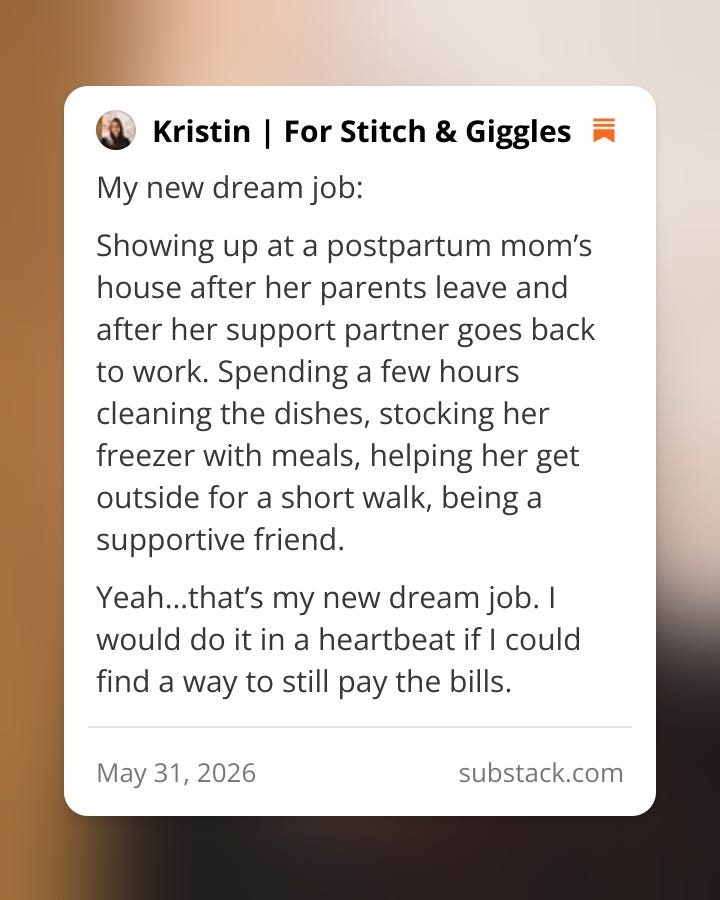
You can imagine my absolute shock when comment after comment said, “I think you’re talking about a postpartum doula,” “this is a job and it’s called a postpartum doula,” and “oh this is called a postpartum doula or mother’s helper.”
Part of me felt a little dumb. Obviously, so many other moms on Substack had heard about postpartum doulas. But I had to Google it. I had heard of a doula, of course. Those were the women who helped birth babies at home in a water bath or something like that. But I had never heard the words postpartum doula before.
According to the American Pregnancy Association, “a postpartum doula provides evidenced-based information on things such as infant feeding, emotional and physical recovery from birth, mother-baby bonding, infant soothing, and basic newborn care.”
They also help with light housekeeping, running errands, sibling care, light meal prepping, and breastfeeding support. In short, these incredible people are a helpful support for struggling moms.
So why doesn’t our medical system immediately connect pregnant mothers with doula agencies?
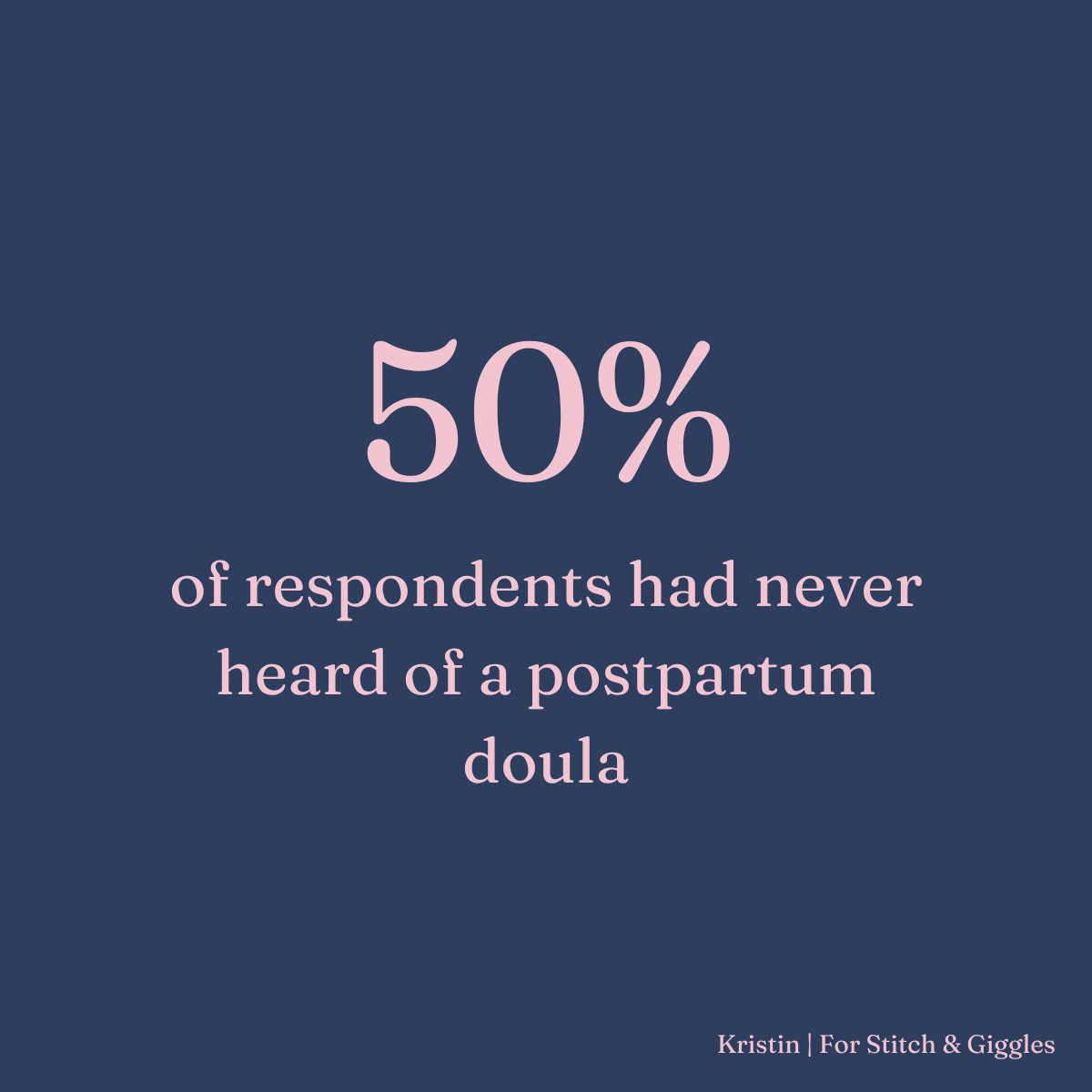
I decided to poll my Substack followers to identify the general level of knowledge of postpartum doulas. I didn’t have a swarm of responses, but I did get 20 survey respondents. And 50% of you said that you had no knowledge of postpartum doulas. Only 10% of you received education about them. And only 15% of you actually had a postpartum doula. Also note, respondents were in lots of different countries. Some countries have health insurance that covers postpartum doulas entirely and really proactively educate moms about available care.
I live in the United States. I won’t belabor our healthcare system and its issues. But the United States is definitely not ranking well in maternal mental health, as we recently got a “C” from the Policy Center for Maternal Mental Health. My current state of Arkansas received a “D.” And that makes sense in a lot of ways since my own postpartum care was so poorly handled.
But doulas really do help. One study from the National Library of Medicine reads, “This systematic review found that doula support was most consistently associated with improved maternal anxiety and breastfeeding initiation, with emerging evidence for improving use of postpartum follow-up.” The study also states how truly under-researched doula support is and the importance of more evidence-based research to further build a case for the importance of doula care.
The fact that I learned what a postpartum doula was from other moms on Substack says some wonderful things about Substack. But not such great things about the system.
I’m still doing some research on this. Evidently, there are a number of states that have included doula services in Medicaid plans. Check with your state’s plan to see if it’s covered if you’re on Medicaid. If you are on a private health insurance plan, this will vary widely (as it all often does). But some larger healthcare companies are making moves towards this, so definitely call and ask.
Here’s what you can do to potentially pay for a postpartum doula:
Contact your health insurance provider to ask if they cover doula services.
Get an itemized bill from your doula and submit to your insurance company under “out-of-network” providers and see if they would reimburse you. (This will be even better if you’ve already hit your max out-of-pocket, which having a baby tends to do.)
Use HSA/FSA funds to pay for your doula.
Have a doula fund on your baby registry. (This is a great idea, and I wish I had done that!)
Ask for financial support from family. I totally understand how difficult it is to ask for help. But sometimes, you need support, and family will step up when you really need them to. Mine definitely has.
Ask your doula for a payment plan. I personally have not met a postpartum doula yet, but if they are anything like me, they just really want to help moms. I’m sure they would do everything they can to work with you.
If you’re pregnant or considering having a baby, I hope this was helpful information for you! I am currently looking into training and certifications for becoming a postpartum doula. Knowing that I can use my experiences to help other moms gives me hope that my story can be an encouragement to others someday.
Need to talk? My inbox is always open. <3
Important note: I am not a licensed therapist. My experiences are lived experiences and not intended to be taken as medical or psychiatric advice. If you are in a crisis, call 988, the national suicide hotline. If you are not in a crisis, but need timely support, call or text 1-833-852-6262, the National Maternal Mental Health Hotline.
Other resources:
Comments
Nothing yet. Say the first thing.
Sign in to join the conversation.