
I have a confession to make, and it has taken me more than twenty years to finally say it out loud.
My earliest memory of hearing my voice was in high school. At the time, I thought I was following it perfectly when I chose my college path, but looking back, I realize my inner critic kept me from fully weighing my options.
I was applying for colleges in North Carolina, and there was no shortage of incredible schools to choose from. But even before visiting a single campus, I had loudly declared that I wanted to go to NC State.
Although I was adamant, my dad insisted that I visit a few others, including UNC-Wilmington, Asheville, and Greensboro, just to be sure. So I did. But I didn’t waver.
What did I love so much about NC State? It’s hard to put my finger on it, honestly. It was a feeling. The way the brick buildings surrounded me as I stood in the quad. The Free Expression Tunnel, where students were spray-painting graffiti as I walked through. The dorms where student life was buzzing, people playing volleyball, and music blasting. It all felt so me, something I wanted to be a part of.
My voice was screaming that this was my place! I applied, and I got in.
But there’s another side to this story that I’ve never told. There’s another popular school in North Carolina that you might have heard of: UNC-Chapel Hill. It’s my fiercest rival today, located only 30 minutes down the road from NC State, and it’s widely considered the more “prestigious” academic choice. As a communications major, UNC technically had the better program. Many journalists you see on TV have a UNC pedigree on their resumes. It would have been an excellent choice for me.
But I didn’t even apply. I insisted NC State was my only choice.
Here’s the untold story: I shut down the possibility of going to UNC simply because I didn’t think I could get in. There. I said it for the very first time in the 20+ years since I made that choice.
Guided by the external narrative around how tough it was to get into Chapel Hill, my inner critic took over the steering wheel. I had a solid 3.5 GPA and a great list of extracurriculars, but my SAT score was underwhelming. That score deflated me. The societal narrative around how tough the school was made it seem out of reach, so I didn’t even try.
I didn’t want to face the idea of failure or the judgment from friends or family if my application was rejected. But worse, I didn’t want to face that rejection head-on myself. I squandered my authentic voice. I didn’t even give myself the chance to see if it was a school I actually wanted to attend, because I shut it down before it even had a chance to breathe.
This was the first time I can remember an external narrative rewriting my personal destiny.
Don’t get me wrong: it turned out wonderfully. I absolutely loved going to NC State and wouldn’t take it back for anything. I had the quintessential undergrad experience, got obsessed with NC State sports, made lifelong friends, and kinda killed it academically too :)
But the truth remains: I limited my options because I let outside noise cover up my own voice. That’s the voice that hides under our inner critics and buries itself beneath societal scripts, suggesting the neat little boxes we are supposed to fit into. My authentic voice back then might have said, “Submit an application. Let’s just see what happens.” Who knows? Maybe I would have gotten in and realized NC State was still my frontrunner. But I denied myself the choice.
I was only 16 at the time. Sixteen! Even at that young age, we already let other voices guide our decision-making and dictate what we think we deserve. When we do that for decades—decision after decision, year after year—it takes a massive toll. Living inauthentically inevitably causes stress, burnout, unfulfillment, and numbing behaviors.
“Finding your authentic voice” can sound a bit awkward because technically, we hear our inner monologue all day long. But usually, it sounds like this:
“I should start dinner now.”
“If I leave by 4 PM, I should miss the traffic, but I need to pick up a few things first.”
“Why did I say that in the meeting?”
“I should have done a better job on that presentation.”
Our inner voice constantly ruminates on scenarios we wish had played out differently or future situations we hope will go our way. A 2020 study found that you and I have more than 6,000 thoughts per day. And while there’s no specific number on how many of those are negative, psychological research on our inherent “negativity bias” shows we place far more weight on negative thoughts than positive ones.
These are the layers we have to shave away to hear what our authentic voice actually wants. But we rarely do the shaving. We mistake societal narratives for our own truths and run on autopilot because routine offers the least resistance.
But right underneath all that noise is a soft whisper telling you exactly what you want.
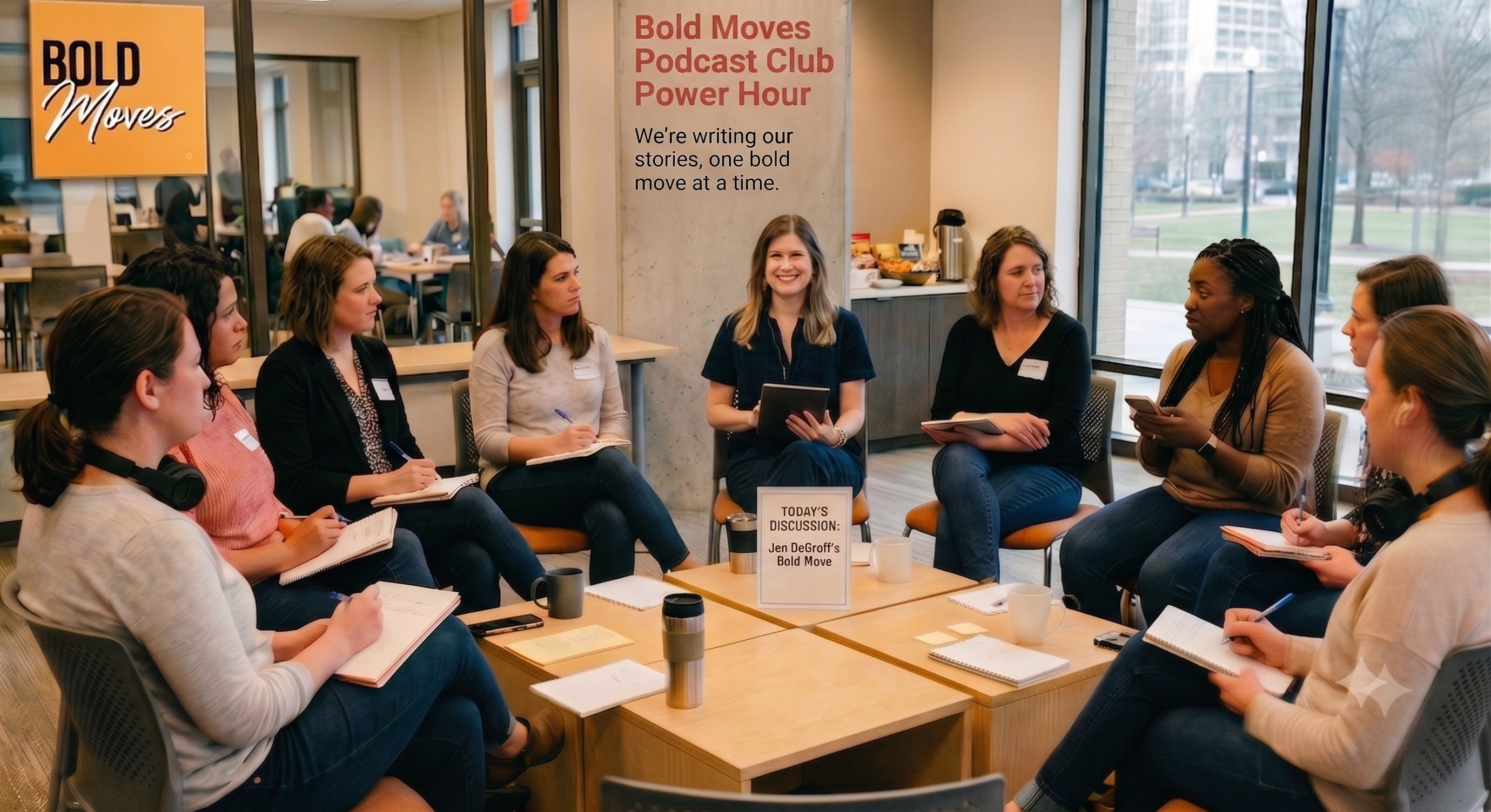
During our very first Bold Moves Podcast Club Power Hour (think a classic book club, but for my podcast episodes!) on Wednesday, July 8. We are going to dissect my latest episode with Jen DeGroff and dig deeper into the societal scripts that bury our authentic voices. It’s a safe space to gather with a group of friends who are all rooting for each other to break out of the status quo.
Perhaps during our discussion, you’ll get a little bit clearer about what your voice is trying to tell you when it’s finally unburdened by all the heavy layers.
Join the Bold Moves community and me on Wednesday, July 8.
👉 RSVP HERE FOR THE POWER HOUR
To set us in motion, here are a few questions we’ll be diving into, discussing the episode, “The Toxic Cost of Burnout and Stress: How to Stop Performing Life and Start Living It (feat. Jen DeGroff of TrueIcon)”:
On paper, Jen was a classic corporate “success story.” She had her MBA, climbed into marketing, interfaced with the C-suite, and helped build a startup . Why do you think it is so common for high-performers to master the art of “checking all the boxes” even when the role no longer serves them?
When you listened to Jen’s transition from a high-performing corporate executive to a fitness and mindset coach, what was the most unexpected or eye-opening detail that stuck with you?
Jen’s turning point was incredibly physical, eventually causing her to temporarily lose her hearing from sheer stress. In the episode, I talk about how if you ignore your voice long enough, your body will step in to force a recalibration. Do you think our culture trains us to ignore these physical alarm bells, or do we just become too good at tuning them out?
👉 RSVP HERE FOR THE POWER HOUR
The Podcast Club Power Hour is 100% free to attend because I firmly believe that no one should have to make bold moves alone. If these Bold Move podcast episodes, stories, reflections, and community spaces bring value to your life, please consider upgrading to a paid subscription. It is an incredibly meaningful way to support the behind-the-scenes work that goes into curating this space dedicated to helping you discover – and lean into – your own midlife click.
No posts
Comments
Nothing yet. Say the first thing.
Sign in to join the conversation.