
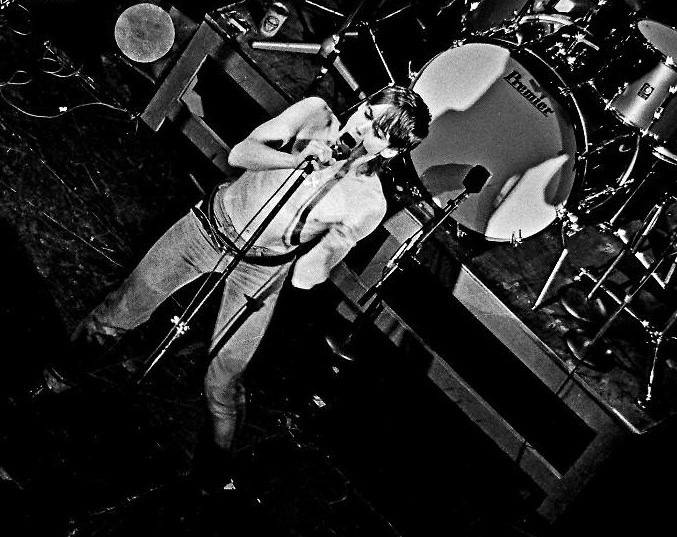
pic: Geoff Tyrell
Like thermonuclear motorboats that collided in the night, Iggy Pop and David Bowie enjoyed a fruitful 35 year friendship that produced classic albums in both their catalogues. Unchallenged by music industry traditions and expectations, the pair helped rewrite rock ‘n’ roll and punk history.
“I’ve always thought Iggy was, for me, rock ‘n’ roll, absolute rock ‘n’ roll, uncompromising rock ‘n’ roll.”
David Bowie, Zigzag, January 1977
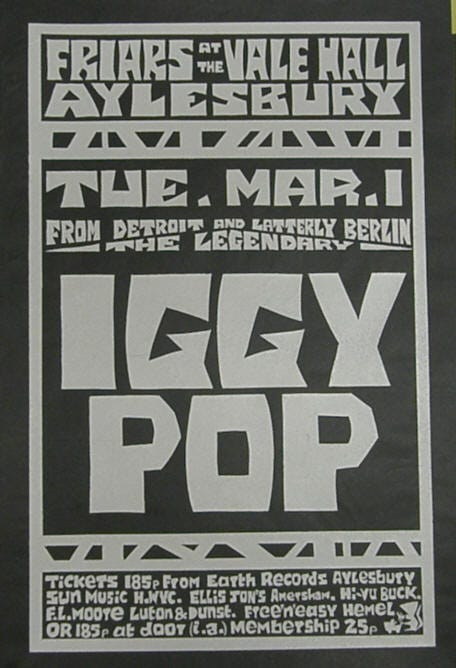
MARCH 1, 1977. It’s the opening night of Iggy Pop’s The Idiot World Tour and the venue just happens to be Friars Aylesbury, the local club I’ve been involved in since it opened in 1969 where David Bowie chose to unveil Ziggy Stardust five years earlier.
I’ve been sworn to secrecy that Bowie will be playing keyboards in Iggy’s band after co-writing and producing The Idiot with the legendary Stooges front man. Although there had been speculation in the press, few believed Bowie would show up in such a humble capacity, assuming a guest role at best. By the day of the show, it’s the worst kept secret in town as I use any excuse to pop out from the local newspaper office where I’m a reporter to check the action at the Civic Centre. Not that there is much at first, in fact panic is creeping in by four o’clock when the huge truck making its way from Berlin with Bowie’s on loan equipment still hasn’t arrived.
Finally, having endured 40 hours in customs and getting lost in Aylesbury’s traffic system, the truck arrives around five. While roadies beaver frantically a brown-haired figure in green anorak and brown flat cap strolls in through the back door accompanied by a smaller fellow in a grey cap. I haven’t spoken to David since 1973 but he’s immediately friendly, pointing at my Acme Attractions winklepickers and laughing, “Hey, I used to have a pair like that!”
After confirming he is indeed playing the whole set on keyboards, giggling “I’m up there!” as he points at the piano/synth setup onstage, Bowie joins guitarist Ricky Gardiner, drummer Hunt Sales and his bass-playing brother Tony to blast through ‘Raw Power’. When he returns he simply declares, “I could never have come back to Aylesbury as David Bowie”.
The gig’s running so late a proper soundcheck is impossible, especially when Bowie insists the doors are opened on time because it’s raining outside. One of the venue’s less clued in security men even tries to throw him out. “But I’m one of the band!” he protests with much humour. This is a much different David Bowie to the terrifyingly glacial Thin White Duke apparition I’d seen the previous May at Wembley Arena on the Station To Station tour. Or even from the last time we’d sat and had a chat in an Oxford hotel on the Aladdin Sane tour in ‘73. Now he seemed back to the approachable, funny individual who adopted our club in ’72 to launch Ziggy Stardust’s spectacular flight, then returned that July after it was an alien sensation.
A lot of this transformation had to do with hanging out and working with Iggy; a genuine friendship starting six years earlier when Bowie brought Iggy into his MainMan fold along with Mott the Hoople and Lou Reed. The pair would end up working on three of Iggy’s albums together; The Idiot, Lust for Life then 1986’s Blah Blah Blah, remaining friends for life.
Bowie met Iggy for the first time when he was in New York City closing his RCA record deal in September 1971. Accompanied by hotshot manager Tony Defries, he displayed his innate knack of charming everyone into falling in love with him, although it didn’t work so well with Andy Warhol, who Bowie was introduced to by Tony Zanetta, who he had met when Warhol’s uproarious Pork descended on London’s Roundhouse earlier in the year. Warhol wasn’t impressed by David’s song about him on Hunky Dory or the mime routine he insisted on performing, although he confessed to liking Bowie’s big yellow shoes.
After Bowie’s death in 2016, Zanetta recalled how he was charged with looking after Bowie that week, which led to meeting Warhol, Lou Reed and Iggy. “The record company, when they signed him, arranged for a dinner at a restaurant called The Ginger Man. They invited Lou and David and Mick, me and DeFries. So that was the first time Lou and David actually met … I think he and David were pretty cautious of each other. They were kind of sizing each other up. Lou was on his best behavior with David and then after dinner we went to Max’s Kansas City.” Although Reed didn’t come they met scene dynamo manager Danny Fields, who had Iggy staying at his apartment. Bowie had become a big Iggy fan on his previous US visit promoting The Man Who Sold the World. “So Iggy became his big obsession. Iggy was in Danny’s apartment and he called Iggy to come over to meet David. Iggy at the time was between record deals, he was getting off heroin, he was on methadone and living with his parents in Michigan. So he was wide-eyed for any opportunity and he knew the whole score with David. They got along immediately. The talk would be about ambition, stardom, music, what they were going to do, all that kind of stuff.”
Despite falling on hard times, Iggy still carried enough livewire charisma when he swaggered into Max’s to enthrall and seduce Bowie, who wanted to grab some of that kamikaze energy for the new creation gestating in his racing brain. By the end of Bowie’s trip, it was arranged Iggy would come to the UK and sign with Defries’ management stable once he had cleaned up. The whole New York experience gave Bowie a jolt that, starting with Ziggy Stardust would propel him through the different phases of the next five years, taking Iggy with him until it all went pear-shaped after the chaotic – and well-documented - Raw Power saga. When I asked David how Iggy was doing in ’73, he just looked at the floor and shook his head with an exasperated laugh. He obviously still carried a lot of respect and affection for Iggy and would be one of the few to visit him in an L.A. mental institution when he was trying to kick smack after the Stooges imploded in 1974.
In 1976, while beset with his own Thick White Line drug demons (“I was psychically damaged”), Bowie took along Iggy as his companion on the Station To Station tour. Despite the side effects of the cocaine, every night Bowie turned in a killer show bathed in eye-blasting white light influenced by Brechtian theatre, which greatly impressed Iggy. It was inevitable they work together. “The friendship was basically that this guy salvaged me from certain professional and maybe personal annihilation - simple as that,” Iggy told The New York Times in 2016. “A lot of people were curious about me, but he was the only one who actually really liked what I did and could get on board with it, and who also had decent enough intentions to help me out. He resurrected me.”
Bowie had been so busy during Raw Power’s creation he just mixed the album after it was recorded. After the tour, work began on The Idiot at France’s Chateau D’Herouville using Bowie’s rhythm section. “There’s a great deal of his influence on it, but it’s only as strong as guys in the past,” said Iggy. “I’ve always worked with one person as the keynote, kicking ideas back and forth with me, like Ron Asheton, James Williamson. It was done very much in the manner that I’ve always worked. We sat in the basement, me on drums and him on piano. He wrote a lot of the music, and I wrote the lyrics, but the melodies are mine.”
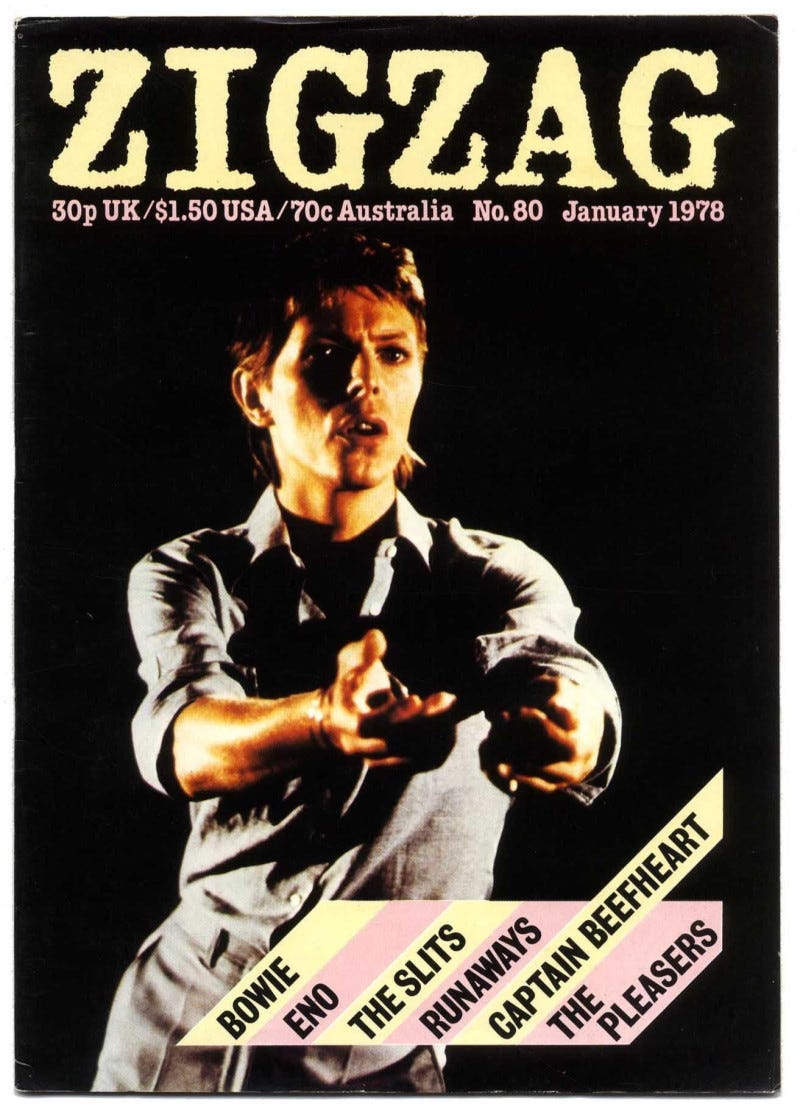
This was affirmed by Bowie in an exclusive interview with Zigzag’s John Tobler that provided our January ’77 cover story and I interviewed Eno: “Jim hadn’t worked for at least two years, had been through some very bad times and needed more than a little bit of support emotionally and mentally as well as materially. I think he resolved most of his problems on the first album, and if it shows at all, my influence or attributes won’t be quite as recognisable in any future stuff that we’re doing, and we’re doing another album after this. Jim is very much in charge of his own situation, and he realises what he wants to write and what he wants to write about. He’s becoming an excellent songwriter. I think he always was an excellent songwriter but he had that lapse.” Bowie cited ‘China Girl’ as an example of Iggy’s songwriting prowess; “’China Girl’ has an extraordinary lyric. It was really sort of thrown out as Iggy was writing it. He had an extraordinary talent for spontaneous free thought.”
After The Idiot was nailed in September, Bowie started on Low, both sets finished at Hansa studios in their newly adopted home of Berlin, where they relocated to a seven room flat to defeat their addictions and rebuild charred psyches. “I was trying very hard to drag myself out of an awful period of my life,” said David. Low’s startling mix of short vignettes and atmospheric instrumentals Bowie said were inspired by Warsaw and the Wall-divided Berlin came first in January so fans were already aware of the changes afoot when Iggy toured the UK two weeks before The Idiot‘s release. When The Idiot arrived, it was as shocking for Stooges fans as Low was for those of all Bowie’s previous recent phases. At that time of rampant guitars and hollering vocals inspired by The Stooges, Iggy dropped a future bomb that would reverberate into the next decade but sounded totally alien then.
As punk gained steam and many were discovering The Stooges, Iggy’s album was predicting the machine-driven 80s, although his career-straddling setlist started with ‘Raw Power’ and included ‘TV Eye’, ‘Dirt’, ‘1969’, ‘No Fun’, ‘Search and Destroy’ and I Wanna Be Your Dog’, with only ‘Sister Midnight’, ‘Funtime’ and ‘China Girl’’ from the new album (along with ‘Tonight’, ‘Turn Blue’ and ‘Some Weird Sin’ from Lust For Life).
When Iggy stepped out on that Aylesbury stage for the first time since the King’s Cross Scala gig five years earlier, he was faced with wanting to play his new album but knowing he had to keep Stooges fans happy. Thankfully he had the moral support of Bowie who would’ve been in the same boat but was just playing keyboards.
The demand to see Iggy, let alone Bowie meant gigs were packed with curious punks, Ziggy space cadets and long-time fans. After the doors opened at Friars, while Iggy and David pushed through the Market Square in ‘Five Years’ to have a drink in the Bell Hotel’s Gun Bar, a coach from London spilled out Sex Pistols minus Rotten, Generation X, the Damned and Johnny Thunders and the Heartbreakers. For this fan of eight years, it was amazing to witness Iggy Pop in action for the first time. He might have been feeling his way back in again with gyrations and chest-scratching but his effect on women was undeniable as my companion slowly curled herself around me as the set progressed while never taking her eye off the stage! Bowie remained seated behind his keyboard setup throughout, occasionally managing a sly smile at the adoring throng crowded before him that made the audience weirdly unsymmetrical. Bowie remained one of the band throughout, telling Zigzag, “He encouraged me to play piano with him and I thought the idea was thoroughly enticing and very tempting and I did it for the nerve of it, really. I never enjoyed a tour so much because I had no responsibilities on my shoulders at all. I mean I just had to sit there, drink a bit, have a cigarette, wink at the band and watch him.”
After encoring with ‘China Girl’, Iggy and Bowie immediately roared off in a black Mercedes, leaving a crowd not believing what had just happened. Some seemed disappointed Iggy hadn’t been wilder but this was obviously a warm up as, when I saw him at the Rainbow later that week he seemed possessed by the original spirit; leaping, falling off speakers and ending ‘I Wanna Be Your Dog’ with seven backflips.
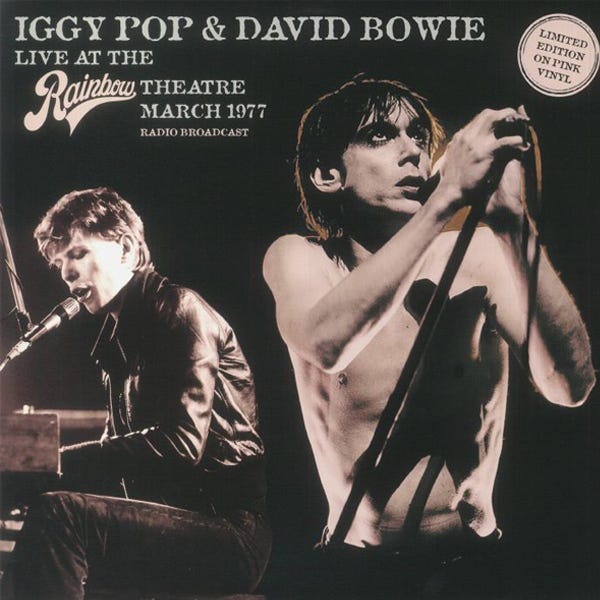
Then The Idiot turned up, as shocking for Stooges fans as Low was for those of Bowie’s previous recent phases. At that time of rampant guitars and hollering vocals inspired by The Stooges, Iggy dropped a future bomb that would reverberate into the next decade but sounded totally alien then. I couldn’t stop playing it. Reviewing it in Zigzag, I raved, “It’s so compelling... This is a very strange album, morbid, obscure and unsettling. Like Low it’s aimed squarely at the cold, mechanical future. An attempt to recycle the ‘Search and Destroy’ style on record might have sounded posed and hackneyed in the light of the New Wave. Iggy was unique in 1972. Now he’s moved on.” I cited ‘Nightclubbing’ as “the bleak sound of the 1985 disco as ghostly electronic washes sky-write phrases over an unsettling, distorted disco pulse,” ‘China Girl’ as “the only really ‘up’ track… giving way to a long, distended instrumental fade which is pure Bowie – the man’s string synthesiser, electronics and sax building an impenetrable Berlin Wall over the bedrock drumming,” ‘Dum Dum Boys’ lamenting the Stooges and ‘Mass Production’ closer as “the closing killer epic. Fun House is a hazy memory by now, obliterated by a malevolent, monolithic riff, Teutonic in the extreme. Bowie’s loopy synthesiser break in the middle is how I would imagine a musical police siren in the nightmare of cold turkey.”
After the tour had traversed the US with Blondie supporting (another story), Iggy and Bowie recorded Lust For Life. Led by its classic title track, the set showed Iggy exerting heftier influences on more guitar-based ditties with the three tour-honed tracks sounding magnificent. After the live TV Eye LP, the pair’s paths separated, Bowie completing his Berlin trilogy with Heroes and Lodger, Iggy touring to survive and going on to release New Values, Soldier and Party. By then, he was drinking heavily and taking any drug thrust in his direction.
Things started looking up when Blondie’s Chris Stein asked Iggy if he would do an album for his Animal Records. With Blondie now one of the biggest groups in the world, the label was Stein’s way of showcasing “abnormal” artists he liked, including the Gun Club. Stein and drummer Clem Burke provided the rhythm section for the great Zombie Birdhouse (itself another story).
Remember Lust For Life’s black and white cover depicting Iggy smiling with almost manic radiance? One afternoon in October 1986 I spent two hours sitting opposite the same eager, gleaming smile from an Iggy Pop positively radiating vitality and happy to talk about his new album Blah Blah Blah, which saw a rekindling of his personal and studio relationship with Bowie.
It was something of a relief comparing the ultra-friendly, fearsomely articulate individual shaking my hand as I walked into A&M Records’ Park Avenue South offices with the crazed loon I’d seen terrorising London’s Venue a few years earlier. Those two hours chatting with James Osterberg about his personal resuscitation, re-invention and renaissance marked my first Iggy interview after he’d blown me out twice in the 70s, for which he was truly apologetic.
Sporting short brown hair, black t-shirt and jeans striped with purple paint, Iggy spent most of our two hours pacing around the room or perched on the window-ledge, justifiably proud of the new album. I was there to interview him for Creem, its New York representative after recently moving to the city. It still stands as one of the most fascinating interviews I’ve ever done. Iggy had been through incredible highs and brain-melting darkness which took much of his then-39 years to navigate to this point where he was bristling with natural energy and brutal honesty not often encountered in a rock ’n’ roll icon.
It came about after Bowie had recorded Let’s Dance with Chic’s Nile Rodgers who had worked on Debbie’s solo Koo Koo and was big mates with Stein. His version of ‘China Girl’ hitting the UK top ten was a welcome shot of cash and recognition for Iggy who’d recently come out of a three year personal rebuilding programme. Now living in NYC with partner Suchi, he began our interview with a half hour description of turning his life around, joining an acting class “with a lot of vicious young actors who couldn’t care less who I was. I learned to focus my energies without always jumping up and down when all else failed. At the same time I spent two to four hours a morning working with my typewriter, writing an essay on whatever I felt like writing about, rather than wanting to feel like ‘I’m a rock singer and I’ve got lots of fans and this is what they listen to and this is what I think might appeal to them’. Instead, I just wanted to get to know what I’m really interested in because I wasn’t sure any more.
“The other big activity was making up little songs around the house, just trying to develop my voice as an instrument and seeing if I could write melodies. We’d take care of the place ourselves and actually learned to enjoy it. I like housework. It’s calming sometimes. You know the floor’s gotta be vacuumed and thou shalt vacuum!”
Iggy visited Bowie for five days when he was recording the follow-up to Let’s Dance at Canada’s Le Studio. The pair had co-written ‘Tumble And Twirl’ and collaborated on another called ‘Dancing With The Big Boys’. Comparing the sessions to The Idiot’s, Bowie also covered ‘Tonight’ (his album’s title track) and ‘Neighbourhood Threat’ from Lust For Life, plus ‘Don’t Look Down’ from New Values.
In June, Iggy hitched up with former Sex Pistol Steve Jones in L.A. to write songs. This could’ve been disastrous but Jones had also cleaned up. Back in New York, a visiting Bowie was impressed enough with Iggy’s demos to suggest working together on his next album. “I thought this sounded like a good idea, so I embarked on a similar project with David as I did with Steve. He said that most of the stuff me and Steve had done seemed to be in a middling tempo so he would try and write some slower and faster material. I said, ‘Fine, but how are we gonna demo? You can barely operate a cassette recorder!’.”
Unabashed, Bowie ordered a custom-built portable studio with drum-machine, synth, bells and whistles. “We took the bleeding lot down to the Caribbean and started writing songs, not killing ourselves over it,” recalled Iggy. “We spent December there, January and February skiing, doing the same thing. By March we had an album’s worth of stuff.” They wrote more songs at Bowie’s homes in Mustique and Gstaad, building enough for an album. Iggy spent March and April in New York honing his lyrics before they entered Queen’s Mountain Studios in Switzerland where Bowie had recorded Lodger. Jones couldn’t make it because he was tied up with Andy Taylor of Duran Duran’s solo album so Bowie roped in Kevin Armstrong, who he’d worked with on his Live Aid appearance. All other instruments were handled by Erdel Kizilcay, a university graduate from Istanbul.
The whole process took one month of working intensely all day, having dinner in the evening then turning in early. Iggy described the sessions as ‘very regimented’. From this idyllic graft they created Blah Blah Blah. Iggy signed to A&M who pretty much took the finished album as it was. Blah Blah Blah indeed seemed like a concerted stab at mainstream success, telling me, “I have achieved failure and I want success. I want badly to be a very, very good artist and I don’t think I’m all that great. So I’ve got a lot of work to do to be as good as I want, which is why I’ve never given up.”
Iggy was now clean, focused and obviously had a blast creating the record with his old mate Bowie. There was a new melodic edge in his stronger voice and sense of optimism that suggested this was the album which should’ve been called Lust For Life. “When I was doing the lyrics, I was keen to make them as good as I could but I was terribly aware of the trap where the artist sits in his garrett all alone and there’s no real deadline. So I went down to Pearl Paints on Canal Street, bought a lot of canvas and acrylic paints and started painting as an exercise in visualisation to see…well, what did I see? Let’s find out! They’re not abstract, they’re recognizable, and that helped me a lot. That’s how I got the lyrics done. I worked long on each one. David’s the one who turned me on to painting. He showed me how to stretch a canvas. I really enjoy painting. It’s fulfilling. You look at this thing and it’s alive. You gave it birth. You feel like Frankenstein!”
Many cited Bowie co-write ‘Shades’ as one of the best things Iggy recorded that decade. “He was at my girlfriend’s birthday party. He watched her opening her presents and he watched me enjoying her enjoying herself. So he turned the situation around and wrote the first verse of this song as if I was receiving the presents; from the viewpoint of a guy whose basically stating, ‘If I hadn’t met you life would be a much poorer place right now’.”
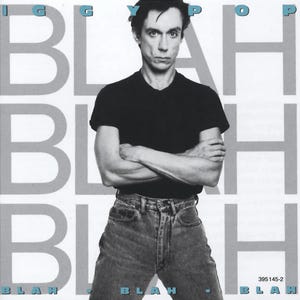
The title track came from sitting around watching surreal TV show The Comic Strip, with Alexei Sayle storming around as an Eastern European spy ranting.; ‘Nuclear installation…blah blah blah…Secret arms cache…blah blah blah.’
“I loved it. I started going crazy and imitating him all evening – ‘Iggy Pop….blah blah blah’. David heard I was taken with that and next morning presented me with this tape and said, ‘Here’s your music for ‘Blah Blah Blah’, let’s write the ‘blah blah blah’ song.”
During the 70s through the 80s an Iggy gig was a fairly unpredictable affair. On different occasions I saw him barely move from the same spot, going berserk bound up in gaffer and singing beautifully while moving in graceful syncopation. Many still wanted the Detroit Demon cutting himself with broken glass. Iggy admitted there’ll always be the element screaming “’Lobotomy!’ They’ll be there but I think they can be kept in perspective. The craziness is, in large, part of a myth which is as much the press’s creation as my own. It has been frustrating but I do feel a lot of people have enjoyed the music. I still get it in a lot of interviews. Ten years ago it was ‘Tell us all about the heroin!’. Now it’s, ‘Tell us about the broken glass!” I tend to look at those years as the same sort of process as when you roll away the dirty part of one of those wall towels in a gas station bathroom. If you give it a few rolls eventually the dirt gets to the bottom of the roll and then disappears altogether. That seems to be what’s happening lately. They generally seem to put in the smut at the end of the article! Ha ha! Eventually I’m sure it’ll disappear altogether, although I never want to be squeaky clean.” Then he catches himself and springs into mock-protest animation. “I helped out! I’ve done my share, no doubt about it. I know it! In the late 70s I had all these bleeding Bowie fans going, “Where’s David?”, like it was a fashion party. But I continued to tour for some years and I knew there was a core of people who liked me for myself.”
The album yielded Iggy’s first UK hit when his rollicking cover of Johnny O’Keefe’s 1959 ‘Wild One’, retitled ‘Real Wild Child (Wild One)’ hit the top ten. Iggy hit the UK for press and TV, including Saturday morning kids’ shown Number 73, where he got banned for dry-humping a large teddy bear behind the closing credits.
His spark undimmed, even intensified by sobriety, Iggy carried on with more albums, Stooges reunions and the stage-diving live extravaganzas that continue today as punk’s unchallenged godfather and untamed force of. Sadly, Bowie’s no longer here but there’s a good chance Iggy wouldn’t be touring the UK in May at the age of 77 either if that bond hadn’t given them both the strength to shake off their 70s excesses and embark on their next respective career trajectories: never predictable, always unique.
No posts
Comments
Nothing yet. Say the first thing.
Sign in to join the conversation.