
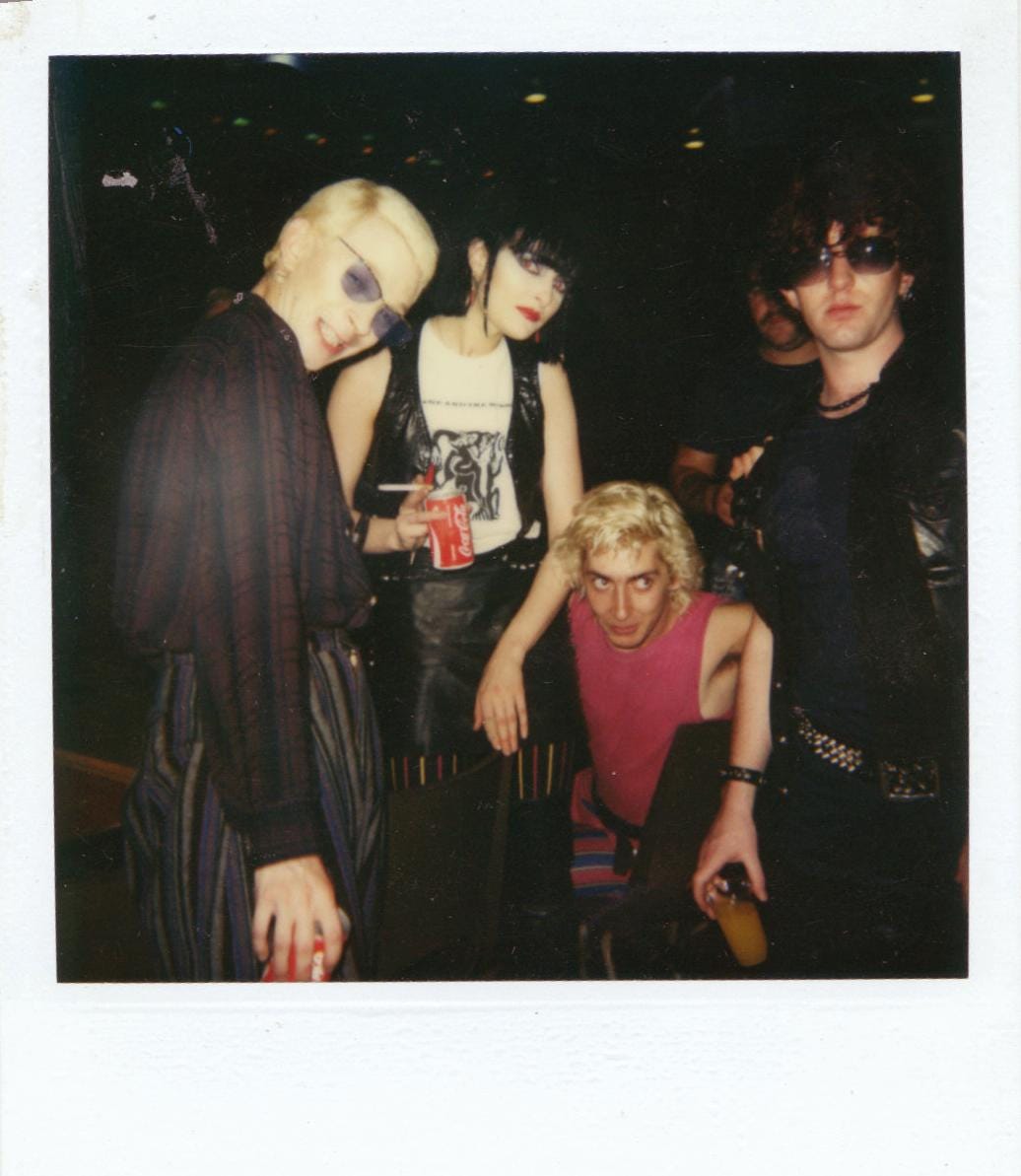
Pic by me; Cardiff, 1981
In September 1976, Siouxsie & The Banshees defined the DIY punk ethic by venturing onstage for the first time with instruments they’d never touched until the day before. Siouxsie became one of the faces of British punk, but the Banshees subsequently developed a sound which left Ramones imitators in the dust; fearlessly uncompromising, experimental, always progressing but boasting uncanny pop sensibility. Their striking, sometimes shocking, visuals cleverly avoided obvious moves like pushing Siouxsie as a UK Debbie Harry.
From the numbered gatefold of their first 7” single, ‘Hong Kong Garden’, Siouxsie & the Banshees paid special attention to presentation and marketing. They were at the forefront of the 12” revolution, including extended mixes and bonus tracks, while sleeves and videos came with band-hatched concepts. Even now they stand alone among the bands from that era.
In 1976, you couldn’t miss Siouxsie and her suburban misfit mates, dubbed the Bromley Contingent. Siouxsie always had a voracious desire to break out of suburban normality in the loudest, most shocking way possible, getting an early taste of the night-life by accompanying her go-go dancer sister to work and frequenting the capital’s underground gay clubs. She met a fellow malcontent called Steve at a Roxy Music gig and, along with others like Billy Broad (later Idol), glammed up early Pistols gigs. Calling herself Suzi while causing a stir in her fetish underwear creations, she introduced the Pistols crowd to the seminal multi-sexual Louise’s club on Poland Street.
The scene which developed around Louise’s, McLaren’s Sex shop and Pistols gigs galvanised Sioux and Steve, now calling himself Spunker. When another group was needed for the Pistols’ 20 September show at the 1976 100 Club Festival, Sioux thought up the name Suzi & the Banshees the night before, while looking for something that “sounded offensive but would get people confused”. Joined by guitarist Marco Pirroni and Johnny Rotten’s old mate Sid Vicious on drums, Steve picked up a bass. Their 20-minute cacophony revolved around ‘The Lord’s Prayer’, incorporating piss-taking snatches of ‘She Loves You’, ‘Twist & Shout’ and ‘Knocking On Heaven’s Door’. They planned to play until forced off but got bored before the audience did.
While Sid sang with infamous bedroom band Flowers Of Romance and Marco joined Adam & the Ants, Suzi became Siouxsie Sioux and was thrust into the nation’s front rooms after being leched over by a drunken Bill Grundy on teatime TV, prodding the Pistols to swear themselves to overnight notoriety. Siouxsie and Steve, now Severin after the Velvets’ ‘Venus In Furs’ character, continued with the Banshees, recruiting guitarist PJ Fenton and drummer Kenny Morris, who’d rehearsed with the Flowers. Although musically inept, they had bold ideas and provocative lyrics, bent on abusing rock’s traditions and taboos. “You don’t think about old forms,” said Steve. “You pretend you’re the first person to pick up a guitar.” With that fearless attitude, but also an admiration for glam’s simplicity, the primitive Banshees sounded like nobody else. By March, they were supporting Johnny Thunders & the Heartbreakers, whose record label Track let them rehearse at their Carnaby Street HQ.
The Banshees started playing at the Roxy, the Covent Garden underground transvestite joint which was about the only place for punk groups to play, but didn’t feel sufficiently developed to appear on The Roxy London WC2 (Jan-April 1977) album. In July, the Banshees started appearing at the Vortex, the Wardour Street club which replaced the floundering Roxy as London’s hangout.
Siouxsie and Steve’s lyrics were graphically evocative, dealing with situations not encountered in rock music. ‘Carcass’ concerned a butcher who fell in love with his meat to the extent of cutting his limbs off. “We just like to get people’s backs up,” cackled Sioux. “We’ve got a morbid sense of humour,” adding that the lyrics were “just explaining what is around you.”
At first, they used the swastika in order to debunk a shock image but phased it out as more sinister, wide-reaching implications loomed. Other early songs included ‘Love In A Void’, ‘Make Up To Break Up’ and irreverent covers of T. Rex’s ‘20th Century Boy’ and the Captain Scarlet theme. Gradually, a majestic, heavy, monster sound emerged, helped by guitarist John MacKay replacing Fenton in July.
While entrenched in the front line of the London punk scene as editor of original fanzine Zigzag, I witnessed the Banshees’ rise up close from earliest gigs to heady success, the magazine acting like a monitor in the heart of the group as they continued to claw an ever-deepening weal across the nation’s erogenous zones. The October 1977 issue marked the first of many covers, placing Siouxsie as the strongest no-nonsense female singer this country had seen. “I don’t want to appear as some kind of Women’s Libber, ‘cos I’m not, but neither am I someone who lets herself be pushed around and manipulated. I’ve got a mind of my own,” she said.
The Banshees continued packing out the Vortex and venturing further afield, improving all the time. Siouxsie started appearing on music weekly covers, now crowned the Ice Queen. Many asked why the Banshees hadn’t been signed despite record labels in a frenzy, snarfing up any punked-up hopefuls. Despite selling out gigs, the Banshees seemed to baffle or repel A&R men. Atlantic’s Dave Dee, having turned down the Sex Pistols, proclaimed that “punk’s finished”. Decca offered a princely two grand, with other similarly paltry deals dismissed.
In November, the Banshees recorded a John Peel session (’Love In A Void’, ‘Mirage’, ‘Metal’, ‘Suburban Relapse’), which went out on 5 December and became one of the most requested in the show’s history. Peel and his producer John Walters were massive fans and even talked with Banshees manager Nils Stevenson about releasing them on the BBC label. Their popularity further escalated in early 1978 as they sold out the Nashville, Music Machine and 100 Club, even promoting their own well-attended gig at North London’s Alexandra Palace in March.
Another Peel session in February, with the new ‘Hong Kong Garden’, ‘Overground’, ‘Carcass’ and their terrifying disembowelment of the Beatles’ ‘Helter Skelter’, stepped up the pressure. They ran away with Best Unsigned Band In Zigzag’s annual readers’ poll. The group got so annoyed at A&R men coming to gigs, getting drunk on expense accounts then passing out, that mysterious “SIGN THE BANSHEES” graffiti started appearing on record company buildings. Deciding a Zigzag cover and four-page feature might help, Severin designed a front page and an interview was arranged. The feature became a celebration instead of a protest when news came that the Banshees had signed with Polydor.
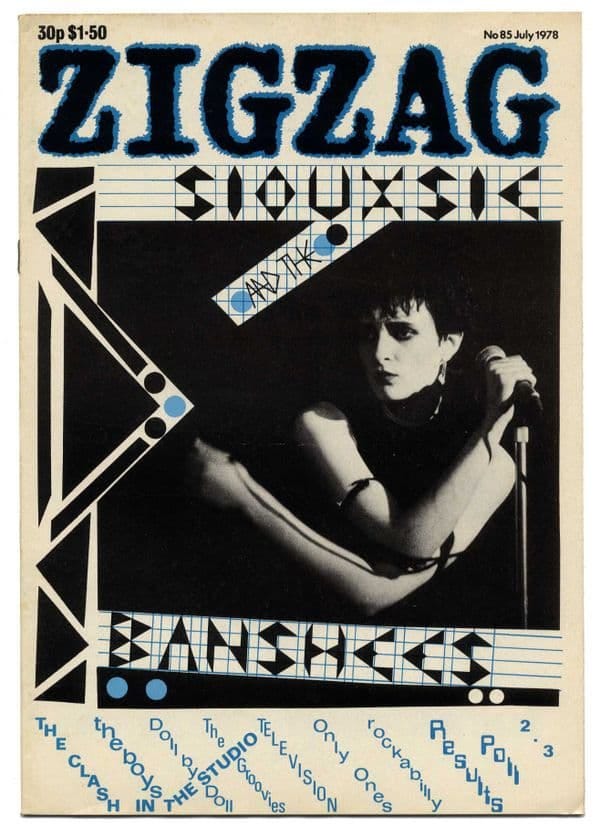
The Banshees were happy, especially with complete control over track selection, packaging and promotion. Sitting with the group in Soho Square, Siouxsie made no secret that she wanted to reach the biggest possible audience. “I can’t understand bands that are in love with the idea of being underground. If they’ve got something to offer, why don’t they make it on the television or the radio? If we got to No 1 on Top Of The Pops it’d be a great achievement.”
“We’ve always aimed to get into one of the big five companies,” added Steve. “Everybody got signed up, but hardly anybody got into those five companies.” Siouxsie did admit, though, that “if everybody starts liking us then we’re going to find it very hard!”
The Banshees already saw battles with the record company coming up, but Siouxsie reasoned, “We don’t exist if we don’t have something to fight against.” She knew that with the success of Blondie, Polydor would try and push her as the UK’s Debbie Harry. “Yes, yes, yes! I think every record company we’ve come into contact with wanted to do that but we were aware of it. That’s how we could stop it. It’s like a barrier. If it’s a girl, ‘Oh, she’s just flogging an image, she hasn’t really got anything to say.’ They like that, whereas if they think she’s got as much there as anyone else and more so, they don’t like it. Everyone’s so conditioned to think men say this and girls follow behind or just look pretty.”
August’s ‘Hong Kong Garden’ was one of the brightest singles to emerge from the Class of ‘76, chiming guitars and glorious chorus laced with mystery and exotic embroidery. Flipped with the spectral ‘Voices’, initial 7” copies came in numbered gatefold which, with the clamouring demand, propelled it into the Top 10. Now the Banshees were touring on the back of a hit single and packing the Hammersmith Odeon.
First album The Scream, produced by the band and Steve Lillywhite, was released in November, reaching No 12. It stands as one of the great debut albums from any era. From the primeval scene-setting of ‘Pure’ through the fractured psychotic charge of ‘Jigsaw Feeling’, it rollercoasters through coruscating scenarios, including ‘Helter Skelter’ and the harrowing breakdown of ‘Suburban Relapse’, before closing with the emotional tour de force of ‘Switch’. Unhampered by tradition and virtuosity, the Banshees had arrived at their own monolithic sound, redefining the traditional guitar-bass-drums- voice lineup in the process. Typically, the UK release didn’t feature the hit, although it later appeared on the US version.
The November tour, supported by Spizz Oil and some unknowns called the Human League, saw Zigzag travelling with the group in their black Mercedes. While the previous feature celebrated the deal, we now set out to debunk the morbid image which had grown around the Banshees, showing that, although deadly serious about the music, they were also engagingly human and could even partake in booze-fuelled stupidity after hours. While belittling lager louts in a post-gig Indian restaurant, Siouxsie declared that people were “too serious about the wrong things and not serious enough about other things… just in you doing this, observing a couple of days, shows the bad reputation that we’ve had through interviews”.
The live set was now an amazing beast, mixing the album with new songs like ‘Premature Burial’, while ‘The Lord’s Prayer’ traversed a different irreverent orbit every night. After starting with nothing two years earlier, Siouxsie & the Banshees were now ferociously spectacular.
On a roll, they came up with next single, ‘The Staircase Mystery’. “It’s a waltz and is about an unsolved mystery,” explained Sioux. It was released the following March, flipped by a live version of T. Rex’s ‘20th Century Boy’, before they started demoing material for the second album, previewing tracks in another Peel session. Recording lasted three weeks, the band producing with Nils. Midway, Sioux guested on Radio 1’s Round Table reviews show, her honest opinions resulting in a lifetime ban. The Banshees swept the board in the Zigzag poll and pelted guests at London’s Venue with cuddly animal trophies, although Sioux kept the giraffe.
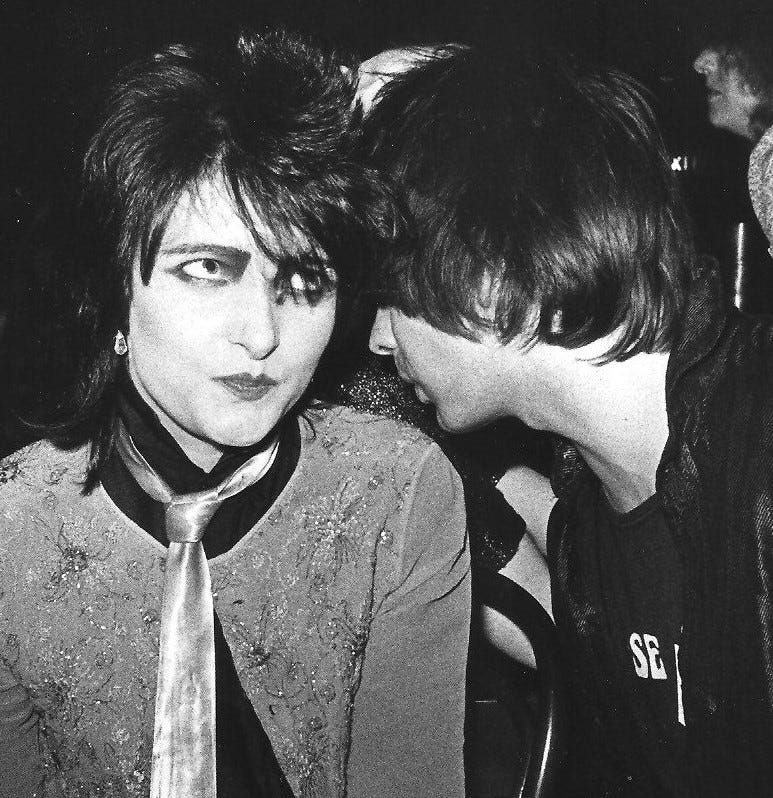
Sioux and drunken idiot at the Zigzag party
The Banshees recorded a version of ‘Metal Postcard’ for German release in September as ‘Mittageisen’. With ‘Love In A Void’ on the flip, import demand prodded hasty UK release as a double A-side. The cover was adapted from a photo-montage by pre-war anti-Nazi artist John Heartfield, depicting a German family under the Nazi regime eating guns and machinery in reference to Göring’s World War Two Hamburg speech (”Would you rather have butter or guns? Guns make us powerful; butter merely makes us fat.”), which also provides the song’s chorus. Polydor obliterated Hitler and swastikas from the original.
Having discounted ‘Icon’ as a single, the bell-driven swirl of ‘Playground Twist’ was released in June, flipped with sinister kiddy-song ‘Pull To Bits’. Reviewed on BBC’s Juke Box Jury, the panel of Elaine Page, Joan Collins, Alan Freeman and John Lydon predicted a Hit before it reached No 28.
Join Hands was released in August, a worthy follow-up with anti-war themes, mixing juggernaut grandeur (’Regal Zone’), anthems (’Icon’) and spine-frosting skincrawlers (’Placebo Effect’, ‘Premature Burial’). The World War One mood was set with memorial cover and funereal scene-setter ‘Poppy Day’. Most startling is the introspective ‘Mother’, which features Sioux backed by a music box playing ‘Oh Mein Papa’. The album closes with ‘The Lord’s Prayer’, picked by Sioux and Steve from various improvisations to represent the group’s original confrontational manifesto, as another side to the successful singles band.
A Zigzag interview threw up disquieting rumblings from Morris and McKay, the guitarist declaring, “The next step will have to be in a very different direction. I’m not sure how it will happen.” Morris railed against this writer for leading the group astray on the previous tour. Next time I saw him, at Throbbing Gristle’s YMCA gig, he was pissed and moaning, “I don’t want to be just a drummer, I’m an artist.”
Comments
Nothing yet. Say the first thing.
Sign in to join the conversation.