
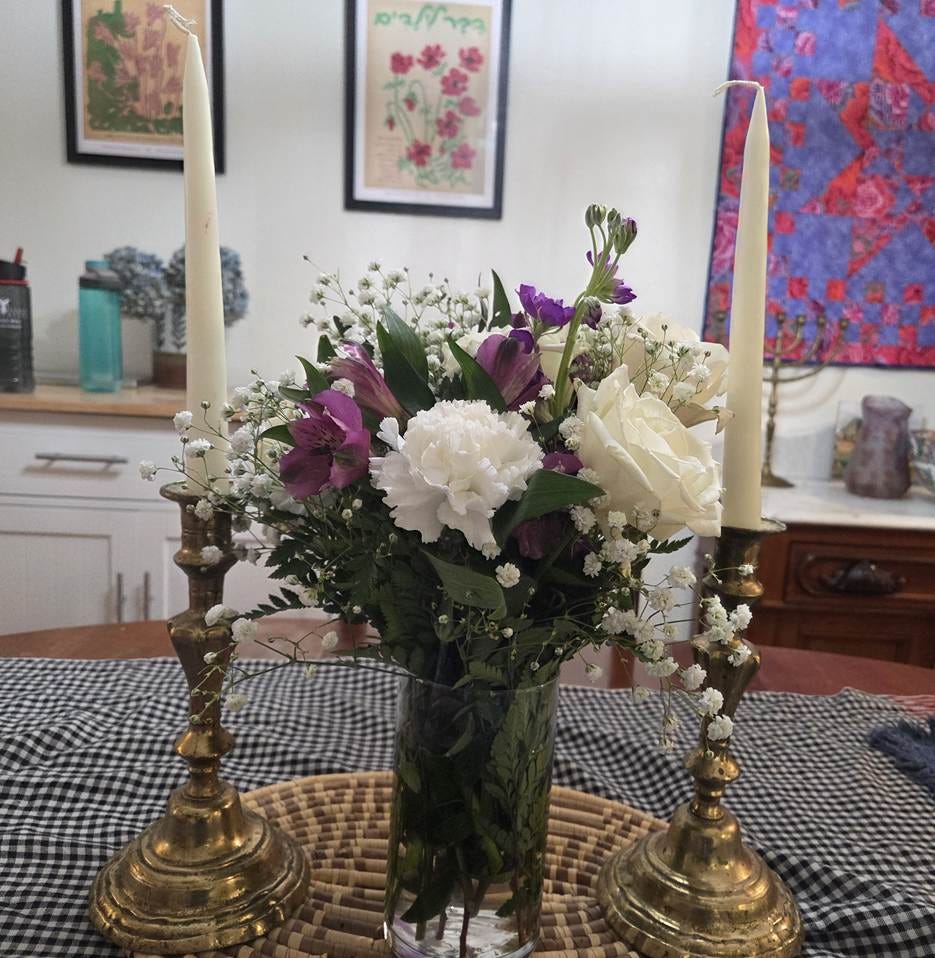
I had a lovely Mother’s Day – a visit with my granddaughter and her parents, a cheerful call and flowers from my daughter and son-in-law. The only thing wrong with it was the food: I decided to buy the side salads to save time as a gift to myself. They weren’t good; I should have taken the time to make them. I’m apparently a better cook than Whole Foods. However, each of my family members, present or absent, showered me with love. I needed that cushion.
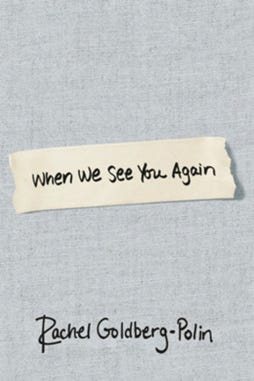
I hadn’t intentionally chosen to read Rachel Goldberg-Polin’s book, When We See You Again, on Mother’s Day Weekend. It is the most powerful book I’ve ever read about a mother’s intense love for her young adult child.
I knew that When We See You Again would be painfully hard to get through, and it was. Not because of the writing, which is forceful and poetic and heart-rending. A reviewer said he read this small volume in one sitting. I don’t know how he did it. I am not emotionally strong enough to sit with this brave mother through her agony for more than a few chapters. The book reads quickly, but my heart can only take in small sections at a time.
In our siloed world, I wondered how many people would look at me blankly when I mentioned the name Rachel Goldber-Polin, the mother who worked tirelessly for the release of the 251 hostages taken into Gaza during the October 7 pogrom. She and her husband appeared on countless news broadcasts around the world including Sixty Minutes. On August 24, 2024, when she and her husband spoke at the Democratic Convention, the crowd rose and chanted “Bring Them Home” for over a minute. A little over a week later, her first-born, her only son, Hersh, was murdered in the tunnels under Rafah.
When we went to Barnes and Noble to pick up When We See You Again, I was surprised it wasn’t out on one of their “featured” shelves; it’s been #1 on the New York Times bestseller list for Hardcover Nonfiction since it came out in April. When the helpful salesperson, led me to to the table where a few copies were laid out, she commented, “Might be an interesting book, but it’s got an ugly cover.” I mumbled something about rainbows and unicorns not being its theme. She clearly had no idea of the little grey volumes’ content, of the lives and deaths recorded in there. Sadly, I don’t think she is alone in her lack of knowledge about what the hostages endured or what their families went through.
I will never forget checking my phone as Jim and I were about to say goodbye to our son and his wife on August 31, 2024. “Six Hostages found Dead.”
“I hope one of them isn’t Hersh,” I said as we walked out the door. By the time we had driven halfway down the freeway to Tacoma, we knew he was among those six murdered young people, who tragically became known as the “Beautiful Six.” They died together, each of them executed at close range by the Hamas operatives who had held them captive in the bowels of the earth for 338 days, shackled much of the time, tortured… and brave.
Goldberg-Polin screams to us from the corners of her grief; she gently composes a monument to a loving, brave, kind son. She takes us step by step in describing how Hersh’s beautiful life, brutal death broke and transformed her. If I came face to face with her, I don’t know what I’d do. She’d hate a hug from a stranger, no matter how compassionate. Better, I just read it alone. And cry on my living room couch.
This book is the most graphic description of the pain a mother can feel that I have ever read. But more specifically, it is a Jewish book written about the impact on one family of the horrific day of terrorism intentionally carried out on Israelis by Hamas. If one must universalize it, please see it as a metaphor for what most Jews, certainly my Jewish family, experienced and continue to experience as the direct result of that horrible day, the months and months the hostages were imprisoned in Gaza.
Rachel Goldberg-Polin is a holy woman, a woman who tries to frame her love and suffering in terms of rabbinical teachings, of the words of the Torah, the writings of the Psalms. It is not a politically intentioned book. But it tells a story it seems most of the world was eager to move on from, eager to justify, eager to forget.
*
This Yiddish children’s song, “Oyfn Pripetshik,” kept running through my mind as I thought on music to include. It was written in the early 1900’s by Mark M. Warshawsky.
The translation is on each frame, but it is a song encouraging Jewish children to learn their Hebrew alphabet:
Learn, children, don’t be afraid.
Every beginning is hard.
Lucky is the Jew who studies Torah.
What more do we need?
And, always in the back of the teacher’s mind, is the reminder to the children that as it is important to these children to learn, “Tears lie in the letters they are learning.”
Comments
Nothing yet. Say the first thing.
Sign in to join the conversation.