
The global semiconductor and advanced AI chip theme that has captivated markets this year has moved on from Nvidia and Micron in the US to SK Hynix in Korea and TSMC in Taiwan.
Now, we believe China’s chipmakers are benefiting, thanks to strong domestic demand and innovation driven by policy and a supply crunch in the global ecosystem. At the same time, we believe China’s chipmakers may be better insulated from potential disruptions in hyperscalers’ capex than their US and global counterparts.
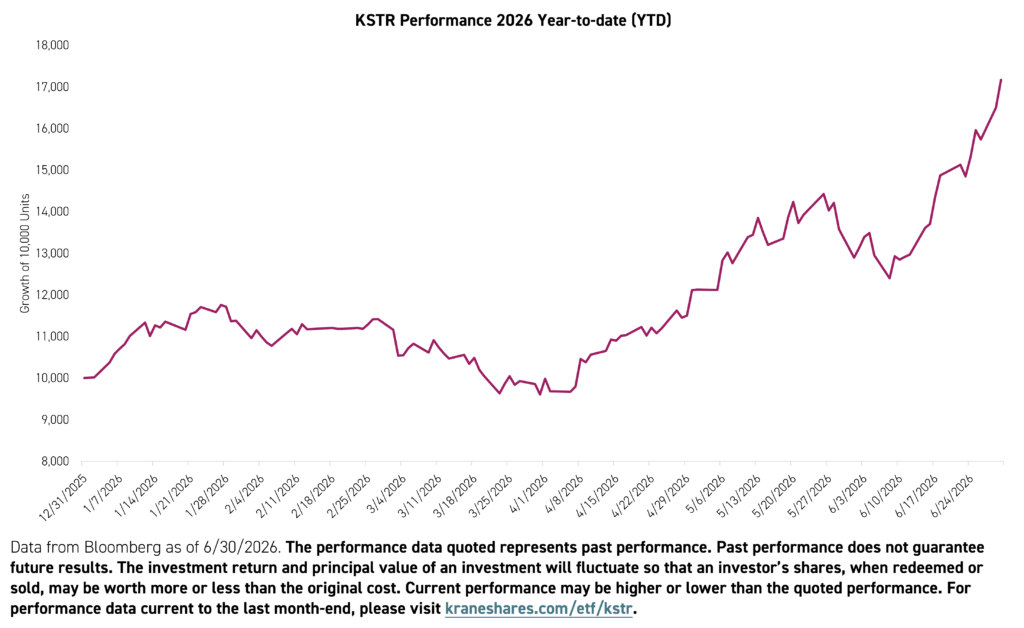
Our China semiconductor ETF the KraneShares China Technology & Semiconductor STAR Market 50 Index ETF (Ticker: KSTR) provides access to the China semiconductor opportunity. As of June 30, 2026, KSTR is up 71.70% year-to-date and 131.80% over the prior year as of June 30th, 2026.1
For KSTR top 10 holdings, standard performance, and risks, please click here.
The global semiconductor market is under serious structural strain right now. AI infrastructure is consuming an enormous share of manufacturing capacity, squeezing supply across the entire value chain. The five largest hyperscalers, Amazon, Microsoft, Google, Meta, and Oracle, have committed over $660 billion in 2026 capital expenditures, yet they’ve hit a wall.2
Many global producers of high-bandwidth memory chips, the lifeblood of AI compute, are reporting that existing orders cover all of their production capacity through the end of 2026.2 Meanwhile, supply growth is not keeping pace. TSMC’s next Arizona fab was delayed to 2027, while Intel’s Ohio production start was pushed back to 2030.3
Meanwhile, as many production facilities have shifted gears to produce the most high-end chips needed for the AI buildout, there are fewer chips being made for “simple” purposes, like making laptops and smartphones.
The world needs someone to help fill the gap, and China’s semiconductor industry is stepping up to do exactly that. Apple is already in negotiations to purchase memory chips from the China-based ChangXin Memory Technologies (CXMT), reportedly to lower costs, amid a global memory shortage.4
We believe this is a significant development in the global technology supply chain that may not yet be widely recognized by all investors.
US chip export restrictions that began in 2022 appear to have lit a fire under China’s domestic industry. Policymakers and corporations alike have made it clear that they want a domestic alternative for advanced chips. Companies such as Cambricon, which is held in KSTR at a 9.38% weight as of June 30, 2026, are stepping up to meet surging domestic demand for the latest chips.
What was supposed to be a ceiling for China’s chip industry has now become a floor.
KSTR tracks the 50 largest companies listed on China’s STAR Market. The STAR Market is an exchange designed specifically to list China’s next generation of high-technology and strategic emerging industry companies, similar in concept to the Nasdaq.
At the sub-industry level, as of 6/30/2026, approximately 60% of KSTR is allocated to pure semiconductor companies, while another 24% is currently allocated to semiconductor materials and equipment suppliers, giving the fund approximately 84% exposure to the core of China’s chip ecosystem.
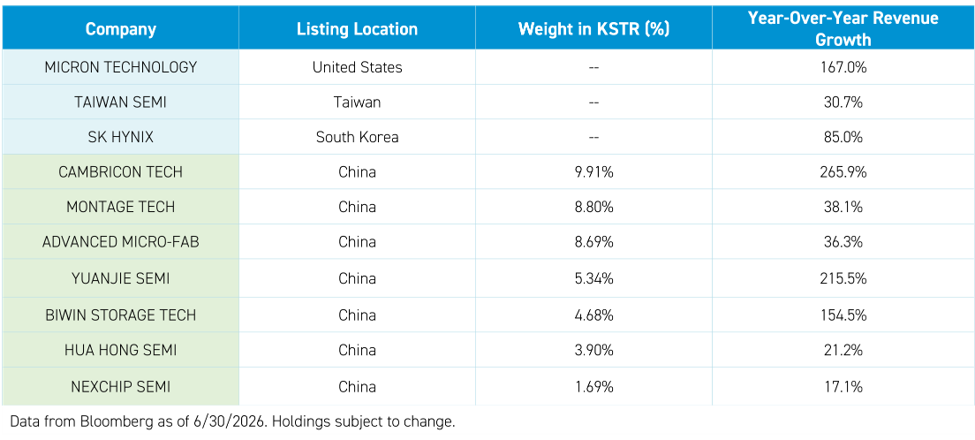
Cambricon, Hygon, Montage, AMEC, Biwin, Yuanjie, and Hua Hong Semiconductor are some examples of companies that have driven KSTR’s strong performance over the past year. Their revenue growth rates are also impressive and are, in some cases, higher than leaders from other global markets like the US, Taiwan, and Korea.
Hyperscalers’ capital expenditures and expectations for these outlays to continue have fueled the rise of Nvidia, TSMC, SK Hynix, and other global semiconductor stocks. Any disruption to this spending, or even just the expectation of one, could have severe consequences for the valuations of these firms.
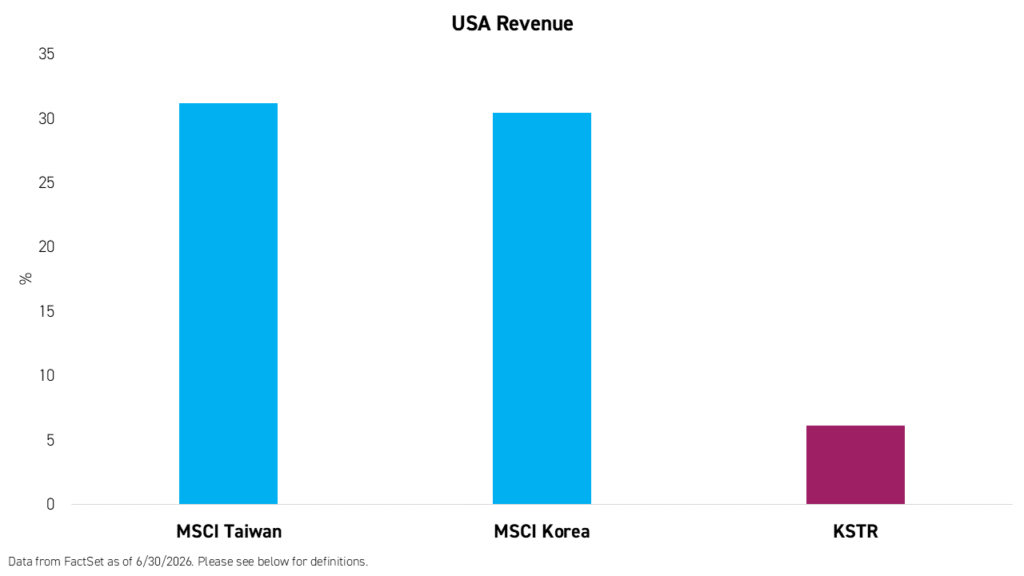
To put this into perspective, the 77 companies within the MSCI Taiwan Index, which is heavily concentrated in TSMC, receive 30% of their revenues from the United States, likely originating from high spending by US-based hyperscalers such as Alphabet and Meta. The picture is relatively the same in Korea. However, China’s semiconductor industry, represented by KSTR, is more oriented toward serving domestic customers and would therefore be less impacted by a disruption in the spending outlook for US tech giants.
Not only have China’s firms established themselves as cost-effective suppliers of memory chips to global customers, but they are also stepping in to help meet surging local demand. We believe China’s chipmakers are currently being overlooked by global investors, who may consider including them in any global AI-aware global portfolio because of their strong growth trajectory as well as their relative insulation from a potential disruption in US hyperscalers’ capital expenditure. KSTR provides access to what we believe are the current leaders in China’s semiconductor industry.
Citations:
Data from Bloomberg as of 6/30/2026.
Crosley, Blake. “The AI Memory Supercycle: How HBM Became AI’s Most Critical Bottleneck,” Introl. January 3, 2026.
Subin, Samantha. “Intel delays Ohio chip plant opening to next decade, was supposed to start production by 2026,” CNBC. February 28, 2026.
Schuman, Evan. “Cheap Chinese chips could offer way out of RAM price crisis, Apple suggests” Network World. July 2, 2026.
This should not be regarded as investment advice or a recommendation of specific securities. Holdings are subject to change. Securities mentioned may or may not be current holdings and do not make up the entire portfolio and, in the aggregate, may represent a small percentage of the fund.
Definitions:
Foundry: A semiconductor manufacturing facility that produces chips designed by other companies (”fabless” firms) under contract.
HBM (High-Bandwidth Memory): A type of advanced memory architecture used in AI accelerators and GPUs, characterized by extremely fast data transfer speeds and high density.
STAR Market: The Science and Technology Innovation Board on the Shanghai Stock Exchange, launched in 2019 as China’s technology-focused exchange, similar in concept to the Nasdaq.
Carefully consider the Funds’ investment objectives, risk factors, charges and expenses before investing. This and additional information can be found in the Funds’ full and summary prospectus, which may be obtained by visiting www.kraneshares.com. Read the prospectus carefully before investing.
Risk Disclosures:
Investing involves risk, including possible loss of principal. There can be no assurance that a Fund will achieve its stated objectives. Indices are unmanaged and do not include the effect of fees. One cannot invest directly in an index.
This information should not be relied upon as research, investment advice, or a recommendation regarding any products, strategies, or any security in particular. This material is strictly for illustrative, educational, or informational purposes and is subject to change. Certain content represents an assessment of the market environment at a specific time and is not intended to be a forecast of future events or a guarantee of future results; material is as of the dates noted and is subject to change without notice.
KSTR may invest in derivatives, which are often more volatile than other investments and may magnify KSTR’s gains or losses. A derivative (i.e., futures/forward contracts, swaps, and options) is a contract that derives its value from the performance of an underlying asset. The primary risk of derivatives is that changes in the asset’s market value and the derivative may not be proportionate, and some derivatives can have the potential for unlimited losses. Derivatives are also subject to liquidity and counterparty risk. KSTR is subject to liquidity risk, meaning that certain investments may become difficult to purchase or sell at a reasonable time and price. If a transaction for these securities is large, it may not be possible to initiate, which may cause KSTR to suffer losses. Counterparty risk is the risk of loss in the event that the counterparty to an agreement fails to make required payments or otherwise comply with the terms of the derivative.
The Chinese economy is an emerging market, vulnerable to domestic and regional economic and political changes, often showing more volatility than developed markets. Companies face risks from potential government interventions, and the export-driven economy is sensitive to downturns in key trading partners, impacting KSTR. U.S.-China tensions raise concerns over tariffs and trade restrictions, which could harm China’s exports and KSTR. China’s regulatory standards are less stringent than in the U.S., resulting in limited information about issuers. Tax laws are unclear and subject to change, potentially impacting KSTR and leading to unexpected liabilities for foreign investors. Fluctuations in currency of foreign countries may have an adverse effect to domestic currency values. KSTR may invest in Initial Public Offerings (IPOs). Securities issued in IPOs have no trading history, and information about the companies may be available for very limited periods. In addition, the prices of securities sold in IPOs may be highly volatile. In addition, as KSTR increases in size, the impact of IPOs on KSTR’s performance will generally decrease.
Narrowly focused investments typically exhibit higher volatility. KSTR’s assets are expected to be concentrated in a sector, industry, market, or group of concentrations to the extent that the Underlying Index has such concentrations. The securities or futures in that concentration could react similarly to market developments. Thus, KSTR is subject to loss due to adverse occurrences that affect that concentration. In addition to the normal risks associated with investing, investments in smaller companies typically exhibit higher volatility. KSTR is non-diversified.
ETF shares are bought and sold on an exchange at market price (not NAV) and are not individually redeemed from the Fund. However, shares may be redeemed at NAV directly by certain authorized broker-dealers (Authorized Participants) in very large creation/redemption units. The returns shown do not represent the returns you would receive if you traded shares at other times. Shares may trade at a premium or discount to their NAV in the secondary market. Brokerage commissions will reduce returns. Beginning 12/23/2020, market price returns are based on the official closing price of an ETF share or, if the official closing price isn’t available, the midpoint between the national best bid and national best offer (”NBBO”) as of the time the ETF calculates the current NAV per share. Prior to that date, market price returns were based on the midpoint between the Bid and Ask price. NAVs are calculated using prices as of 4:00 PM Eastern Time.
The KraneShares ETFs and KFA Funds ETFs are distributed by SEI Investments Distribution Company (SIDCO), 1 Freedom Valley Drive, Oaks, PA 19456, which is not affiliated with Krane Funds Advisors, LLC, the Investment Adviser for the Funds, or any sub-advisers for the Funds.
Comments
Nothing yet. Say the first thing.
Sign in to join the conversation.