

Many of the stocks listed on China’s STAR Market have delivered solid total returns to investors this year. This has been reflected in the year-to-date (YTD) performance of China technology ETF the KraneShares SSE STAR Market 50 Index ETF (Ticker: KSTR) compared to the broader China equity market, as represented by the S&P China 500 Index.
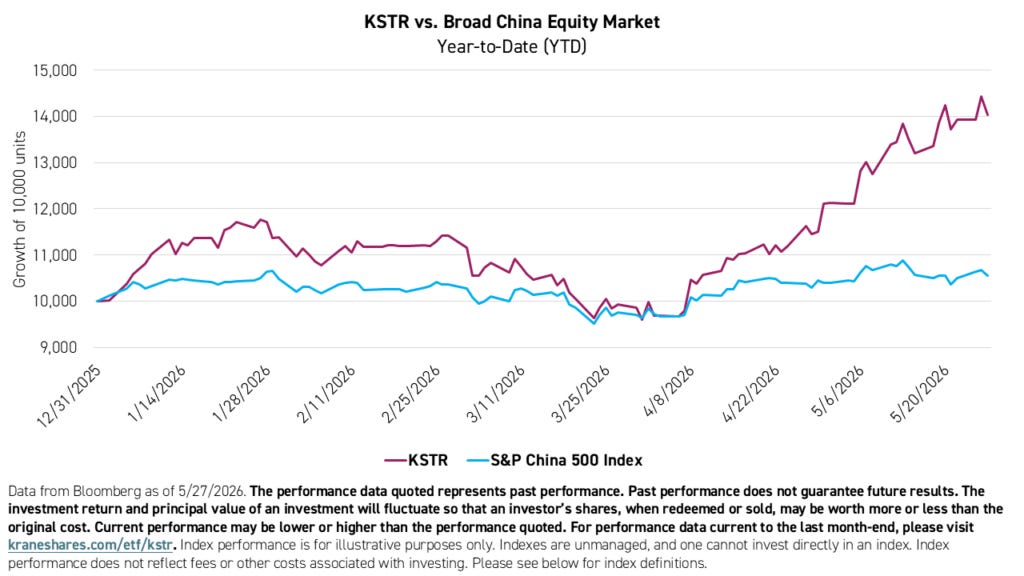
We believe STAR Market-listed companies represent the vanguard of China’s technological innovation. Many are becoming technology leaders not only in the domestic market, but also on the world stage. The latest example of this is Chang Xin Memory Technologies, which could serve a critical role in the global AI supply chain and has just filed to list on the STAR Market.
Chang Xin Memory Technologies’ STAR Market IPO matters because it adds a credible fourth dynamic, rapid-access memory (DRAM) champion to the global publicly traded roster, just as AI-driven demand pulls high-bandwidth memory (HBM) and DRAM chips to the center of global compute infrastructure. For AI-enabled services to achieve full functionality, they rely on these complex memory systems to both “remember” information and continuously provide a stream of reasoning and information to the end user. The supply crunch for this key input has recently elevated the share prices of SK Hynix and Samsung.
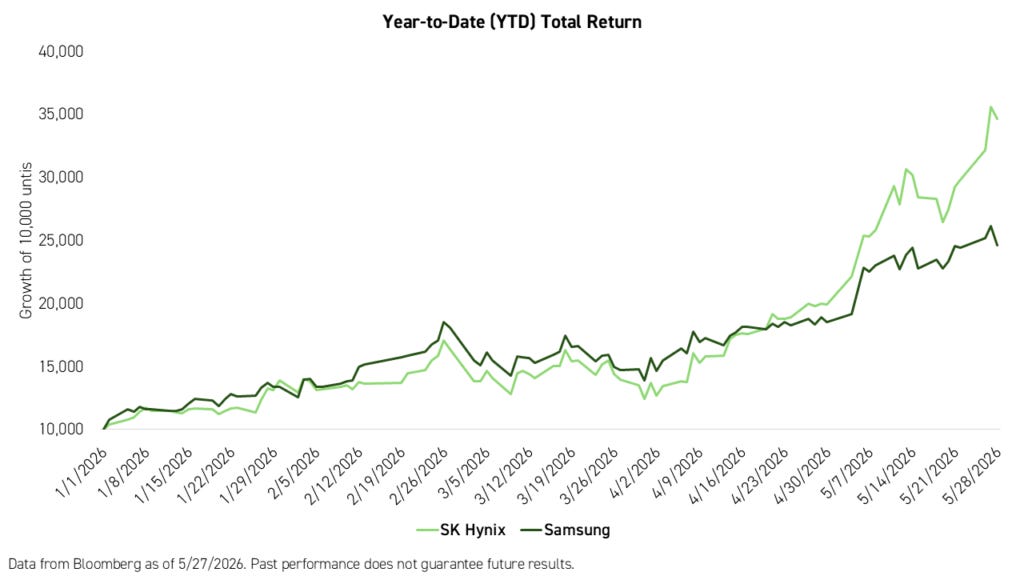
We believe Chang Xin Memory could be well-positioned to capitalize on opportunities from a memory-starved world due to its technological trajectory, strategic timing, ability to serve as an anchor for China’s AI and memory stack, and its advantageous position as a much-needed fourth major global supplier.
Chang Xin is China’s largest DRAM maker and already the world’s fourth‑largest by capacity and shipments, with around 7–8% global DRAM market share as of late 2025.1
As AI accelerators consume ever more HBM alongside conventional DRAM, we believe a scaled fourth player with competitive technology is strategically positioned to extend into HBM and adjacent high‑performance memory.
Chang Xin has moved from a relative laggard in terms of its technology to being now within a generation or two of the leaders, according to industry analysts.2
Its DRAM technology has progressed enough so that it can be repurposed into HBM stacks, if needed.3
The global AI boom has created a memory crunch, with DRAM and HBM pricing and margins surging.
Chang Xin’s profits reportedly jumped more than 1,600% year‑on‑year in early 2026 on revenue growth above 700%.4
As AI hyperscalers consume more HBM and DRAM chips, any incremental, technologically credible supplier that can ramp advanced nodes becomes systemically important to the ecosystem, potentially easing bottlenecks and diversifying supply away from Samsung, SK Hynix, and Micron, which represent the largest three memory chip suppliers.5
U.S. export controls on advanced chips, including HBM for AI accelerators, have pushed Beijing to back domestic players like Chang Xin as national champions in strategic memory.
Chang Xin already supplies major Chinese tech brands across cloud, smartphones, PCs, and autos, as China builds a homegrown AI stack with graphics processing units (GPUs), accelerators, and servers.
The planned STAR Market IPO is expected to value the company between RMB 300 billion ($42 billion) and RMB 2 trillion ($290 billion).6 That would make it the second‑largest semiconductor listing since the launch of the STAR Market in 2019.7
Meanwhile, the significant capital raise would help finance the company’s move from “DRAM follower” to a definitive full‑stack HBM ecosystem participant. For investors, Chang Xin’s IPO signals that China can now list deep‑tech, capital‑intensive memory champions onshore at scale, potentially driving a broader wave of domestic funding into AI‑linked memory, packaging, and equipment vendors feeding into the global HBM supply chain.
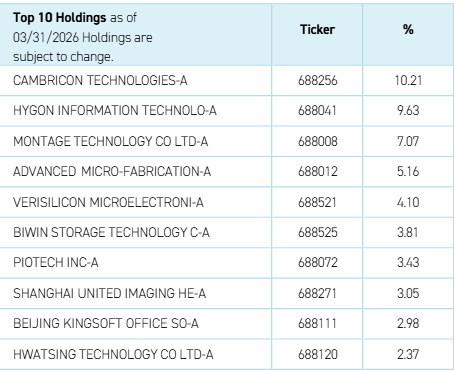
Even if valued at the low end of its estimated range, Chang Xin would boast a market capitalization near that of Advanced Micro Fabrication, which is included in the SSE STAR Market 50 Index and the fourth-largest holding in our China technology ETF, the KraneShares SSE STAR Market 50 Index ETF (Ticker: KSTR), as of May 27, 2026.8
KSTR could be a convenient way for US and global investors to access this exciting IPO.
For KSTR standard performance, risks, and top 10 holdings, please click here.
Index Definitions:
SSE STAR Market 50 Index: The SSE STAR Market 50 Index (often called the “STAR 50 Index”) is designed to track the performance of the 50 largest and most liquid companies listed on the Shanghai Stock Exchange Science and Technology Innovation Board (the STAR Market), based on free‑float market capitalization and liquidity screens. The index was launched on July 23, 2020.
S&P China 500 Index: The S&P China 500 Index is a float‑adjusted, market‑cap‑weighted index that seeks to measure the performance of 500 of the largest and most liquid Chinese companies across all major Chinese share classes and listing venues. The index was launched on August 28, 2015.
Citations:
“China’s DRAM giant CXMT plans US$4.2 billion IPO on Shanghai’s STAR Market,” South China Morning Post. December 31, 2025.
Broersma, Matthew. “China Memory Maker CXMT Prepares Massive IPO,” Silicon Technology Powering Business. October 22, 2025.
Chen, Fred. “China’s top memory chip maker CXMT narrows tech gap with leaders Samsung, Hynix, Micron,” Semi Wiki. January 30, 2025.
Ting-Fang, Cheng. “China chipmaker CXMT logs 1,688% profit surge amid global memory crunch,” Nikkei Asia. May 18, 2026.
Xu, Eunice. “Global memory chip crunch to persist even as Samsung, SK Hynix, Micron boost production,” South China Morning Post. January 21, 2026.
Gu, Zhaowei. “Changxin Clears Key Hurdle for Record STAR Market IPO,” Caixin Global.
“CXMT’s STAR Mkt IPO Approved by SSE Listing Committee; SMIC Soars ~6% Against Mkt; HUA HONG SEMI Leaps 12%,” AA Stocks. May 27, 2026.
Data from KraneShares and Bloomberg as of 5/27/2026.
Carefully consider the Funds’ investment objectives, risk factors, charges and expenses before investing. This and additional information can be found in the Funds’ full and summary prospectus, which may be obtained by visiting www.kraneshares.com. Read the prospectus carefully before investing.
Risk Disclosures:
Investing involves risk, including possible loss of principal. There can be no assurance that a Fund will achieve its stated objectives. Indices are unmanaged and do not include the effect of fees. One cannot invest directly in an index.
This information should not be relied upon as research, investment advice, or a recommendation regarding any products, strategies, or any security in particular. This material is strictly for illustrative, educational, or informational purposes and is subject to change. Certain content represents an assessment of the market environment at a specific time and is not intended to be a forecast of future events or a guarantee of future results; material is as of the dates noted and is subject to change without notice.
KSTR may invest in derivatives, which are often more volatile than other investments and may magnify KSTR’s gains or losses. A derivative (i.e., futures/forward contracts, swaps, and options) is a contract that derives its value from the performance of an underlying asset. The primary risk of derivatives is that changes in the asset’s market value and the derivative may not be proportionate, and some derivatives can have the potential for unlimited losses. Derivatives are also subject to liquidity and counterparty risk. KSTR is subject to liquidity risk, meaning that certain investments may become difficult to purchase or sell at a reasonable time and price. If a transaction for these securities is large, it may not be possible to initiate, which may cause KSTR to suffer losses. Counterparty risk is the risk of loss in the event that the counterparty to an agreement fails to make required payments or otherwise comply with the terms of the derivative.
The Chinese economy is an emerging market, vulnerable to domestic and regional economic and political changes, often showing more volatility than developed markets. Companies face risks from potential government interventions, and the export-driven economy is sensitive to downturns in key trading partners, impacting KSTR. U.S.-China tensions raise concerns over tariffs and trade restrictions, which could harm China’s exports and KSTR. China’s regulatory standards are less stringent than in the U.S., resulting in limited information about issuers. Tax laws are unclear and subject to change, potentially impacting KSTR and leading to unexpected liabilities for foreign investors. Fluctuations in currency of foreign countries may have an adverse effect to domestic currency values. KSTR may invest in Initial Public Offerings (IPOs). Securities issued in IPOs have no trading history, and information about the companies may be available for very limited periods. In addition, the prices of securities sold in IPOs may be highly volatile. In addition, as KSTR increases in size, the impact of IPOs on KSTR’s performance will generally decrease.
Narrowly focused investments typically exhibit higher volatility. KSTR’s assets are expected to be concentrated in a sector, industry, market, or group of concentrations to the extent that the Underlying Index has such concentrations. The securities or futures in that concentration could react similarly to market developments. Thus, KSTR is subject to loss due to adverse occurrences that affect that concentration. In addition to the normal risks associated with investing, investments in smaller companies typically exhibit higher volatility. KSTR is non-diversified.
ETF shares are bought and sold on an exchange at market price (not NAV) and are not individually redeemed from the Fund. However, shares may be redeemed at NAV directly by certain authorized broker-dealers (Authorized Participants) in very large creation/redemption units. The returns shown do not represent the returns you would receive if you traded shares at other times. Shares may trade at a premium or discount to their NAV in the secondary market. Brokerage commissions will reduce returns. Beginning 12/23/2020, market price returns are based on the official closing price of an ETF share or, if the official closing price isn’t available, the midpoint between the national best bid and national best offer (”NBBO”) as of the time the ETF calculates the current NAV per share. Prior to that date, market price returns were based on the midpoint between the Bid and Ask price. NAVs are calculated using prices as of 4:00 PM Eastern Time.
The KraneShares ETFs and KFA Funds ETFs are distributed by SEI Investments Distribution Company (SIDCO), 1 Freedom Valley Drive, Oaks, PA 19456, which is not affiliated with Krane Funds Advisors, LLC, the Investment Adviser for the Funds, or any sub-advisers for the Funds.
Comments
Nothing yet. Say the first thing.
Sign in to join the conversation.